What is Example of Kinetic Energy – Definition

Examples of Kinetic Energy. The kinetic energy depends on the speed of an object and is the ability of a moving object to do work on other objects. Periodic Table

What is Kinetic Energy
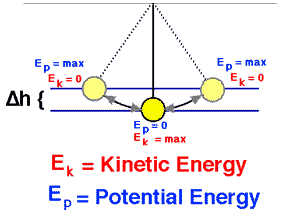
conservartion-of-mechanical-energy-pendulum

The kinetic energy, K, is defined as the energy stored in an object because of its motion. An object in motion has the ability to do work and thus can be said to have energy. It is called kinetic energy, from the Greek word kinetikos, meaning “motion.”

The kinetic energy depends on the speed of an object and is the ability of a moving object to do work on other objects when it collides with them. On the other hand, the kinetic energy of an object represents the amount of energy required to increase the velocity of the object from rest (v = 0) to its final velocity. The kinetic energy also depends linearly on the mass, which is a numerical measure of object’s inertia and the measure of an object’s resistance to acceleration when a force is applied.

We define the quantity:

K = ½ mv2

to be the translational kinetic energy of the object. It must be added, it is called the “translational” kinetic energy to distinguish it from rotational kinetic energy.

Examples of Kinetic Energy

 
Kinetic energy of fission fragments
As can be seen when the compound nucleus splits, it breaks into two fission fragments. In most cases, the resultant fission fragments have masses that vary widely, but the most probable pair of fission fragments for the thermal neutron-induced fission of the 235U have masses of about 94 and 139.

The largest part of the energy produced during fission (about 80 % or about 170 MeV or about 27 picojoules) appears as kinetic energy of the fission fragments. The fission fragments interact strongly (intensely) with the surrounding atoms or molecules traveling at high speed, causing them to ionize. Creation of ion pairs requires energy, which is lost from the kinetic energy of the charged fission fragment causing it to decelerate. The positive ions and free electrons created by the passage of the charged fission fragment will then reunite, releasing energy in the form of heat (e.g. vibrational energy or rotational energy of atoms).

The range of these massive, highly charged particles in the fuel is of the order of micrometers, so that the recoil energy is effectively deposited as heat at the point of fission. This is the principle how fission fragments heat up fuel in the reactor core.

See also: Interaction of Heavy Charged Particles with Matter

Kinetic energy of prompt neutrons
Prompt neutrons are emitted directly from fission and they are emitted within very short time of about 10-14 second. Usually more than 99 percent of the fission neutrons are the prompt neutrons, but the exact fraction is dependent on the nuclide to be fissioned and is also dependent on an incident neutron energy (usually increases with energy).

For example a fission of 235U by thermal neutron yields 2.43 neutrons, of which 2.42 neutrons are the prompt neutrons and 0.01585 neutrons (0.01585/2.43=0.0065=ß) are the delayed neutrons. Almost all prompt fission neutrons have energies between 0.1 MeV and 10 MeV. The mean neutron energy is about 2 MeV. The most probable neutron energy is about 0.7 MeV.

Most of this energy is deposited in the coolant (moderator), because the water have the highest macroscopic slowing down power (MSDP) of the materials that are in a reactor core (PWR). The range of neutrons in a reactor depends strongly on certain reactor type, in the case of PWRs it is usually of the order of centimeters.

 
Kinetic Energy in Elastic Nuclear Collision
A neutron (n) of mass 1.01 u traveling with a speed of 3.60 x 104m/s interacts with a carbon (C) nucleus (mC = 12.00 u) initially at rest in an elastic head-on collision.

What are the velocities of the neutron and carbon nucleus after the collision?

Solution:

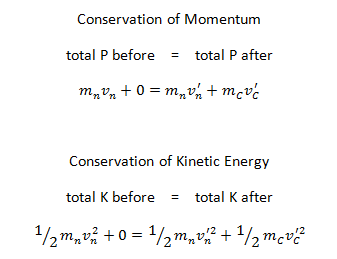
This is an elastic head-on collision of two objects with unequal masses. We have to use the conservation laws of momentum and of kinetic energy, and apply them to our system of two particles.
conservation-laws-elastic-collisions

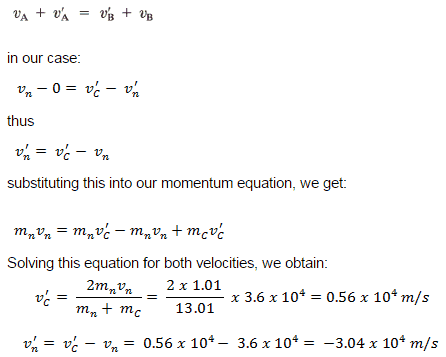
We can solve this system of equation or we can use the equation derived in previous section. This equation stated that the relative speed of the two objects after the collision has the same magnitude (but opposite direction) as before the collision, no matter what the masses are.
solution-elastic-collision

The minus sign for v’ tells us that the neutron scatters back of the carbon nucleus, because the carbon nucleus is significantly heavier. On the other hand its speed is less than its initial speed. This process is known as the neutron moderation and it significantly depends on the mass of moderator nuclei.

Block sliding down a frictionless incline slope

The 1 kg block starts out a height H (let say 1 m) above the ground, with potential energy mgH and kinetic energy that is equal to 0. It slides to the ground (without friction) and arrives with no potential energy and kinetic energy K = ½ mv2. Calculate the velocity of the block on the ground and its kinetic energy.

Emech = U + K = const

=> ½ mv2 = mgH

=> v = √2gH = 4.43 m/s

=> K2 = ½ x 1 kg x (4.43 m/s)2 = 19.62 kg.m2.s-2 = 19.62 J

Pendulum

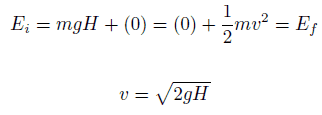
conservartion-of-mechanical-energy-pendulumAssume a pendulum (ball of mass m suspended on a string of length L that we have pulled up so that the ball is a height H < L above its lowest point on the arc of its stretched string motion. The pendulum is subjected to the conservative gravitational force where frictional forces like air drag and friction at the pivot are negligible.

We release it from rest. How fast is it going at the bottom?
conservartion-of-mechanical-energy-pendulum2

The pendulum reaches greatest kinetic energy and least potential energy when in the vertical position, because it will have the greatest speed and be nearest the Earth at this point. On the other hand, it will have its least kinetic energy and greatest potential energy at the extreme positions of its swing, because it has zero speed and is farthest from Earth at these points.

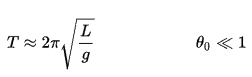
If the amplitude is limited to small swings, the period T of a simple pendulum, the time taken for a complete cycle, is:
period-of-pendulum-conservation-of-energy

where L is the length of the pendulum and g is the local acceleration of gravity. For small swings the period of swing is approximately the same for different size swings. That is, the period is independent of amplitude.

Example: Proton’s kinetic energy

What is proton - physicsA proton (m = 1.67 x 10⁻²⁷ kg) travels at a speed v = 0.9900c = 2.968 x 10⁸m/s. What is its kinetic energy?

According to a classical calculation, which is not correct, we would obtain:

K = 1/2mv2 = ½ x (1.67 x 10⁻²⁷ kg) x (2.968 x 10⁸m/s)2 = 7.355 x 10⁻¹¹ J

With relativistic correction the relativistic kinetic energy is equal to:

K = (ɣ – 1)mc2

where the Lorentz factor

ɣ = 7.089

therefore

K = 6.089 x (1.67 x 10-27 kg) x (2.9979 x 10⁸m/s)2 = 9.139 x 10⁻¹⁰ J = 5.701 GeV

This is about 12 times higher energy as in the classical calculation. According to this relationship, an acceleration of a proton beam to 5.7 GeV requires energies that are in the order different.

 
References:
Reactor Physics and Thermal Hydraulics:
  1. J. R. Lamarsh, Introduction to Nuclear Reactor Theory, 2nd ed., Addison-Wesley, Reading, MA (1983).
  2. J. R. Lamarsh, A. J. Baratta, Introduction to Nuclear Engineering, 3d ed., Prentice-Hall, 2001, ISBN: 0-201-82498-1.
  3. W. M. Stacey, Nuclear Reactor Physics, John Wiley & Sons, 2001, ISBN: 0- 471-39127-1.
  4. Glasstone, Sesonske. Nuclear Reactor Engineering: Reactor Systems Engineering, Springer; 4th edition, 1994, ISBN: 978-0412985317
  5. Todreas Neil E., Kazimi Mujid S. Nuclear Systems Volume I: Thermal Hydraulic Fundamentals, Second Edition. CRC Press; 2 edition, 2012, ISBN: 978-0415802871
  6. Zohuri B., McDaniel P. Thermodynamics in Nuclear Power Plant Systems. Springer; 2015, ISBN: 978-3-319-13419-2
  7. Moran Michal J., Shapiro Howard N. Fundamentals of Engineering Thermodynamics, Fifth Edition, John Wiley & Sons, 2006, ISBN: 978-0-470-03037-0
  8. Kleinstreuer C. Modern Fluid Dynamics. Springer, 2010, ISBN 978-1-4020-8670-0.
  9. U.S. Department of Energy, THERMODYNAMICS, HEAT TRANSFER, AND FLUID FLOW. DOE Fundamentals Handbook, Volume 1, 2 and 3. June 1992.

See also:

Kinetic Energy

We hope, this article, Example of Kinetic Energy, helps you. If so, give us a like in the sidebar. Main purpose of this website is to help the public to learn some interesting and important information about radiation and dosimeters.

What is Proton’s kinetic energy – Definition

According to relativistic relationship, an acceleration of a proton beam to 5.7 GeV requires energies that are in the order different. Periodic Table

Example: Proton’s kinetic energy

What is proton - physicsA proton (m = 1.67 x 10⁻²⁷ kg) travels at a speed v = 0.9900c = 2.968 x 10⁸m/s. What is its kinetic energy?

According to a classical calculation, which is not correct, we would obtain:

K = 1/2mv2 = ½ x (1.67 x 10⁻²⁷ kg) x (2.968 x 10⁸m/s)2 = 7.355 x 10⁻¹¹ J

With relativistic correction the relativistic kinetic energy is equal to:

K = (ɣ – 1)mc2

where the Lorentz factor

ɣ = 7.089

therefore

K = 6.089 x (1.67 x 10-27 kg) x (2.9979 x 10⁸m/s)2 = 9.139 x 10⁻¹⁰ J = 5.701 GeV

This is about 12 times higher energy as in the classical calculation. According to this relationship, an acceleration of a proton beam to 5.7 GeV requires energies that are in the order different.

 
References:
Reactor Physics and Thermal Hydraulics:
  1. J. R. Lamarsh, Introduction to Nuclear Reactor Theory, 2nd ed., Addison-Wesley, Reading, MA (1983).
  2. J. R. Lamarsh, A. J. Baratta, Introduction to Nuclear Engineering, 3d ed., Prentice-Hall, 2001, ISBN: 0-201-82498-1.
  3. W. M. Stacey, Nuclear Reactor Physics, John Wiley & Sons, 2001, ISBN: 0- 471-39127-1.
  4. Glasstone, Sesonske. Nuclear Reactor Engineering: Reactor Systems Engineering, Springer; 4th edition, 1994, ISBN: 978-0412985317
  5. Todreas Neil E., Kazimi Mujid S. Nuclear Systems Volume I: Thermal Hydraulic Fundamentals, Second Edition. CRC Press; 2 edition, 2012, ISBN: 978-0415802871
  6. Zohuri B., McDaniel P. Thermodynamics in Nuclear Power Plant Systems. Springer; 2015, ISBN: 978-3-319-13419-2
  7. Moran Michal J., Shapiro Howard N. Fundamentals of Engineering Thermodynamics, Fifth Edition, John Wiley & Sons, 2006, ISBN: 978-0-470-03037-0
  8. Kleinstreuer C. Modern Fluid Dynamics. Springer, 2010, ISBN 978-1-4020-8670-0.
  9. U.S. Department of Energy, THERMODYNAMICS, HEAT TRANSFER, AND FLUID FLOW. DOE Fundamentals Handbook, Volume 1, 2 and 3. June 1992.

See also:

Kinetic Energy

We hope, this article, Proton’s kinetic energy, helps you. If so, give us a like in the sidebar. Main purpose of this website is to help the public to learn some interesting and important information about radiation and dosimeters.
What is Relativistic Kinetic Energy – Definition

As velocity of an object approaches the speed of light, the relativistic kinetic energy approaches infinity. Relativistic kinetic energy formula is based on the relativistic energy-momentum relation. Periodic Table

Relativistic Kinetic Energy

relativistic kinetic energy
As velocity of an object approaches the speed of light, the relativistic kinetic energy approaches infinity. It is caused by the Lorentz factor, which approaches infinity for v → c.

The previous relationship between work and kinetic energy are based on Newton’s laws of motion. When we generalize these laws according to the principle of relativity, we need a corresponding generalization of the equation for kinetic energy. If an object’s speed is close to the speed of light, it is necessary to use relativistic mechanics to calculate its kinetic energy.

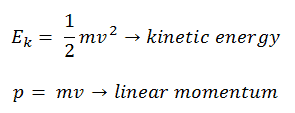
In classical mechanics, kinetic energy and momentum are expressed as:

classical momentum and kinetic energy

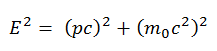
Derivation of its relativistic relationships is based on the relativistic energy-momentum relation:

energy-momentum relation

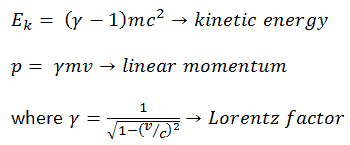
It can be derived, the relativistic kinetic energy and the relativistic momentum are:

relativistic kinetic energy - formula

The first term (ɣmc2) of the relativistic kinetic energy increases with the speed v of the particle. The second term (mc2) is constant; it is called the rest energy (rest mass) of the particle, and represents a form of energy that a particle has even when at zero velocity. As velocity of an object approaches the speed of light, the kinetic energy approaches infinity. It is caused by the Lorentz factor, which approaches infinity for v → c. Therefore the speed of light cannot be reached by any massive particles.

The first term (ɣmc2) is known as the total energy E of the particle, because it equals the rest energy plus the kinetic energy:

E = K + mc2

For a particle at rest, i.e. K is zero, so the total energy is its rest energy:

E = mc2

This is one of the striking results of Einstein’s theory of relativity is that mass and energy are equivalent and convertible one into the other. Equivalence of the mass and energy is described by Einstein’s famous formula E = mc2. This result have been experimentally confirmed countless times in nuclear and elementary particle physics. For example, see Positron-electron Pair Production or Conservation of Energy in Nuclear Reactions.

See also: Relativistic Mass

Example: Proton’s kinetic energy

What is proton - physicsA proton (m = 1.67 x 10⁻²⁷ kg) travels at a speed v = 0.9900c = 2.968 x 10⁸m/s. What is its kinetic energy?

According to a classical calculation, which is not correct, we would obtain:

K = 1/2mv2 = ½ x (1.67 x 10⁻²⁷ kg) x (2.968 x 10⁸m/s)2 = 7.355 x 10⁻¹¹ J

With relativistic correction the relativistic kinetic energy is equal to:

K = (ɣ – 1)mc2

where the Lorentz factor

ɣ = 7.089

therefore

K = 6.089 x (1.67 x 10-27 kg) x (2.9979 x 10⁸m/s)2 = 9.139 x 10⁻¹⁰ J = 5.701 GeV

This is about 12 times higher energy as in the classical calculation. According to this relationship, an acceleration of a proton beam to 5.7 GeV requires energies that are in the order different.

 
References:
Reactor Physics and Thermal Hydraulics:
  1. J. R. Lamarsh, Introduction to Nuclear Reactor Theory, 2nd ed., Addison-Wesley, Reading, MA (1983).
  2. J. R. Lamarsh, A. J. Baratta, Introduction to Nuclear Engineering, 3d ed., Prentice-Hall, 2001, ISBN: 0-201-82498-1.
  3. W. M. Stacey, Nuclear Reactor Physics, John Wiley & Sons, 2001, ISBN: 0- 471-39127-1.
  4. Glasstone, Sesonske. Nuclear Reactor Engineering: Reactor Systems Engineering, Springer; 4th edition, 1994, ISBN: 978-0412985317
  5. Todreas Neil E., Kazimi Mujid S. Nuclear Systems Volume I: Thermal Hydraulic Fundamentals, Second Edition. CRC Press; 2 edition, 2012, ISBN: 978-0415802871
  6. Zohuri B., McDaniel P. Thermodynamics in Nuclear Power Plant Systems. Springer; 2015, ISBN: 978-3-319-13419-2
  7. Moran Michal J., Shapiro Howard N. Fundamentals of Engineering Thermodynamics, Fifth Edition, John Wiley & Sons, 2006, ISBN: 978-0-470-03037-0
  8. Kleinstreuer C. Modern Fluid Dynamics. Springer, 2010, ISBN 978-1-4020-8670-0.
  9. U.S. Department of Energy, THERMODYNAMICS, HEAT TRANSFER, AND FLUID FLOW. DOE Fundamentals Handbook, Volume 1, 2 and 3. June 1992.

See also:

Kinetic Energy

We hope, this article, Relativistic Kinetic Energy, helps you. If so, give us a like in the sidebar. Main purpose of this website is to help the public to learn some interesting and important information about radiation and dosimeters.
What is Kinetic Energy – Definition

The kinetic energy, K, is defined as the energy stored in an object because of its motion. It is called kinetic energy, from the Greek word kinetikos – motion. Periodic Table

What is Kinetic Energy

conservartion-of-mechanical-energy-pendulum

The kinetic energy, K, is defined as the energy stored in an object because of its motion. An object in motion has the ability to do work and thus can be said to have energy. It is called kinetic energy, from the Greek word kinetikos, meaning “motion.”

The kinetic energy depends on the speed of an object and is the ability of a moving object to do work on other objects when it collides with them. On the other hand, the kinetic energy of an object represents the amount of energy required to increase the velocity of the object from rest (v = 0) to its final velocity. The kinetic energy also depends linearly on the mass, which is a numerical measure of object’s inertia and the measure of an object’s resistance to acceleration when a force is applied.

We define the quantity:

K = ½ mv2

to be the translational kinetic energy of the object. It must be added, it is called the “translational” kinetic energy to distinguish it from rotational kinetic energy.

 
Kinetic energy of fission fragments
As can be seen when the compound nucleus splits, it breaks into two fission fragments. In most cases, the resultant fission fragments have masses that vary widely, but the most probable pair of fission fragments for the thermal neutron-induced fission of the 235U have masses of about 94 and 139.

The largest part of the energy produced during fission (about 80 % or about 170 MeV or about 27 picojoules) appears as kinetic energy of the fission fragments. The fission fragments interact strongly (intensely) with the surrounding atoms or molecules traveling at high speed, causing them to ionize. Creation of ion pairs requires energy, which is lost from the kinetic energy of the charged fission fragment causing it to decelerate. The positive ions and free electrons created by the passage of the charged fission fragment will then reunite, releasing energy in the form of heat (e.g. vibrational energy or rotational energy of atoms).

The range of these massive, highly charged particles in the fuel is of the order of micrometers, so that the recoil energy is effectively deposited as heat at the point of fission. This is the principle how fission fragments heat up fuel in the reactor core.

See also: Interaction of Heavy Charged Particles with Matter

Kinetic energy of prompt neutrons
Prompt neutrons are emitted directly from fission and they are emitted within very short time of about 10-14 second. Usually more than 99 percent of the fission neutrons are the prompt neutrons, but the exact fraction is dependent on the nuclide to be fissioned and is also dependent on an incident neutron energy (usually increases with energy).

For example a fission of 235U by thermal neutron yields 2.43 neutrons, of which 2.42 neutrons are the prompt neutrons and 0.01585 neutrons (0.01585/2.43=0.0065=ß) are the delayed neutrons. Almost all prompt fission neutrons have energies between 0.1 MeV and 10 MeV. The mean neutron energy is about 2 MeV. The most probable neutron energy is about 0.7 MeV.

Most of this energy is deposited in the coolant (moderator), because the water have the highest macroscopic slowing down power (MSDP) of the materials that are in a reactor core (PWR). The range of neutrons in a reactor depends strongly on certain reactor type, in the case of PWRs it is usually of the order of centimeters.

Conservation of Mechanical Energy

First the principle of the Conservation of Mechanical Energy was stated:

The total mechanical energy (defined as the sum of its potential and kinetic energies) of a particle being acted on by only conservative forces is constant.

conservartion-of-mechanical-energy-example

See also: Conservation of Mechanical Energy

An isolated system is one in which no external force causes energy changes. If only conservative forces act on an object and U is the potential energy function for the total conservative force, then

Emech = U + K

The potential energy, U, depends on the position of an object subjected to a conservative force.

potential-energy-equation

It is defined as the object’s ability to do work and is increased as the object is moved in the opposite direction of the direction of the force.

The potential energy associated with a system consisting of Earth and a nearby particle is gravitational potential energy.

gravitational-potential-energy-equation

The kinetic energy, K, depends on the speed of an object and is the ability of a moving object to do work on other objects when it collides with them.

 K = ½ mv2

The above mentioned definition (Emech = U + K) assumes that the system is free of friction and other non-conservative forces. The difference between a conservative and a non-conservative force is that when a conservative force moves an object from one point to another, the work done by the conservative force is independent of the path.

In any real situation, frictional forces and other non-conservative forces are present, but in many cases their effects on the system are so small that the principle of conservation of mechanical energy can be used as a fair approximation. For example the frictional force is a non-conservative force, because it acts to reduce the mechanical energy in a system.

Note that non-conservative forces do not always reduce the mechanical energy. A non-conservative force changes the mechanical energy, there are forces that increase the total mechanical energy, like the force provided by a motor or engine, is also a non-conservative force.

 
Kinetic Energy in Elastic Nuclear Collision
A neutron (n) of mass 1.01 u traveling with a speed of 3.60 x 104m/s interacts with a carbon (C) nucleus (mC = 12.00 u) initially at rest in an elastic head-on collision.

What are the velocities of the neutron and carbon nucleus after the collision?

Solution:

This is an elastic head-on collision of two objects with unequal masses. We have to use the conservation laws of momentum and of kinetic energy, and apply them to our system of two particles.

conservation-laws-elastic-collisions

We can solve this system of equation or we can use the equation derived in previous section. This equation stated that the relative speed of the two objects after the collision has the same magnitude (but opposite direction) as before the collision, no matter what the masses are.

solution-elastic-collision

The minus sign for v’ tells us that the neutron scatters back of the carbon nucleus, because the carbon nucleus is significantly heavier. On the other hand its speed is less than its initial speed. This process is known as the neutron moderation and it significantly depends on the mass of moderator nuclei.

Block sliding down a frictionless incline slope

The 1 kg block starts out a height H (let say 1 m) above the ground, with potential energy mgH and kinetic energy that is equal to 0. It slides to the ground (without friction) and arrives with no potential energy and kinetic energy K = ½ mv2. Calculate the velocity of the block on the ground and its kinetic energy.

Emech = U + K = const

=> ½ mv2 = mgH

=> v = √2gH = 4.43 m/s

=> K2 = ½ x 1 kg x (4.43 m/s)2 = 19.62 kg.m2.s-2 = 19.62 J

Pendulum

conservartion-of-mechanical-energy-pendulumAssume a pendulum (ball of mass m suspended on a string of length L that we have pulled up so that the ball is a height H < L above its lowest point on the arc of its stretched string motion. The pendulum is subjected to the conservative gravitational force where frictional forces like air drag and friction at the pivot are negligible.

We release it from rest. How fast is it going at the bottom?

conservartion-of-mechanical-energy-pendulum2

The pendulum reaches greatest kinetic energy and least potential energy when in the vertical position, because it will have the greatest speed and be nearest the Earth at this point. On the other hand, it will have its least kinetic energy and greatest potential energy at the extreme positions of its swing, because it has zero speed and is farthest from Earth at these points.

If the amplitude is limited to small swings, the period T of a simple pendulum, the time taken for a complete cycle, is:

period-of-pendulum-conservation-of-energy

where L is the length of the pendulum and g is the local acceleration of gravity. For small swings the period of swing is approximately the same for different size swings. That is, the period is independent of amplitude.

Relativistic Kinetic Energy

relativistic kinetic energy
As velocity of an object approaches the speed of light, the relativistic kinetic energy approaches infinity. It is caused by the Lorentz factor, which approaches infinity for v → c.

The previous relationship between work and kinetic energy are based on Newton’s laws of motion. When we generalize these laws according to the principle of relativity, we need a corresponding generalization of the equation for kinetic energy. If an object’s speed is close to the speed of light, it is necessary to use relativistic mechanics to calculate its kinetic energy.

In classical mechanics, kinetic energy and momentum are expressed as:

classical momentum and kinetic energy

Derivation of its relativistic relationships is based on the relativistic energy-momentum relation:

energy-momentum relation

It can be derived, the relativistic kinetic energy and the relativistic momentum are:

relativistic kinetic energy - formula

The first term (ɣmc2) of the relativistic kinetic energy increases with the speed v of the particle. The second term (mc2) is constant; it is called the rest energy (rest mass) of the particle, and represents a form of energy that a particle has even when at zero velocity. As velocity of an object approaches the speed of light, the kinetic energy approaches infinity. It is caused by the Lorentz factor, which approaches infinity for v → c. Therefore the speed of light cannot be reached by any massive particles.

The first term (ɣmc2) is known as the total energy E of the particle, because it equals the rest energy plus the kinetic energy:

E = K + mc2

For a particle at rest, i.e. K is zero, so the total energy is its rest energy:

E = mc2

This is one of the striking results of Einstein’s theory of relativity is that mass and energy are equivalent and convertible one into the other. Equivalence of the mass and energy is described by Einstein’s famous formula E = mc2. This result have been experimentally confirmed countless times in nuclear and elementary particle physics. For example, see Positron-electron Pair Production or Conservation of Energy in Nuclear Reactions.

See also: Relativistic Mass

Example: Proton’s kinetic energy

What is proton - physicsA proton (m = 1.67 x 10⁻²⁷ kg) travels at a speed v = 0.9900c = 2.968 x 10⁸m/s. What is its kinetic energy?

According to a classical calculation, which is not correct, we would obtain:

K = 1/2mv2 = ½ x (1.67 x 10⁻²⁷ kg) x (2.968 x 10⁸m/s)2 = 7.355 x 10⁻¹¹ J

With relativistic correction the relativistic kinetic energy is equal to:

K = (ɣ – 1)mc2

where the Lorentz factor

ɣ = 7.089

therefore

K = 6.089 x (1.67 x 10-27 kg) x (2.9979 x 10⁸m/s)2 = 9.139 x 10⁻¹⁰ J = 5.701 GeV

This is about 12 times higher energy as in the classical calculation. According to this relationship, an acceleration of a proton beam to 5.7 GeV requires energies that are in the order different.

 
References:
Reactor Physics and Thermal Hydraulics:
  1. J. R. Lamarsh, Introduction to Nuclear Reactor Theory, 2nd ed., Addison-Wesley, Reading, MA (1983).
  2. J. R. Lamarsh, A. J. Baratta, Introduction to Nuclear Engineering, 3d ed., Prentice-Hall, 2001, ISBN: 0-201-82498-1.
  3. W. M. Stacey, Nuclear Reactor Physics, John Wiley & Sons, 2001, ISBN: 0- 471-39127-1.
  4. Glasstone, Sesonske. Nuclear Reactor Engineering: Reactor Systems Engineering, Springer; 4th edition, 1994, ISBN: 978-0412985317
  5. Todreas Neil E., Kazimi Mujid S. Nuclear Systems Volume I: Thermal Hydraulic Fundamentals, Second Edition. CRC Press; 2 edition, 2012, ISBN: 978-0415802871
  6. Zohuri B., McDaniel P. Thermodynamics in Nuclear Power Plant Systems. Springer; 2015, ISBN: 978-3-319-13419-2
  7. Moran Michal J., Shapiro Howard N. Fundamentals of Engineering Thermodynamics, Fifth Edition, John Wiley & Sons, 2006, ISBN: 978-0-470-03037-0
  8. Kleinstreuer C. Modern Fluid Dynamics. Springer, 2010, ISBN 978-1-4020-8670-0.
  9. U.S. Department of Energy, THERMODYNAMICS, HEAT TRANSFER, AND FLUID FLOW. DOE Fundamentals Handbook, Volume 1, 2 and 3. June 1992.

See also:

Energy

We hope, this article, Kinetic Energy, helps you. If so, give us a like in the sidebar. Main purpose of this website is to help the public to learn some interesting and important information about radiation and dosimeters.
What is Mechanical Energy – Definition

In physics, mechanical energy (Emech) is the energy associated with the motion and position of an object usually in some force field (e.g. gravitational field). Periodic Table

What is Mechanical Energy

conservartion-of-mechanical-energy-pendulumIn physics, mechanical energy (Emech) is the energy associated with the motion and position of an object usually in some force field (e.g. gravitational field). Mechanical energy (and also the thermal energy) can be separated into two categories, transient and stored. Transient energy is energy in motion, that is, energy being transferred from one place to another. Stored energy is the energy contained within a substance or object. Transient mechanical energy is commonly referred to as work. Stored mechanical energy exists in one of two forms: kinetic or potential:

  • Potential energy. Potential energy, U, is defined as the energy stored in an object subjected to a conservative force. Common types include the gravitational potential energy of an object that depends on its mass and its distance from the center of mass of another object.
  • Kinetic energy. The kinetic energy, K, is defined as the energy stored in an object because of its motion. It depends on the speed of an object and is the ability of a moving object to do work on other objects when it collides with them.

Conservation of Mechanical Energy

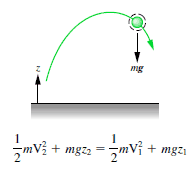
First the principle of the Conservation of Mechanical Energy was stated:

The total mechanical energy (defined as the sum of its potential and kinetic energies) of a particle being acted on by only conservative forces is constant.

conservartion-of-mechanical-energy-example

See also: Conservation of Mechanical Energy

An isolated system is one in which no external force causes energy changes. If only conservative forces act on an object and U is the potential energy function for the total conservative force, then

Emech = U + K

The potential energy, U, depends on the position of an object subjected to a conservative force.

potential-energy-equation

It is defined as the object’s ability to do work and is increased as the object is moved in the opposite direction of the direction of the force.

The potential energy associated with a system consisting of Earth and a nearby particle is gravitational potential energy.

gravitational-potential-energy-equation

The kinetic energy, K, depends on the speed of an object and is the ability of a moving object to do work on other objects when it collides with them.

 K = ½ mv2

The above mentioned definition (Emech = U + K) assumes that the system is free of friction and other non-conservative forces. The difference between a conservative and a non-conservative force is that when a conservative force moves an object from one point to another, the work done by the conservative force is independent of the path.

In any real situation, frictional forces and other non-conservative forces are present, but in many cases their effects on the system are so small that the principle of conservation of mechanical energy can be used as a fair approximation. For example the frictional force is a non-conservative force, because it acts to reduce the mechanical energy in a system.

Note that non-conservative forces do not always reduce the mechanical energy. A non-conservative force changes the mechanical energy, there are forces that increase the total mechanical energy, like the force provided by a motor or engine, is also a non-conservative force.

Block sliding down a frictionless incline slope

The 1 kg block starts out a height H (let say 1 m) above the ground, with potential energy mgH and kinetic energy that is equal to 0. It slides to the ground (without friction) and arrives with no potential energy and kinetic energy K = ½ mv2. Calculate the velocity of the block on the ground and its kinetic energy.

Emech = U + K = const

=> ½ mv2 = mgH

=> v = √2gH = 4.43 m/s

=> K2 = ½ x 1 kg x (4.43 m/s)2 = 19.62 kg.m2.s-2 = 19.62 J

Pendulum

conservartion-of-mechanical-energy-pendulumAssume a pendulum (ball of mass m suspended on a string of length L that we have pulled up so that the ball is a height H < L above its lowest point on the arc of its stretched string motion. The pendulum is subjected to the conservative gravitational force where frictional forces like air drag and friction at the pivot are negligible.

We release it from rest. How fast is it going at the bottom?

conservartion-of-mechanical-energy-pendulum2

The pendulum reaches greatest kinetic energy and least potential energy when in the vertical position, because it will have the greatest speed and be nearest the Earth at this point. On the other hand, it will have its least kinetic energy and greatest potential energy at the extreme positions of its swing, because it has zero speed and is farthest from Earth at these points.

If the amplitude is limited to small swings, the period T of a simple pendulum, the time taken for a complete cycle, is:

period-of-pendulum-conservation-of-energy

where L is the length of the pendulum and g is the local acceleration of gravity. For small swings the period of swing is approximately the same for different size swings. That is, the period is independent of amplitude.

 
References:
Reactor Physics and Thermal Hydraulics:
  1. J. R. Lamarsh, Introduction to Nuclear Reactor Theory, 2nd ed., Addison-Wesley, Reading, MA (1983).
  2. J. R. Lamarsh, A. J. Baratta, Introduction to Nuclear Engineering, 3d ed., Prentice-Hall, 2001, ISBN: 0-201-82498-1.
  3. W. M. Stacey, Nuclear Reactor Physics, John Wiley & Sons, 2001, ISBN: 0- 471-39127-1.
  4. Glasstone, Sesonske. Nuclear Reactor Engineering: Reactor Systems Engineering, Springer; 4th edition, 1994, ISBN: 978-0412985317
  5. Todreas Neil E., Kazimi Mujid S. Nuclear Systems Volume I: Thermal Hydraulic Fundamentals, Second Edition. CRC Press; 2 edition, 2012, ISBN: 978-0415802871
  6. Zohuri B., McDaniel P. Thermodynamics in Nuclear Power Plant Systems. Springer; 2015, ISBN: 978-3-319-13419-2
  7. Moran Michal J., Shapiro Howard N. Fundamentals of Engineering Thermodynamics, Fifth Edition, John Wiley & Sons, 2006, ISBN: 978-0-470-03037-0
  8. Kleinstreuer C. Modern Fluid Dynamics. Springer, 2010, ISBN 978-1-4020-8670-0.
  9. U.S. Department of Energy, THERMODYNAMICS, HEAT TRANSFER, AND FLUID FLOW. DOE Fundamentals Handbook, Volume 1, 2 and 3. June 1992.

See also:

Energy

We hope, this article, Mechanical Energy, helps you. If so, give us a like in the sidebar. Main purpose of this website is to help the public to learn some interesting and important information about radiation and dosimeters.

What is Example of Energy of 1 Joule – Definition

One joule in everyday life and in science corresponds to approximately the kinetic energy of a 50 kg object (e.g. human) moving very slowly. Periodic Table

Energy Units

Energy is generally defined as the potential to do work or produce heat. This definition causes  the SI unit for energy is the same as the unit of work – the joule (J). Joule is a derived unit of energy and it is named in honor of James Prescott Joule and his experiments on the mechanical equivalent of heat. In more fundamental terms, 1 joule is equal to:

1 J = 1 kg.m2/s2

Since energy is a fundamental physical quantity and it is used in various physical and engineering branches, there are many energy units in physics and engineering.

Joule – Energy Units

Joule (unit: J). Joule  is a derived unit of energy. It is equal to the energy transferred to an object when a force of one newton acts on that object in the direction of its motion through a distance of one metre.

  • 1 joule = 0.239 Calories
  • 1 joule = 9.48 x 10⁻⁴ BTU
  • 1 joule = 2.778 x 10⁻⁷ kWh

conversion - joule, calorie, kilowatthour - energy units

Examples of Energy of 1 Joule

One joule in everyday life and in science corresponds to approximately:

  • The kinetic energy of an object with mass 1 kg moving at √2 ≈ 1.4 m/s.
  • The kinetic energy of a 50 kg object (e.g. human) moving very slowly – approximately 0.72 km/h.
  • The energy required to lift a medium-size apple (100 g) 1 meter vertically from the surface of the Earth.
  • The heat required to raise the temperature of 1 g of water by 0.24 °C.
  • The heat required to evaporate of 0.00044 g of liquid water at 100°C.
  • The amount of electricity required to light a 1 watt LED for 1 s.
  • Is released by approximately 3.1⋅1010 fissions in a nuclear reactor.
 
References:
Reactor Physics and Thermal Hydraulics:
  1. J. R. Lamarsh, Introduction to Nuclear Reactor Theory, 2nd ed., Addison-Wesley, Reading, MA (1983).
  2. J. R. Lamarsh, A. J. Baratta, Introduction to Nuclear Engineering, 3d ed., Prentice-Hall, 2001, ISBN: 0-201-82498-1.
  3. W. M. Stacey, Nuclear Reactor Physics, John Wiley & Sons, 2001, ISBN: 0- 471-39127-1.
  4. Glasstone, Sesonske. Nuclear Reactor Engineering: Reactor Systems Engineering, Springer; 4th edition, 1994, ISBN: 978-0412985317
  5. Todreas Neil E., Kazimi Mujid S. Nuclear Systems Volume I: Thermal Hydraulic Fundamentals, Second Edition. CRC Press; 2 edition, 2012, ISBN: 978-0415802871
  6. Zohuri B., McDaniel P. Thermodynamics in Nuclear Power Plant Systems. Springer; 2015, ISBN: 978-3-319-13419-2
  7. Moran Michal J., Shapiro Howard N. Fundamentals of Engineering Thermodynamics, Fifth Edition, John Wiley & Sons, 2006, ISBN: 978-0-470-03037-0
  8. Kleinstreuer C. Modern Fluid Dynamics. Springer, 2010, ISBN 978-1-4020-8670-0.
  9. U.S. Department of Energy, THERMODYNAMICS, HEAT TRANSFER, AND FLUID FLOW. DOE Fundamentals Handbook, Volume 1, 2 and 3. June 1992.

See also:

Energy

We hope, this article, Example of Energy of 1 Joule, helps you. If so, give us a like in the sidebar. Main purpose of this website is to help the public to learn some interesting and important information about radiation and dosimeters.

What is Kilowatt to Kilowatthour – kW to kWh – Definition

Kilowatt to Kilowatthour. The kilowatt hour is commonly used by electric utilities as a billing unit for energy delivered to consumers. 1kW . h = 1kWh. Periodic Table

Energy Units

Energy is generally defined as the potential to do work or produce heat. This definition causes  the SI unit for energy is the same as the unit of work – the joule (J). Joule is a derived unit of energy and it is named in honor of James Prescott Joule and his experiments on the mechanical equivalent of heat. In more fundamental terms, 1 joule is equal to:

1 J = 1 kg.m2/s2

Since energy is a fundamental physical quantity and it is used in various physical and engineering branches, there are many energy units in physics and engineering.

Kilowatt to Kilowatthour – kW to kWh

Kilowatt-hour (unit: kWh). Kilowatt-hour is a derived unit of energy. It is used to measure energy, especially electrical energy in commercial applications.

One kilowatt-hour is equal to one kilowatt of power produced or consumed over a period of one hour (kilowatts multiplied by the time in hours).

1kW . h = 1kWh

The kilowatt hour is commonly used by electric utilities as a billing unit for energy delivered to consumers. 1kW . h = 1kWh . 3600s = 3600kWs = 3600kJ = 3600000J. One kilowatt-hour corresponds to the heat required to evaporate of 1.58 kg of liquid water at 100°C. A radio rated at 100 watts operating for 10 hours continuously uses one kilowatt hour.

  • 1 kWh = 3.6 x 10⁶ J
  • 1 kWh = 8.6 x 10⁵ cal
  • 1 kWh = 3412 BTU

conversion - joule, calorie, kilowatthour - energy units

 
References:
Reactor Physics and Thermal Hydraulics:
  1. J. R. Lamarsh, Introduction to Nuclear Reactor Theory, 2nd ed., Addison-Wesley, Reading, MA (1983).
  2. J. R. Lamarsh, A. J. Baratta, Introduction to Nuclear Engineering, 3d ed., Prentice-Hall, 2001, ISBN: 0-201-82498-1.
  3. W. M. Stacey, Nuclear Reactor Physics, John Wiley & Sons, 2001, ISBN: 0- 471-39127-1.
  4. Glasstone, Sesonske. Nuclear Reactor Engineering: Reactor Systems Engineering, Springer; 4th edition, 1994, ISBN: 978-0412985317
  5. Todreas Neil E., Kazimi Mujid S. Nuclear Systems Volume I: Thermal Hydraulic Fundamentals, Second Edition. CRC Press; 2 edition, 2012, ISBN: 978-0415802871
  6. Zohuri B., McDaniel P. Thermodynamics in Nuclear Power Plant Systems. Springer; 2015, ISBN: 978-3-319-13419-2
  7. Moran Michal J., Shapiro Howard N. Fundamentals of Engineering Thermodynamics, Fifth Edition, John Wiley & Sons, 2006, ISBN: 978-0-470-03037-0
  8. Kleinstreuer C. Modern Fluid Dynamics. Springer, 2010, ISBN 978-1-4020-8670-0.
  9. U.S. Department of Energy, THERMODYNAMICS, HEAT TRANSFER, AND FLUID FLOW. DOE Fundamentals Handbook, Volume 1, 2 and 3. June 1992.

See also:

Energy

We hope, this article, Kilowatt to Kilowatthour – kW to kWh, helps you. If so, give us a like in the sidebar. Main purpose of this website is to help the public to learn some interesting and important information about radiation and dosimeters.

What is Example of Energies in Electronvolts – Definition

Example of Energies in Electronvolts. Here are few examples of energies of electronvolts, which are a traditional unit of energy particularly in atomic and nuclear physics. Periodic Table

Energy Units

Energy is generally defined as the potential to do work or produce heat. This definition causes  the SI unit for energy is the same as the unit of work – the joule (J). Joule is a derived unit of energy and it is named in honor of James Prescott Joule and his experiments on the mechanical equivalent of heat. In more fundamental terms, 1 joule is equal to:

1 J = 1 kg.m2/s2

Since energy is a fundamental physical quantity and it is used in various physical and engineering branches, there are many energy units in physics and engineering.

Example of Energies in Electronvolts

Electronvolt - definition
Electronvolt is equal to energy gained by a single electron when it is accelerated through 1 volt of electric potential difference. The work done on the charge is given by the charge times the voltage difference, therefore the work W on electron is: W = qV = (1.6 x 10⁻¹⁹ C) x (1 J/C) = 1.6 x 10⁻¹⁹ J.
  • Thermal neutrons are neutrons in thermal equilibrium with a surrounding medium of temperature 290K (17 °C or 62 °F). Most probable energy at 17°C (62°F) for Maxwellian distribution is 0.025 eV (~2 km/s).
  • Thermal energy of a molecule is at room temperature about 0.04 eV.
  • Approximately 1 eV corresponds to an infrared photon of wavelength 1240 nm.
  • Visible light photons have energies in range 1.65 eV (red) – 3.26 eV (violet).
  • The first resonance in n + 238U reaction is at 6.67 eV (energy of incident neutron), which corresponds to the first virtual level in 239U, has a total width of only 0.027 eV, and the mean life of this state is 2.4×10⁻¹⁴s.
  • Ionization energy of atomic hydrogen is 13.6 eV.
  • Carbon-14 decays into nitrogen-14 through beta decay (pure beta decay). The emitted beta particles have a maximum energy of 156 keV, while their weighted mean energy is 49 keV.
  • High energy diagnostic medical x-ray photons have kinetic energies of about 200 keV.
  • Thallium 208, which is one of nuclides in the 232U decay chain, emits gamma rays of 2.6 MeV which are very energetic and highly penetrating.
  • Typical kinetic energy of alpha particle from radioactive decay is about 5 MeV. It is caused by the mechanism of their production.
  • The total energy released in a reactor is about 210 MeV per 235U fission, distributed as shown in the table. In a reactor, the average recoverable energy per fission is about 200 MeV, being the total energy minus the energy of the energy of antineutrinos that are radiated away.
  • Cosmic ray can have energies of 1 MeV – 1000 TeV.
 
References:
Reactor Physics and Thermal Hydraulics:
  1. J. R. Lamarsh, Introduction to Nuclear Reactor Theory, 2nd ed., Addison-Wesley, Reading, MA (1983).
  2. J. R. Lamarsh, A. J. Baratta, Introduction to Nuclear Engineering, 3d ed., Prentice-Hall, 2001, ISBN: 0-201-82498-1.
  3. W. M. Stacey, Nuclear Reactor Physics, John Wiley & Sons, 2001, ISBN: 0- 471-39127-1.
  4. Glasstone, Sesonske. Nuclear Reactor Engineering: Reactor Systems Engineering, Springer; 4th edition, 1994, ISBN: 978-0412985317
  5. Todreas Neil E., Kazimi Mujid S. Nuclear Systems Volume I: Thermal Hydraulic Fundamentals, Second Edition. CRC Press; 2 edition, 2012, ISBN: 978-0415802871
  6. Zohuri B., McDaniel P. Thermodynamics in Nuclear Power Plant Systems. Springer; 2015, ISBN: 978-3-319-13419-2
  7. Moran Michal J., Shapiro Howard N. Fundamentals of Engineering Thermodynamics, Fifth Edition, John Wiley & Sons, 2006, ISBN: 978-0-470-03037-0
  8. Kleinstreuer C. Modern Fluid Dynamics. Springer, 2010, ISBN 978-1-4020-8670-0.
  9. U.S. Department of Energy, THERMODYNAMICS, HEAT TRANSFER, AND FLUID FLOW. DOE Fundamentals Handbook, Volume 1, 2 and 3. June 1992.

See also:

Energy

We hope, this article, Example of Energies in Electronvolts, helps you. If so, give us a like in the sidebar. Main purpose of this website is to help the public to learn some interesting and important information about radiation and dosimeters.

What is Electronvolt (unit eV) – Energy Unit – Definition

Electronvolts are a traditional unit of energy. Electronvolt is equal to energy gained by a single electron when it is accelerated through 1 volt of electric potential difference. Periodic Table

Energy Units

Energy is generally defined as the potential to do work or produce heat. This definition causes  the SI unit for energy is the same as the unit of work – the joule (J). Joule is a derived unit of energy and it is named in honor of James Prescott Joule and his experiments on the mechanical equivalent of heat. In more fundamental terms, 1 joule is equal to:

1 J = 1 kg.m2/s2

Since energy is a fundamental physical quantity and it is used in various physical and engineering branches, there are many energy units in physics and engineering.

Electronvolt (unit: eV)

Electronvolt - definition
Electronvolt is equal to energy gained by a single electron when it is accelerated through 1 volt of electric potential difference. The work done on the charge is given by the charge times the voltage difference, therefore the work W on electron is: W = qV = (1.6 x 10⁻¹⁹ C) x (1 J/C) = 1.6 x 10⁻¹⁹ J.

Electronvolt (unit: eV). Electronvolts are a traditional unit of energy particularly in atomic and nuclear physics. Electronvolt is equal to energy gained by a single electron when it is accelerated through 1 volt of electric potential difference. The work done on the charge is given by the charge times the voltage difference, therefore the work W on electron is: W = qV = (1.6 x 10⁻¹⁹ C) x (1 J/C) = 1.6 x 10⁻¹⁹ J. Since this is very small unit, it is more convenient to use multiples of electronvolts: kilo-electronvolts (keV), mega-electronvolts (MeV), giga-electronvolts (GeV) and so on. Since Albert Einstein showed that mass and energy are equivalent and convertible one into the other, the electronvolt is also a unit of mass. It is common in particle physics, where units of mass and energy are often interchanged, to express mass in units of eV/c2, where c is the speed of light in vacuum (from E = mc2). For example, it can be said the proton has mass of 938.3 MeV, although strictly speaking it should be 938.3 MeV/c2. For another example, an electron–positron annihilation occurs when a negatively charged electron and a positively charged positron (each with a mass of 0.511 MeV/c2) collide. When an electron and a positron collide, they annihilate resulting in the complete conversion of their rest mass to pure energy (according to the E=mc2 formula) in the form of two oppositely directed 0.511 MeV gamma rays (photons).

e− + e+ → γ + γ (2x 0.511 MeV)

  • 1 eV = 1.603 x 10⁻¹⁹ J
  • 1 eV = 3.83 x 10⁻²⁰ cal
  • 1 eV = 1.52 x 10⁻²² BTU

conversion -megawattday, electronvolt - energy units

Example of Energies in Electronvolts

  • Thermal neutrons are neutrons in thermal equilibrium with a surrounding medium of temperature 290K (17 °C or 62 °F). Most probable energy at 17°C (62°F) for Maxwellian distribution is 0.025 eV (~2 km/s).
  • Thermal energy of a molecule is at room temperature about 0.04 eV.
  • Approximately 1 eV corresponds to an infrared photon of wavelength 1240 nm.
  • Visible light photons have energies in range 1.65 eV (red) – 3.26 eV (violet).
  • The first resonance in n + 238U reaction is at 6.67 eV (energy of incident neutron), which corresponds to the first virtual level in 239U, has a total width of only 0.027 eV, and the mean life of this state is 2.4×10⁻¹⁴s.
  • Ionization energy of atomic hydrogen is 13.6 eV.
  • Carbon-14 decays into nitrogen-14 through beta decay (pure beta decay). The emitted beta particles have a maximum energy of 156 keV, while their weighted mean energy is 49 keV.
  • High energy diagnostic medical x-ray photons have kinetic energies of about 200 keV.
  • Thallium 208, which is one of nuclides in the 232U decay chain, emits gamma rays of 2.6 MeV which are very energetic and highly penetrating.
  • Typical kinetic energy of alpha particle from radioactive decay is about 5 MeV. It is caused by the mechanism of their production.
  • The total energy released in a reactor is about 210 MeV per 235U fission, distributed as shown in the table. In a reactor, the average recoverable energy per fission is about 200 MeV, being the total energy minus the energy of the energy of antineutrinos that are radiated away.
  • Cosmic ray can have energies of 1 MeV – 1000 TeV.
 
References:
Reactor Physics and Thermal Hydraulics:
  1. J. R. Lamarsh, Introduction to Nuclear Reactor Theory, 2nd ed., Addison-Wesley, Reading, MA (1983).
  2. J. R. Lamarsh, A. J. Baratta, Introduction to Nuclear Engineering, 3d ed., Prentice-Hall, 2001, ISBN: 0-201-82498-1.
  3. W. M. Stacey, Nuclear Reactor Physics, John Wiley & Sons, 2001, ISBN: 0- 471-39127-1.
  4. Glasstone, Sesonske. Nuclear Reactor Engineering: Reactor Systems Engineering, Springer; 4th edition, 1994, ISBN: 978-0412985317
  5. Todreas Neil E., Kazimi Mujid S. Nuclear Systems Volume I: Thermal Hydraulic Fundamentals, Second Edition. CRC Press; 2 edition, 2012, ISBN: 978-0415802871
  6. Zohuri B., McDaniel P. Thermodynamics in Nuclear Power Plant Systems. Springer; 2015, ISBN: 978-3-319-13419-2
  7. Moran Michal J., Shapiro Howard N. Fundamentals of Engineering Thermodynamics, Fifth Edition, John Wiley & Sons, 2006, ISBN: 978-0-470-03037-0
  8. Kleinstreuer C. Modern Fluid Dynamics. Springer, 2010, ISBN 978-1-4020-8670-0.
  9. U.S. Department of Energy, THERMODYNAMICS, HEAT TRANSFER, AND FLUID FLOW. DOE Fundamentals Handbook, Volume 1, 2 and 3. June 1992.

See also:

Energy

We hope, this article, Electronvolt (unit eV) – Energy Unit, helps you. If so, give us a like in the sidebar. Main purpose of this website is to help the public to learn some interesting and important information about radiation and dosimeters.
What is Megawatt-day (unit MWd) – Energy Unit – Definition

Megawatt-day is a derived unit of energy. It is used to measure energy produced, especially in power engineering. One megawatt-day is equal to one megawatt of power produced by power plant over a period of one day. Periodic Table

Energy Units

Energy is generally defined as the potential to do work or produce heat. This definition causes  the SI unit for energy is the same as the unit of work – the joule (J). Joule is a derived unit of energy and it is named in honor of James Prescott Joule and his experiments on the mechanical equivalent of heat. In more fundamental terms, 1 joule is equal to:

1 J = 1 kg.m2/s2

Since energy is a fundamental physical quantity and it is used in various physical and engineering branches, there are many energy units in physics and engineering.

Megawatt-day (unit: MWd)

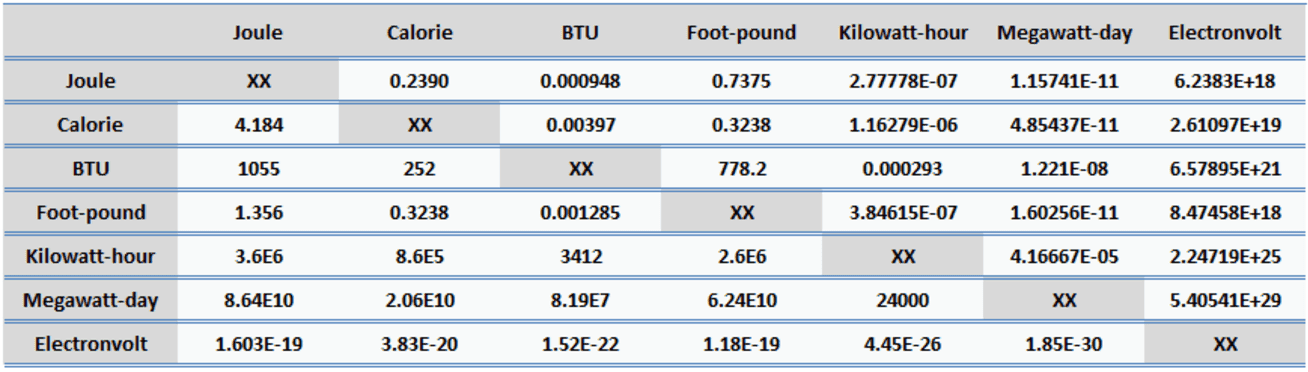
Megawatt-day (unit: MWd).  Megawatt-day is a derived unit of energy. It is used to measure energy produced, especially in power engineering. One megawatt-day is equal to one megawatt of power produced by power plant over a period of one day (megawatts multiplied by the time in days). 1 MWd = 24,000 kWh. At nuclear power plants there are also gigawatt-days, because it approximately corresponds to energy produced by power plant over a period of one day. This unit (MWd) was also used to derive unit of fuel burnup. The most commonly used measure of fuel burnup is the fission energy release per unit mass of fuel. Therefore fuel burnup of nuclear fuel is normally have units of megawatt-days per metric tonne (MWd/MTU), where tonne refers to a metric ton of uranium metal (sometimes MWd/tU HM as Heavy Metal). In this field, the megawatt-day refers to the thermal power of the reactor, not the fraction which is converted to electricity. For example, for a typical nuclear reactor with a thermal power of 3000 MWth, about ~1000MWe of electrical power is generated in the generator. For example, a reactor with 100 000 kg of fuel operating at 3000MWth power level for 1000 days would have a burnup increase of 30,000 MWd/MTU. In words of fissions,  fissioning of about 1 g of U-235 produces about 1 MWd of thermal energy (see: Energy Release per Fission).

  • 1 MWd = 8.64 x 10¹⁰ J
  • 1 MWd = 2.06 x 10¹⁰ cal
  • 1 MWd = 8.19 x 10⁷ BTU

conversion -megawattday, electronvolt - energy units

 
References:
Reactor Physics and Thermal Hydraulics:
  1. J. R. Lamarsh, Introduction to Nuclear Reactor Theory, 2nd ed., Addison-Wesley, Reading, MA (1983).
  2. J. R. Lamarsh, A. J. Baratta, Introduction to Nuclear Engineering, 3d ed., Prentice-Hall, 2001, ISBN: 0-201-82498-1.
  3. W. M. Stacey, Nuclear Reactor Physics, John Wiley & Sons, 2001, ISBN: 0- 471-39127-1.
  4. Glasstone, Sesonske. Nuclear Reactor Engineering: Reactor Systems Engineering, Springer; 4th edition, 1994, ISBN: 978-0412985317
  5. Todreas Neil E., Kazimi Mujid S. Nuclear Systems Volume I: Thermal Hydraulic Fundamentals, Second Edition. CRC Press; 2 edition, 2012, ISBN: 978-0415802871
  6. Zohuri B., McDaniel P. Thermodynamics in Nuclear Power Plant Systems. Springer; 2015, ISBN: 978-3-319-13419-2
  7. Moran Michal J., Shapiro Howard N. Fundamentals of Engineering Thermodynamics, Fifth Edition, John Wiley & Sons, 2006, ISBN: 978-0-470-03037-0
  8. Kleinstreuer C. Modern Fluid Dynamics. Springer, 2010, ISBN 978-1-4020-8670-0.
  9. U.S. Department of Energy, THERMODYNAMICS, HEAT TRANSFER, AND FLUID FLOW. DOE Fundamentals Handbook, Volume 1, 2 and 3. June 1992.

See also:

Energy

We hope, this article, Megawatt-day (unit MWd) – Energy Unit, helps you. If so, give us a like in the sidebar. Main purpose of this website is to help the public to learn some interesting and important information about radiation and dosimeters.