What is Nuclide – Definition

In nuclear physics and nuclear chemistry, the various species of atoms whose nuclei contain particular numbers of protons and neutrons are called nuclides. Nuclides are also characterized by its nuclear energy states (e.g. metastable nuclide 242mAm). Periodic Table

Nuclides

Proton Number - Atomic NumberIn nuclear physics and nuclear chemistry, the various species of atoms whose nuclei contain particular numbers of protons and neutrons are called nuclides. Nuclides are also characterized by its nuclear energy states (e.g. metastable nuclide 242mAm). Each nuclide is denoted by chemical symbol of the element (this specifies Z) with the atomic mass number as superscript. Hydrogen (H), for example , consist of one electron and one proton. The number of neutrons in a nucleus is known as the neutron number and is given the symbol N. The total number of nucleons, that is, protons and neutrons in a nucleus, is equal to Z + N = A, where A is called the atomic mass number.

Thus the symbol 1H refers to the nuclide of hydrogen with a single proton as nucleus. 2H is the hydrogen nuclide with a neutron as well as a proton in the nucleus (2H is also called deuterium or heavy hydrogen). Atoms such as 1H, 2H whose nuclei contain the same number of protons but different number of neutrons (different A) are known as isotopes. Uranium, for instance, has three isotopes occurring in nature – 238U, 235U and 234U. All have 92 protons in their nuclei. But, whereas the 235U isotope has 143 neutrons in its nucleus, that of the 238U isotope contains 146 neutrons. The stable isotopes (plus a few of the unstable isotopes) are the atoms that are found in the naturally occurring elements in nature. However, they are not found in equal amounts. Some isotopes of a given element are more abundant than others. For example 99,27% of naturally occuring uranium atoms are the isotope 238U, 0,72% are the isotope 235U and 0,0055% are the isotope 234U. As can be seen, all nuclides can be grouped according to number of protons, neutrons and its nuclear energy states:

  • Isotopes. Isotopes are nuclides that have the same atomic number and are therefore the same element, but differ in the number of neutrons.
  • Isotones. Isotones are nuclides that have the same neutron number and are therefore different elements, since they must differ in the number of protons.
  • Isobars. Isobars are nuclides that have the same mass number and are therefore different elements, since they must differ in the number of protons.
  • Isomers. Isomers are nuclides with equal proton number and equal mass number (thus making them by definition the same isotope), but different energy states.
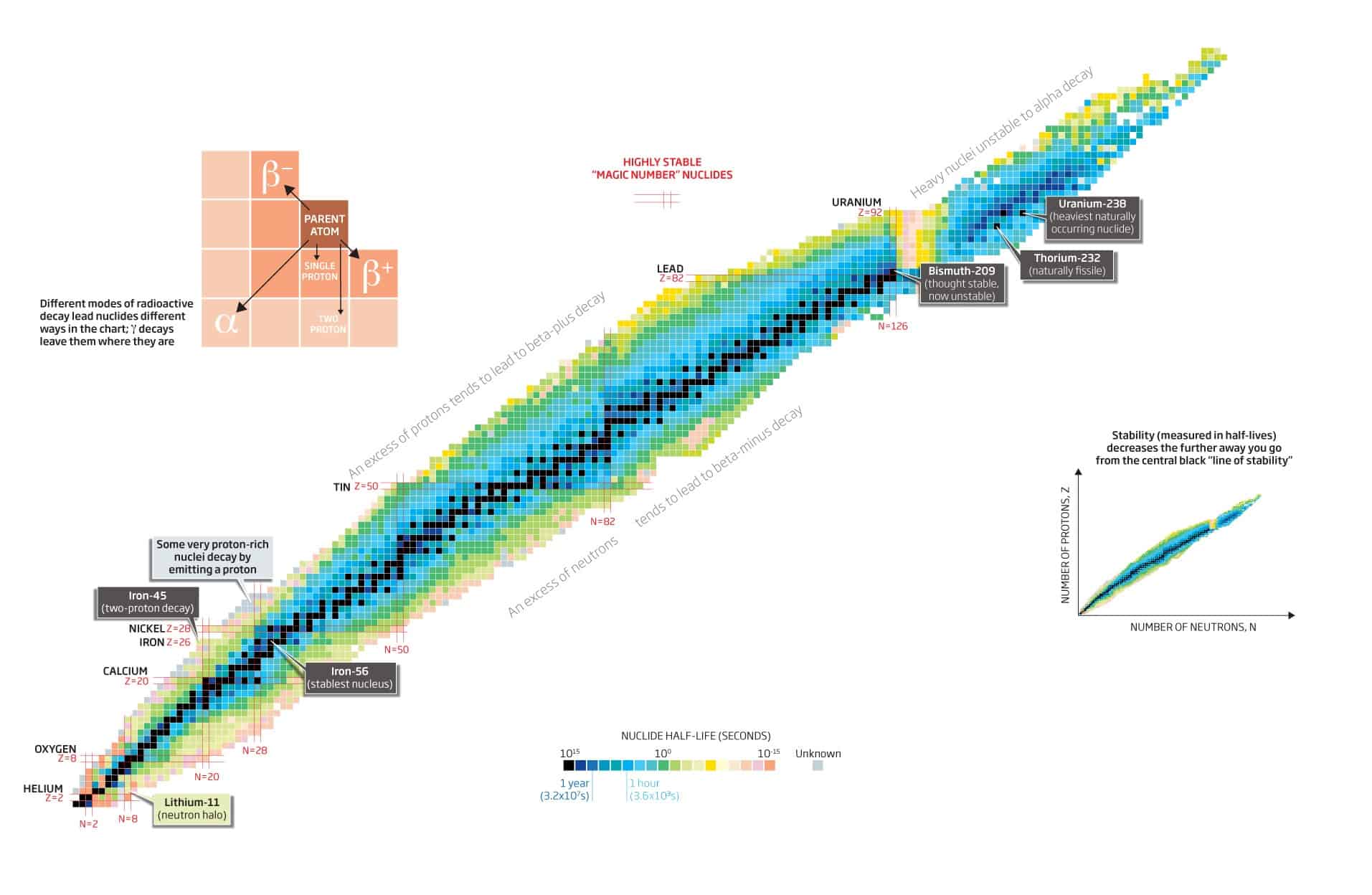
Nuclide chart - Nuclear Stability
Segre chart – This chart shows a plot of the known nuclides as a function of their atomic and neutron numbers. It can be observed from the chart that there are more neutrons than protons in nuclides with Z greater than about 20 (Calcium). These extra neutrons are necessary for stability of the heavier nuclei. The excess neutrons act somewhat like nuclear glue.

Examples of Nuclides

Uranium

Uranium is a naturally-occurring chemical element with atomic number 92 which means there are 92 protons and 92 electrons in the atomic structure. The chemical symbol for uranium is U. Uranium is commonly found  at low levels (a few ppm – parts per million) in all rocks, soil, water, plants, and animals (including humans). Uranium occurs also in seawater, and can be recovered from the ocean water. Significant concentrations of uranium occur in some substances such as uraninite (the most common uranium ore), phosphate rock deposits, and other minerals.

Natural uranium consists primarily of isotope 238U (99.28%), therefore the atomic mass of uranium element is close to the atomic mass of 238U isotope (238.03u).  Natural uranium also consists of two other isotopes: 235U (0.71%) and 234U (0.0054%). The abundance of  isotopes in the nature is caused by difference in the half-lifes. All three naturally-occurring isotopes of uranium (238U, 235U and 234U)  are unstable. On the other hand these isotopes (except 234U) belong to primordial nuclides, because their half-life is comparable to the age of the Earth (~4.5×10⁹ years for 238U).

In nuclear reactors we have to consider three artificial isotopes, 236U, 233U and 232U. These are produced by transmutation in nuclear reactors from 235U and 232Th.

Xenon

Xenon is a naturally-occurring chemical element with atomic number 54 which means there are 54 protons and 54 electrons in the atomic structure. The chemical symbol for xenon is Xe. Xenon is a colorless, dense, odorless noble gas found in the Earth’s atmosphere in trace amounts.

Natural xenon consists of eight stable isotopes, 124Xe (0.095%), 126Xe (0.089%), 128Xe (1.91%), 129Xe (26.4%), 130Xe (4.07%), 131Xe (21.23%), 132Xe (26.91%),  134Xe (10.44%), and one isotope with very long half-life 136Xe (8.86%).

In nuclear industry, especially artificial xenon 135 has a tremendous impact on the operation of a nuclear reactor. For physicists and for reactor operators, it is important to understand the mechanisms that produce and remove xenon from the reactor to predict how the reactor will respond following changes in power level.

Another important isotope is the xenon 133, which has half-life of 5.2 days, and its presence in a reactor coolant indicates (together with xenon 135) a possible failure of fuel cladding. A new defect will often result in a step increase in only the Xe-133 activity, which is measured from reactor coolant. As the defect enlarges, the release rate of the soluble, longer-lived nuclides, particularly I-131, I-134, Cs-134, and Cs-137 will increase.

Boron

Boron is a naturally-occurring chemical element with atomic number 5 which means there are 5 protons and 5 electrons in the atomic structure. The chemical symbol for boron is B.

Natural boron consists primarily of two stable isotopes, 11B (80.1%) and  10B (19.9%). In nuclear industry boron is commonly used as a neutron absorberdue to the high neutron cross-section of isotope  10B. Its (n,alpha) reaction cross-section for thermal neutrons is about 3840 barns (for 0.025 eV neutron). Isotope  11B has absorption cross-section for thermal neutrons about 0.005 barns (for 0.025 eV neutron). Most of (n,alpha) reactions of thermal neutrons are 10B(n,alpha)7Li reactions accompanied by 0.48 MeV gamma emission.

(n,alpha) reactions of 10B

Moreover, isotope 10B has high (n,alpha) reaction cross-section along the entire neutron energy spectrum. The cross-sections of most other elements becomes very small at high energies as in the case of cadmium. The cross-section of 10B decreases monotonically with energy. For fast neutrons its cross-section is on the order of barns.

References:
Nuclear and Reactor Physics:
  1. J. R. Lamarsh, Introduction to Nuclear Reactor Theory, 2nd ed., Addison-Wesley, Reading, MA (1983).
  2. J. R. Lamarsh, A. J. Baratta, Introduction to Nuclear Engineering, 3d ed., Prentice-Hall, 2001, ISBN: 0-201-82498-1.
  3. W. M. Stacey, Nuclear Reactor Physics, John Wiley & Sons, 2001, ISBN: 0- 471-39127-1.
  4. Glasstone, Sesonske. Nuclear Reactor Engineering: Reactor Systems Engineering, Springer; 4th edition, 1994, ISBN: 978-0412985317
  5. W.S.C. Williams. Nuclear and Particle Physics. Clarendon Press; 1 edition, 1991, ISBN: 978-0198520467
  6. G.R.Keepin. Physics of Nuclear Kinetics. Addison-Wesley Pub. Co; 1st edition, 1965
  7. Robert Reed Burn, Introduction to Nuclear Reactor Operation, 1988.
  8. U.S. Department of Energy, Nuclear Physics and Reactor Theory. DOE Fundamentals Handbook, Volume 1 and 2. January 1993.
  9. Paul Reuss, Neutron Physics. EDP Sciences, 2008. ISBN: 978-2759800414.

Advanced Reactor Physics:

  1. K. O. Ott, W. A. Bezella, Introductory Nuclear Reactor Statics, American Nuclear Society, Revised edition (1989), 1989, ISBN: 0-894-48033-2.
  2. K. O. Ott, R. J. Neuhold, Introductory Nuclear Reactor Dynamics, American Nuclear Society, 1985, ISBN: 0-894-48029-4.
  3. D. L. Hetrick, Dynamics of Nuclear Reactors, American Nuclear Society, 1993, ISBN: 0-894-48453-2.
  4. E. E. Lewis, W. F. Miller, Computational Methods of Neutron Transport, American Nuclear Society, 1993, ISBN: 0-894-48452-4.

See also:

Atom

We hope, this article, Nuclide, helps you. If so, give us a like in the sidebar. Main purpose of this website is to help the public to learn some interesting and important information about radiation and dosimeters.

What is Isotope – Nuclide – Definition

Isotopes are nuclides that have the same atomic number and are therefore the same element, but differ in the number of neutrons. The stable isotopes (plus a few of the unstable isotopes) are the atoms that are found in the naturally occurring elements in nature. Periodic Table

Isotope

Proton Number - Atomic NumberIn nuclear physics and nuclear chemistry, the various species of atoms whose nuclei contain particular numbers of protons and neutrons are called nuclides. Nuclides are also characterized by its nuclear energy states (e.g. metastable nuclide 242mAm). Each nuclide is denoted by chemical symbol of the element (this specifies Z) with the atomic mass number as superscript. Isotopes are nuclides that have the same atomic number and are therefore the same element, but differ in the number of neutrons. Hydrogen (H), for example , consist of one electron and one proton. The number of neutrons in a nucleus is known as the neutron number and is given the symbol N. The total number of nucleons, that is, protons and neutrons in a nucleus, is equal to Z + N = A, where A is called the atomic mass number.

Thus the symbol 1H refers to the nuclide of hydrogen with a single proton as nucleus. 2H is the hydrogen nuclide with a neutron as well as a proton in the nucleus (2H is also called deuterium or heavy hydrogen). Atoms such as 1H, 2H whose nuclei contain the same number of protons but different number of neutrons (different A) are isotopes. Uranium, for instance, has three isotopes occurring in nature – 238U, 235U and 234U. All have 92 protons in their nuclei. But, whereas the 235U isotope has 143 neutrons in its nucleus, that of the 238U isotope contains 146 neutrons. The stable isotopes (plus a few of the unstable isotopes) are the atoms that are found in the naturally occurring elements in nature. However, they are not found in equal amounts. Some isotopes of a given element are more abundant than others. For example 99,27% of naturally occuring uranium atoms are the isotope 238U, 0,72% are the isotope 235U and 0,0055% are the isotope 234U.

Because all the isotopes of a given element exhibit the same chemical properties, their separation is very difficult by chemical means. The traditional methods of isotope separation are based directly on the atomic weight of the isotope or based on the small differences in chemical reaction rates produced by different atomic weights. These methods have included mass spectometry, centrifugal separation and processes that depend on the different rates at which heavy and light particles diffuse.

Nuclide chart - Nuclear Stability
Segre chart – This chart shows a plot of the known nuclides as a function of their atomic and neutron numbers. It can be observed from the chart that there are more neutrons than protons in nuclides with Z greater than about 20 (Calcium). These extra neutrons are necessary for stability of the heavier nuclei. The excess neutrons act somewhat like nuclear glue.

Isotopes of the highest importance in reactor physics

Uranium

Uranium is a naturally-occurring chemical element with atomic number 92 which means there are 92 protons and 92 electrons in the atomic structure. The chemical symbol for uranium is U. Uranium is commonly found  at low levels (a few ppm – parts per million) in all rocks, soil, water, plants, and animals (including humans). Uranium occurs also in seawater, and can be recovered from the ocean water. Significant concentrations of uranium occur in some substances such as uraninite (the most common uranium ore), phosphate rock deposits, and other minerals.

Natural uranium consists primarily of isotope 238U (99.28%), therefore the atomic mass of uranium element is close to the atomic mass of 238U isotope (238.03u).  Natural uranium also consists of two other isotopes: 235U (0.71%) and 234U (0.0054%). The abundance of  isotopes in the nature is caused by difference in the half-lifes. All three naturally-occurring isotopes of uranium (238U, 235U and 234U)  are unstable. On the other hand these isotopes (except 234U) belong to primordial nuclides, because their half-life is comparable to the age of the Earth (~4.5×10⁹ years for 238U).

In nuclear reactors we have to consider three artificial isotopes, 236U, 233U and 232U. These are produced by transmutation in nuclear reactors from 235U and 232Th.

Xenon

Xenon is a naturally-occurring chemical element with atomic number 54 which means there are 54 protons and 54 electrons in the atomic structure. The chemical symbol for xenon is Xe. Xenon is a colorless, dense, odorless noble gas found in the Earth’s atmosphere in trace amounts.

Natural xenon consists of eight stable isotopes, 124Xe (0.095%), 126Xe (0.089%), 128Xe (1.91%), 129Xe (26.4%), 130Xe (4.07%), 131Xe (21.23%), 132Xe (26.91%),  134Xe (10.44%), and one isotope with very long half-life 136Xe (8.86%).

In nuclear industry, especially artificial xenon 135 has a tremendous impact on the operation of a nuclear reactor. For physicists and for reactor operators, it is important to understand the mechanisms that produce and remove xenon from the reactor to predict how the reactor will respond following changes in power level.

Another important isotope is the xenon 133, which has half-life of 5.2 days, and its presence in a reactor coolant indicates (together with xenon 135) a possible failure of fuel cladding. A new defect will often result in a step increase in only the Xe-133 activity, which is measured from reactor coolant. As the defect enlarges, the release rate of the soluble, longer-lived nuclides, particularly I-131, I-134, Cs-134, and Cs-137 will increase.

Boron

Boron is a naturally-occurring chemical element with atomic number 5 which means there are 5 protons and 5 electrons in the atomic structure. The chemical symbol for boron is B.

Natural boron consists primarily of two stable isotopes, 11B (80.1%) and  10B (19.9%). In nuclear industry boron is commonly used as a neutron absorberdue to the high neutron cross-section of isotope  10B. Its (n,alpha) reaction cross-section for thermal neutrons is about 3840 barns (for 0.025 eV neutron). Isotope  11B has absorption cross-section for thermal neutrons about 0.005 barns (for 0.025 eV neutron). Most of (n,alpha) reactions of thermal neutrons are 10B(n,alpha)7Li reactions accompanied by 0.48 MeV gamma emission.

(n,alpha) reactions of 10B

Moreover, isotope 10B has high (n,alpha) reaction cross-section along the entire neutron energy spectrum. The cross-sections of most other elements becomes very small at high energies as in the case of cadmium. The cross-section of 10B decreases monotonically with energy. For fast neutrons its cross-section is on the order of barns.

References:
Nuclear and Reactor Physics:
  1. J. R. Lamarsh, Introduction to Nuclear Reactor Theory, 2nd ed., Addison-Wesley, Reading, MA (1983).
  2. J. R. Lamarsh, A. J. Baratta, Introduction to Nuclear Engineering, 3d ed., Prentice-Hall, 2001, ISBN: 0-201-82498-1.
  3. W. M. Stacey, Nuclear Reactor Physics, John Wiley & Sons, 2001, ISBN: 0- 471-39127-1.
  4. Glasstone, Sesonske. Nuclear Reactor Engineering: Reactor Systems Engineering, Springer; 4th edition, 1994, ISBN: 978-0412985317
  5. W.S.C. Williams. Nuclear and Particle Physics. Clarendon Press; 1 edition, 1991, ISBN: 978-0198520467
  6. G.R.Keepin. Physics of Nuclear Kinetics. Addison-Wesley Pub. Co; 1st edition, 1965
  7. Robert Reed Burn, Introduction to Nuclear Reactor Operation, 1988.
  8. U.S. Department of Energy, Nuclear Physics and Reactor Theory. DOE Fundamentals Handbook, Volume 1 and 2. January 1993.
  9. Paul Reuss, Neutron Physics. EDP Sciences, 2008. ISBN: 978-2759800414.

Advanced Reactor Physics:

  1. K. O. Ott, W. A. Bezella, Introductory Nuclear Reactor Statics, American Nuclear Society, Revised edition (1989), 1989, ISBN: 0-894-48033-2.
  2. K. O. Ott, R. J. Neuhold, Introductory Nuclear Reactor Dynamics, American Nuclear Society, 1985, ISBN: 0-894-48029-4.
  3. D. L. Hetrick, Dynamics of Nuclear Reactors, American Nuclear Society, 1993, ISBN: 0-894-48453-2.
  4. E. E. Lewis, W. F. Miller, Computational Methods of Neutron Transport, American Nuclear Society, 1993, ISBN: 0-894-48452-4.

See also:

Nuclide

We hope, this article, Isotope – Nuclide, helps you. If so, give us a like in the sidebar. Main purpose of this website is to help the public to learn some interesting and important information about radiation and dosimeters.

What is Isotone – Nuclide – Definition

Isotones are nuclides that have the same neutron number and are therefore different elements, since they must differ in the number of protons. Therefore, isotones must be different chemical elements. For example, carbon – 13 and boron – 12 are isotones, since both nuclei contain 7 neutrons. Periodic Table

Isotones

Proton Number - Atomic NumberIn nuclear physics and nuclear chemistry, the various species of atoms whose nuclei contain particular numbers of protons and neutrons are called nuclides. Nuclides are also characterized by its nuclear energy states (e.g. metastable nuclide 242mAm). Each nuclide is denoted by chemical symbol of the element (this specifies Z) with the atomic mass number as superscript. Hydrogen (H), for example , consist of one electron and one proton. The number of neutrons in a nucleus is known as the neutron number and is given the symbol N. The total number of nucleons, that is, protons and neutrons in a nucleus, is equal to Z + N = A, where A is called the atomic mass number.

Isotones are nuclides that have the same neutron number and are therefore different elements, since they must differ in the number of protons. Therefore, isotones must be different chemical elements. For example, carbon – 13 and boron – 12 are isotones, since both nuclei contain 7 neutrons. The name isotone has been derived from the name isotope by changing the “p” in “isotope” from “p” for “proton” to “n” for “neutron”.

The nuclear properties (atomic mass, nuclear cross-sections) of the element are determined by the number of protons and number of neutrons (neutron number). For example, actinides with odd neutron number are usually fissile (fissionable with slow neutrons) while actinides with even neutron number are usually not fissile (but are fissionable with fast neutrons). Heavy nuclei with an even number of protons and an even number of neutrons are (due to Pauli exclusion principle) very stable thanks to the occurrence of ‘paired spin’. On the other hand, nuclei with an odd number of protons and neutrons are mostly unstable (i.e. radioactive). Neutron numbers for which there are no stable isotones are 19, 21, 35, 39, 45, 61, 89, 115, 123, and 127 or more.

See also: Magic Numbers

Nuclide chart - Nuclear Stability
Segre chart – This chart shows a plot of the known nuclides as a function of their atomic and neutron numbers. It can be observed from the chart that there are more neutrons than protons in nuclides with Z greater than about 20 (Calcium). These extra neutrons are necessary for stability of the heavier nuclei. The excess neutrons act somewhat like nuclear glue.
References:
Nuclear and Reactor Physics:
  1. J. R. Lamarsh, Introduction to Nuclear Reactor Theory, 2nd ed., Addison-Wesley, Reading, MA (1983).
  2. J. R. Lamarsh, A. J. Baratta, Introduction to Nuclear Engineering, 3d ed., Prentice-Hall, 2001, ISBN: 0-201-82498-1.
  3. W. M. Stacey, Nuclear Reactor Physics, John Wiley & Sons, 2001, ISBN: 0- 471-39127-1.
  4. Glasstone, Sesonske. Nuclear Reactor Engineering: Reactor Systems Engineering, Springer; 4th edition, 1994, ISBN: 978-0412985317
  5. W.S.C. Williams. Nuclear and Particle Physics. Clarendon Press; 1 edition, 1991, ISBN: 978-0198520467
  6. G.R.Keepin. Physics of Nuclear Kinetics. Addison-Wesley Pub. Co; 1st edition, 1965
  7. Robert Reed Burn, Introduction to Nuclear Reactor Operation, 1988.
  8. U.S. Department of Energy, Nuclear Physics and Reactor Theory. DOE Fundamentals Handbook, Volume 1 and 2. January 1993.
  9. Paul Reuss, Neutron Physics. EDP Sciences, 2008. ISBN: 978-2759800414.

Advanced Reactor Physics:

  1. K. O. Ott, W. A. Bezella, Introductory Nuclear Reactor Statics, American Nuclear Society, Revised edition (1989), 1989, ISBN: 0-894-48033-2.
  2. K. O. Ott, R. J. Neuhold, Introductory Nuclear Reactor Dynamics, American Nuclear Society, 1985, ISBN: 0-894-48029-4.
  3. D. L. Hetrick, Dynamics of Nuclear Reactors, American Nuclear Society, 1993, ISBN: 0-894-48453-2.
  4. E. E. Lewis, W. F. Miller, Computational Methods of Neutron Transport, American Nuclear Society, 1993, ISBN: 0-894-48452-4.

See also:

Nuclide

We hope, this article, Isotone – Nuclide, helps you. If so, give us a like in the sidebar. Main purpose of this website is to help the public to learn some interesting and important information about radiation and dosimeters.
What is Isobar – Nuclide – Definition

Isobars are nuclides of different elements that have the same mass number (same number of nucleons). An example of a series of isobars would be Te-135, I-135 and Xe-135. The term isobar is derived from the Greek word isos, meaning “equal” and baros, meaning “weight”.

Isobars

Proton Number - Atomic NumberIn nuclear physics and nuclear chemistry, the various species of atoms whose nuclei contain particular numbers of protons and neutrons are called nuclides. Nuclides are also characterized by its nuclear energy states (e.g. metastable nuclide 242mAm). Each nuclide is denoted by chemical symbol of the element (this specifies Z) with the atomic mass number as superscript. Hydrogen (H), for example , consist of one electron and one proton. The number of neutrons in a nucleus is known as the neutron number and is given the symbol N. The total number of nucleons, that is, protons and neutrons in a nucleus, is equal to Z + N = A, where A is called the atomic mass number.

Isobars are nuclides of different elements that have the same mass number (same number of nucleons). An example of a series of isobars would be Te-135, I-135 and Xe-135, which are responsible for xenon poisoning in nuclear reactors. The nuclei of these nuclides all contain 135 nucleons; however, they contain varying numbers of protons and neutrons.

The term “isobars” (originally “isobares”) for nuclides was suggested by a British chemist Alfred Walter Stewart in 1918. It is derived from the Greek word isos, meaning “equal” and baros, meaning “weight”.

As can be seen, isobars have the same mass number. Atomic mass number determines especially the atomic mass of atoms. The mass number is different for each different isotope of a chemical element. The mass number is written either after the element name or as a superscript to the left of an element’s symbol. For example, the most common isotope of carbon is carbon-12, or 12C.

For 12C the atomic mass is exactly 12u, since the atomic mass unit is defined from it. For other isotopes, the isotopic mass usually differs and is usually within 0.1 u of the mass number. For example, 63Cu (29 protons and 34 neutrons) has a mass number of 63 and an isotopic mass in its nuclear ground state is 62.91367 u.

There are two reasons for the difference between mass number and isotopic mass, known as the mass defect:

  1. The neutron is slightly heavier than the proton. This increases the mass of nuclei with more neutrons than protons relative to the atomic mass unit scale based on 12C with equal numbers of protons and neutrons.
  2. The nuclear binding energy varies between nuclei. A nucleus with greater binding energy has a lower total energy, and therefore a lower mass according to Einstein’s mass-energy equivalence relation E = mc2. For 63Cu the atomic mass is less than 63 so this must be the dominant factor.
Nuclide chart - Nuclear Stability
Segre chart – This chart shows a plot of the known nuclides as a function of their atomic and neutron numbers. It can be observed from the chart that there are more neutrons than protons in nuclides with Z greater than about 20 (Calcium). These extra neutrons are necessary for stability of the heavier nuclei. The excess neutrons act somewhat like nuclear glue.
References:
Nuclear and Reactor Physics:
  1. J. R. Lamarsh, Introduction to Nuclear Reactor Theory, 2nd ed., Addison-Wesley, Reading, MA (1983).
  2. J. R. Lamarsh, A. J. Baratta, Introduction to Nuclear Engineering, 3d ed., Prentice-Hall, 2001, ISBN: 0-201-82498-1.
  3. W. M. Stacey, Nuclear Reactor Physics, John Wiley & Sons, 2001, ISBN: 0- 471-39127-1.
  4. Glasstone, Sesonske. Nuclear Reactor Engineering: Reactor Systems Engineering, Springer; 4th edition, 1994, ISBN: 978-0412985317
  5. W.S.C. Williams. Nuclear and Particle Physics. Clarendon Press; 1 edition, 1991, ISBN: 978-0198520467
  6. G.R.Keepin. Physics of Nuclear Kinetics. Addison-Wesley Pub. Co; 1st edition, 1965
  7. Robert Reed Burn, Introduction to Nuclear Reactor Operation, 1988.
  8. U.S. Department of Energy, Nuclear Physics and Reactor Theory. DOE Fundamentals Handbook, Volume 1 and 2. January 1993.
  9. Paul Reuss, Neutron Physics. EDP Sciences, 2008. ISBN: 978-2759800414.

Advanced Reactor Physics:

  1. K. O. Ott, W. A. Bezella, Introductory Nuclear Reactor Statics, American Nuclear Society, Revised edition (1989), 1989, ISBN: 0-894-48033-2.
  2. K. O. Ott, R. J. Neuhold, Introductory Nuclear Reactor Dynamics, American Nuclear Society, 1985, ISBN: 0-894-48029-4.
  3. D. L. Hetrick, Dynamics of Nuclear Reactors, American Nuclear Society, 1993, ISBN: 0-894-48453-2.
  4. E. E. Lewis, W. F. Miller, Computational Methods of Neutron Transport, American Nuclear Society, 1993, ISBN: 0-894-48452-4.

See also:

Nuclide

We hope, this article, Isobar – Nuclide, helps you. If so, give us a like in the sidebar. Main purpose of this website is to help the public to learn some interesting and important information about radiation and dosimeters.
What is Isomer – Nuclear Isomer – Definition

Isomers are nuclides with equal proton number and equal mass number (thus making them by definition the same isotope), but different energy states. We usually indicate isomers with a superscript m, thus: 241mAm or 110mAg. Isomers are usually associated with gamma decay. Periodic Table

Nuclear Isomers

In nuclear physics and nuclear chemistry, the various species of atoms whose nuclei contain particular numbers of protons and neutrons are called nuclides. Nuclides are also characterized by its nuclear energy states (e.g. metastable nuclide 242mAm). Each nuclide is denoted by chemical symbol of the element (this specifies Z) with the atomic mass number as superscript. Hydrogen (H), for example , consist of one electron and one proton. The number of neutrons in a nucleus is known as the neutron number and is given the symbol N. The total number of nucleons, that is, protons and neutrons in a nucleus, is equal to Z + N = A, where A is called the atomic mass number.

Isomers are nuclides with equal proton number and equal mass number (thus making them by definition the same isotope), but different energy states. We usually indicate isomers with a superscript m, thus: 241mAm or 110mAg.

Isomers are usually associated with gamma decay. Gamma rays are emitted by unstable nuclei in their transition from a high energy state to a lower state. This transition is known as the isomeric transition. The emission of a gamma ray from an excited nuclear state allows the nucleus to lose energy and reach a lower energy state, sometimes its ground state. In certain cases, the excited nuclear state following a nuclear reaction or other type of radioactive decay can become a metastable nuclear excited state. Some nuclei are able to stay in metastable state for a long time (hours, days and sometimes much longer). The long-lived excited nuclei are known as isomeric states (or isomers) minutes, hours, days, or occasionally far longer, before undergoing gamma decay, in which they emit a gamma ray. Extremely unstable nuclei that decay as soon as they are formed in nuclear reactions (half-life less than 10-11s) are not generally classified as nuclear isomers.

References:
Nuclear and Reactor Physics:
  1. J. R. Lamarsh, Introduction to Nuclear Reactor Theory, 2nd ed., Addison-Wesley, Reading, MA (1983).
  2. J. R. Lamarsh, A. J. Baratta, Introduction to Nuclear Engineering, 3d ed., Prentice-Hall, 2001, ISBN: 0-201-82498-1.
  3. W. M. Stacey, Nuclear Reactor Physics, John Wiley & Sons, 2001, ISBN: 0- 471-39127-1.
  4. Glasstone, Sesonske. Nuclear Reactor Engineering: Reactor Systems Engineering, Springer; 4th edition, 1994, ISBN: 978-0412985317
  5. W.S.C. Williams. Nuclear and Particle Physics. Clarendon Press; 1 edition, 1991, ISBN: 978-0198520467
  6. G.R.Keepin. Physics of Nuclear Kinetics. Addison-Wesley Pub. Co; 1st edition, 1965
  7. Robert Reed Burn, Introduction to Nuclear Reactor Operation, 1988.
  8. U.S. Department of Energy, Nuclear Physics and Reactor Theory. DOE Fundamentals Handbook, Volume 1 and 2. January 1993.
  9. Paul Reuss, Neutron Physics. EDP Sciences, 2008. ISBN: 978-2759800414.

Advanced Reactor Physics:

  1. K. O. Ott, W. A. Bezella, Introductory Nuclear Reactor Statics, American Nuclear Society, Revised edition (1989), 1989, ISBN: 0-894-48033-2.
  2. K. O. Ott, R. J. Neuhold, Introductory Nuclear Reactor Dynamics, American Nuclear Society, 1985, ISBN: 0-894-48029-4.
  3. D. L. Hetrick, Dynamics of Nuclear Reactors, American Nuclear Society, 1993, ISBN: 0-894-48453-2.
  4. E. E. Lewis, W. F. Miller, Computational Methods of Neutron Transport, American Nuclear Society, 1993, ISBN: 0-894-48452-4.

See also:

Nuclide

We hope, this article, Isomer – Nuclear Isomer, helps you. If so, give us a like in the sidebar. Main purpose of this website is to help the public to learn some interesting and important information about radiation and dosimeters.
What is Electron Affinity – Definition

In chemistry and atomic physics, the electron affinity of an atom or molecule is defined as: the change in energy (in kJ/mole) of a neutral atom or molecule (in the gaseous phase) when an electron is added to the atom to form a negative ion. Electron Affinity

Electron Affinity

In chemistry and atomic physics, the electron affinity of an atom or molecule is defined as:

the change in energy (in kJ/mole) of a neutral atom or molecule (in the gaseous phase) when an electron is added to the atom to form a negative ion.

X + e– → X– + energy        Affinity = – ∆H

In other words, it can be expressed as the neutral atom’s likelihood of gaining an electron. Note that, ionization energies measure the tendency of a neutral atom to resist the loss of electrons. Electron affinities are more difficult to measure than ionization energies.

A fluorine atom in the gas phase, for example, gives off energy when it gains an electron to form a fluoride ion.

F + e– → F–        – ∆H = Affinity = 328 kJ/mol

To use electron affinities properly, it is essential to keep track of sign. When an electron is added to a neutral atom, energy is released. This affinity is known as the first electron affinity and these energies are negative. By convention, the negative sign shows a release of energy. However, more energy is required to add an electron to a negative ion which overwhelms any the release of energy from the electron attachment process. This affinity is known as the second electron affinity and these energies are positive.

Affinities of Non metals vs. Affinities of Metals

  • Metals: Metals like to lose valence electrons to form cations to have a fully stable shell. The electron affinity of metals is lower than that of nonmetals. Mercury most weakly attracts an extra electron.
  • Nonmetals: Generally, nonmetals have more positive electron affinity than metals. Nonmetals like to gain electrons to form anions to have a fully stable electron shell. Chlorine most strongly attracts extra electrons. The electron affinities of the noble gases have not been conclusively measured, so they may or may not have slightly negative values.

Periodic Table

Hydro­gen1H He­lium2He
Lith­ium3Li Beryl­lium4Be Boron5B Carbon6C Nitro­gen7N Oxy­gen8O Fluor­ine9F Neon10Ne
So­dium11Na Magne­sium12Mg Alumin­ium13Al Sili­con14Si Phos­phorus15P Sulfur16S Chlor­ine17Cl Argon18Ar
Potas­sium19K Cal­cium20Ca Scan­dium21Sc Tita­nium22Ti Vana­dium23V Chrom­ium24Cr Manga­nese25Mn Iron26Fe Cobalt27Co Nickel28Ni Copper29Cu Zinc30Zn Gallium31Ga Germa­nium32Ge Arsenic33As Sele­nium34Se Bromine35Br Kryp­ton36Kr
Rubid­ium37Rb Stront­ium38Sr Yttrium39Y Zirco­nium40Zr Nio­bium41Nb Molyb­denum42Mo Tech­netium43Tc Ruthe­nium44Ru Rho­dium45Rh Pallad­ium46Pd Silver47Ag Cad­mium48Cd Indium49In Tin50Sn Anti­mony51Sb Tellur­ium52Te Iodine53I Xenon54Xe
Cae­sium55Cs Ba­rium56Ba Lan­thanum57La 1 asterisk Haf­nium72Hf Tanta­lum73Ta Tung­sten74W Rhe­nium75Re Os­mium76Os Iridium77Ir Plat­inum78Pt Gold79Au Mer­cury80Hg Thallium81Tl Lead82Pb Bis­muth83Bi Polo­nium84Po Asta­tine85At Radon86Rn
Fran­cium87Fr Ra­dium88Ra Actin­ium89Ac 1 asterisk Ruther­fordium104Rf Dub­nium105Db Sea­borgium106Sg Bohr­ium107Bh Has­sium108Hs Meit­nerium109Mt Darm­stadtium110Ds Roent­genium111Rg Coper­nicium112Cn Nihon­ium113Nh Flerov­ium114Fl Moscov­ium115Mc Liver­morium116Lv Tenness­ine117Ts Oga­nesson118Og
1 asterisk Cerium58Ce Praseo­dymium59Pr Neo­dymium60Nd Prome­thium61Pm Sama­rium62Sm Europ­ium63Eu Gadolin­ium64Gd Ter­bium65Tb Dyspro­sium66Dy Hol­mium67Ho Erbium68Er Thulium69Tm Ytter­bium70Yb Lute­tium71Lu
1 asterisk Thor­ium90Th Protac­tinium91Pa Ura­nium92U Neptu­nium93Np Pluto­nium94Pu Ameri­cium95Am Curium96Cm Berkel­ium97Bk Califor­nium98Cf Einstei­nium99Es Fer­mium100Fm Mende­levium101Md Nobel­ium102No Lawren­cium103Lr

–
–

References:
Nuclear and Reactor Physics:
  1. J. R. Lamarsh, Introduction to Nuclear Reactor Theory, 2nd ed., Addison-Wesley, Reading, MA (1983).
  2. J. R. Lamarsh, A. J. Baratta, Introduction to Nuclear Engineering, 3d ed., Prentice-Hall, 2001, ISBN: 0-201-82498-1.
  3. W. M. Stacey, Nuclear Reactor Physics, John Wiley & Sons, 2001, ISBN: 0- 471-39127-1.
  4. Glasstone, Sesonske. Nuclear Reactor Engineering: Reactor Systems Engineering, Springer; 4th edition, 1994, ISBN: 978-0412985317
  5. W.S.C. Williams. Nuclear and Particle Physics. Clarendon Press; 1 edition, 1991, ISBN: 978-0198520467
  6. G.R.Keepin. Physics of Nuclear Kinetics. Addison-Wesley Pub. Co; 1st edition, 1965
  7. Robert Reed Burn, Introduction to Nuclear Reactor Operation, 1988.
  8. U.S. Department of Energy, Nuclear Physics and Reactor Theory. DOE Fundamentals Handbook, Volume 1 and 2. January 1993.
  9. Paul Reuss, Neutron Physics. EDP Sciences, 2008. ISBN: 978-2759800414.

Advanced Reactor Physics:

  1. K. O. Ott, W. A. Bezella, Introductory Nuclear Reactor Statics, American Nuclear Society, Revised edition (1989), 1989, ISBN: 0-894-48033-2.
  2. K. O. Ott, R. J. Neuhold, Introductory Nuclear Reactor Dynamics, American Nuclear Society, 1985, ISBN: 0-894-48029-4.
  3. D. L. Hetrick, Dynamics of Nuclear Reactors, American Nuclear Society, 1993, ISBN: 0-894-48453-2.
  4. E. E. Lewis, W. F. Miller, Computational Methods of Neutron Transport, American Nuclear Society, 1993, ISBN: 0-894-48452-4.

See also:

Chemical Properties

We hope, this article, Electron Affinity, helps you. If so, give us a like in the sidebar. Main purpose of this website is to help the public to learn some interesting and important information about radiation and dosimeters.

What is Electronegativity – Pauling Scale – Definition

Electronegativity, symbol χ, is a chemical property that describes the tendency of an atom to attract electrons towards this atom. For this purposes, a dimensionless quantity the Pauling scale, symbol χ, is the most commonly used. The electronegativity of fluorine is: χ = 4.0

Electronegativity

Electronegativity, symbol χ, is a chemical property that describes the tendency of an atom to attract electrons towards this atom. For this purposes, a dimensionless quantity the Pauling scale, symbol χ, is the most commonly used.

The electronegativity of fluorine is:

χ = 4.0

In general, an atom’s electronegativity is affected by both its atomic number and the distance at which its valence electrons reside from the charged nucleus. The higher the associated electronegativity number, the more an element or compound attracts electrons towards it.

The most electronegative atom, fluorine, is assigned a value of 4.0, and values range down to cesium and francium which are the least electronegative at 0.7.

electron affinity and electronegativity

Periodic Table

Hydro­gen1H He­lium2He
Lith­ium3Li Beryl­lium4Be Boron5B Carbon6C Nitro­gen7N Oxy­gen8O Fluor­ine9F Neon10Ne
So­dium11Na Magne­sium12Mg Alumin­ium13Al Sili­con14Si Phos­phorus15P Sulfur16S Chlor­ine17Cl Argon18Ar
Potas­sium19K Cal­cium20Ca Scan­dium21Sc Tita­nium22Ti Vana­dium23V Chrom­ium24Cr Manga­nese25Mn Iron26Fe Cobalt27Co Nickel28Ni Copper29Cu Zinc30Zn Gallium31Ga Germa­nium32Ge Arsenic33As Sele­nium34Se Bromine35Br Kryp­ton36Kr
Rubid­ium37Rb Stront­ium38Sr Yttrium39Y Zirco­nium40Zr Nio­bium41Nb Molyb­denum42Mo Tech­netium43Tc Ruthe­nium44Ru Rho­dium45Rh Pallad­ium46Pd Silver47Ag Cad­mium48Cd Indium49In Tin50Sn Anti­mony51Sb Tellur­ium52Te Iodine53I Xenon54Xe
Cae­sium55Cs Ba­rium56Ba Lan­thanum57La 1 asterisk Haf­nium72Hf Tanta­lum73Ta Tung­sten74W Rhe­nium75Re Os­mium76Os Iridium77Ir Plat­inum78Pt Gold79Au Mer­cury80Hg Thallium81Tl Lead82Pb Bis­muth83Bi Polo­nium84Po Asta­tine85At Radon86Rn
Fran­cium87Fr Ra­dium88Ra Actin­ium89Ac 1 asterisk Ruther­fordium104Rf Dub­nium105Db Sea­borgium106Sg Bohr­ium107Bh Has­sium108Hs Meit­nerium109Mt Darm­stadtium110Ds Roent­genium111Rg Coper­nicium112Cn Nihon­ium113Nh Flerov­ium114Fl Moscov­ium115Mc Liver­morium116Lv Tenness­ine117Ts Oga­nesson118Og
1 asterisk Cerium58Ce Praseo­dymium59Pr Neo­dymium60Nd Prome­thium61Pm Sama­rium62Sm Europ­ium63Eu Gadolin­ium64Gd Ter­bium65Tb Dyspro­sium66Dy Hol­mium67Ho Erbium68Er Thulium69Tm Ytter­bium70Yb Lute­tium71Lu
1 asterisk Thor­ium90Th Protac­tinium91Pa Ura­nium92U Neptu­nium93Np Pluto­nium94Pu Ameri­cium95Am Curium96Cm Berkel­ium97Bk Califor­nium98Cf Einstei­nium99Es Fer­mium100Fm Mende­levium101Md Nobel­ium102No Lawren­cium103Lr

–
–

References:
Nuclear and Reactor Physics:
  1. J. R. Lamarsh, Introduction to Nuclear Reactor Theory, 2nd ed., Addison-Wesley, Reading, MA (1983).
  2. J. R. Lamarsh, A. J. Baratta, Introduction to Nuclear Engineering, 3d ed., Prentice-Hall, 2001, ISBN: 0-201-82498-1.
  3. W. M. Stacey, Nuclear Reactor Physics, John Wiley & Sons, 2001, ISBN: 0- 471-39127-1.
  4. Glasstone, Sesonske. Nuclear Reactor Engineering: Reactor Systems Engineering, Springer; 4th edition, 1994, ISBN: 978-0412985317
  5. W.S.C. Williams. Nuclear and Particle Physics. Clarendon Press; 1 edition, 1991, ISBN: 978-0198520467
  6. G.R.Keepin. Physics of Nuclear Kinetics. Addison-Wesley Pub. Co; 1st edition, 1965
  7. Robert Reed Burn, Introduction to Nuclear Reactor Operation, 1988.
  8. U.S. Department of Energy, Nuclear Physics and Reactor Theory. DOE Fundamentals Handbook, Volume 1 and 2. January 1993.
  9. Paul Reuss, Neutron Physics. EDP Sciences, 2008. ISBN: 978-2759800414.

Advanced Reactor Physics:

  1. K. O. Ott, W. A. Bezella, Introductory Nuclear Reactor Statics, American Nuclear Society, Revised edition (1989), 1989, ISBN: 0-894-48033-2.
  2. K. O. Ott, R. J. Neuhold, Introductory Nuclear Reactor Dynamics, American Nuclear Society, 1985, ISBN: 0-894-48029-4.
  3. D. L. Hetrick, Dynamics of Nuclear Reactors, American Nuclear Society, 1993, ISBN: 0-894-48453-2.
  4. E. E. Lewis, W. F. Miller, Computational Methods of Neutron Transport, American Nuclear Society, 1993, ISBN: 0-894-48452-4.

See also:

Chemical Properties

We hope, this article, Electronegativity – Pauling Scale, helps you. If so, give us a like in the sidebar. Main purpose of this website is to help the public to learn some interesting and important information about radiation and dosimeters.

What is Ionization Energy – Ionization Potential – Definition

Ionization energy, also called ionization potential, is the energy necessary to remove an electron from the neutral atom. X + energy → X+ + e− where X is any atom or molecule capable of being ionized, X+ is that atom or molecule with an electron removed (positive ion), and e− is the removed electron. Periodic Table

Ionization Energy

Ionization energy, also called ionization potential, is the energy necessary to remove an electron from the neutral atom.

X + energy → X+ + e−

where X is any atom or molecule capable of being ionized, X+ is that atom or molecule with an electron removed (positive ion), and e− is the removed electron.

A nitrogen atom, for example, requires the following ionization energy to remove the outermost electron.

N + IE → N+ + e−        IE = 14.5 eV

The ionization energy associated with removal of the first electron is most commonly used. The nth ionization energy refers to the amount of energy required to remove an electron from the species with a charge of (n-1).

1st ionization energy

X → X+ + e−

2nd ionization energy

X+ → X2+ + e−

3rd ionization energy

X2+ → X3+ + e−

Ionization Energy for different Elements

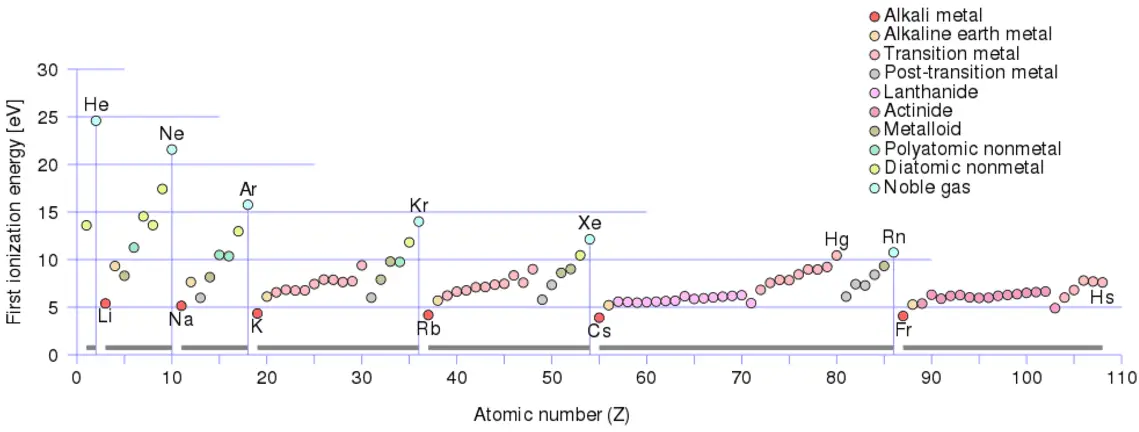
There is an ionization energy for each successive electron removed. The electrons that circle the nucleus move in fairly well-defined orbits. Some of these electrons are more tightly bound in the atom than others. For example, only 7.38 eV is required to remove the outermost electron from a lead atom, while 88,000 eV is required to remove the innermost electron. Helps to understand reactivity of elements (especially metals, which lose electrons).

In general, the ionization energy increases moving up a group and moving left to right across a period. Moreover:

  • Ionization energy is lowest for the alkali metals which have a single electron outside a closed shell.
  • Ionization energy increases across a row on the periodic maximum for the noble gases which have closed shells

For example, sodium requires only 496 kJ/mol or 5.14 eV/atom to ionize it. On the other hand neon, the noble gas, immediately preceding it in the periodic table, requires 2081 kJ/mol or 21.56 eV/atom.

Ionization energy
Source: wikipedia.org License: CC BY-SA 3.0

Periodic Table

Hydro­gen1H He­lium2He
Lith­ium3Li Beryl­lium4Be Boron5B Carbon6C Nitro­gen7N Oxy­gen8O Fluor­ine9F Neon10Ne
So­dium11Na Magne­sium12Mg Alumin­ium13Al Sili­con14Si Phos­phorus15P Sulfur16S Chlor­ine17Cl Argon18Ar
Potas­sium19K Cal­cium20Ca Scan­dium21Sc Tita­nium22Ti Vana­dium23V Chrom­ium24Cr Manga­nese25Mn Iron26Fe Cobalt27Co Nickel28Ni Copper29Cu Zinc30Zn Gallium31Ga Germa­nium32Ge Arsenic33As Sele­nium34Se Bromine35Br Kryp­ton36Kr
Rubid­ium37Rb Stront­ium38Sr Yttrium39Y Zirco­nium40Zr Nio­bium41Nb Molyb­denum42Mo Tech­netium43Tc Ruthe­nium44Ru Rho­dium45Rh Pallad­ium46Pd Silver47Ag Cad­mium48Cd Indium49In Tin50Sn Anti­mony51Sb Tellur­ium52Te Iodine53I Xenon54Xe
Cae­sium55Cs Ba­rium56Ba Lan­thanum57La 1 asterisk Haf­nium72Hf Tanta­lum73Ta Tung­sten74W Rhe­nium75Re Os­mium76Os Iridium77Ir Plat­inum78Pt Gold79Au Mer­cury80Hg Thallium81Tl Lead82Pb Bis­muth83Bi Polo­nium84Po Asta­tine85At Radon86Rn
Fran­cium87Fr Ra­dium88Ra Actin­ium89Ac 1 asterisk Ruther­fordium104Rf Dub­nium105Db Sea­borgium106Sg Bohr­ium107Bh Has­sium108Hs Meit­nerium109Mt Darm­stadtium110Ds Roent­genium111Rg Coper­nicium112Cn Nihon­ium113Nh Flerov­ium114Fl Moscov­ium115Mc Liver­morium116Lv Tenness­ine117Ts Oga­nesson118Og
1 asterisk Cerium58Ce Praseo­dymium59Pr Neo­dymium60Nd Prome­thium61Pm Sama­rium62Sm Europ­ium63Eu Gadolin­ium64Gd Ter­bium65Tb Dyspro­sium66Dy Hol­mium67Ho Erbium68Er Thulium69Tm Ytter­bium70Yb Lute­tium71Lu
1 asterisk Thor­ium90Th Protac­tinium91Pa Ura­nium92U Neptu­nium93Np Pluto­nium94Pu Ameri­cium95Am Curium96Cm Berkel­ium97Bk Califor­nium98Cf Einstei­nium99Es Fer­mium100Fm Mende­levium101Md Nobel­ium102No Lawren­cium103Lr

–
–

References:
Nuclear and Reactor Physics:
  1. J. R. Lamarsh, Introduction to Nuclear Reactor Theory, 2nd ed., Addison-Wesley, Reading, MA (1983).
  2. J. R. Lamarsh, A. J. Baratta, Introduction to Nuclear Engineering, 3d ed., Prentice-Hall, 2001, ISBN: 0-201-82498-1.
  3. W. M. Stacey, Nuclear Reactor Physics, John Wiley & Sons, 2001, ISBN: 0- 471-39127-1.
  4. Glasstone, Sesonske. Nuclear Reactor Engineering: Reactor Systems Engineering, Springer; 4th edition, 1994, ISBN: 978-0412985317
  5. W.S.C. Williams. Nuclear and Particle Physics. Clarendon Press; 1 edition, 1991, ISBN: 978-0198520467
  6. G.R.Keepin. Physics of Nuclear Kinetics. Addison-Wesley Pub. Co; 1st edition, 1965
  7. Robert Reed Burn, Introduction to Nuclear Reactor Operation, 1988.
  8. U.S. Department of Energy, Nuclear Physics and Reactor Theory. DOE Fundamentals Handbook, Volume 1 and 2. January 1993.
  9. Paul Reuss, Neutron Physics. EDP Sciences, 2008. ISBN: 978-2759800414.

Advanced Reactor Physics:

  1. K. O. Ott, W. A. Bezella, Introductory Nuclear Reactor Statics, American Nuclear Society, Revised edition (1989), 1989, ISBN: 0-894-48033-2.
  2. K. O. Ott, R. J. Neuhold, Introductory Nuclear Reactor Dynamics, American Nuclear Society, 1985, ISBN: 0-894-48029-4.
  3. D. L. Hetrick, Dynamics of Nuclear Reactors, American Nuclear Society, 1993, ISBN: 0-894-48453-2.
  4. E. E. Lewis, W. F. Miller, Computational Methods of Neutron Transport, American Nuclear Society, 1993, ISBN: 0-894-48452-4.

See also:

Chemical Properties

We hope, this article, Ionization Energy – Ionization Potential, helps you. If so, give us a like in the sidebar. Main purpose of this website is to help the public to learn some interesting and important information about radiation and dosimeters.

What is Periodic Table – Definition

The periodic table is a tabular arrangement of the chemical elements. It is organized in order of increasing atomic number. There is a recurring pattern called the “periodic law” in their properties, in which elements in the same column (group) have similar properties. Periodic Table

Periodic Table

The periodic table is a tabular arrangement of the chemical elements. It is organized in order of increasing atomic number. There is a recurring pattern called the “periodic law” in their properties, in which elements in the same column (group) have similar properties. Generally, within one row (period) the elements are metals to the left, and non-metals to the right, with the elements having similar chemical behaviours placed in the same column.

Every solid, liquid, gas, and plasma is composed of neutral or ionized atoms. The chemical properties of the atom are determined by the number of protons, in fact, by number and arrangement of electrons. The configuration of these electrons follows from the principles of quantum mechanics. The number of electrons in each element’s electron shells, particularly the outermost valence shell, is the primary factor in determining its chemical bonding behavior. In the periodic table, the elements are listed in order of increasing atomic number Z.

The total number of protons in the nucleus of an atom is called the atomic number (or the proton number) of the atom and is given the symbol Z. The number of electrons in an electrically-neutral atom is the same as the number of protons in the nucleus. The total electrical charge of the nucleus is therefore +Ze, where e (elementary charge) equals to 1,602 x 10-19coulombs. Each electron is influenced by the electric fields produced by the positive nuclear charge and the other (Z – 1) negative electrons in the atom.

It is the Pauli exclusion principle that requires the electrons in an atom to occupy different energy levels instead of them all condensing in the ground state. The ordering of the electrons in the ground state of multielectron atoms, starts with the lowest energy state (ground state) and moves progressively from there up the energy scale until each of the atom’s electrons has been assigned a unique set of quantum numbers. This fact has key implications for the building up of the periodic table of elements.

Periodic Table

Hydro­gen1H He­lium2He
Lith­ium3Li Beryl­lium4Be Boron5B Carbon6C Nitro­gen7N Oxy­gen8O Fluor­ine9F Neon10Ne
So­dium11Na Magne­sium12Mg Alumin­ium13Al Sili­con14Si Phos­phorus15P Sulfur16S Chlor­ine17Cl Argon18Ar
Potas­sium19K Cal­cium20Ca Scan­dium21Sc Tita­nium22Ti Vana­dium23V Chrom­ium24Cr Manga­nese25Mn Iron26Fe Cobalt27Co Nickel28Ni Copper29Cu Zinc30Zn Gallium31Ga Germa­nium32Ge Arsenic33As Sele­nium34Se Bromine35Br Kryp­ton36Kr
Rubid­ium37Rb Stront­ium38Sr Yttrium39Y Zirco­nium40Zr Nio­bium41Nb Molyb­denum42Mo Tech­netium43Tc Ruthe­nium44Ru Rho­dium45Rh Pallad­ium46Pd Silver47Ag Cad­mium48Cd Indium49In Tin50Sn Anti­mony51Sb Tellur­ium52Te Iodine53I Xenon54Xe
Cae­sium55Cs Ba­rium56Ba Lan­thanum57La 1 asterisk Haf­nium72Hf Tanta­lum73Ta Tung­sten74W Rhe­nium75Re Os­mium76Os Iridium77Ir Plat­inum78Pt Gold79Au Mer­cury80Hg Thallium81Tl Lead82Pb Bis­muth83Bi Polo­nium84Po Asta­tine85At Radon86Rn
Fran­cium87Fr Ra­dium88Ra Actin­ium89Ac 1 asterisk Ruther­fordium104Rf Dub­nium105Db Sea­borgium106Sg Bohr­ium107Bh Has­sium108Hs Meit­nerium109Mt Darm­stadtium110Ds Roent­genium111Rg Coper­nicium112Cn Nihon­ium113Nh Flerov­ium114Fl Moscov­ium115Mc Liver­morium116Lv Tenness­ine117Ts Oga­nesson118Og
1 asterisk Cerium58Ce Praseo­dymium59Pr Neo­dymium60Nd Prome­thium61Pm Sama­rium62Sm Europ­ium63Eu Gadolin­ium64Gd Ter­bium65Tb Dyspro­sium66Dy Hol­mium67Ho Erbium68Er Thulium69Tm Ytter­bium70Yb Lute­tium71Lu
1 asterisk Thor­ium90Th Protac­tinium91Pa Ura­nium92U Neptu­nium93Np Pluto­nium94Pu Ameri­cium95Am Curium96Cm Berkel­ium97Bk Califor­nium98Cf Einstei­nium99Es Fer­mium100Fm Mende­levium101Md Nobel­ium102No Lawren­cium103Lr

–
–

References:
Nuclear and Reactor Physics:
  1. J. R. Lamarsh, Introduction to Nuclear Reactor Theory, 2nd ed., Addison-Wesley, Reading, MA (1983).
  2. J. R. Lamarsh, A. J. Baratta, Introduction to Nuclear Engineering, 3d ed., Prentice-Hall, 2001, ISBN: 0-201-82498-1.
  3. W. M. Stacey, Nuclear Reactor Physics, John Wiley & Sons, 2001, ISBN: 0- 471-39127-1.
  4. Glasstone, Sesonske. Nuclear Reactor Engineering: Reactor Systems Engineering, Springer; 4th edition, 1994, ISBN: 978-0412985317
  5. W.S.C. Williams. Nuclear and Particle Physics. Clarendon Press; 1 edition, 1991, ISBN: 978-0198520467
  6. G.R.Keepin. Physics of Nuclear Kinetics. Addison-Wesley Pub. Co; 1st edition, 1965
  7. Robert Reed Burn, Introduction to Nuclear Reactor Operation, 1988.
  8. U.S. Department of Energy, Nuclear Physics and Reactor Theory. DOE Fundamentals Handbook, Volume 1 and 2. January 1993.
  9. Paul Reuss, Neutron Physics. EDP Sciences, 2008. ISBN: 978-2759800414.

Advanced Reactor Physics:

  1. K. O. Ott, W. A. Bezella, Introductory Nuclear Reactor Statics, American Nuclear Society, Revised edition (1989), 1989, ISBN: 0-894-48033-2.
  2. K. O. Ott, R. J. Neuhold, Introductory Nuclear Reactor Dynamics, American Nuclear Society, 1985, ISBN: 0-894-48029-4.
  3. D. L. Hetrick, Dynamics of Nuclear Reactors, American Nuclear Society, 1993, ISBN: 0-894-48453-2.
  4. E. E. Lewis, W. F. Miller, Computational Methods of Neutron Transport, American Nuclear Society, 1993, ISBN: 0-894-48452-4.

See also:

Chemical Properties

We hope, this article, Periodic Table, helps you. If so, give us a like in the sidebar. Main purpose of this website is to help the public to learn some interesting and important information about radiation and dosimeters.

What is Radiation Protection – Definition

Radiation protection is the science and practice of protecting people and the environment from the harmful effects of ionizing radiation. According to the ICRP, the System of Radiological Protection is based on the following three principles: justification, optimisation of protection and dose limitation. Periodic Table
ionizing radiation - hazard symbol
ionizing radiation – hazard symbol

Radiation protection is the science and practice of protecting people and the environment from the harmful effects of ionizing radiation. The International Atomic Energy Agency (IAEA) defines radiation protection as:

“The protection of people from harmful effects of exposure to ionizing radiation, and the means for achieving this”

It is a serious topic not only in nuclear power plants, but also in industry or in medical centres. According to the IAEA, radiation protection can be divided into three groups:

  • occupational radiation protection, which is the protection of workers in situations where their exposure is directly related to or required by their work
  • medical radiation protection, which is the protection of patients exposed to radiation as part of their diagnosis or treatment
  • public radiation protection, which is the protection of individual members of the public and of the population in general

According to the ICRP (Publication 103), the System of Radiological Protection is based on the following three principles:

  1. Justification. “Any decision that alters the radiation exposure situation should do more good than harm.”
  2. Optimisation of Protection. “Doses should all be kept as low as reasonably achievable, taking into account economic and societal factors.” (known as ALARA or ALARP)
  3. Dose Limitation. “The total dose to any individual … should not exceed the appropriate limits.”

See also: ICRP, 2007. The 2007 Recommendations of the International Commission on Radiological Protection. ICRP Publication 103. Ann. ICRP 37 (2-4).

The International Commission on Radiological Protection (ICRP) is an independent, international, non-governmental organization created by the 1928 International Congress of Radiology to advance for the public benefit the science of radiological protection. The ICRP is a sister organisation to the International Commission on Radiation Units and Measurements (ICRU), which is a standardization body and develop concepts, definitions and recommendations for the use of quantities and their units for ionizing radiation and its interaction with matter, in particular with respect to the biological effects induced by radiation.

What is Radiation
Most general definition of radiation is that radiation is energy that comes from a source and travels through some material or through space. This is very general definition, the kind of radiation discussed in this article is called ionizing radiation. Ionizing radiation is characterized by the kinetic energy of particles (photons, electrons, etc.) of ionizing radiation is sufficient and the particle can ionize (to form ion by losing electrons) target atoms to form ions. Simply ionizing radiation can knock electrons from an atom.

External Dose Uptake

External exposure is radiation that comes from outside our body and interacts with us. In this case, we analyze predominantly exposure from gamma rays, since alpha and beta particles, in general, constitute no external exposure hazard because the particles generally do not pass through skin. The source of radiation can be, for example, a piece of equipment that produces the radiation like a container with a radioactive materials, or like an x-ray machine. In radiation protection there are three ways how to protect people from identified external radiation sources:

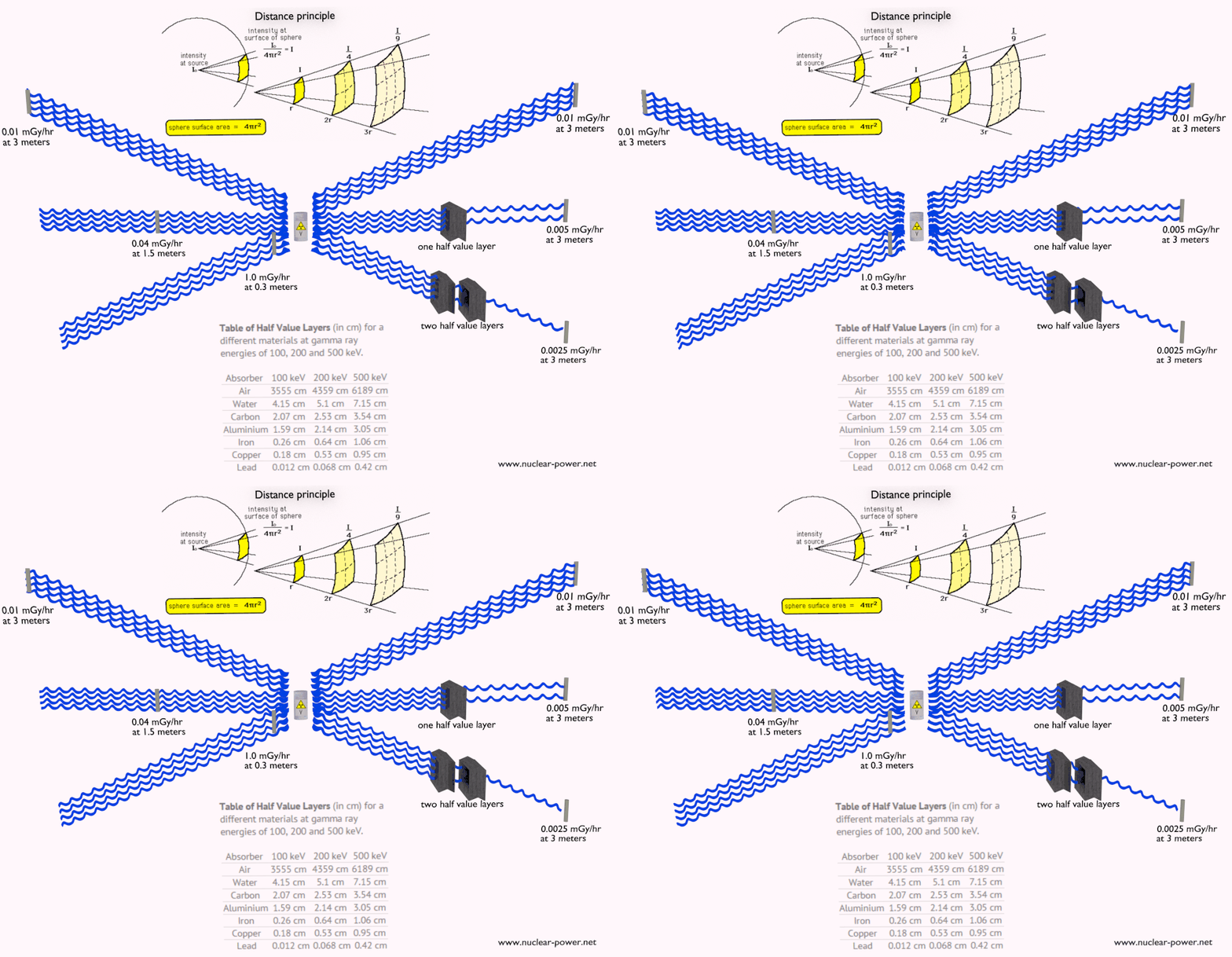
  • radiation protection pronciples - time, distance, shielding
    Principles of Radiation Protection – Time, Distance, Shielding

    Limiting Time. The amount of radiation exposure depends directly (linearly) on the time people spend near the source of radiation. The dose can be reduced by limiting exposure time.

  • Distance. The amount of radiation exposure depends on the distance from the source of radiation. Similarly to a heat from a fire, if you are too close, the intensity of heat radiation is high and you can get burned. If you are at the right distance, you can withstand there without any problems and moreover it is comfortable. If you are too far from heat source, the insufficiency of heat can also hurt you. This analogy, in a certain sense, can be applied to radiation also from radiation sources.
  • Shielding. Finally, if the source is too intensive and time or distance do not provide sufficient radiation protection, the shielding must be used. Radiation shielding usually consist of barriers of lead, concrete or water. There are many many materials, which can be used for radiation shielding, but there are many many situations in radiation protection. It highly depends on the type of radiation to be shielded, its energy and many other parametres. For example, even depleted uranium can be used as a good protection from gamma radiation, but on the other hand uranium is absolutely inappropriate shielding of neutron radiation.

Internal Dose Uptake

If the source of radiation is inside our body, we say, it is internal exposure. The intake of radioactive material can occur through various pathways such as ingestion of radioactive contamination in food or liquids. Protection from internal exposure is more complicated. Most radionuclides will give you much more radiation dose if they can somehow enter your body, than they would if they remained outside.

Public Exposure and Nuclear Power Plants

It must be noted, radiation is all around us. In, around, and above the world we live in. It is a part of our natural world that has been here since the birth of our planet. There are radioactive isotopes in our bodies, houses, air, water and in the ground – and we are exposed to radiation from outer space. This radiation is called the natural background radiation.

Exposure from nuclear power plants and its fuel cycle belongs to man-made sources of radiation. By far, the most significant source of man-made radiation exposure to the public is from medical procedures, such as diagnostic X-rays and nuclear medicine. Moreover, according to the United Nations Scientific Committee on the Effects of Atomic Radiation (UNSCEAR), public exposure to radiation resulting from the generation of electricity by nuclear power plants is just a fraction of that from coal-powered plants.

See also: SOURCES, EFFECTS AND RISKS OF IONIZING RADIATION, UNSCEAR 2016. ISBN: 978-92-1-142316-7.

References:

Radiation Protection:

  1. Knoll, Glenn F., Radiation Detection and Measurement 4th Edition, Wiley, 8/2010. ISBN-13: 978-0470131480.
  2. Stabin, Michael G., Radiation Protection and Dosimetry: An Introduction to Health Physics, Springer, 10/2010. ISBN-13: 978-1441923912.
  3. Martin, James E., Physics for Radiation Protection 3rd Edition, Wiley-VCH, 4/2013. ISBN-13: 978-3527411764.
  4. U.S.NRC, NUCLEAR REACTOR CONCEPTS
  5. U.S. Department of Energy, Nuclear Physics and Reactor Theory. DOE Fundamentals Handbook, Volume 1 and 2. January 1993.

Nuclear and Reactor Physics:

  1. J. R. Lamarsh, Introduction to Nuclear Reactor Theory, 2nd ed., Addison-Wesley, Reading, MA (1983).
  2. J. R. Lamarsh, A. J. Baratta, Introduction to Nuclear Engineering, 3d ed., Prentice-Hall, 2001, ISBN: 0-201-82498-1.
  3. W. M. Stacey, Nuclear Reactor Physics, John Wiley & Sons, 2001, ISBN: 0- 471-39127-1.
  4. Glasstone, Sesonske. Nuclear Reactor Engineering: Reactor Systems Engineering, Springer; 4th edition, 1994, ISBN: 978-0412985317
  5. W.S.C. Williams. Nuclear and Particle Physics. Clarendon Press; 1 edition, 1991, ISBN: 978-0198520467
  6. G.R.Keepin. Physics of Nuclear Kinetics. Addison-Wesley Pub. Co; 1st edition, 1965
  7. Robert Reed Burn, Introduction to Nuclear Reactor Operation, 1988.
  8. U.S. Department of Energy, Nuclear Physics and Reactor Theory. DOE Fundamentals Handbook, Volume 1 and 2. January 1993.
  9. Paul Reuss, Neutron Physics. EDP Sciences, 2008. ISBN: 978-2759800414.

See also:

Nuclear Engineering

We hope, this article, Radiation Protection, helps you. If so, give us a like in the sidebar. Main purpose of this website is to help the public to learn some interesting and important information about radiation and dosimeters.