What is Exothermic Reaction – Definition

The positive Q reactions are said to be exothermic (or exergic). Exothermic reactions release energy. For example fusion reaction or fission reaction. Periodic Table

Exothermic Reactions
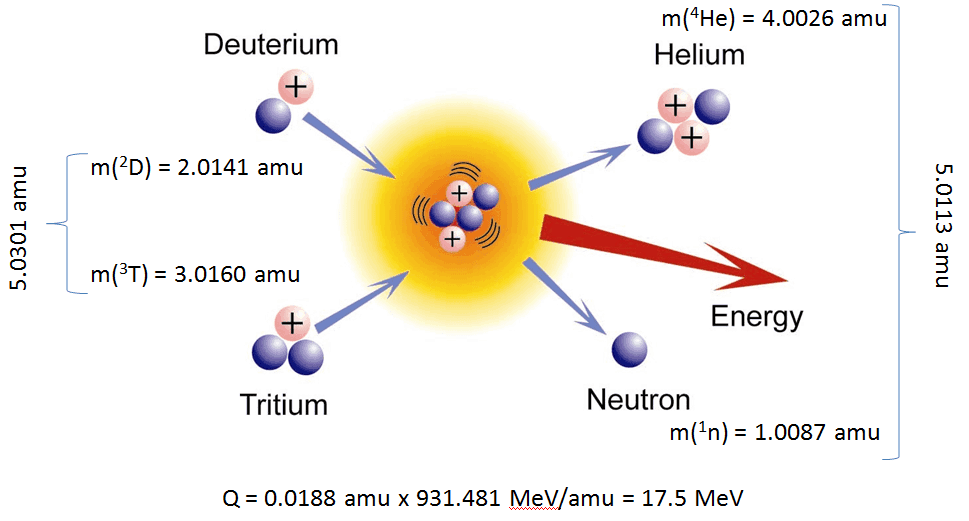
Q-value of DT fusion reaction

In nuclear and particle physics the energetics of nuclear reactions is determined by the Q-value of that reaction. The Q-value of the reaction is defined as the difference between the sum of the masses of the initial reactants and the sum of the masses of the final products, in energy units (usually in MeV).

Consider a typical reaction, in which the projectile a and the target A gives place to two products, B and b. This can also be expressed in the notation that we used so far, a + A → B + b, or even in a more compact notation, A(a,b)B.

See also: E=mc2

The Q-value of this reaction is given by:

Q = [ma + mA – (mb + mB)]c2

which is the same as the excess kinetic energy of the final products:

Q = Tfinal – Tinitial

   = Tb + TB – (Ta + TA)

For reactions in which there is an increase in the kinetic energy of the products Q is positive. The positive Q reactions are said to be exothermic (or exergic). There is a net release of energy, since the kinetic energy of the final state is greater than the kinetic energy of the initial state.

See also: Q-value Calculator

Example of Exothermic Reaction – Nuclear Fission
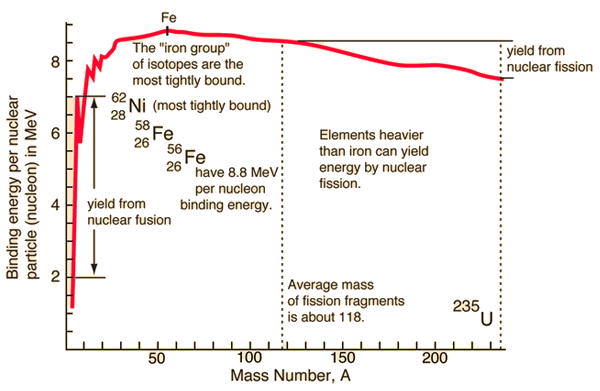
Nuclear binding energy curve.
Source: hyperphysics.phy-astr.gsu.edu

Nuclear fission is a nuclear reaction in which the nucleus of an atom splits into smaller parts (lighter nuclei). The fission process often produces free neutrons and photons (in the form of gamma rays), and releases a large amount of energy.

From the nuclear binding energy curve and from the table it can be seen that, in the case of splitting a 235U nucleus into two parts, the binding energy of the fragments (A ≈ 120) together is larger than that of the original 235U nucleus. According to the Weizsaecker formula, the total energy released for such reaction will be approximately 235 x (8.5 – 7.6) ≈ 200 MeV (it can also be derived from nuclear binding curve).

The total energy released in a reactor per 235U fission is distributed as shown in the table.
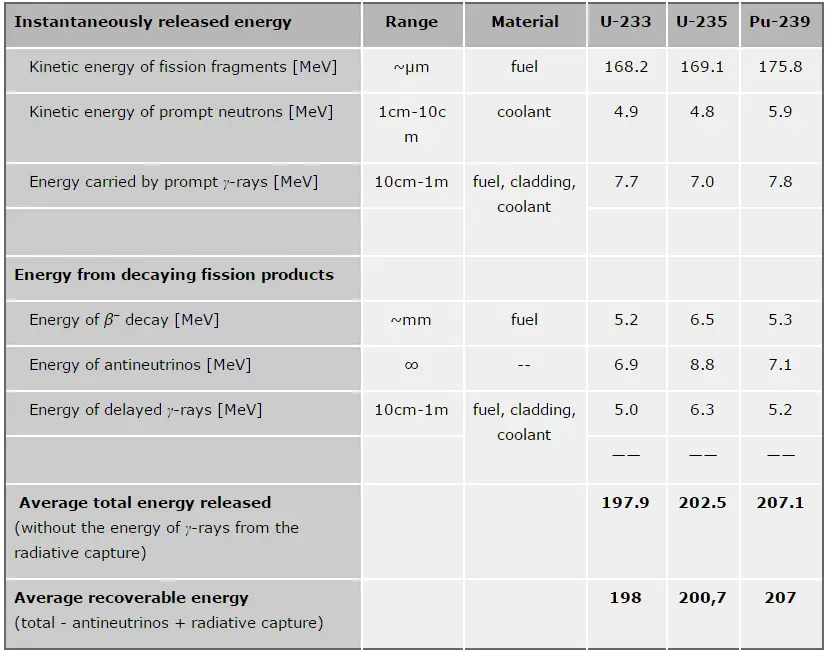
Energy release per fission

Example of Exothermic Reaction – DT fusion

The DT fusion reaction of deuterium and tritium is particularly interesting because of its potential of providing energy for the future. Calculate the reaction Q-value.

3T (d, n) 4He

The atom masses of the reactants and products are:

m(3T) = 3.0160 amu

m(2D) = 2.0141 amu

m(1n) = 1.0087 amu

m(4He) = 4.0026 amu

Using the mass-energy equivalence, we get the Q-value of this reaction as:

Q = {(3.0160+2.0141) [amu] – (1.0087+4.0026) [amu]} x 931.481 [MeV/amu]

= 0.0188 x 931.481 = 17.5 MeV

Example of Exothermic Reaction – Tritium in Reactors

Cross-section of 10B(n,2alpha)T reaction.

Tritium is a byproduct in nuclear reactors. Most of the tritium produced in nuclear power plants stems from the boric acid, which is commonly used as a chemical shim to compensate an excess of initial reactivity. Main reaction, in which the tritium is generated from boron is below:

10B(n,2*alpha)T

This reaction of a neutron with an isotope 10B is the main way, how radioactive tritium in primary circuit of all PWRs is generated. Note that, this reaction is a threshold reaction due to its cross-section.

Calculate the reaction Q-value.

The atom masses of the reactants and products are:

m(10B) = 10.01294 amu

m(1n) = 1.00866 amu

m(3T) = 3.01604 amu

m(4He) = 4.0026 amu

Using the mass-energy equivalence, we get the Q-value of this reaction as:

Q = {(10.0129+1.00866) [amu] – (3.01604+2 x 4.0026) [amu]} x 931.481 [MeV/amu]

= 0.00036 x 931.481 = 0.335 MeV

 
References:
Nuclear and Reactor Physics:
  1. J. R. Lamarsh, Introduction to Nuclear Reactor Theory, 2nd ed., Addison-Wesley, Reading, MA (1983).
  2. J. R. Lamarsh, A. J. Baratta, Introduction to Nuclear Engineering, 3d ed., Prentice-Hall, 2001, ISBN: 0-201-82498-1.
  3. W. M. Stacey, Nuclear Reactor Physics, John Wiley & Sons, 2001, ISBN: 0- 471-39127-1.
  4. Glasstone, Sesonske. Nuclear Reactor Engineering: Reactor Systems Engineering, Springer; 4th edition, 1994, ISBN: 978-0412985317
  5. W.S.C. Williams. Nuclear and Particle Physics. Clarendon Press; 1 edition, 1991, ISBN: 978-0198520467
  6. Kenneth S. Krane. Introductory Nuclear Physics, 3rd Edition, Wiley, 1987, ISBN: 978-0471805533
  7. G.R.Keepin. Physics of Nuclear Kinetics. Addison-Wesley Pub. Co; 1st edition, 1965
  8. Robert Reed Burn, Introduction to Nuclear Reactor Operation, 1988.
  9. U.S. Department of Energy, Nuclear Physics and Reactor Theory. DOE Fundamentals Handbook, Volume 1 and 2. January 1993.

Advanced Reactor Physics:

  1. K. O. Ott, W. A. Bezella, Introductory Nuclear Reactor Statics, American Nuclear Society, Revised edition (1989), 1989, ISBN: 0-894-48033-2.
  2. K. O. Ott, R. J. Neuhold, Introductory Nuclear Reactor Dynamics, American Nuclear Society, 1985, ISBN: 0-894-48029-4.
  3. D. L. Hetrick, Dynamics of Nuclear Reactors, American Nuclear Society, 1993, ISBN: 0-894-48453-2.
  4. E. E. Lewis, W. F. Miller, Computational Methods of Neutron Transport, American Nuclear Society, 1993, ISBN: 0-894-48452-4.

See also:

Nuclear Reactions

We hope, this article, Exothermic Reaction, helps you. If so, give us a like in the sidebar. Main purpose of this website is to help the public to learn some interesting and important information about radiation and dosimeters.
What is Endothermic Reaction – Definition

The negative Q reactions are said to be endothermic (or endoergic) and they require a net energy input. Production of photoneutrons is an example endothermic reaction. Periodic Table

Endothermic Reactions

In nuclear and particle physics the energetics of nuclear reactions is determined by the Q-value of that reaction. The Q-value of the reaction is defined as the difference between the sum of the masses of the initial reactants and the sum of the masses of the final products, in energy units (usually in MeV).

Consider a typical reaction, in which the projectile a and the target A gives place to two products, B and b. This can also be expressed in the notation that we used so far, a + A → B + b, or even in a more compact notation, A(a,b)B.

See also: E=mc2

The Q-value of this reaction is given by:

Q = [ma + mA – (mb + mB)]c2

which is the same as the excess kinetic energy of the final products:

Q = Tfinal – Tinitial

   = Tb + TB – (Ta + TA)

For reactions in which there is a decrease in the kinetic energy of the products Q is negative. The negative Q reactions are said to be endothermic (or endoergic) and they require a net energy input.

See also: Q-value Calculator

Example of Endothermic Reaction – Photoneutrons

In nuclear reactors the gamma radiation plays a significant role also in reactor kinetics and in a subcriticality control. Especially in nuclear reactors with D2O moderator (CANDU reactors) or with Be reflectors (some experimental reactors). Neutrons can be produced also in (γ, n) reactions and therefore they are usually referred to as photoneutrons.

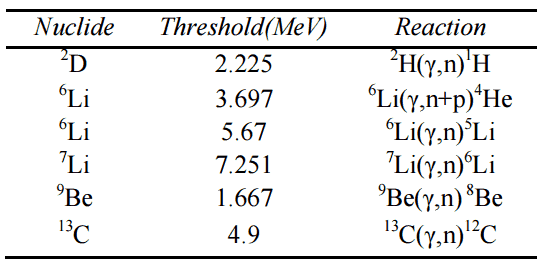
A high energy photon (gamma ray) can under certain conditions eject a neutron from a nucleus. It occurs when its energy exceeds the binding energy of the neutron in the nucleus. Most nuclei have binding energies in excess of 6 MeV, which is above the energy of most gamma rays from fission. On the other hand there are few nuclei with sufficiently low binding energy to be of practical interest. These are: 2D, 9Be, 6Li, 7Li and 13C. As can be seen from the table the lowest threshold have 9Be with 1.666 MeV and 2D with 2.226 MeV.

Photoneutron sources
Nuclides with low photodisintegration
threshold energies.

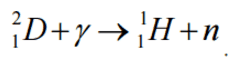
In case of deuterium, neutrons can be produced by the interaction of gamma rays (with a minimum energy of 2.22 MeV) with deuterium:

Photoneutron - deuterium

The reaction Q-value is calculated below:

The atom masses of the reactant and products are:

m(2D) = 2.01363 amu

m(1n) = 1.00866 amu

m(1H) = 1.00728 amu

Using the mass-energy equivalence, we get the Q-value of this reaction as:

Q = {2.01363 [amu] – (1.00866+1.00728) [amu]} x 931.481 [MeV/amu]

= -0.00231 x 931.481 = -2.15 MeV

Example: Endothermic Reaction – (α,n) reaction

Calculate the reaction Q-value of the following reaction:

7Li (α, n) 10B

The atom masses of the reactants and products are:

m(4He) = 4.0026 amu

m(7Li) = 7.0160 amu

m(1n) = 1.0087 amu

m(10B) = 10.01294 amu

Using the mass-energy equivalence, we get the Q-value of this reaction as:

Q = {(7.0160+4.0026) [amu] – (1.0087+10.01294) [amu]} x 931.481 [MeV/amu]

= 0.00304 x 931.481 = -2.83 MeV

 
References:
Nuclear and Reactor Physics:
  1. J. R. Lamarsh, Introduction to Nuclear Reactor Theory, 2nd ed., Addison-Wesley, Reading, MA (1983).
  2. J. R. Lamarsh, A. J. Baratta, Introduction to Nuclear Engineering, 3d ed., Prentice-Hall, 2001, ISBN: 0-201-82498-1.
  3. W. M. Stacey, Nuclear Reactor Physics, John Wiley & Sons, 2001, ISBN: 0- 471-39127-1.
  4. Glasstone, Sesonske. Nuclear Reactor Engineering: Reactor Systems Engineering, Springer; 4th edition, 1994, ISBN: 978-0412985317
  5. W.S.C. Williams. Nuclear and Particle Physics. Clarendon Press; 1 edition, 1991, ISBN: 978-0198520467
  6. Kenneth S. Krane. Introductory Nuclear Physics, 3rd Edition, Wiley, 1987, ISBN: 978-0471805533
  7. G.R.Keepin. Physics of Nuclear Kinetics. Addison-Wesley Pub. Co; 1st edition, 1965
  8. Robert Reed Burn, Introduction to Nuclear Reactor Operation, 1988.
  9. U.S. Department of Energy, Nuclear Physics and Reactor Theory. DOE Fundamentals Handbook, Volume 1 and 2. January 1993.

Advanced Reactor Physics:

  1. K. O. Ott, W. A. Bezella, Introductory Nuclear Reactor Statics, American Nuclear Society, Revised edition (1989), 1989, ISBN: 0-894-48033-2.
  2. K. O. Ott, R. J. Neuhold, Introductory Nuclear Reactor Dynamics, American Nuclear Society, 1985, ISBN: 0-894-48029-4.
  3. D. L. Hetrick, Dynamics of Nuclear Reactors, American Nuclear Society, 1993, ISBN: 0-894-48453-2.
  4. E. E. Lewis, W. F. Miller, Computational Methods of Neutron Transport, American Nuclear Society, 1993, ISBN: 0-894-48452-4.

See also:

Nuclear Reactions

We hope, this article, Endothermic Reaction, helps you. If so, give us a like in the sidebar. Main purpose of this website is to help the public to learn some interesting and important information about radiation and dosimeters.
What is Exothermic vs. Endothermic Reaction – Definition

Exothermic vs. Endothermic Reaction. The positive Q reactions are said to be exothermic (or exergic). The negative Q reactions are said to be endothermic (or endoergic). Periodic Table

Exothermic vs. Endothermic Reactions

For reactions in which there is an increase in the kinetic energy of the products Q is positive. The positive Q reactions are said to be exothermic (or exergic). There is a net release of energy, since the kinetic energy of the final state is greater than the kinetic energy of the initial state.

For reactions in which there is a decrease in the kinetic energy of the products Q is negative. The negative Q reactions are said to be endothermic (or endoergic) and they require a net energy input.

The Q-value of this reaction is given by:

Q = [ma + mA – (mb + mB)]c2

which is the same as the excess kinetic energy of the final products:

Q = Tfinal – Tinitial

   = Tb + TB – (Ta + TA)

See also: Q-value Calculator

See also: E=mc2

Exothermic Reactions

Exothermic Reaction - DT fusion
Q-value of DT fusion reaction

The DT fusion reaction of deuterium and tritium is particularly interesting because of its potential of providing energy for the future. Calculate the reaction Q-value.

3T (d, n) 4He

The atom masses of the reactants and products are:

m(3T) = 3.0160 amu

m(2D) = 2.0141 amu

m(1n) = 1.0087 amu

m(4He) = 4.0026 amu

Using the mass-energy equivalence, we get the Q-value of this reaction as:

Q = {(3.0160+2.0141) [amu] – (1.0087+4.0026) [amu]} x 931.481 [MeV/amu]

= 0.0188 x 931.481 = 17.5 MeV

Exothermic Reaction - Tritium
Cross-section of 10B(n,2alpha)T reaction.

Tritium is a byproduct in nuclear reactors. Most of the tritium produced in nuclear power plants stems from the boric acid, which is commonly used as a chemical shim to compensate an excess of initial reactivity. Main reaction, in which the tritium is generated from boron is below:

10B(n,2*alpha)T

This reaction of a neutron with an isotope 10B is the main way, how radioactive tritium in primary circuit of all PWRs is generated. Note that, this reaction is a threshold reaction due to its cross-section.

Calculate the reaction Q-value.

The atom masses of the reactants and products are:

m(10B) = 10.01294 amu

m(1n) = 1.00866 amu

m(3T) = 3.01604 amu

m(4He) = 4.0026 amu

Using the mass-energy equivalence, we get the Q-value of this reaction as:

Q = {(10.0129+1.00866) [amu] – (3.01604+2 x 4.0026) [amu]} x 931.481 [MeV/amu]

= 0.00036 x 931.481 = 0.335 MeV

[/su_accordion]

Endothermic Reactions

Endothermic Reaction - Photoneutrons
In nuclear reactors the gamma radiation plays a significant role also in reactor kinetics and in a subcriticality control. Especially in nuclear reactors with D2O moderator (CANDU reactors) or with Be reflectors (some experimental reactors). Neutrons can be produced also in (γ, n) reactions and therefore they are usually referred to as photoneutrons.

A high energy photon (gamma ray) can under certain conditions eject a neutron from a nucleus. It occurs when its energy exceeds the binding energy of the neutron in the nucleus. Most nuclei have binding energies in excess of 6 MeV, which is above the energy of most gamma rays from fission. On the other hand there are few nuclei with sufficiently low binding energy to be of practical interest. These are: 2D, 9Be, 6Li, 7Li and 13C. As can be seen from the table the lowest threshold have 9Be with 1.666 MeV and 2D with 2.226 MeV.

Photoneutron sources
Nuclides with low photodisintegration
threshold energies.

In case of deuterium, neutrons can be produced by the interaction of gamma rays (with a minimum energy of 2.22 MeV) with deuterium:

Photoneutron - deuterium

The reaction Q-value is calculated below:

The atom masses of the reactant and products are:

m(2D) = 2.01363 amu

m(1n) = 1.00866 amu

m(1H) = 1.00728 amu

Using the mass-energy equivalence, we get the Q-value of this reaction as:

Q = {2.01363 [amu] – (1.00866+1.00728) [amu]} x 931.481 [MeV/amu]

= -0.00231 x 931.481 = -2.15 MeV

Endothermic Reaction - (α,n) reaction
Calculate the reaction Q-value of the following reaction:

7Li (α, n) 10B

The atom masses of the reactants and products are:

m(4He) = 4.0026 amu

m(7Li) = 7.0160 amu

m(1n) = 1.0087 amu

m(10B) = 10.01294 amu

Using the mass-energy equivalence, we get the Q-value of this reaction as:

Q = {(7.0160+4.0026) [amu] – (1.0087+10.01294) [amu]} x 931.481 [MeV/amu]

= 0.00304 x 931.481 = -2.83 MeV

[/su_accordion]
 
References:
Nuclear and Reactor Physics:
  1. J. R. Lamarsh, Introduction to Nuclear Reactor Theory, 2nd ed., Addison-Wesley, Reading, MA (1983).
  2. J. R. Lamarsh, A. J. Baratta, Introduction to Nuclear Engineering, 3d ed., Prentice-Hall, 2001, ISBN: 0-201-82498-1.
  3. W. M. Stacey, Nuclear Reactor Physics, John Wiley & Sons, 2001, ISBN: 0- 471-39127-1.
  4. Glasstone, Sesonske. Nuclear Reactor Engineering: Reactor Systems Engineering, Springer; 4th edition, 1994, ISBN: 978-0412985317
  5. W.S.C. Williams. Nuclear and Particle Physics. Clarendon Press; 1 edition, 1991, ISBN: 978-0198520467
  6. Kenneth S. Krane. Introductory Nuclear Physics, 3rd Edition, Wiley, 1987, ISBN: 978-0471805533
  7. G.R.Keepin. Physics of Nuclear Kinetics. Addison-Wesley Pub. Co; 1st edition, 1965
  8. Robert Reed Burn, Introduction to Nuclear Reactor Operation, 1988.
  9. U.S. Department of Energy, Nuclear Physics and Reactor Theory. DOE Fundamentals Handbook, Volume 1 and 2. January 1993.

Advanced Reactor Physics:

  1. K. O. Ott, W. A. Bezella, Introductory Nuclear Reactor Statics, American Nuclear Society, Revised edition (1989), 1989, ISBN: 0-894-48033-2.
  2. K. O. Ott, R. J. Neuhold, Introductory Nuclear Reactor Dynamics, American Nuclear Society, 1985, ISBN: 0-894-48029-4.
  3. D. L. Hetrick, Dynamics of Nuclear Reactors, American Nuclear Society, 1993, ISBN: 0-894-48453-2.
  4. E. E. Lewis, W. F. Miller, Computational Methods of Neutron Transport, American Nuclear Society, 1993, ISBN: 0-894-48452-4.

See also:

Nuclear Reactions

We hope, this article, Exothermic vs. Endothermic Reaction, helps you. If so, give us a like in the sidebar. Main purpose of this website is to help the public to learn some interesting and important information about radiation and dosimeters.

What is Law of Conservation of Matter – Definition

The law of conservation of matter / mass. The law of conservation of matter or principle of mass conservation states that the mass can neither be created nor destroyed. Periodic Table

The Law of Conservation of Matter – Conservation of Mass

The law of conservation of matter or principle of matter conservation states that the mass of an object or collection of objects never changes over time, no matter how the constituent parts rearrange themselves.

The mass can neither be created nor destroyed.

The law requires that during any nuclear reaction, radioactive decay or chemical reaction in an isolated system, the total mass of the reactants or starting materials must be equal to the mass of the products.

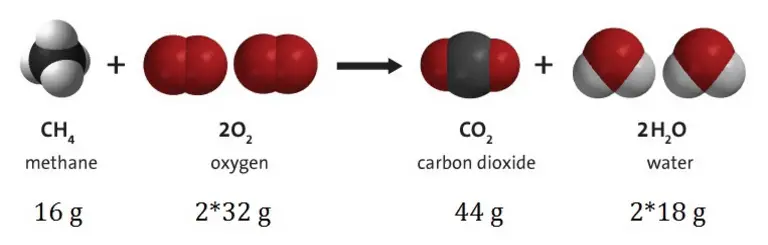
The concept of mass conservation is widely used in many fields such as chemistry, mechanics, and fluid dynamics. In chemistry the law of conservation of matter may be explained in the following way (see the picture of combustion of methane). The masses of a methane and oxygen together must be equal to the masses of carbon dioxide and water. In other words, during a chemical reaction, everything you start with, you must end up with, but it might look different.
Law of Conservation of Matter

Historically, already the ancient Greeks proposed the idea that the total amount of matter in the universe is constant. The principle of conservation of mass was first outlined by Mikhail Lomonosov in 1748. However, the law of conservation of matter (or the principle of mass/matter conservation) as a fundamental principle of physics was discovered in by Antoine Lavoisier in the late 18th century. It was of great importance in progressing from alchemy to modern chemistry. Before this discovery, there were questions like:

  • Why a piece of wood weighs less after burning?
  • Can a matter or some of its part disappear?

In the case of burned wood the problem was the measurement of the weight of released gases. Measurements of the weight of released gases was complicated, because of the buoyancy effect of the Earth’s atmosphere on the weight of gases. Once understood, the conservation of matter was of crucial importance in the progress from alchemy to the modern natural science of chemistry.

 
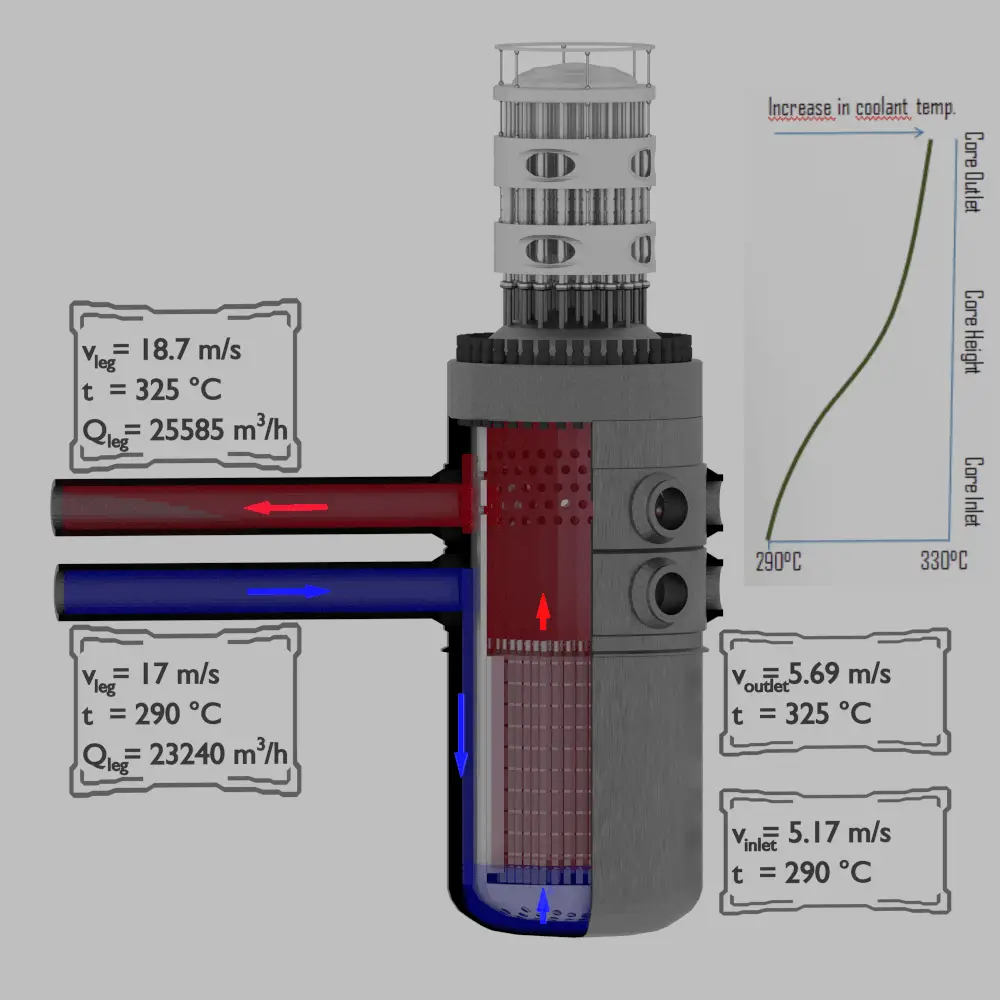
Example: Conservation of Flow Rate in Reactor Core
In this example, we will calculate the flow rate through a reactor core from continuity equation. It is an illustrative example, following data do not represent any reactor design.

ṁin = ṁout 

(ρAv)in = (ρAv)out 

____________________________

Chart - density - water - temperature
Density as a function of temperature of water

Pressurized water reactors are cooled and moderated by high-pressure liquid water (e.g. 16MPa). At this pressure water boils at approximately 350°C (662°F).  Inlet temperature of the water is about 290°C (⍴ ~ 720 kg/m3). The water (coolant) is heated in the reactor core to approximately 325°C (⍴ ~ 654 kg/m3) as the water flows through the core.

The primary circuit of typical PWR is divided into 4 independent loops (piping diameter ~ 700mm), each loop comprises a steam generator and one main coolant pump. Inside the reactor pressure vessel (RPV), the coolant first flows down outside the reactor core (through the downcomer). From the bottom of the pressure vessel, the flow is reversed up through the core, where the coolant temperature increases as it passes through the fuel rods and the assemblies formed by them.

Calculate:

  • the primary piping volumetric flow rate (m3/s),
  • the primary piping flow velocity (m/s),
  • the core inlet flow velocity (m/s),
  • the core outlet flow velocity (m/s)

when

  • the mass flow rate in the hot leg of primary piping is equal to 4648 kg/s,
  • Reactor core flow cross-section is equal to 5m2,
  • Primary piping flow cross-section (single loop) is equal to 0.38 m2

Results:

Continuity Equation - Flow Rates through Reactor
Example of flow rates in a reactor. It is an illustrative example, data do not represent any reactor design.

Cold leg volumetric flow rate:

Qcold = ṁ / ⍴ = 4648 / 720 = 6.46 m3/s = 23240 m3/hod

Cold leg flow velocity:

A1 = π.d2 / 4

vcold = Qcold / A1 = 6.46 / (3.14 x 0.72 / 4) = 6.46 / 0.38 = 17 m/s

Hot leg volumetric flow rate:

Qhot = ṁ / ⍴ = 4648 / 654 = 7.11 m3/s = 25585 m3/hod

Hot leg flow velocity:

A = π.d2 / 4

vhot = Qhot / A1 = 7.11 / (3.14 x 0.72 / 4) = 7.11 / 0.38 = 18,7 m/s

or according to the continuity equation:

⍴1 . A1 . v1 = ⍴2 . A2 . v2

vhot =  vcold . ⍴cold / ⍴hot = 17 x 720 / 654 = 18.7 m/s

Core inlet flow velocity:

Acore = 5m2

Apiping = 4 x A1 = 4 x 0.38 = 1.52 m2

⍴inlet = ⍴cold

according to the continuity equation:

⍴inlet . Acore . vinlet = ⍴cold . Apiping . vcold

vinlet =  vcold . Apiping / Acore = 17 x 1.52 / 5 = 5.17 m/s

Core outlet flow velocity:

⍴inlet = ⍴cold

⍴outlet = ⍴hot

according to the continuity equation:

⍴outlet . Acore . voutlet = ⍴inlet . Acore . vinlet
voutlet =  vinlet . ⍴inlet / ⍴outlet = 5.17 x 720 / 654 = 5.69 m/s

The Law of Conservation of Matter in Special Relativity Theory

At the beginning of the 20th century, the notion of mass underwent a radical revision. Mass lost its absoluteness. One of the striking results of Einstein’s theory of relativity is that mass and energy are equivalent and convertible one into the other. Equivalence of the mass and energy is described by Einstein’s famous formula E = mc2. In words, energy equals mass multiplied by the speed of light squared. Because the speed of light is a very large number, the formula implies that any small amount of matter contains a very large amount of energy. The mass of an object was seen to be equivalent to energy, to be interconvertible with energy, and to increase significantly at exceedingly high speeds near that of light. The total energy of an object was understood to comprise its rest mass as well as its increase of mass caused by increase in kinetic energy.

In special theory of relativity certain types of matter may be created or destroyed, but in all of these processes, the mass and energy associated with such matter remains unchanged in quantity. It was found the rest mass an atomic nucleus is measurably smaller than the sum of the rest masses of its constituent protons, neutrons and electrons. Mass was no longer considered unchangeable in the closed system. The difference is a measure of the nuclear binding energy which holds the nucleus together. According to the Einstein relationship (E = mc2) this binding energy is proportional to this mass difference and it is known as the mass defect.

 
Example: Mass defect of a 63Cu
Calculate the mass defect of a 63Cu nucleus if the actual mass of 63Cu in its nuclear ground state is 62.91367 u.

63Cu nucleus has 29 protons and also has (63 – 29) 34 neutrons.

The mass of a proton is 1.00728 u and a neutron is 1.00867 u.

The combined mass is: 29 protons x (1.00728 u/proton) + 34 neutrons x (1.00867 u/neutron) = 63.50590 u

The mass defect is Δm = 63.50590 u – 62.91367 u =  0.59223 u

Convert the mass defect into energy (nuclear binding energy).

(0.59223 u/nucleus) x (1.6606 x 10⁻²⁷ kg/u) = 9.8346 x 10⁻²⁸ kg/nucleus

ΔE = Δmc2

ΔE = (9.8346 x 10⁻²⁸ kg/nucleus) x (2.9979 x 10⁸ m/s)2 = 8.8387 x 10⁻¹¹ J/nucleus

The energy calculated in the previous example is the nuclear binding energy.  However, the nuclear binding energy may be expressed as kJ/mol (for better understanding).

Calculate the nuclear binding energy of 1 mole of 63Cu:

(8.8387 x 10⁻¹¹ J/nucleus) x (1 kJ/1000 J) x (6.022 x 10²³ nuclei/mol) = 5.3227 x 10¹⁰ kJ/mol of nuclei.

One mole of 63Cu (~63 grams) is bound by the nuclear binding energy (5.3227 x 10¹⁰ kJ/mol) which is equivalent to:

  • 14.8 million kilowatt-hours (≈ 15 GW·h)
  • 336,100 US gallons of automotive gasoline
Example: Mass defect of the reactor core
Calculate the mass defect of the 3000MWth reactor core after one year of operation.

It is known the average recoverable energy per fission is about 200 MeV, being the total energy minus the energy of the energy of antineutrinos that are radiated away.

The reaction rate per entire 3000MWth reactor core is about  9.33×10¹⁹ fissions / second.

The overall energy release in the units of joules is:

200×106 (eV) x 1.602×10⁻¹⁹ (J/eV) x 9.33×10¹⁹ (s-1) x 31.5×106 (seconds in year) = 9.4×10¹⁶ J/year

The mass defect is calculated as:

Δm = ΔE/c2

Δm = 9.4×10¹⁶ / (2.9979 x 10⁸)2 = 1.046 kg

That means in a typical 3000MWth reactor core about 1 kilogram of matter is converted into pure energy.

Note that, a typical annual uranium load for a 3000MWth reactor core is about 20 tonnes of enriched uranium (i.e. about 22.7 tonnes of UO2). Entire reactor core may contain about 80 tonnes of enriched uranium.

Mass defect directly from E=mc2

The mass defect can be calculated directly from the Einstein relationship (E = mc2) as:

Δm = ΔE/c2

Δm = 3000×106 (W = J/s) x 31.5×10⁶ (seconds in year) / (2.9979 x 10⁸)2 = 1.051 kg

Nuclear binding energy curve.
Source: hyperphysics.phy-astr.gsu.edu

During the nuclear splitting or nuclear fusion, some of the mass of the nucleus gets converted into huge amounts of energy and thus this mass is removed from the total mass of the original particles, and the mass is missing in the resulting nucleus. The nuclear binding energies are enormous, they are of the order of a million times greater than the electron binding energies of atoms.

Generally, in both chemical and nuclear reactions, some conversion between rest mass and energy occurs, so that the products generally have smaller or greater mass than the reactants. Therefore the new conservation principle is the conservation of mass-energy.

See also: Energy Release from Fission

Mass Defect

 
Matter - Antimatter Creation
Matter and Antimatter - ComparisonMatter – Antimatter creation occurs naturally in high-energy processes involving cosmic rays, and also in high-energy experiments in accelerators in Earth. High-energy cosmic rays impacting Earth’s atmosphere (or any other matter in the Solar System) produce minute quantities of antiparticles in the resulting particle jets, which are immediately annihilated by contact with nearby matter. The presence of the resulting antimatter is detectable by the two gamma rays (with 511 keV) produced every time positrons annihilate with nearby matter.

Antimatter creation is also very common in nuclear decay of many isotopes. Let assume a decay of potassium-40. Naturally occurring potassium is composed of three isotopes, of which 40K is radioactive. Traces of 40K are found in all potassium, and it is the most common radioisotope in the human body. 40K is a radioactive isotope of potassium which has a very long half-life of 1.251×10⁹ years and undergoes both types of beta decay.

  • About 89.28% of the time (10.72% is by electron capture), it decays to calcium-40 (40Ca) with emission of a beta particle (β−, an electron) with a maximum energy of 1.33 MeV and an antineutrino, which is an antiparticle to the neutrino.
  • Very rarely (0.001% of the time) it will decay to 40Ar by emitting a positron (β+) and a neutrino.

Another very interesting source of antimatter is, in fact, a nuclear reactor. Nuclear reactors are the major source of human-generated antineutrinos. This is due to the fact that antineutrinos are produced in a negative beta decay. In a nuclear reactor occurs especially the β−decay, because the common feature of the fission fragments is an excess of neutrons. Please note that billions of solar neutrinos per second pass (mostly without any interaction) through every square centimeter (~6×10¹⁰) on the Earth’s surface and antineutrino radiation is by no means dangerous.

Finally, the fact is that antimatter is much more common, than it may seem.

In January 2011, research by the American Astronomical Society discovered antimatter (positrons) originating above thunderstorm clouds.  It is suggested that these positrons are formed in terrestrial gamma-ray flashes (TGF). These positrons are produced in gamma-ray flashes created by electrons accelerated by strong electric fields in the clouds. TGFs are brief bursts occurring inside thunderstorms and associated with lightning. The streams of positrons and electrons collide higher in the atmosphere to generate more gamma rays. About 500 TGFs may occur every day worldwide, but mostly go undetected.

See also: Electron-Positron Pair Production

See also: Reactor as the Source of Antineutrinos

Matter - Antimatter Annihilation
positron annihilation
When a positron (antimatter particle) comes to rest, it interacts with an electron, resulting in the annihilation of the both particles and the complete conversion of their rest mass to pure energy in the form of two oppositely directed 0.511 MeV photons.

As was written, a particle and its antiparticle have the same mass as one another, but opposite electric charge, and other differences in quantum numbers. That means a proton has positive charge while an antiproton has negative charge and therefore they attract each other. A collision between any particle and its antiparticle partner is known to lead to their mutual annihilation. Since matter and antimatter carry an immense amount of energy (due to E = mc2), their mutual annihilation is associated with production of intense photons (gamma rays), neutrinos, and sometimes less-massive particle–antiparticle pairs.

One of best known processes is electron-positron annihilation. Electron–positron annihilation occurs when a negatively charged electron and a positively charged positron collide.When a low-energy electron annihilates a low-energy positron (antiparticle of electron), they can only produce two or more photons (gamma rays). The production of only one photon is forbidden because of conservation of linear momentum and total energy. The production of another particle is also forbidden because of both particles (electron-positron) together do not carry enough mass-energy to produce heavier particles. When an electron and a positron collide, they annihilate resulting in the complete conversion of their rest mass to pure energy (according to the E=mc2 formula) in the form of two oppositely directed 0.511 MeV gamma rays (photons).

e− + e+ → γ + γ (2x 0.511 MeV)

This process must satisfy a number of conservation laws, including:

  • Conservation of electric charge. The net charge before and after is zero.
  • Conservation of linear momentum and total energy. T
  • Conservation of angular momentum.

The Law of Conservation of Matter in Fluid Dynamics

The mass can neither be created nor destroyed.
Continuity Equation - Definition
Continuity Equation – Definition

This principle is generally known as the conservation of matter principle and states that the mass of an object or collection of objects never changes over time, no matter how the constituent parts rearrange themselves. This principle can be use in the analysis of flowing fluids. Conservation of mass in fluid dynamics states that all mass flow rates into a control volume are equal to all mass flow rates out of the control volume plus the rate of change of mass within the control volume. This principle is expressed mathematically by following equation:

ṁin = ṁout +∆m⁄∆t

Mass entering per unit time = Mass leaving per unit time + Increase of mass in the control volume per unit time

Continuity Equation - Flow Rates through Reactor
Example of flow rates in a reactor. It is an illustrative example, data do not represent any reactor design.

This equation describes nonsteady-state flow. Nonsteady-state flow refers to the condition where the fluid properties at any single point in the system may change over time. Steady-state flow refers to the condition where the fluid properties (temperature, pressure, and velocity) at any single point in the system do not change over time. But one of the most significant properties that is constant in a steady-state flow system is the system mass flow rate. This means that there is no accumulation of mass within any component in the system.

See also: Continuity Equation

Continuity Equation

The continuity equation is simply a mathematical expression of the principle of conservation of mass. For a control volume that has a single inlet and a single outlet, the principle of conservation of mass states that, for steady-state flow, the mass flow rate into the volume must equal the mass flow rate out.

ṁin = ṁout 

Mass entering per unit time = Mass leaving per unit time

This equation is called the continuity equation for steady one-dimensional flow. For a steady flow through a control volume with many inlets and outlets, the net mass flow must be zero, where inflows are negative and outflows are positive.

This principle can be applied to a streamtube such as that shown above. No fluid flows across the boundary made by the streamlines so mass only enters and leaves through the two ends of this streamtube section.

When a fluid is in motion, it must move in such a way that mass is conserved. To see how mass conservation places restrictions on the velocity field, consider the steady flow of fluid through a duct (that is, the inlet and outlet flows do not vary with time).

Differential Form of Continuity Equation

A general continuity equation can also be written in a differential form:

∂⍴⁄∂t + ∇ . (⍴ ͞v) = σ

where

  • ∇ . is divergence,
  • ρ is the density of quantity q,
  • ⍴ ͞v is the flux of quantity q,
  • σ is the generation of q per unit volume per unit time. Terms that generate (σ > 0) or remove (σ < 0) q are referred to as a “sources” and “sinks” respectively. If q is a conserved quantity (such as energy), σ is equal to 0.
 
References:
Nuclear and Reactor Physics:
  1. J. R. Lamarsh, Introduction to Nuclear Reactor Theory, 2nd ed., Addison-Wesley, Reading, MA (1983).
  2. J. R. Lamarsh, A. J. Baratta, Introduction to Nuclear Engineering, 3d ed., Prentice-Hall, 2001, ISBN: 0-201-82498-1.
  3. W. M. Stacey, Nuclear Reactor Physics, John Wiley & Sons, 2001, ISBN: 0- 471-39127-1.
  4. Glasstone, Sesonske. Nuclear Reactor Engineering: Reactor Systems Engineering, Springer; 4th edition, 1994, ISBN: 978-0412985317
  5. W.S.C. Williams. Nuclear and Particle Physics. Clarendon Press; 1 edition, 1991, ISBN: 978-0198520467
  6. G.R.Keepin. Physics of Nuclear Kinetics. Addison-Wesley Pub. Co; 1st edition, 1965
  7. Robert Reed Burn, Introduction to Nuclear Reactor Operation, 1988.
  8. U.S. Department of Energy, Nuclear Physics and Reactor Theory. DOE Fundamentals Handbook, Volume 1 and 2. January 1993.

Advanced Reactor Physics:

  1. K. O. Ott, W. A. Bezella, Introductory Nuclear Reactor Statics, American Nuclear Society, Revised edition (1989), 1989, ISBN: 0-894-48033-2.
  2. K. O. Ott, R. J. Neuhold, Introductory Nuclear Reactor Dynamics, American Nuclear Society, 1985, ISBN: 0-894-48029-4.
  3. D. L. Hetrick, Dynamics of Nuclear Reactors, American Nuclear Society, 1993, ISBN: 0-894-48453-2.
  4. E. E. Lewis, W. F. Miller, Computational Methods of Neutron Transport, American Nuclear Society, 1993, ISBN: 0-894-48452-4.

See also:

Laws of Conservation

We hope, this article, Law of Conservation of Matter, helps you. If so, give us a like in the sidebar. Main purpose of this website is to help the public to learn some interesting and important information about radiation and dosimeters.
What is Law of Conservation – Definition

Laws of Conservation. A conservation law states that a measurable property of an isolated physical system does not change as the system evolves over time. Periodic Table

Laws of Conservation

In physics, a conservation law states that a particular measurable property of an isolated physical system does not change as the system evolves over time. These properties are sometimes called “constants of the motion“. These quantities are said to be “conserved” and the conservation laws which result can be considered to be the most fundamental principles of mechanics. In mechanics, examples of conserved quantities are energy, momentum, and angular momentum. The laws of conservation are exact for an isolated system.

 
Laws of Conservation in Nuclear Reactions
A nuclear reaction is considered to be the process in which two nuclear particles (two nuclei or a nucleus and a nucleon) interact to produce two or more nuclear particles or ˠ-rays (gamma rays). Thus, a nuclear reaction must cause a transformation of at least one nuclide to another. Sometimes if a nucleus interacts with another nucleus or particle without changing the nature of any nuclide, the process is referred to a nuclear scattering, rather than a nuclear reaction.

In analyzing nuclear reactions, we apply the many conservation laws. Nuclear reactions are subject to classical conservation laws for charge, momentum, angular momentum, and energy (including rest energies).  Additional conservation laws, not anticipated by classical physics, are are electric charge, lepton number and baryon number. Certain of these laws are obeyed under all circumstances, others are not. We have accepted conservation of energy and momentum. In all the examples given we assume that the number of protons and the number of neutrons is separately conserved. We shall find circumstances and conditions in which  this rule is not true. Where we are considering non-relativistic nuclear reactions, it is essentially true. However, where we are considering relativistic nuclear energies or those involving the weak interactions, we shall find that these principles must be extended.

Some conservation principles have arisen from theoretical considerations, others are just empirical relationships. Notwithstanding, any reaction not expressly forbidden by the conservation laws will generally occur, if perhaps at a slow rate. This expectation is based on quantum mechanics. Unless the barrier between the initial and final states is infinitely high, there is always a non-zero probability that a system will make the transition between them.

For purposes of this article it is sufficient to note four of the fundamental laws governing these reactions.

  1. Conservation of nucleons. The total number of nucleons before and after a reaction are the same.
  2. Conservation of charge. The sum of the charges on all the particles before and after a reaction are the same
  3. Conservation of momentum. The total momentum of the interacting particles before and after a reaction are the same.
  4. Conservation of energy. Energy, including rest mass energy, is conserved in nuclear reactions.

The Law of Conservation of Matter

The law of conservation of matter or principle of matter conservation states that the mass of an object or collection of objects never changes over time, no matter how the constituent parts rearrange themselves.

The mass can neither be created nor destroyed.

The law requires that during any nuclear reaction, radioactive decay or chemical reaction in an isolated system, the total mass of the reactants or starting materials must be equal to the mass of the products.

The concept of mass conservation is widely used in many fields such as chemistry, mechanics, and fluid dynamics. In chemistry the law of conservation of matter may be explained in the following way (see the picture of combustion of methane). The masses of a methane and oxygen together must be equal to the masses of carbon dioxide and water. In other words, during a chemical reaction, everything you start with, you must end up with, but it might look different.
Law of Conservation of MatterHistorically, already the ancient Greeks proposed the idea that the total amount of matter in the universe is constant. The principle of conservation of mass was first outlined by Mikhail Lomonosov in 1748. However, the law of conservation of matter (or the principle of mass/matter conservation) as a fundamental principle of physics was discovered in by Antoine Lavoisier in the late 18th century. It was of great importance in progressing from alchemy to modern chemistry. Before this discovery, there were questions like:
  • Why a piece of wood weighs less after burning?
  • Can a matter or some of its part disappear?

In the case of burned wood the problem was the measurement of the weight of released gases. Measurements of the weight of released gases was complicated, because of the buoyancy effect of the Earth’s atmosphere on the weight of gases. Once understood, the conservation of matter was of crucial importance in the progress from alchemy to the modern natural science of chemistry.

Law of Conservation of Energy

The law of conservation of energy is one of the basic laws of physics along with the conservation of mass and the conservation of momentum. The law of conservation of energy states that energy can change from one form into another, but it cannot be created or destroyed. Or the general definition is:

The total energy of an isolated system remains constant over time.

law of conservation of energy - pendulum
Newton’s cradle. A device that demonstrates the Law of Conservation of Mechanical Energy and Momentum.

Energy can be defined as the capacity for doing work. It may exist in a variety of forms and may be transformed from one type of energy to another in hundreds of ways.

For example, burning gasoline to power cars is an energy conversion process we rely on. The chemical energy in gasoline is converted to thermal energy, which is then converted to mechanical energy that makes the car move. The mechanical energy has been converted to kinetic energy. When we use the brakes to stop a car, that kinetic energy is converted by friction back to heat, or thermal energy.

A consequence of the law of conservation of energy is that a perpetual motion machine of the first kind, which produces work without the input of energy, cannot exist.

The concept of energy conservation is widely used in many fields. In this article the following fields are discussed:

Law of Conservation of Mass-Energy – Mass-Energy Equivalence

E=MC2At the beginning of the 20th century, the notion of mass underwent a radical revision. Mass lost its absoluteness. One of the striking results of Einstein’s theory of relativity is that mass and energy are equivalent and convertible one into the other. Equivalence of the mass and energy is described by Einstein’s famous formula E = mc2. In words, energy equals mass multiplied by the speed of light squared. Because the speed of light is a very large number, the formula implies that any small amount of matter contains a very large amount of energy. The mass of an object was seen to be equivalent to energy, to be interconvertible with energy, and to increase significantly at exceedingly high speeds near that of light. The total energy of an object was understood to comprise its rest mass as well as its increase of mass caused by increase in kinetic energy.

In special theory of relativity certain types of matter may be created or destroyed, but in all of these processes, the mass and energy associated with such matter remains unchanged in quantity. It was found the rest mass an atomic nucleus is measurably smaller than the sum of the rest masses of its constituent protons, neutrons and electrons. Mass was no longer considered unchangeable in the closed system. The difference is a measure of the nuclear binding energy which holds the nucleus together. According to the Einstein relationship (E = mc2) this binding energy is proportional to this mass difference and it is known as the mass defect.

 
Example: Mass defect of a 63Cu
Calculate the mass defect of a 63Cu nucleus if the actual mass of 63Cu in its nuclear ground state is 62.91367 u.

63Cu nucleus has 29 protons and also has (63 – 29) 34 neutrons.

The mass of a proton is 1.00728 u and a neutron is 1.00867 u.

The combined mass is: 29 protons x (1.00728 u/proton) + 34 neutrons x (1.00867 u/neutron) = 63.50590 u

The mass defect is Δm = 63.50590 u – 62.91367 u =  0.59223 u

Convert the mass defect into energy (nuclear binding energy).

(0.59223 u/nucleus) x (1.6606 x 10⁻²⁷ kg/u) = 9.8346 x 10⁻²⁸ kg/nucleus

ΔE = Δmc2

ΔE = (9.8346 x 10⁻²⁸ kg/nucleus) x (2.9979 x 10⁸ m/s)2 = 8.8387 x 10⁻¹¹ J/nucleus

The energy calculated in the previous example is the nuclear binding energy.  However, the nuclear binding energy may be expressed as kJ/mol (for better understanding).

Calculate the nuclear binding energy of 1 mole of 63Cu:

(8.8387 x 10⁻¹¹ J/nucleus) x (1 kJ/1000 J) x (6.022 x 10²³ nuclei/mol) = 5.3227 x 10¹⁰ kJ/mol of nuclei.

One mole of 63Cu (~63 grams) is bound by the nuclear binding energy (5.3227 x 10¹⁰ kJ/mol) which is equivalent to:

  • 14.8 million kilowatt-hours (≈ 15 GW·h)
  • 336,100 US gallons of automotive gasoline
Example: Mass defect of the reactor core
Calculate the mass defect of the 3000MWth reactor core after one year of operation.

It is known the average recoverable energy per fission is about 200 MeV, being the total energy minus the energy of the energy of antineutrinos that are radiated away.

The reaction rate per entire 3000MWth reactor core is about  9.33×10¹⁹ fissions / second.

The overall energy release in the units of joules is:

200×106 (eV) x 1.602×10⁻¹⁹ (J/eV) x 9.33×10¹⁹ (s-1) x 31.5×106 (seconds in year) = 9.4×10¹⁶ J/year

The mass defect is calculated as:

Δm = ΔE/c2

Δm = 9.4×10¹⁶ / (2.9979 x 10⁸)2 = 1.046 kg

That means in a typical 3000MWth reactor core about 1 kilogram of matter is converted into pure energy.

Note that, a typical annual uranium load for a 3000MWth reactor core is about 20 tonnes of enriched uranium (i.e. about 22.7 tonnes of UO2). Entire reactor core may contain about 80 tonnes of enriched uranium.

Mass defect directly from E=mc2

The mass defect can be calculated directly from the Einstein relationship (E = mc2) as:

Δm = ΔE/c2

Δm = 3000×106 (W = J/s) x 31.5×10⁶ (seconds in year) / (2.9979 x 10⁸)2 = 1.051 kg

Nuclear binding energy curve.
Source: hyperphysics.phy-astr.gsu.edu

During the nuclear splitting or nuclear fusion, some of the mass of the nucleus gets converted into huge amounts of energy and thus this mass is removed from the total mass of the original particles, and the mass is missing in the resulting nucleus. The nuclear binding energies are enormous, they are of the order of a million times greater than the electron binding energies of atoms.

Generally, in both chemical and nuclear reactions, some conversion between rest mass and energy occurs, so that the products generally have smaller or greater mass than the reactants. Therefore the new conservation principle is the conservation of mass-energy.

See also: Energy Release from Fission

Mass Defect

 
References:
Nuclear and Reactor Physics:
  1. J. R. Lamarsh, Introduction to Nuclear Reactor Theory, 2nd ed., Addison-Wesley, Reading, MA (1983).
  2. J. R. Lamarsh, A. J. Baratta, Introduction to Nuclear Engineering, 3d ed., Prentice-Hall, 2001, ISBN: 0-201-82498-1.
  3. W. M. Stacey, Nuclear Reactor Physics, John Wiley & Sons, 2001, ISBN: 0- 471-39127-1.
  4. Glasstone, Sesonske. Nuclear Reactor Engineering: Reactor Systems Engineering, Springer; 4th edition, 1994, ISBN: 978-0412985317
  5. W.S.C. Williams. Nuclear and Particle Physics. Clarendon Press; 1 edition, 1991, ISBN: 978-0198520467
  6. G.R.Keepin. Physics of Nuclear Kinetics. Addison-Wesley Pub. Co; 1st edition, 1965
  7. Robert Reed Burn, Introduction to Nuclear Reactor Operation, 1988.
  8. U.S. Department of Energy, Nuclear Physics and Reactor Theory. DOE Fundamentals Handbook, Volume 1 and 2. January 1993.

Advanced Reactor Physics:

  1. K. O. Ott, W. A. Bezella, Introductory Nuclear Reactor Statics, American Nuclear Society, Revised edition (1989), 1989, ISBN: 0-894-48033-2.
  2. K. O. Ott, R. J. Neuhold, Introductory Nuclear Reactor Dynamics, American Nuclear Society, 1985, ISBN: 0-894-48029-4.
  3. D. L. Hetrick, Dynamics of Nuclear Reactors, American Nuclear Society, 1993, ISBN: 0-894-48453-2.
  4. E. E. Lewis, W. F. Miller, Computational Methods of Neutron Transport, American Nuclear Society, 1993, ISBN: 0-894-48452-4.

We hope, this article, Law of Conservation, helps you. If so, give us a like in the sidebar. Main purpose of this website is to help the public to learn some interesting and important information about radiation and dosimeters.

What is Mass Defect – Definition

The binding energy which is proportional to this mass difference is known as the mass defect. The mass defect may be calculated directly from e=mc2 equation. Periodic Table

Mass Defect

In special theory of relativity certain types of matter may be created or destroyed, but in all of these processes, the mass and energy associated with such matter remains unchanged in quantity. It was found the rest mass of an atomic nucleus is measurably smaller than the sum of the rest masses of its constituent protons, neutrons and electrons. Mass was no longer considered unchangeable in the closed system. The difference is a measure of the nuclear binding energy which holds the nucleus together. According to the Einstein relationship (E=mc2), this binding energy is proportional to this mass difference and it is known as the mass defect.

Nuclear binding energy curve.
Source: hyperphysics.phy-astr.gsu.edu

During the nuclear splitting or nuclear fusion, some of the mass of the nucleus gets converted into huge amounts of energy and thus this mass is removed from the total mass of the original particles, and the mass is missing in the resulting nucleus. The nuclear binding energies are enormous, they are on the order of a million times greater than the electron binding energies of atoms.

 
Atomic Mass Unit
Atomic mass unit

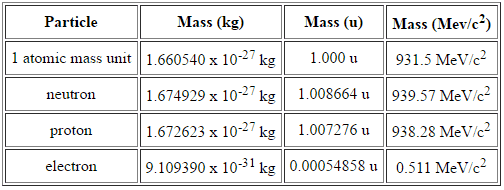
It is defined as one twelfth of the mass of an unbound neutral atom of carbon-12 in its nuclear and electronic ground state, and has a value of 1.66054×10⁻²⁷ kg.

Atomic Mass Unit
Masses of protons, neutrons and electrons in various units.

Examples of mass defect calculation

 
Example: Mass defect of a 63Cu
Calculate the mass defect of a 63Cu nucleus if the actual mass of 63Cu in its nuclear ground state is 62.91367 u.

63Cu nucleus has 29 protons and also has (63 – 29) 34 neutrons.

The mass of a proton is 1.00728 u and a neutron is 1.00867 u.

The combined mass is: 29 protons x (1.00728 u/proton) + 34 neutrons x (1.00867 u/neutron) = 63.50590 u

The mass defect is Δm = 63.50590 u – 62.91367 u =  0.59223 u

Convert the mass defect into energy (nuclear binding energy).

(0.59223 u/nucleus) x (1.6606 x 10⁻²⁷ kg/u) = 9.8346 x 10⁻²⁸ kg/nucleus

ΔE = Δmc2

ΔE = (9.8346 x 10⁻²⁸ kg/nucleus) x (2.9979 x 10⁸ m/s)2 = 8.8387 x 10⁻¹¹ J/nucleus

The energy calculated in the previous example is the nuclear binding energy.  However, the nuclear binding energy may be expressed as kJ/mol (for better understanding).

Calculate the nuclear binding energy of 1 mole of 63Cu:

(8.8387 x 10⁻¹¹ J/nucleus) x (1 kJ/1000 J) x (6.022 x 10²³ nuclei/mol) = 5.3227 x 10¹⁰ kJ/mol of nuclei.

One mole of 63Cu (~63 grams) is bound by the nuclear binding energy (5.3227 x 10¹⁰ kJ/mol) which is equivalent to:

  • 14.8 million kilowatt-hours (≈ 15 GW·h)
  • 336,100 US gallons of automotive gasoline
Example: Mass defect of the reactor core
Calculate the mass defect of the 3000MWth reactor core after one year of operation.

It is known the average recoverable energy per fission is about 200 MeV, being the total energy minus the energy of the energy of antineutrinos that are radiated away.

The reaction rate per entire 3000MWth reactor core is about  9.33×10¹⁹ fissions / second.

The overall energy release in the units of joules is:

200×106 (eV) x 1.602×10⁻¹⁹ (J/eV) x 9.33×10¹⁹ (s-1) x 31.5×106 (seconds in year) = 9.4×10¹⁶ J/year

The mass defect is calculated as:

Δm = ΔE/c2

Δm = 9.4×10¹⁶ / (2.9979 x 10⁸)2 = 1.046 kg

That means in a typical 3000MWth reactor core about 1 kilogram of matter is converted into pure energy.

Note that, a typical annual uranium load for a 3000MWth reactor core is about 20 tonnes of enriched uranium (i.e. about 22.7 tonnes of UO2). Entire reactor core may contain about 80 tonnes of enriched uranium.

Mass defect directly from E=mc2

The mass defect can be calculated directly from the Einstein relationship (E = mc2) as:

Δm = ΔE/c2

Δm = 3000×106 (W = J/s) x 31.5×10⁶ (seconds in year) / (2.9979 x 10⁸)2 = 1.051 kg

 
References:
Nuclear and Reactor Physics:
  1. J. R. Lamarsh, Introduction to Nuclear Reactor Theory, 2nd ed., Addison-Wesley, Reading, MA (1983).
  2. J. R. Lamarsh, A. J. Baratta, Introduction to Nuclear Engineering, 3d ed., Prentice-Hall, 2001, ISBN: 0-201-82498-1.
  3. W. M. Stacey, Nuclear Reactor Physics, John Wiley & Sons, 2001, ISBN: 0- 471-39127-1.
  4. Glasstone, Sesonske. Nuclear Reactor Engineering: Reactor Systems Engineering, Springer; 4th edition, 1994, ISBN: 978-0412985317
  5. W.S.C. Williams. Nuclear and Particle Physics. Clarendon Press; 1 edition, 1991, ISBN: 978-0198520467
  6. G.R.Keepin. Physics of Nuclear Kinetics. Addison-Wesley Pub. Co; 1st edition, 1965
  7. Robert Reed Burn, Introduction to Nuclear Reactor Operation, 1988.
  8. U.S. Department of Energy, Nuclear Physics and Reactor Theory. DOE Fundamentals Handbook, Volume 1 and 2. January 1993.

Advanced Reactor Physics:

  1. K. O. Ott, W. A. Bezella, Introductory Nuclear Reactor Statics, American Nuclear Society, Revised edition (1989), 1989, ISBN: 0-894-48033-2.
  2. K. O. Ott, R. J. Neuhold, Introductory Nuclear Reactor Dynamics, American Nuclear Society, 1985, ISBN: 0-894-48029-4.
  3. D. L. Hetrick, Dynamics of Nuclear Reactors, American Nuclear Society, 1993, ISBN: 0-894-48453-2.
  4. E. E. Lewis, W. F. Miller, Computational Methods of Neutron Transport, American Nuclear Society, 1993, ISBN: 0-894-48452-4.

See also:

Laws of Conservation

We hope, this article, Mass Defect, helps you. If so, give us a like in the sidebar. Main purpose of this website is to help the public to learn some interesting and important information about radiation and dosimeters.

What is Energy Release from Fission – Definition

The total energy released in fission can be calculated from binding energies of initial target nucleus to be fissioned and binding energies of fission products. Periodic Table
neutron nuclear reactionsIn general, the nuclear fission results in the release of enormous quantities of energy. The amount of energy depends strongly on the nucleus to be fissioned and also depends strongly on the kinetic energy of an incident neutron. In order to calculate the power of a reactor, it is necessary to be able precisely identify the individual components of this energy. At first, it is important to distinguish between the total energy released and the energy that can be recovered in a reactor.

The total energy released in fission can be calculated from binding energies of initial target nucleus to be fissioned and binding energies of fission products. But not all the total energy can be recovered in a reactor. For example, about 10 MeV is released in the form of neutrinos (in fact antineutrinos). Since the neutrinos are weakly interacting (with extremely low cross-section of any interaction), they do not contribute to the energy that can be recovered in a reactor.

In order to understand this issue, we have to first investigate a typical fission reaction such as the one listed below.

Uranium absorption reaction

Using this picture, we can identify and also describe almost all the individual components of the total energy energy released during the fission reaction.

 
Kinetic energy of fission fragments
As can be seen when the compound nucleus splits, it breaks into two fission fragments. In most cases, the resultant fission fragments have masses that vary widely, but the most probable pair of fission fragments for the thermal neutron-induced fission of the 235U have masses of about 94 and 139.

The largest part of the energy produced during fission (about 80 % or about 170 MeV or about 27 picojoules) appears as kinetic energy of the fission fragments. The fission fragments interact strongly (intensely) with the surrounding atoms or molecules traveling at high speed, causing them to ionize. Creation of ion pairs requires energy, which is lost from the kinetic energy of the charged fission fragment causing it to decelerate. The positive ions and free electrons created by the passage of the charged fission fragment will then reunite, releasing energy in the form of heat (e.g. vibrational energy or rotational energy of atoms).

The range of these massive, highly charged particles in the fuel is of the order of micrometers, so that the recoil energy is effectively deposited as heat at the point of fission. This is the principle how fission fragments heat up fuel in the reactor core.

See also: Interaction of Heavy Charged Particles with Matter

Kinetic energy of prompt neutrons.
Prompt neutrons are emitted directly from fission and they are emitted within very short time of about 10-14 second. Usually more than 99 percent of the fission neutrons are the prompt neutrons, but the exact fraction is dependent on the nuclide to be fissioned and is also dependent on an incident neutron energy (usually increases with energy).

For example a fission of 235U by thermal neutron yields 2.43 neutrons, of which 2.42 neutrons are the prompt neutrons and 0.01585 neutrons (0.01585/2.43=0.0065=ß) are the delayed neutrons. Almost all prompt fission neutrons have energies between 0.1 MeV and 10 MeV. The mean neutron energy is about 2 MeV. The most probable neutron energy is about 0.7 MeV.

Most of this energy is deposited in the coolant (moderator), because the water have the highest macroscopic slowing down power (MSDP) of the materials that are in a reactor core (PWR). The range of neutrons in a reactor depends strongly on certain reactor type, in the case of PWRs it is usually of the order of centimeters.

Energy carried by prompt γ-rays.
With the prompt neutrons prompt gamma rays are associated. Most of prompt gamma rays are emitted after prompt neutrons. The fission reaction releases approximately ~7 MeV in prompt gamma rays.

The gamma rays are well attenuated by high-density and high Z materials. In a reactor core the largest share of the energy will be deposited in the fuel containing uranium dioxide, but a significant share of the energy will be deposited also in the fuel cladding and in the coolant (moderator).

The range of gamma rays in a reactor vary according to the initial energy of the gamma ray. It can be stated the most of gammas in a reactor have range from 10cm-1m.

Energy of β− decay.
About 6 MeV of fission energy is in the form of kinetic energy of electrons (beta particles). The fission fragments are neutron-rich nuclei and therefore they usually undergo beta decay in order to stabilize itself. Beta particles deposit their energy essentially in the fuel element, within about 1 mm of the fission fragment.
Energy of antineutrinos
Antineutrinos are produced in a negative beta decay. In a nuclear reactor occurs especially the β− decay, because the common feature of the fission fragments is an excess of neutrons. The existence of emission of antineutrinos and their extremely low cross-section for any interaction leads to very interesting phenomenon. Roughly about 5% of released energy per one fission is radiated away from reactor in the form of antineutrinos.

For a typical nuclear reactor with a thermal power of 3000 MWth (~1000MWe of electrical power), the total power produced is in fact higher, approximately 3150 MW, of which 150 MW is radiated away into space as antineutrino radiation. This amount of energy is forever lost, because antineutrinos are able to penetrate all reactor materials without any interaction.

In fact, a common statement in physics texts is that the mean free path of a neutrino is approximately a light-year of lead. Moreover, a neutrino of moderate energy can easily penetrate a thousand light-years of lead (according to the J. B. Griffiths).

Energy of delayed γ-rays.
The fission fragments are neutron-rich and very unstable nuclei. These nuclei undergo many beta decays in order to stabilize itself. Gamma rays usually accompany the beta decay. Their energy is transferred as heat to the surrounding material similarly as the energy carried by prompt γ-rays.
Energy of γ-rays from radiative capture
A fraction of the neutron absorption reactions result in radiative capture followed by gamma ray emission, producing on average about 7 MeV per fission in the form of energetic gamma rays. Their energy is transferred as heat to the surrounding material similarly as the energy carried by prompt γ-rays.
Energy release per fission
The total energy released in a reactor is about 210 MeV per 235U fission, distributed as shown in the table. In a reactor, the average recoverable energy per fission is about 200 MeV, being the total energy minus the energy of the energy of antineutrinos that are radiated away. This means that about 3.1⋅1010 fissions per second are required to produce a power of 1 W. Since 1 gram of any fissile material contains about 2.5 x 10²¹ nuclei, the fissioning of 1 gram of fissile material yields about 1 megawatt-day (MWd) of heat energy.

As can be seen from the description of the individual components of the total energy energy released during the fission reaction, there is significant amount of energy generated outside the nuclear fuel (outside fuel rods). Especially the kinetic energy of prompt neutrons is largely generated in the coolant (moderator). This phenomena needs to be included in the nuclear calculations.

For LWR, it is generally accepted that about 2.5% of total energy is recovered in the moderator. This fraction of energy depends on the materials, their arrangement within the reactor, and thus on the reactor type.

See also:

Critical Energy

See also:

Nuclear Fission

See also:

Fission Fragments

We hope, this article, Energy Release from Fission, helps you. If so, give us a like in the sidebar. Main purpose of this website is to help the public to learn some interesting and important information about radiation and dosimeters.

What is Nuclear Radius – Radius of Nucleus – Definition

Nuclear Radius – Radius of Nucleus. Typical nuclear radii are of the order 10−14 m. Assuming spherical shape, nuclear radii can be calculated according to following formula:

Nuclear Radius

Typical nuclear radii are of the order 10−14 m. Assuming spherical shape, nuclear radii can be calculated according to following formula:

r = r0 . A1/3

where r0 = 1.2 x 10⁻¹⁵ m = 1.2 fm

If we use this approximation, we therefore expect the geometrical cross-sections of nuclei to be of the order of πr2 or 4.5×10⁻³⁰ m² for hydrogen nuclei or 1.74×10⁻²⁸ m² for 238U nuclei.

Since there are many nuclear reaction from the incident particle point of view, but, in nuclear reactor physics, neutron-nuclear reactions are of particular interest. In this case the neutron cross-section must be defined.

See also:

See also:

Neutron Cross-section

See also:

We hope, this article, Nuclear Radius – Radius of Nucleus, helps you. If so, give us a like in the sidebar. Main purpose of this website is to help the public to learn some interesting and important information about radiation and dosimeters.

What is Total Cross-section – Definition

In general, nuclear cross-sections can be measured for all possible interaction processes together, in this case they are called total cross-sections (σt). Periodic Table

Total Cross-section

In general, nuclear cross-sections can be measured for all possible interaction processes together, in this case they are called total cross-sections (σt). The total cross section is the sum of all the partial cross sections such as:

σt = σs + σi + σγ + σf + ……

The total cross-section measures the probability that an interaction of any type will occur when neutron interacts with a target.

Uranium 238. Neutron absorption and scattering. Comparison of cross-sections.
Uranium 238. Comparison of cross-sections.Source: JANIS (Java-based Nuclear Data Information Software); The JEFF-3.1.1 Nuclear Data Library
Hydrogen. Neutron absorption and scattering. Comparison of cross-sections.
Hydrogen. Neutron absorption and scattering. Comparison of cross-sections.Source: JANIS (Java-based Nuclear Data Information Software); The JEFF-3.1.1 Nuclear Data Library
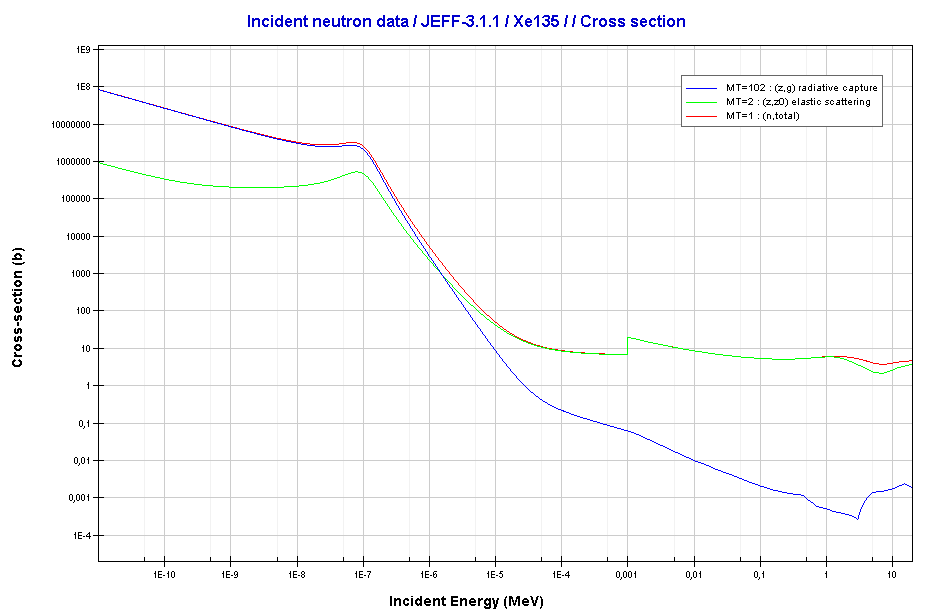
Xenon - 135. Neutron absorption and scattering. Comparison of cross-sections.
Xenon – 135. Neutron absorption and scattering. Comparison of cross-sections.Source: JANIS (Java-based Nuclear Data Information Software); The JEFF-3.1.1 Nuclear Data Library

See also:

See also:

Neutron Cross-section

See also:

We hope, this article, Total Cross-section, helps you. If so, give us a like in the sidebar. Main purpose of this website is to help the public to learn some interesting and important information about radiation and dosimeters.

What is Definition of Cross-section – Definition

Definition of Cross-section. the cross-section is an effective area that quantifies the likelihood of certain interaction between an incident object and a target object. Periodic Table

Definition of Cross-section

In general, the cross-section is an effective area that quantifies the likelihood of certain interaction between an incident object and a target object. The cross-section of a particle is the same as the cross section of a hard object, if the probabilities of hitting them with a ray are the same.

For a given event, the cross section σ is given by

σ = μ/n

where

  • σ is the cross-section of this event [m2],
  • μ is the attenuation coefficient due to the occurrence of this event [m-1],
  • n is the density of the target particles [m-3].

In nuclear physics, the nuclear cross section of a nucleus is commonly used to characterize the probability that a nuclear reaction will occur. The cross-section is typically denoted σ and measured in units of area [m2]. The standard unit for measuring a nuclear cross section is the barn, which is equal to 10−28 m² or 10−24 cm². It can be seen the concept of a nuclear cross section can be quantified physically in terms of “characteristic target area” where a larger area means a larger probability of interaction.

σxy
Uranium 238. Neutron absorption and scattering. Comparison of cross-sections.
Uranium 238. Comparison of cross-sections.

Source: JANIS (Java-based Nuclear Data Information Software); The JEFF-3.1.1 Nuclear Data Library

Hydrogen. Neutron absorption and scattering. Comparison of cross-sections.

Source: JANIS (Java-based Nuclear Data Information Software); The JEFF-3.1.1 Nuclear Data Library

 
References:
Nuclear and Reactor Physics:
  1. J. R. Lamarsh, Introduction to Nuclear Reactor Theory, 2nd ed., Addison-Wesley, Reading, MA (1983).
  2. J. R. Lamarsh, A. J. Baratta, Introduction to Nuclear Engineering, 3d ed., Prentice-Hall, 2001, ISBN: 0-201-82498-1.
  3. W. M. Stacey, Nuclear Reactor Physics, John Wiley & Sons, 2001, ISBN: 0- 471-39127-1.
  4. Glasstone, Sesonske. Nuclear Reactor Engineering: Reactor Systems Engineering, Springer; 4th edition, 1994, ISBN: 978-0412985317
  5. W.S.C. Williams. Nuclear and Particle Physics. Clarendon Press; 1 edition, 1991, ISBN: 978-0198520467
  6. G.R.Keepin. Physics of Nuclear Kinetics. Addison-Wesley Pub. Co; 1st edition, 1965
  7. Robert Reed Burn, Introduction to Nuclear Reactor Operation, 1988.
  8. U.S. Department of Energy, Nuclear Physics and Reactor Theory. DOE Fundamentals Handbook, Volume 1 and 2. January 1993.

Advanced Reactor Physics:

  1. K. O. Ott, W. A. Bezella, Introductory Nuclear Reactor Statics, American Nuclear Society, Revised edition (1989), 1989, ISBN: 0-894-48033-2.
  2. K. O. Ott, R. J. Neuhold, Introductory Nuclear Reactor Dynamics, American Nuclear Society, 1985, ISBN: 0-894-48029-4.
  3. D. L. Hetrick, Dynamics of Nuclear Reactors, American Nuclear Society, 1993, ISBN: 0-894-48453-2.
  4. E. E. Lewis, W. F. Miller, Computational Methods of Neutron Transport, American Nuclear Society, 1993, ISBN: 0-894-48452-4.

See also:

See also:

Neutron Cross-section

See also:

We hope, this article, Definition of Cross-section, helps you. If so, give us a like in the sidebar. Main purpose of this website is to help the public to learn some interesting and important information about radiation and dosimeters.