Natural uranium consumption in a nuclear reactor

Natural uranium refers to uranium with the same isotopic ratio as found in nature. It consists primarily of isotope 238U (99.28%), therefore the atomic mass of uranium element is close to the atomic mass of 238U isotope (238.03u). Natural uranium also consists of two other isotopes: 235U (0.71%) and 234U (0.0054%). The abundance of isotopes in the nature is caused by difference in the half-lifes. All three naturally-occurring isotopes of uranium (238U, 235U and 234U) are unstable. On the other hand these isotopes (except 234U) belong to primordial nuclides, because their half-life is comparable to the age of the Earth (~4.5×10⁹ years for 238U).
Since natural uranium contains only 0.71% of fissile isotope 235U and most of current power reactors require enriched uranium, this natural uranium must be enriched. The level of enrichment required depends on specific reactor design (e.g. PWRs and BWRs require 3% – 5% of 235U) and specific requirements of the nuclear power plant operator. Without required enrichment these reactors are not able to initiate and sustain a nuclear chain reaction for such a long period as 12 months (or more).
The enrichment process separates gaseous uranium hexafluoride into two streams, one being enriched to the required level and known as low-enriched uranium, the other stream is progressively depleted in U-235 and is called ‘tails’, or simply depleted uranium. Typically, to produce 1 kg of enriched uranium with 5% of 235U, about 10 kg of natural uranium is required with a byproduct of about 9 kg of depleted uranium. Therefore annual natural uranium consumption of 3000MWth reactor is about 250 tonnes of natural uranium (to produce of about 25 tonnes of enriched uranium).
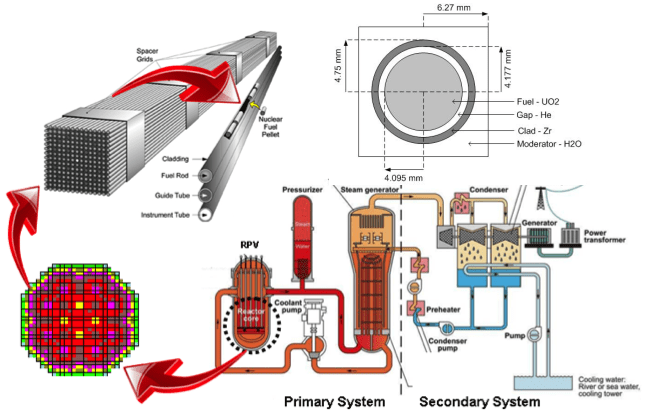
Summary:
Consumption of a 3000MWth (~1000MWe) reactor (12-months fuel cycle)
It is an illustrative example, following data do not correspond to any reactor design.
- Typical reactor may contain about 165 tonnes of fuel (including structural material)
- Typical reactor may contain about 100 tonnes of enriched uranium (i.e. about 113 tonnes of uranium dioxide).
- This fuel is loaded within, for example, 157 fuel assemblies composed of over 45,000 fuel rods.
- A common fuel assembly contain energy for approximately 4 years of operation at full power.
- Therefore about one quarter of the core is yearly removed to spent fuel pool (i.e. about 40 fuel assemblies), while the remainder is rearranged to a location in the core better suited to its remaining level of enrichment (see Power Distribution).
- The removed fuel (spent nuclear fuel) still contains about 96% of reusable material (it must be removed due to decreasing kinf of an assembly).
- Annual natural uranium consumption of this reactor is about 250 tonnes of natural uranium (to produce of about 25 tonnes of enriched uranium).
- Annual enriched uranium consumption of this reactor is about 25 tonnes of enriched uranium.
- Annual fissile material consumption of this reactor is about 1 005 kg.
- Annual matter consumption of this reactor is about 1.051 kg.
- But it corresponds to about 3 200 000 tons of coal burned in coal-fired power plant per year.
We hope, this article, Natural uranium consumption in a nuclear reactor, helps you. If so, give us a like in the sidebar. Main purpose of this website is to help the public to learn some interesting and important information about radiation and dosimeters.