What is E=mc2 Meaning – Definition

E=mc2 is the equivalence of the mass and energy. Each nuclear process can be evaluated from an E = mc2 perspective. E=mc2 meaning. Periodic Table

E = mc2 Meaning

At the beginning of the 20th century, the notion of mass underwent a radical revision. Mass lost its absoluteness. One of the striking results of Einstein’s theory of relativity is that mass and energy are equivalent and convertible one into the other. Equivalence of the mass and energy is described by Einstein’s famous formula E = mc2. In words, energy equals mass multiplied by the speed of light squared. Because the speed of light is a very large number, the formula implies that any small amount of matter contains a very large amount of energy. The mass of an object was seen to be equivalent to energy, to be interconvertible with energy, and to increase significantly at exceedingly high speeds near that of light. The total energy of an object was understood to comprise its rest mass as well as its increase of mass caused by increase in kinetic energy.

In special theory of relativity certain types of matter may be created or destroyed, but in all of these processes, the mass and energy associated with such matter remains unchanged in quantity. It was found the rest mass an atomic nucleus is measurably smaller than the sum of the rest masses of its constituent protons, neutrons and electrons. Mass was no longer considered unchangeable in the closed system. The difference is a measure of the nuclear binding energy which holds the nucleus together. According to the Einstein relationship (E = mc2) this binding energy is proportional to this mass difference and it is known as the mass defect.

E=mc2 represents the new conservation principle – the conservation of mass-energy.

E=MC2 - Nuclear energy
This formule describes equivalence of mass and energy.

, where m is the small amount of mass and c is the speed of light.

What that means? If the nuclear energy is generated (splitting atoms, nuclear fusion), a small amount of mass (saved in the nuclear binding energy) transforms into the pure energy (such as kinetic energy, thermal energy, or radiant energy).

Example:

The energy equivalent of one gram (1/1000 of a kilogram) of mass is equivalent to:

  • 89.9 terajoules
  • 25.0 million kilowatt-hours (≈ 25 GW·h)
  • 21.5 billion kilocalories (≈ 21 Tcal)
  • 85.2 billion BTUs

or to the energy released by combustion of the following:

  • 21.5 kilotons of TNT-equivalent energy (≈ 21 kt)
  • 568,000 US gallons of automotive gasoline

Any time energy is generated, the process can be evaluated from an E = mc2 perspective.

 
Example: Mass defect of a 63Cu
Calculate the mass defect of a 63Cu nucleus if the actual mass of 63Cu in its nuclear ground state is 62.91367 u.

63Cu nucleus has 29 protons and also has (63 – 29) 34 neutrons.

The mass of a proton is 1.00728 u and a neutron is 1.00867 u.

The combined mass is: 29 protons x (1.00728 u/proton) + 34 neutrons x (1.00867 u/neutron) = 63.50590 u

The mass defect is Δm = 63.50590 u – 62.91367 u =  0.59223 u

Convert the mass defect into energy (nuclear binding energy).

(0.59223 u/nucleus) x (1.6606 x 10⁻²⁷ kg/u) = 9.8346 x 10⁻²⁸ kg/nucleus

ΔE = Δmc2

ΔE = (9.8346 x 10⁻²⁸ kg/nucleus) x (2.9979 x 10⁸ m/s)2 = 8.8387 x 10⁻¹¹ J/nucleus

The energy calculated in the previous example is the nuclear binding energy.  However, the nuclear binding energy may be expressed as kJ/mol (for better understanding).

Calculate the nuclear binding energy of 1 mole of 63Cu:

(8.8387 x 10⁻¹¹ J/nucleus) x (1 kJ/1000 J) x (6.022 x 10²³ nuclei/mol) = 5.3227 x 10¹⁰ kJ/mol of nuclei.

One mole of 63Cu (~63 grams) is bound by the nuclear binding energy (5.3227 x 10¹⁰ kJ/mol) which is equivalent to:

  • 14.8 million kilowatt-hours (≈ 15 GW·h)
  • 336,100 US gallons of automotive gasoline
Example: Mass defect of the reactor core
Calculate the mass defect of the 3000MWth reactor core after one year of operation.

It is known the average recoverable energy per fission is about 200 MeV, being the total energy minus the energy of the energy of antineutrinos that are radiated away.

The reaction rate per entire 3000MWth reactor core is about  9.33×10¹⁹ fissions / second.

The overall energy release in the units of joules is:

200×106 (eV) x 1.602×10⁻¹⁹ (J/eV) x 9.33×10¹⁹ (s-1) x 31.5×106 (seconds in year) = 9.4×10¹⁶ J/year

The mass defect is calculated as:

Δm = ΔE/c2

Δm = 9.4×10¹⁶ / (2.9979 x 10⁸)2 = 1.046 kg

That means in a typical 3000MWth reactor core about 1 kilogram of matter is converted into pure energy.

Note that, a typical annual uranium load for a 3000MWth reactor core is about 20 tonnes of enriched uranium (i.e. about 22.7 tonnes of UO2). Entire reactor core may contain about 80 tonnes of enriched uranium.

Mass defect directly from E=mc2

The mass defect can be calculated directly from the Einstein relationship (E = mc2) as:

Δm = ΔE/c2

Δm = 3000×106 (W = J/s) x 31.5×10⁶ (seconds in year) / (2.9979 x 10⁸)2 = 1.051 kg

See also:

Nuclear Energy

We hope, this article, E=mc2 Meaning, helps you. If so, give us a like in the sidebar. Main purpose of this website is to help the public to learn some interesting and important information about radiation and dosimeters.
What is Neutron Absorption – Definition

The neutron absorption reaction is the most important type of reactions that take place in a nuclear reactor. Definition of absorption reaction. Periodic Table

Neutron Absorption

The neutron absorption reaction is the most important type of reactions that take place in a nuclear reactor. The absorption reactions are reactions, where the neutron is completely absorbed and compound nucleus is formed. This is the very important feature, because the mode of decay of such compound nucleus does not depend on the way the compound nucleus was formed. Therefore a variety of emissions or decays may follow. The most important absorption reactions are divided by the exit channel into two following reactions:

σa
  • Radiative Capture. Most absorption reactions result in the loss of a neutron coupled with the production of one or more gamma rays. This is referred to as a capture reaction, and it is denoted by σγ.
  • Neutron-induced Fission Reaction. Some nuclei (fissionable nuclei) may undergo a fission event, leading to two or more fission fragments (nuclei of intermediate atomic weight) and a few neutrons. In a fissionable material, the neutron may simply be captured, or it may cause nuclear fission. For fissionable materials we thus divide the absorption cross section as σa = σγ + σf.

Neutron Absorption Cross-section

The likelihood of a neutron absorption is represented by the absorption cross section as σa. The relative likelihoods of an absorption reaction or a neutron scattering are represented by dividing the total cross section into scattering and absorption cross sections:

σt = σs + σa

Given a collision, σa / σt is the probability that the neutron will be
absorbed and σs / σt is the probability that the neutron will be scattered.

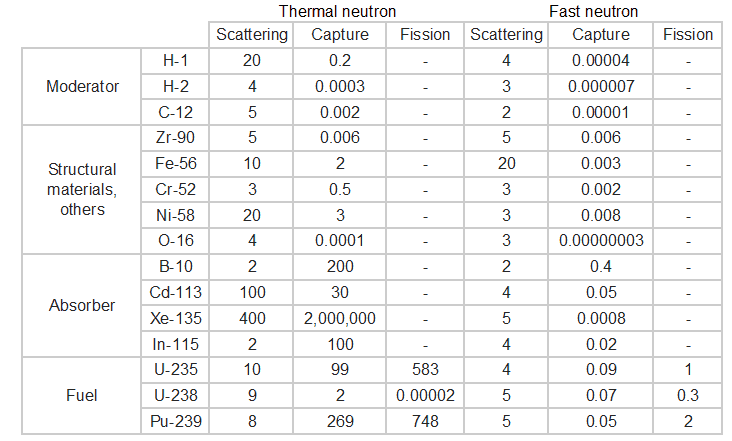
Table of cross-sections

Table of cross-sections.

Source: JANIS (Java-based Nuclear Data Information Software); The JEFF-3.1.1 Nuclear Data Library
Hydrogen. Neutron absorption and scattering. Comparison of cross-sections.

Source: JANIS (Java-based Nuclear Data Information Software); The JEFF-3.1.1 Nuclear Data Library

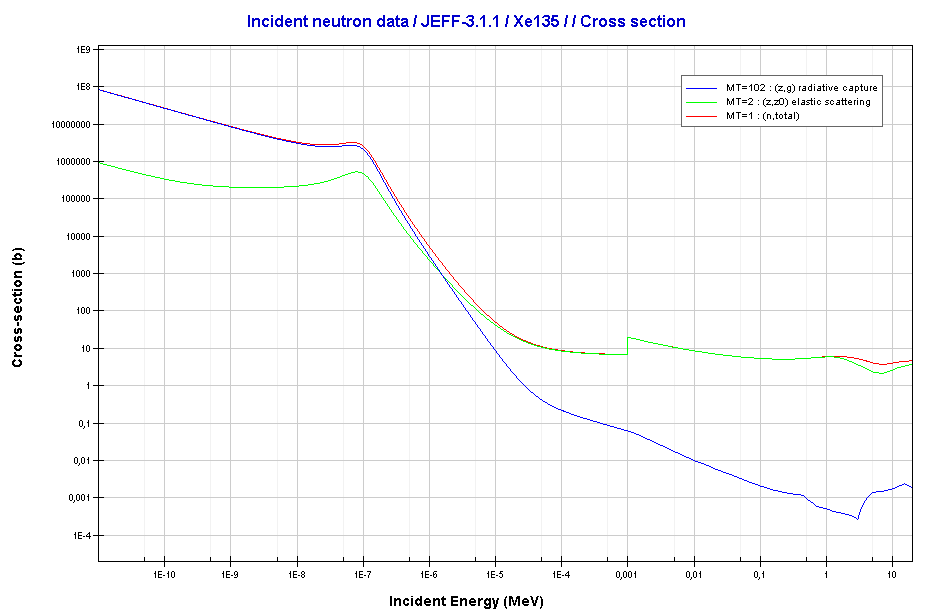
Xenon - 135. Neutron absorption and scattering. Comparison of cross-sections.
Xenon – 135. Neutron absorption and scattering. Comparison of cross-sections.

Source: JANIS (Java-based Nuclear Data Information Software); The JEFF-3.1.1 Nuclear Data Library

 
References:
Nuclear and Reactor Physics:
  1. J. R. Lamarsh, Introduction to Nuclear Reactor Theory, 2nd ed., Addison-Wesley, Reading, MA (1983).
  2. J. R. Lamarsh, A. J. Baratta, Introduction to Nuclear Engineering, 3d ed., Prentice-Hall, 2001, ISBN: 0-201-82498-1.
  3. W. M. Stacey, Nuclear Reactor Physics, John Wiley & Sons, 2001, ISBN: 0- 471-39127-1.
  4. Glasstone, Sesonske. Nuclear Reactor Engineering: Reactor Systems Engineering, Springer; 4th edition, 1994, ISBN: 978-0412985317
  5. W.S.C. Williams. Nuclear and Particle Physics. Clarendon Press; 1 edition, 1991, ISBN: 978-0198520467
  6. G.R.Keepin. Physics of Nuclear Kinetics. Addison-Wesley Pub. Co; 1st edition, 1965
  7. Robert Reed Burn, Introduction to Nuclear Reactor Operation, 1988.
  8. U.S. Department of Energy, Nuclear Physics and Reactor Theory. DOE Fundamentals Handbook, Volume 1 and 2. January 1993.

Advanced Reactor Physics:

  1. K. O. Ott, W. A. Bezella, Introductory Nuclear Reactor Statics, American Nuclear Society, Revised edition (1989), 1989, ISBN: 0-894-48033-2.
  2. K. O. Ott, R. J. Neuhold, Introductory Nuclear Reactor Dynamics, American Nuclear Society, 1985, ISBN: 0-894-48029-4.
  3. D. L. Hetrick, Dynamics of Nuclear Reactors, American Nuclear Society, 1993, ISBN: 0-894-48453-2.
  4. E. E. Lewis, W. F. Miller, Computational Methods of Neutron Transport, American Nuclear Society, 1993, ISBN: 0-894-48452-4.

See also:

See also:

Neutron Reactions

See also:

We hope, this article, Neutron Absorption, helps you. If so, give us a like in the sidebar. Main purpose of this website is to help the public to learn some interesting and important information about radiation and dosimeters.
What is Neutron Absorption Cross-section – Definition

The likelihood of a neutron absorption is represented by the absorption cross section as σa. Neutron Absorption Cross-section of many materials. Periodic Table

Neutron Absorption Cross-section

The likelihood of a neutron absorption is represented by the absorption cross section as σa. The relative likelihoods of an absorption reaction or a neutron scattering are represented by dividing the total cross section into scattering and absorption cross sections:

σt = σs + σa

Given a collision, σa / σt is the probability that the neutron will beabsorbed and σs / σt is the probability that the neutron will be scattered.

σa

Source: JANIS (Java-based Nuclear Data Information Software); The JEFF-3.1.1 Nuclear Data Library

Hydrogen. Neutron absorption and scattering. Comparison of cross-sections.

Source: JANIS (Java-based Nuclear Data Information Software); The JEFF-3.1.1 Nuclear Data Library

Xenon - 135. Neutron absorption and scattering. Comparison of cross-sections.
Xenon – 135. Neutron absorption and scattering. Comparison of cross-sections.

Source: JANIS (Java-based Nuclear Data Information Software); The JEFF-3.1.1 Nuclear Data Library

Table of cross-sections
Table of cross-sections.

 
References:
Nuclear and Reactor Physics:
  1. J. R. Lamarsh, Introduction to Nuclear Reactor Theory, 2nd ed., Addison-Wesley, Reading, MA (1983).
  2. J. R. Lamarsh, A. J. Baratta, Introduction to Nuclear Engineering, 3d ed., Prentice-Hall, 2001, ISBN: 0-201-82498-1.
  3. W. M. Stacey, Nuclear Reactor Physics, John Wiley & Sons, 2001, ISBN: 0- 471-39127-1.
  4. Glasstone, Sesonske. Nuclear Reactor Engineering: Reactor Systems Engineering, Springer; 4th edition, 1994, ISBN: 978-0412985317
  5. W.S.C. Williams. Nuclear and Particle Physics. Clarendon Press; 1 edition, 1991, ISBN: 978-0198520467
  6. G.R.Keepin. Physics of Nuclear Kinetics. Addison-Wesley Pub. Co; 1st edition, 1965
  7. Robert Reed Burn, Introduction to Nuclear Reactor Operation, 1988.
  8. U.S. Department of Energy, Nuclear Physics and Reactor Theory. DOE Fundamentals Handbook, Volume 1 and 2. January 1993.

Advanced Reactor Physics:

  1. K. O. Ott, W. A. Bezella, Introductory Nuclear Reactor Statics, American Nuclear Society, Revised edition (1989), 1989, ISBN: 0-894-48033-2.
  2. K. O. Ott, R. J. Neuhold, Introductory Nuclear Reactor Dynamics, American Nuclear Society, 1985, ISBN: 0-894-48029-4.
  3. D. L. Hetrick, Dynamics of Nuclear Reactors, American Nuclear Society, 1993, ISBN: 0-894-48453-2.
  4. E. E. Lewis, W. F. Miller, Computational Methods of Neutron Transport, American Nuclear Society, 1993, ISBN: 0-894-48452-4.

See also:

Neutron Absorption

We hope, this article, Neutron Absorption Cross-section, helps you. If so, give us a like in the sidebar. Main purpose of this website is to help the public to learn some interesting and important information about radiation and dosimeters.
What is Neutron Capture – Radiative Capture – Definition

The neutron capture is one of the possible absorption reactions that may occur. This capture reaction is also referred to as a radiative capture or (n, γ) reaction. Periodic Table

Neutron Capture – Radiative Capture

The neutron capture is one of the possible absorption reactions that may occur. In fact, for non-fissionable nuclei it is the only possible absorption reaction. Capture reactions result in the loss of a neutron coupled with the production of one or more gamma rays. This capture reaction is also referred to as a radiative capture or (n, γ) reaction, and its cross-section is denoted by σγ.

Neutron Absorption Reaction
The neutron absorption reaction is the most important type of reactions that take place in a nuclear reactor. The absorption reactions are reactions, where the neutron is completely absorbed and compound nucleus is formed. Therefore a variety of emissions or decays may follow. The most important absorption reactions are divided by the exit channel into two following reactions:
  • Radiative Capture. Most absorption reactions result in the loss of a neutron coupled with the production of one or more gamma rays. This is referred to as a capture reaction, and its cross-section is denoted by σγ.
  • Neutron-induced Fission Reaction. Some nuclei (fissionable nuclei) may undergo a fission event, leading to two or more fission fragments (nuclei of intermediate atomic weight) and a few neutrons. In a fissionable material, the neutron may simply be captured, or it may cause nuclear fission. For fissionable materials we thus divide the absorption cross section as σa = σγ + σf.
σγ
The radiative capture is a reaction, in which the incident neutron is completely absorbed and compound nucleus is formed. The compound nucleus then decays to its ground state by gamma emission. This process can occur at all incident neutron energies, but the probability of the interaction strongly depends on the incident neutron energy and also on the target energy (temperature). In fact the energy in the center-of-mass system determines this probability.

Neutron Capture at Small Neutron Flux

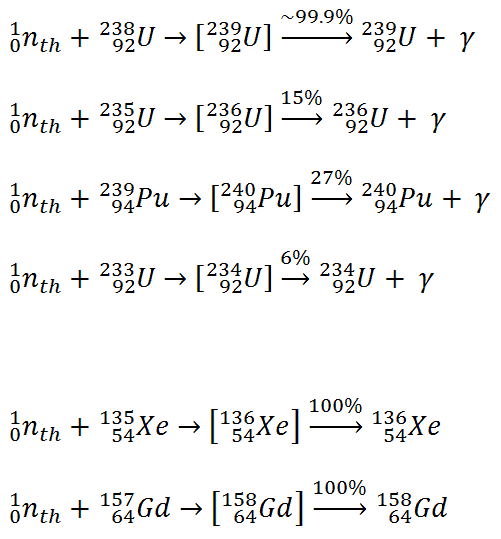
It must be noted we have to distinguish between radiative captures at small neutron flux and at high neutron flux. At small neutron flux, as in a nuclear reactor, the compound nucleus has time to decay between two neutron captures. The most usual capture reactions that occur inside a power reactor are below:

Neutron capture reactions which are of importance in power reactors.

Neutron Capture at High Neutron Flux

At very high flux the atomic nuclei do not necessarily have enough time to decay via beta particle emission between neutron captures. This happens inside stars, where a really tremendous flux may be reached. As a result of many capture reactions without beta decay the mass number rises by a large amount, while the atomic number stays the same. Only afterwards, the highly unstable nuclei decay via many β− decays to stabilize itself.

Since the process entails a succession of many rapid neutron captures, it is called the r-process. The r-process is a nucleosynthesis process that occurs in core-collapse supernovae and is responsible for the creation of approximately half of the neutron-rich atomic nuclei heavier than iron.

Uranium 238. Neutron absorption and scattering. Comparison of cross-sections.
Uranium 238. Comparison of cross-sections.Source: JANIS (Java-based Nuclear Data Information Software); The JEFF-3.1.1 Nuclear Data Library
Xenon - 135. Neutron absorption and scattering. Comparison of cross-sections.
Xenon – 135. Neutron absorption and scattering. Comparison of cross-sections.Source: JANIS (Java-based Nuclear Data Information Software); The JEFF-3.1.1 Nuclear Data Library
Hydrogen. Neutron absorption and scattering. Comparison of cross-sections.
Hydrogen. Neutron absorption and scattering. Comparison of cross-sections.Source: JANIS (Java-based Nuclear Data Information Software); The JEFF-3.1.1 Nuclear Data Library
Gadolinium 155 and 157. Comparison of radiative capture cross-sections.
Source: JANIS (Java-based Nuclear Data Information Software); The JEFF-3.1.1 Nuclear Data Library

Neutron Capture and Fuel Breeding

In reactor calculations, the neutron capture reaction is as important as the fission reaction. Its impact on the neutron balance is evident. But this reaction is of importance also from another point of view. Fissionable nuclei or even fissile nuclei may capture a neutron, this capture leads to formation of unstable nuclei with higher neutron number. Such unstable nuclei undergo a nuclear decay, which may lead to formation of another fissile nuclei. This process is also referred to as the nuclear transmutation and is responsible for new fuel breeding in nuclear reactors.

 
Plutonium 239 breeding
 n+_{92}^{238}textrm{U} {rightarrow} _{92}^{239}textrm{U}+gamma rightarrow _{93}^{239}textrm{Np} rightarrow _{94}^{239}textrm{Pu} 

Neutron capture may also be used to create fissile 239Pu from 238U, which is the dominant constituent of naturally occurring uranium (99.28%). Absorption of a neutron in the 238U nucleus yields 239U. The half-life of 239U is approximately 23.5 minutes. 239U decays (negative beta decay) to 239Np (neptunium), whose half-life is 2.36 days. 239Np decays (negative beta decay)  to 239Pu.

Uranium 233 breeding
n+_{90}^{232}textrm{Th} {rightarrow} _{90}^{232}textrm{Th}+gamma rightarrow _{91}^{233}textrm{Pa} rightarrow _{92}^{233}textrm{U}

232Th is the predominant isotope of natural thorium. If this fertile material is loaded in the nuclear reactor, the nuclei of 232Th absorb a neutron and become nuclei of 233Th. The half-life of 233Th is approximately 21.8 minutes. 233Th decays (negative beta decay) to 233Pa (protactinium), whose half-life is 26.97 days. 233Pa decays (negative beta decay)  to 233U, that is very good fissile material. On the other hand proposed reactor designs must attempt to physically isolate the protactinium from further neutron capture before beta decay can occur.

Radiative Capture Cross-section

The likelihood of a neutron radiative capture is represented by the radiative capture cross section as σγ. As usual, the cross-section can be divided into three regions according to the incident neutron energy.

  • 1/v Region
  • Resonance Region
  • Fast Neutrons Region

1/v Region

In the common case, the cross section is usually much larger at low energies than at high energies. For thermal neutrons (in 1/v region), also radiative capture cross-sections increase as the velocity (kinetic energy) of the neutron decreases. Therefore the 1/v Law can be used to determine shift in capture cross-section, if the neutron is in equilibrium with a surrounding medium. This phenomenon is due to the fact the nuclear force between the target nucleus and the neutron has a longer time to interact.

Resonance Region

The largest cross-sections are usually at neutron energies, that lead to long-lived states of the compound nucleus. The compound nuclei of these certain energies are referred to as nuclear resonances and its formation is typical in the resonance region. The widths of the resonances increase in general with increasing energies. At higher energies the widths may reach the order of the distances between resonances and then no resonances can be observed. The narrowest resonances are usually compound states of heavy nuclei (such as fissionable nuclei).

Since the mode of decay of the compound nucleus does not depend on the way the compound nucleus was formed, the nucleus sometimes emits a gamma ray (radiative capture) or sometimes emits a neutron (scattering). In order to understand the way, how a nucleus will stabilize itself, we have to understand the behaviour of compound nucleus.

The compound nucleus emits a neutron only after one neutron obtains an energy in collision with other nucleon greater than its binding energy in the nucleus. It have some delay, because the excitation energy of the compound nucleus is divided among several nucleons. It is obvious the average time that elapses before a neutron can be emitted is much longer for nuclei with large number of nucleons than when only a few nucleons are involved. It is a consequence of sharing the excitation energy among a large number of nucleons.

This is the reason the radiative capture is comparatively unimportant in light nuclei but becomes increasingly important in the heavier nuclei.

The lifetime of a compound nucleus is inversely proportional to its total width. Narrow resonances therefore correspond to capture while the wider resonances are due to scattering.

Table of cross-sections

Table of cross-sections.

Resonance region - Compound Nucleus
Radiative Capture Cross-section – region of resonances of 238U nuclei.
Source: JANIS (Java-based Nuclear Data Information Software); The JEFF-3.1.1 Nuclear Data Library
Compound state - resonance
ground state compound nucleus - excitation
Energy levels of compound state. For neutron absorption reaction on 238U the first resonance E1 corresponds to the excitation energy of 6.67eV. E0 is a base state of 239U.
radiative capture to elastic scattering cross-sections-
Radiative capture and elastic scattering cross-sections in 16O and 238U.
Example:

Source: R. Lamarsh, Introduction to Nuclear Reactor Theory, 2nd ed., Addison-Wesley, Reading, MA (1983).

The first resonance in 238U at 6.67 eV, which corresponds to the first virtual level in 239U, has a total width of only 0.027 eV, and the mean life of this state is 2.4×10⁻¹⁴s. By contrast, the resonance observed at 443 keV in 16O, which corresponds to the first virtual state in 17O, has a total width of 41 keV, giving a mean lifetime of 1.5×10⁻²¹s. Thus it is highly likely that the compound state in 239U decays at least to some extent by gamma ray emission, while compound state in 17O must decay primarily by nucleon emission. The 443-keV resonance in 16O is clearly a scattering resonance, whereas the 6.67-eV resonance in 238U is in part a capture resonance.

Doppler Broadening

In general, Doppler broadening is the broadening of spectral lines due to the Doppler effect caused by a distribution of kinetic energies of molecules or atoms. In reactor physics a particular case of this phenomenon is the thermal Doppler broadening of resonances caused by the thermal motion of the target particle in the nuclear fuel.

Doppler effect
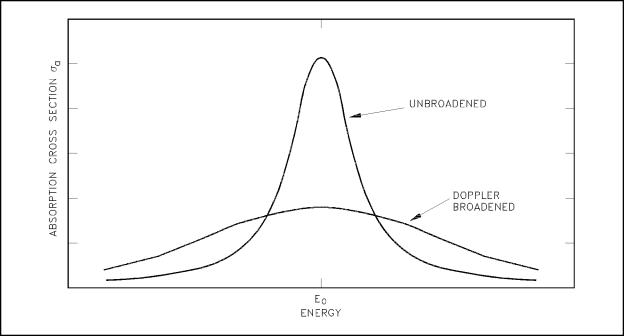
Doppler effect improves reactor stability. Broadened resonance (heating of a fuel) results in a higher probability of absorbtion, thus causes negative reactivity insertion (reduction of reactor power).

The Doppler broadening of resonances is very important phanomenon, which improves reactor stability. The prompt temperature coefficient of most thermal reactors is negative, owing to an nuclear Doppler effect. Although the absorbtion cross-section depends significantly on incident neutron energy, the shape of the cross-section curve depends also on target temperature.

Nuclei are located in atoms which are themselves in continual motion owing to their thermal energy. As a result of these thermal motions neutrons impinging on a target appears to the nuclei in the target to have a continuous spread in energy. This, in turn, has an effect on the observed shape of resonance. The resonance becomes shorter and wider than when the nuclei are at rest.

Although the shape of a resonance changes with temperature, the total area under the resonance remains essentially constant. But this does not imply constant neutron absorbtion. Despite the constant area under resonance, a resonance integral, which determines the absorbtion, increases with increasing target temperature. This, of course, decreases coefficient k (negative reactivity is inserted).

Fast Neutrons Region

The radiative capture cross-section at energies above the resonance region drops rapidly to very small values. This rapid drop is caused by the compound nucleus, which is formed in more highly-excited states. In these highly-excited states it is more likely that one neutron obtains an energy in collision with other nucleon greater than its binding energy in the nucleus. The neutron emission becomes dominant and gamma decay becomes less important. Moreover, at high energies, the inelastic scattering and (n,2n) reaction are highly probable at the expense of both elastic scattering and radiative capture.

 
References:
Nuclear and Reactor Physics:
  1. J. R. Lamarsh, Introduction to Nuclear Reactor Theory, 2nd ed., Addison-Wesley, Reading, MA (1983).
  2. J. R. Lamarsh, A. J. Baratta, Introduction to Nuclear Engineering, 3d ed., Prentice-Hall, 2001, ISBN: 0-201-82498-1.
  3. W. M. Stacey, Nuclear Reactor Physics, John Wiley & Sons, 2001, ISBN: 0- 471-39127-1.
  4. Glasstone, Sesonske. Nuclear Reactor Engineering: Reactor Systems Engineering, Springer; 4th edition, 1994, ISBN: 978-0412985317
  5. W.S.C. Williams. Nuclear and Particle Physics. Clarendon Press; 1 edition, 1991, ISBN: 978-0198520467
  6. G.R.Keepin. Physics of Nuclear Kinetics. Addison-Wesley Pub. Co; 1st edition, 1965
  7. Robert Reed Burn, Introduction to Nuclear Reactor Operation, 1988.
  8. U.S. Department of Energy, Nuclear Physics and Reactor Theory. DOE Fundamentals Handbook, Volume 1 and 2. January 1993.

Advanced Reactor Physics:

  1. K. O. Ott, W. A. Bezella, Introductory Nuclear Reactor Statics, American Nuclear Society, Revised edition (1989), 1989, ISBN: 0-894-48033-2.
  2. K. O. Ott, R. J. Neuhold, Introductory Nuclear Reactor Dynamics, American Nuclear Society, 1985, ISBN: 0-894-48029-4.
  3. D. L. Hetrick, Dynamics of Nuclear Reactors, American Nuclear Society, 1993, ISBN: 0-894-48453-2.
  4. E. E. Lewis, W. F. Miller, Computational Methods of Neutron Transport, American Nuclear Society, 1993, ISBN: 0-894-48452-4.

See also:

See also:

Neutron Reactions

See also:

We hope, this article, Neutron Capture – Radiative Capture, helps you. If so, give us a like in the sidebar. Main purpose of this website is to help the public to learn some interesting and important information about radiation and dosimeters.

What is Neutron Capture Cross-section – Definition

The likelihood of a neutron radiative capture is represented by the radiative capture cross-section with three regions: 1/v, resonance and fast region. Periodic Table

Neutron Capture Cross-section

The likelihood of a neutron radiative capture is represented by the radiative capture cross section as σγ. As usual, the cross-section can be divided into three regions according to the incident neutron energy.

  • 1/v Region
  • Resonance Region
  • Fast Neutrons Region

1/v Region

In the common case, the cross section is usually much larger at low energies than at high energies. For thermal neutrons (in 1/v region), also radiative capture cross-sections increase as the velocity (kinetic energy) of the neutron decreases. Therefore the 1/v Law can be used to determine shift in capture cross-section, if the neutron is in equilibrium with a surrounding medium. This phenomenon is due to the fact the nuclear force between the target nucleus and the neutron has a longer time to interact.

Resonance Region

The largest cross-sections are usually at neutron energies, that lead to long-lived states of the compound nucleus. The compound nuclei of these certain energies are referred to as nuclear resonances and its formation is typical in the resonance region. The widths of the resonances increase in general with increasing energies. At higher energies the widths may reach the order of the distances between resonances and then no resonances can be observed. The narrowest resonances are usually compound states of heavy nuclei (such as fissionable nuclei).

Since the mode of decay of the compound nucleus does not depend on the way the compound nucleus was formed, the nucleus sometimes emits a gamma ray (radiative capture) or sometimes emits a neutron (scattering). In order to understand the way, how a nucleus will stabilize itself, we have to understand the behaviour of compound nucleus.

The compound nucleus emits a neutron only after one neutron obtains an energy in collision with other nucleon greater than its binding energy in the nucleus. It have some delay, because the excitation energy of the compound nucleus is divided among several nucleons. It is obvious the average time that elapses before a neutron can be emitted is much longer for nuclei with large number of nucleons than when only a few nucleons are involved. It is a consequence of sharing the excitation energy among a large number of nucleons.

This is the reason the radiative capture is comparatively unimportant in light nuclei but becomes increasingly important in the heavier nuclei.

The lifetime of a compound nucleus is inversely proportional to its total width. Narrow resonances therefore correspond to capture while the wider resonances are due to scattering.

Example:

Source: R. Lamarsh, Introduction to Nuclear Reactor Theory, 2nd ed., Addison-Wesley, Reading, MA (1983).

The first resonance in 238U at 6.67 eV, which corresponds to the first virtual level in 239U, has a total width of only 0.027 eV, and the mean life of this state is 2.4×10⁻¹⁴s. By contrast, the resonance observed at 443 keV in 16O, which corresponds to the first virtual state in 17O, has a total width of 41 keV, giving a mean lifetime of 1.5×10⁻²¹s. Thus it is highly likely that the compound state in 239U decays at least to some extent by gamma ray emission, while compound state in 17O must decay primarily by nucleon emission. The 443-keV resonance in 16O is clearly a scattering resonance, whereas the 6.67-eV resonance in 238U is in part a capture resonance.

σγ

Table of cross-sections

Table of cross-sections.

Resonance region - Compound Nucleus
Radiative Capture Cross-section – region of resonances of 238U nuclei.

Source: JANIS (Java-based Nuclear Data Information Software); The JEFF-3.1.1 Nuclear Data Library

Compound state - resonance
Energy levels of compound state. For neutron absorption reaction on 238U the first resonance E1 corresponds to the excitation energy of 6.67eV. E0 is a base state of 239U.
ground state compound nucleus - excitation
Energy levels of compound state. For neutron absorption reaction on 238U the first resonance E1 corresponds to the excitation energy of 6.67eV. E0 is a base state of 239U.
radiative capture to elastic scattering cross-sections-
Radiative capture and elastic scattering cross-sections in 16O and 238U.

Doppler Broadening

In general, Doppler broadening is the broadening of spectral lines due to the Doppler effect caused by a distribution of kinetic energies of molecules or atoms. In reactor physics a particular case of this phenomenon is the thermal Doppler broadening of resonances caused by the thermal motion of the target particle in the nuclear fuel.

Doppler effect
Doppler effect improves reactor stability. Broadened resonance (heating of a fuel) results in a higher probability of absorbtion, thus causes negative reactivity insertion (reduction of reactor power).

The Doppler broadening of resonances is very important phanomenon, which improves reactor stability. The prompt temperature coefficient of most thermal reactors is negative, owing to an nuclear Doppler effect. Although the absorbtion cross-section depends significantly on incident neutron energy, the shape of the cross-section curve depends also on target temperature.

Nuclei are located in atoms which are themselves in continual motion owing to their thermal energy. As a result of these thermal motions neutrons impinging on a target appears to the nuclei in the target to have a continuous spread in energy. This, in turn, has an effect on the observed shape of resonance. The resonance becomes shorter and wider than when the nuclei are at rest.

Although the shape of a resonance changes with temperature, the total area under the resonance remains essentially constant. But this does not imply constant neutron absorbtion. Despite the constant area under resonance, a resonance integral, which determines the absorbtion, increases with increasing target temperature. This, of course, decreases coefficient k (negative reactivity is inserted).

Fast Neutrons Region

The radiative capture cross-section at energies above the resonance region drops rapidly to very small values. This rapid drop is caused by the compound nucleus, which is formed in more highly-excited states. In these highly-excited states it is more likely that one neutron obtains an energy in collision with other nucleon greater than its binding energy in the nucleus. The neutron emission becomes dominant and gamma decay becomes less important. Moreover, at high energies, the inelastic scattering and (n,2n) reaction are highly probable at the expense of both elastic scattering and radiative capture.

Cross-sections of key isotopes

Source: JANIS (Java-based Nuclear Data Information Software); The JEFF-3.1.1 Nuclear Data Library

Xenon - 135. Neutron absorption and scattering. Comparison of cross-sections.
Xenon – 135. Neutron absorption and scattering. Comparison of cross-sections.

Source: JANIS (Java-based Nuclear Data Information Software); The JEFF-3.1.1 Nuclear Data LibraryHydrogen. Neutron absorption and scattering. Comparison of cross-sections.

Hydrogen. Neutron absorption and scattering. Comparison of cross-sections.

Source: JANIS (Java-based Nuclear Data Information Software); The JEFF-3.1.1 Nuclear Data Library

Gadolinium 155 and 157. Comparison of radiative capture cross-sections.

Source: JANIS (Java-based Nuclear Data Information Software); The JEFF-3.1.1 Nuclear Data Library

 
References:
Nuclear and Reactor Physics:
  1. J. R. Lamarsh, Introduction to Nuclear Reactor Theory, 2nd ed., Addison-Wesley, Reading, MA (1983).
  2. J. R. Lamarsh, A. J. Baratta, Introduction to Nuclear Engineering, 3d ed., Prentice-Hall, 2001, ISBN: 0-201-82498-1.
  3. W. M. Stacey, Nuclear Reactor Physics, John Wiley & Sons, 2001, ISBN: 0- 471-39127-1.
  4. Glasstone, Sesonske. Nuclear Reactor Engineering: Reactor Systems Engineering, Springer; 4th edition, 1994, ISBN: 978-0412985317
  5. W.S.C. Williams. Nuclear and Particle Physics. Clarendon Press; 1 edition, 1991, ISBN: 978-0198520467
  6. G.R.Keepin. Physics of Nuclear Kinetics. Addison-Wesley Pub. Co; 1st edition, 1965
  7. Robert Reed Burn, Introduction to Nuclear Reactor Operation, 1988.
  8. U.S. Department of Energy, Nuclear Physics and Reactor Theory. DOE Fundamentals Handbook, Volume 1 and 2. January 1993.

Advanced Reactor Physics:

  1. K. O. Ott, W. A. Bezella, Introductory Nuclear Reactor Statics, American Nuclear Society, Revised edition (1989), 1989, ISBN: 0-894-48033-2.
  2. K. O. Ott, R. J. Neuhold, Introductory Nuclear Reactor Dynamics, American Nuclear Society, 1985, ISBN: 0-894-48029-4.
  3. D. L. Hetrick, Dynamics of Nuclear Reactors, American Nuclear Society, 1993, ISBN: 0-894-48453-2.
  4. E. E. Lewis, W. F. Miller, Computational Methods of Neutron Transport, American Nuclear Society, 1993, ISBN: 0-894-48452-4.

See also:

Radiative Capture

We hope, this article, Neutron Capture Cross-section, helps you. If so, give us a like in the sidebar. Main purpose of this website is to help the public to learn some interesting and important information about radiation and dosimeters.

What is Neutron Emission – Definition

The neutron emission is a reaction, in which a neutron is ejected from nucleus. and they may be referred to as neutron emission reactions. Neutron Emission. Periodic Table

Neutron Emission

The neutron emission is one of the radioactive decays, by which unstable nuclei may reach the stability. In general, this type of radioactive decay may occur, when nuclei contain significant excess of neutrons or excitation energy. In this type of decay a neutron is simply ejected from the nucleus.

Although the neutron emission is usually associated with nuclear decay, it must be also mentioned in connection with neutron nuclear reactions. Some neutrons interacts with a target nucleus via a compound nucleus. Among these compound nucleus reactions are also reactions, in which a neutron is ejected from nucleus and they may be referred to as neutron emission reactions. The point is that compound nuclei lose its excitation energy in a way, which is identical to the radioactive decay. Very important feature is the fact the mode of decay of compound nucleus does not depend on the way the compound nucleus was formed.
The compound nucleus reactions, in which neutron emission occurs, are:

  • Elastic Scattering Reaction. In some cases, if the kinetic energy of an incident neutron just right to form a resonance, the neutron may be absorbed and a compound nucleus may be formed. This interaction is more unusual (in comparison with potential scattering) and is also known as resonance elastic scattering. Due to formation of the compound nucleus, initial and final neutron are not the same and this reactions may be also referred to as one type of neutron emission reaction.
  • Inelastic Scattering Reaction. In this case, the connection with neutron emission is more obvious. In an inelastic scattering reaction between a neutron and a target nucleus some energy of the incident neutron is absorbed to the recoiling nucleus and the nucleus remains in the excited state. The neutron is emitted then with a lower kinetic energy. If the kinetic energy of an incident neutron is sufficient the double, triple, or more, neutron emission may take place. These events are referred to as (n, 2n), (n, 3n) or (n, …n) reactions. The probability of such reactions increases with increasing incident neutron energies.
  • Nuclear Fission. The fission reaction is very specific reaction and is of importance in many fields of nuclear engineering. It is known the fission reaction produces fission neutrons that are of importance in any chain-reacting system. But not all neutrons are released at the same time following fission. Even the nature of creation of these neutrons is different. From this point of view we usually divide the fission neutrons into two following groups:
    • Prompt Neutrons. Prompt neutrons are emitted directly from fission and they are emitted within very short time of about 10-14 second.
    • Delayed Neutrons. Delayed neutrons are emitted by neutron rich fission fragments that are called the delayed neutron precursors. These precursors usually undergo beta decay but a small fraction of them are excited enough to undergo neutron emission. The fact the neutron is produced via this type of decay and this happens orders of magnitude later compared to the emission of the prompt neutrons, plays an extremely important role in the control of the reactor.
 
References:
Nuclear and Reactor Physics:
  1. J. R. Lamarsh, Introduction to Nuclear Reactor Theory, 2nd ed., Addison-Wesley, Reading, MA (1983).
  2. J. R. Lamarsh, A. J. Baratta, Introduction to Nuclear Engineering, 3d ed., Prentice-Hall, 2001, ISBN: 0-201-82498-1.
  3. W. M. Stacey, Nuclear Reactor Physics, John Wiley & Sons, 2001, ISBN: 0- 471-39127-1.
  4. Glasstone, Sesonske. Nuclear Reactor Engineering: Reactor Systems Engineering, Springer; 4th edition, 1994, ISBN: 978-0412985317
  5. W.S.C. Williams. Nuclear and Particle Physics. Clarendon Press; 1 edition, 1991, ISBN: 978-0198520467
  6. G.R.Keepin. Physics of Nuclear Kinetics. Addison-Wesley Pub. Co; 1st edition, 1965
  7. Robert Reed Burn, Introduction to Nuclear Reactor Operation, 1988.
  8. U.S. Department of Energy, Nuclear Physics and Reactor Theory. DOE Fundamentals Handbook, Volume 1 and 2. January 1993.

Advanced Reactor Physics:

  1. K. O. Ott, W. A. Bezella, Introductory Nuclear Reactor Statics, American Nuclear Society, Revised edition (1989), 1989, ISBN: 0-894-48033-2.
  2. K. O. Ott, R. J. Neuhold, Introductory Nuclear Reactor Dynamics, American Nuclear Society, 1985, ISBN: 0-894-48029-4.
  3. D. L. Hetrick, Dynamics of Nuclear Reactors, American Nuclear Society, 1993, ISBN: 0-894-48453-2.
  4. E. E. Lewis, W. F. Miller, Computational Methods of Neutron Transport, American Nuclear Society, 1993, ISBN: 0-894-48452-4.

See also:

See also:

Neutron Reactions

See also:

We hope, this article, Neutron Emission, helps you. If so, give us a like in the sidebar. Main purpose of this website is to help the public to learn some interesting and important information about radiation and dosimeters.

What is Charged Particle Ejection – Definition

Charged particle reactions are nuclear reactions, in which target nucleus is excited to a high energy level and is able to eject a new charged particle. Periodic Table

Charged Particle Ejection

Charged particle reactions are usually associated with formation of a compound nucleus, which is excited to a high energy level, that such compound nucleus can eject a new charged particle while the incident neutron remains in the nucleus. After the new particle is ejected, the remaining nucleus is completely changed, but may or may not exist in an excited state depending upon the mass-energy balance of the reaction. This type of reaction is more common for charged particles as incident particles (such as alpha particles, protons, and so on).

The case of neutron-induced charged particle reactions is not so common, but there are some neutron-induced charged particle reactions, that are of importance in the reactivity control and also in the detection of neutrons.

The most important charged particle reactions in nuclear reactor physics are reactions of thermal neutrons with boron nuclei (rather with 10B nuclei). In nuclear industry boron is commonly used as a neutron absorber and a neutron converter (in neutron radiation detectors) due to its high neutron cross-section of isotope 10B along entire neutron energy spectrum. Its (n,alpha) reaction cross-section for thermal neutrons is about 3840 barns (for 0.025 eV neutron). Examples of neutron-induced charged particle reactions are shown below:

See also: Application of boron based materials
See also: Detection of neutrons

σ

Examples of (n,alpha) reactions

10B(n,alpha)7Li

This reaction is the most important (n,alpha) reaction of isotope 10B with thermal neutrons. This reaction can be used as in the case of neutron absorbers (chemical shim, burnable absorbers or control rods), and in the case of neutron converters (neutron detectors), because its cross-section is very high and produces energetic alpha particles.

(n,alpha) reactions of 10B

6Li(n,α)3H

This is a reaction allowing detection of neutrons. The reaction cross-section for thermal neutrons is σ = 925 barns and the natural lithium has abundance of 6Li 7,4%.

Boron 10. Comparison of total cross-section and cross-section for (n,alpha) reactions.
Source: JANIS (Java-based Nuclear Data Information Software); The JEFF-3.1.1 Nuclear Data Library
Boron 10. Comparison of total cross-section and cross-section for (n,alpha) reactions.

Source: JANIS (Java-based Nuclear Data Information Software); The JEFF-3.1.1 Nuclear Data Library

Examples of (n,p) reactions

3He(n,p)3H

This is a reaction allowing detection of neutrons. The reaction cross-section for thermal neutrons is σ = 5350 barns and the natural helium has abundance of isotope 3He 0.014%.

14N (n,p) 14C

This nuclear reaction continually take place especially in the earth’s atmosphere, forming equilibrium amounts of the radionuclide 14C. In nuclear power plants, it is important especially from radiation protection point of view. The reaction is responsible for most of the radiation dose delivered to the human body by thermal neutrons. The nitrogen atoms are contained in proteins, therefore if the human body is exposed to thermal neutrons, then these thermal neutrons may be absorbed by 14N, causing a proton emission. Protons are directly ionizing particles and deposit their energy over a very short distance in the body tissue.

Examples of (n,…) reactions

Cross-section of 10B(n,2alpha)T reaction.

10B(n,T + 2*alpha)

This threshold reaction of fast neutron with an isotope 10B is the main way, how radioactive tritium in primary circuit of all PWRs is generated. 10B is the principal source of radioactive tritium in primary circuit of all PWRs (which use boric acid as a chemical shim). Direct nuclear reactionNote that, this reaction occurs very rarely in comparison with the most common (n,alpha) reaction of isotope 10B with thermal neutrons.

There are more reactions with neutrons, which can rarely lead to formation of radioactive tritium, for example:

10B(n,alpha)7Li + 7Li(n,n+alpha)3H  – threshold reaction (~3 MeV).

 
References:
Nuclear and Reactor Physics:
  1. J. R. Lamarsh, Introduction to Nuclear Reactor Theory, 2nd ed., Addison-Wesley, Reading, MA (1983).
  2. J. R. Lamarsh, A. J. Baratta, Introduction to Nuclear Engineering, 3d ed., Prentice-Hall, 2001, ISBN: 0-201-82498-1.
  3. W. M. Stacey, Nuclear Reactor Physics, John Wiley & Sons, 2001, ISBN: 0- 471-39127-1.
  4. Glasstone, Sesonske. Nuclear Reactor Engineering: Reactor Systems Engineering, Springer; 4th edition, 1994, ISBN: 978-0412985317
  5. W.S.C. Williams. Nuclear and Particle Physics. Clarendon Press; 1 edition, 1991, ISBN: 978-0198520467
  6. G.R.Keepin. Physics of Nuclear Kinetics. Addison-Wesley Pub. Co; 1st edition, 1965
  7. Robert Reed Burn, Introduction to Nuclear Reactor Operation, 1988.
  8. U.S. Department of Energy, Nuclear Physics and Reactor Theory. DOE Fundamentals Handbook, Volume 1 and 2. January 1993.

Advanced Reactor Physics:

  1. K. O. Ott, W. A. Bezella, Introductory Nuclear Reactor Statics, American Nuclear Society, Revised edition (1989), 1989, ISBN: 0-894-48033-2.
  2. K. O. Ott, R. J. Neuhold, Introductory Nuclear Reactor Dynamics, American Nuclear Society, 1985, ISBN: 0-894-48029-4.
  3. D. L. Hetrick, Dynamics of Nuclear Reactors, American Nuclear Society, 1993, ISBN: 0-894-48453-2.
  4. E. E. Lewis, W. F. Miller, Computational Methods of Neutron Transport, American Nuclear Society, 1993, ISBN: 0-894-48452-4.

See also:

See also:

Neutron Reactions

See also:

We hope, this article, Charged Particle Ejection, helps you. If so, give us a like in the sidebar. Main purpose of this website is to help the public to learn some interesting and important information about radiation and dosimeters.

What is Tritium – Definition

Tritium is the only naturally-occurring radioisotope of hydrogen. Tritium is also a byproduct of the production of electricity by nuclear power plants. Periodic Table

Tritium

Tritium is the only naturally-occurring radioisotope of hydrogen. Its atomic number is naturally 1 which means there is 1 proton and 1 electron in the atomic structure. Unlike the hydrogen nucleus and deuterium nucleus, tritium has 2 neutrons in the nucleus. Tritium is naturally-occurring, but it is extremely rare. Tritium is produced in the atmosphere when cosmic rays collide with air molecules. Tritium is also a byproduct of the production of electricity by nuclear power plants. The name of this isotope is formed from the Greek word τρίτος (trítos) meaning “third”.

Decay of Tritium

Tritium is a radioactive isotope, bur it emits a very weak form of radiation, a low-energy beta particle that is similar to an electron. It is a pure beta emitter (i.e. beta emitter without an accompanying gamma radiation). The electron’s kinetic energy varies, with an average of 5.7 keV, while the remaining energy is carried off by the nearly undetectable electron antineutrino. Such a very low energy of electron causes, that the electron cannot penetrate the skin or even does not travel very far in air. Beta particles from tritium can penetrate only about 6.0 mm of air.

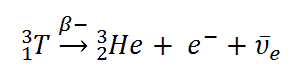
Tritium decays via negative beta decay into helium-3 with half-life of 12.3 years.

Decay of Tritium

3H

Tritium in nuclear reactors

Cross-section of 10B(n,2alpha)T reaction.

Tritium is a byproduct in nuclear reactors. Most important source (due to releases of tritiated water) of tritium in nuclear power plants stems from the boric acid, which is commonly used as a chemical shim to compensate an excess of initial reactivity. Main reactions, in which the tritium is generated from boron are below:

10B(n,T + 2*alpha)

This threshold reaction of fast neutron with an isotope 10B is the main way, how radioactive tritium in primary circuit of all PWRs is generated. 10B is the principal source of radioactive tritium in primary circuit of all PWRs (which use boric acid as a chemical shim). Direct nuclear reactionNote that, this reaction occurs very rarely in comparison with the most common (n,alpha) reaction of isotope 10B with thermal neutrons.

There are more reactions with neutrons, which can rarely lead to formation of radioactive tritium, for example:

10B(n,alpha)7Li + 7Li(n,n+alpha)3H  – threshold reaction (~3 MeV).

Boron 10. Comparison of total cross-section and cross-section for (n,alpha) reactions.
Source: JANIS (Java-based Nuclear Data Information Software); The JEFF-3.1.1 Nuclear Data Library[/caption
Boron 10. Comparison of total cross-section and cross-section for (n,alpha) reactions.

Source: JANIS (Java-based Nuclear Data Information Software); The JEFF-3.1.1 Nuclear Data Library

Tritium is also a fission product (ternary fission) of the splitting of fissionable materials. In fact, fission probably produces more tritium than all other sources in Light Water Reactors. Its production (yield) is of about one atom per each 10,000 fissions. On the other hand only a very small fraction of the fission-product tritium diffuses out of the fuel matrix and fuel cladding into the primary coolant.

Tritium is also produced in reaction with 6Li.

6Li(n,α)3H

This is a reaction allowing detection of neutrons, but in some cases, LiOH is added to control the pH of primary coolant in some LWR. The reaction cross-section for thermal neutrons is σ = 925 barns and the natural lithium has abundance of 6Li 7,4%.

Tritium occurs in nuclear power plants in the form of tritiated water. Tritiated water is like normal water, but is very very weakly radioactive. Therefore it dose not pose a hazard to human health. The releases of tritiated water are closely monitored by plant operators and state supervisors.

Reference: Jacobs D.G. Sources of Tritium and Its Behaviour Upon Release to the Environment. US Atomic Energy Commission, 1968.

Tritium in Nature

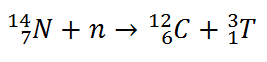
Tritium is produced in the atmosphere when cosmic rays collide with air molecules. In the most important reaction for natural production, a fast neutron (which must have energy greater than 4.0 MeV) interacts with atmospheric nitrogen:

Worldwide, the production of tritium from natural sources is 148 petabecquerels per year. In result, the tritiated water produced participates in the water cycle.

  • about 400 Bq/m3 in continental water
  • about 100 Bq/m3 in oceans

Tritium poses a risk to health as a result of internal exposure only following ingestion in drinking water or food, or inhalation or absorption through the skin. The tritium taken into the body is uniformly distributed among all soft tissues. An average annual dose from natural tritium intake is 0.01 μSv.

In case of artificial tritium ingestion or inhalation, a biological half-time of tritium is 10 days for HTO and 40 days for OBT (organically bound tritium) formed from HTO in the body of adults. It was also shown that the biological half-time of HTO depends strongly on many variables and varies from about 4 to 18 days. During the warmer months, the average half-life is lower, which is attributed to increased water intake. As well as, drinking larger amounts of alcohol will reduce the biological half-life of water in the body.

See also: Tritium in Nature

See also:

Glossary

We hope, this article, Tritium, helps you. If so, give us a like in the sidebar. Main purpose of this website is to help the public to learn some interesting and important information about radiation and dosimeters.

What is Liquid Drop Model of Nucleus – Definition

According to the liquid drop model, the atomic nucleus behaves like the molecules in a drop of liquid. But in this nuclear scale, the fluid is made of nucleons (protons and neutrons). Periodic Table

Liquid Drop Model of Nucleus

Liquid Drop ModelOne of the first models which could describe very well the behavior of the nuclear binding energies and therefore of nuclear masses was the mass formula of von Weizsaecker (also called the semi-empirical mass formula – SEMF), that was published in 1935 by German physicist Carl Friedrich von Weizsäcker. This theory is based on the liquid drop model proposed by George Gamow.

According to this model, the atomic nucleus behaves like the molecules in a drop of liquid. But in this nuclear scale, the fluid is made of nucleons (protons and neutrons), which are held together by the strong nuclear force. The liquid drop model of the nucleus takes into account the fact that the nuclear forces on the nucleons on the surface are different from those on nucleons in the interior of the nucleus. The interior nucleons are completely surrounded by other attracting nucleons. Here is the analogy with the forces that form a drop of liquid.

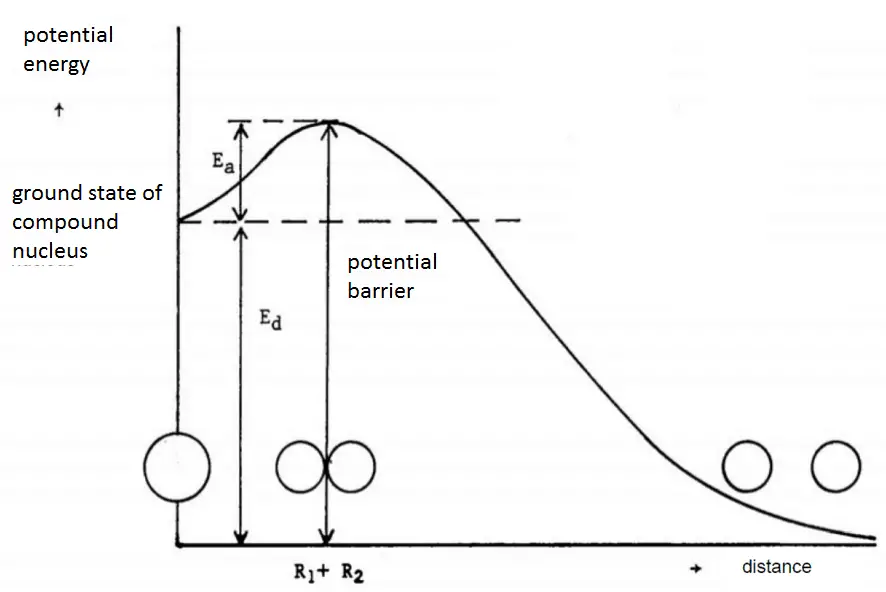
In the ground state the nucleus is spherical. If the sufficient kinetic or binding energy is added, this spherical nucleus may be distorted into a dumbbell shape and then may be splitted into two fragments. Since these fragments are a more stable configuration, the splitting of such heavy nuclei must be accompanied by energy release. This model does not explain all the properties of the atomic nucleus, but does explain the predicted nuclear binding energies.

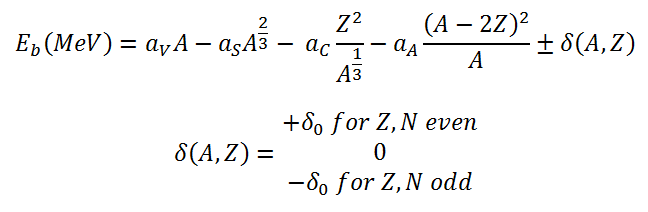
The nuclear binding energy as a function of the mass number A and the number ofprotons Z based on the liquid drop model can be written as:Weizsaecker formula - semi-empirical mass formulaThis formula is called the Weizsaecker Formula (or the semi-empirical mass formula). The physical meaning of this equation can be discussed term by term.

 
Volume term
Volume term – aV.A. The first two terms describe a spherical liquid drop of an incompressible fluid with a contribution from the volume scaling with A and from the surface, scaling with A2/3. The first positive term aV.A is known as the volume term and it is caused by the attracting strong forces between the nucleons. The strong force has a very limited range and a given nucleon may only interact with its direct neighbours. Therefore this term is proportional to A, instead of A2. The coefficient aV is usually about ~ 16 MeV.
Surface term
Surface term – asf.A2/3. The surface term is also based on the strong force, it is, in fact, a correction to the volume term. The point is that particles at the surface of the nucleus are not completely surrounded by other particles. In the volume term, it is suggested that each nucleon interacts with a constant number of nucleons, independent of A. This assumption is very nearly true for nucleons deep within the nucleus, but causes an overestimation of the binding energy on the surface. By analogy with a liquid drop this effect is indicated as the surface tension effect. If the volume of the nucleus is proportional to A, then the geometrical radius should be proportional to A1/3 and therefore the surface term must be proportional to the surface area i.e. proportional to A2/3.
Coulomb term
Coulomb term – aC.Z2.A-⅓. This term describes the Coulomb repulsion between the uniformly distributed protons and is proportional to the number of proton pairs Z2/R, whereby R is proportional to A1/3. This effect lowers the binding energy because of the repulsion between charges of equal sign.
Asymmetry term
Asymmetry term – aA.(A-2Z)2/A. This term cannot be described as ‘classically’ as the first three. This effect is not based on any of the fundamental forces, this effect is based only on the Pauli exclusion principle (no two fermions can occupy exactly the same quantum state in an atom). The heavier nuclei contain more neutrons than protons. These extra neutrons are necessary for stability of the heavier nuclei. They provide (via the attractive forces between the neutrons and protons) some compensation for the repulsion between the protons. On the other hand, if there are significantly more neutrons than protons in a nucleus, some of the neutrons will be higher in energy level in the nucleus. This is the basis for a correction factor, the so-called symmetry term.
Pairing term
Pairing term – δ(A,Z). The last term is the pairing term δ(A,Z). This term captures the effect of spin-coupling. Nuclei with an even number of protons and an even number of neutrons are (due to Pauli exclusion principle) very stable thanks to the occurrence of ‘paired spin’. On the other hand, nuclei with an odd number of protons and neutrons are mostly unstable.
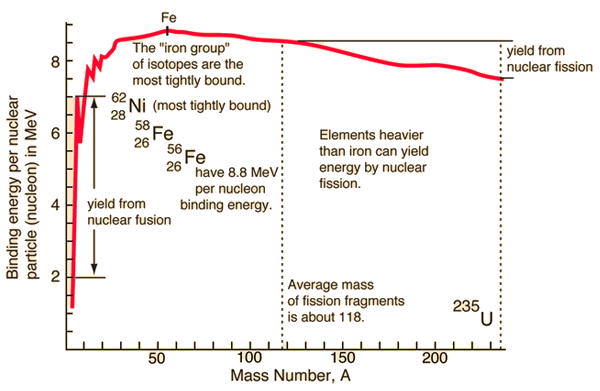
Nuclear binding energy curve.
Source: hyperphysics.phy-astr.gsu.edu

With the aid of the Weizsaecker formula the binding energy can be calculated very well for nearly all isotopes. This formula provides a good fit for heavier nuclei. For light nuclei, especially for 4He, it provides a poor fit. The main reason is the formula does not consider the internal shell structure of the nucleus.

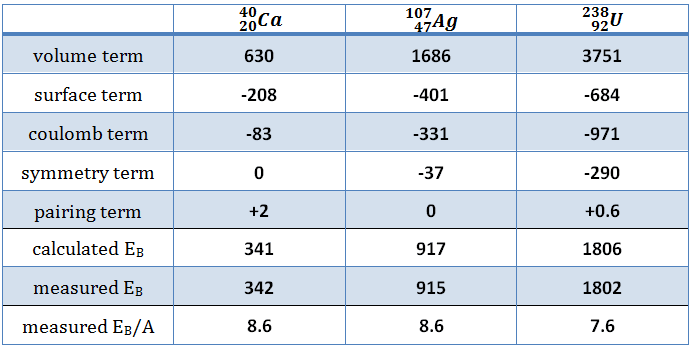
In order to calculate the binding energy, the coefficients aV, aS, aC, aA and aP must be known. The coefficients have units of megaelectronvolts (MeV) and are calculated by fitting to experimentally measured masses of nuclei. They usually vary depending on the fitting methodology. According to ROHLF, J. W., Modern Physics from α to Z0 , Wiley, 1994., the coefficients in the equation are following:Weizsaecker formula - semi-empirical mass formulaUsing the Weizsaecker formula, also the mass of an atomic nucleus can be derived and is given by:

m = Z.mp +N.mn -Eb/c2

where mp and mn are the rest mass of a proton and a neutron, respectively, and Eb is the nuclear binding energy of the nucleus.From the nuclear binding energy curve and from the table it can be seen that, in the case of splitting a 235U nucleus into two parts, the binding energy of the fragments (A ≈ 120) together is larger than that of the original 235U nucleus.

According to the Weizsaecker formula, the total energy released for such reaction will be approximately 235 x (8.5 – 7.6) ≈ 200 MeV.

the semi-empirical mass formula - weizsaecker formula
Table of binding energies fo some nuclides. Calculated according to the semi-empirical mass formula.
Critical Energy - Threshold Energy
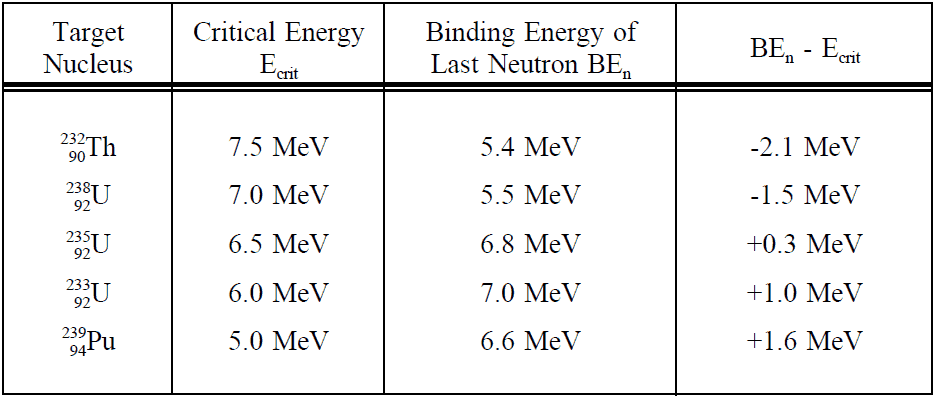
The minimum excitation energy required for fission to occur is known as the critical energy (Ecrit) or threshold energy.
Critical Energy to Binding Energy
This table shows critical energies compared to binding energies of the last neutron of a number of nuclei.

[/lgc_column]

See also:

Binding Energy

See also:

Nuclear Fission

See also:

Critical Energy

We hope, this article, Liquid Drop Model of Nucleus, helps you. If so, give us a like in the sidebar. Main purpose of this website is to help the public to learn some interesting and important information about radiation and dosimeters.

What is Weizsaecker Formula – Semi-empirical Mass Formula – Definition

With the aid of the Weizsaecker formula (the semi-empirical mass formula) the binding energy can be calculated very well for nearly all isotopes. Periodic Table

Weizsaecker Formula – Semi-empirical Mass Formula

Weizsaecker formula - semi-empirical mass formulaThis formula is called the Weizsaecker Formula (or the semi-empirical mass formula). The physical meaning of this equation can be discussed term by term.

 
Volume term
Volume term – aV.A. The first two terms describe a spherical liquid drop of an incompressible fluid with a contribution from the volume scaling with A and from the surface, scaling with A2/3. The first positive term aV.A is known as the volume term and it is caused by the attracting strong forces between the nucleons. The strong force has a very limited range and a given nucleon may only interact with its direct neighbours. Therefore this term is proportional to A, instead of A2. The coefficient aV is usually about ~ 16 MeV.
Surface term
Surface term – asf.A2/3. The surface term is also based on the strong force, it is, in fact, a correction to the volume term. The point is that particles at the surface of the nucleus are not completely surrounded by other particles. In the volume term, it is suggested that each nucleon interacts with a constant number of nucleons, independent of A. This assumption is very nearly true for nucleons deep within the nucleus, but causes an overestimation of the binding energy on the surface. By analogy with a liquid drop this effect is indicated as the surface tension effect. If the volume of the nucleus is proportional to A, then the geometrical radius should be proportional to A1/3 and therefore the surface term must be proportional to the surface area i.e. proportional to A2/3.
Coulomb term
Coulomb term – aC.Z2.A-⅓. This term describes the Coulomb repulsion between the uniformly distributed protons and is proportional to the number of proton pairs Z2/R, whereby R is proportional to A1/3. This effect lowers the binding energy because of the repulsion between charges of equal sign.
Asymmetry term
Asymmetry term – aA.(A-2Z)2/A. This term cannot be described as ‘classically’ as the first three. This effect is not based on any of the fundamental forces, this effect is based only on the Pauli exclusion principle (no two fermions can occupy exactly the same quantum state in an atom). The heavier nuclei contain more neutrons than protons. These extra neutrons are necessary for stability of the heavier nuclei. They provide (via the attractive forces between the neutrons and protons) some compensation for the repulsion between the protons. On the other hand, if there are significantly more neutrons than protons in a nucleus, some of the neutrons will be higher in energy level in the nucleus. This is the basis for a correction factor, the so-called symmetry term.
Pairing term
Pairing term – δ(A,Z). The last term is the pairing term δ(A,Z). This term captures the effect of spin-coupling. Nuclei with an even number of protons and an even number of neutrons are (due to Pauli exclusion principle) very stable thanks to the occurrence of ‘paired spin’. On the other hand, nuclei with an odd number of protons and neutrons are mostly unstable.
Table of Calculated Binding Energies
the semi-empirical mass formula - weizsaecker formula
Table of binding energies fo some nuclides. Calculated according to the semi-empirical mass formula.
Nuclear binding energy curve.
Source: hyperphysics.phy-astr.gsu.edu

With the aid of the Weizsaecker formula the binding energy can be calculated very well for nearly all isotopes. This formula provides a good fit for heavier nuclei. For light nuclei, especially for 4He, it provides a poor fit. The main reason is the formula does not consider the internal shell structure of the nucleus.

In order to calculate the binding energy, the coefficients aV, aS, aC, aA and aP must be known. The coefficients have units of megaelectronvolts (MeV) and are calculated by fitting to experimentally measured masses of nuclei. They usually vary depending on the fitting methodology. According to ROHLF, J. W., Modern Physics from α to Z0 , Wiley, 1994., the coefficients in the equation are following:Weizsaecker formula - semi-empirical mass formulaUsing the Weizsaecker formula, also the mass of an atomic nucleus can be derived and is given by:m = Z.mp +N.mn -Eb/c2

where mp and mn are the rest mass of a proton and a neutron, respectively, and Eb is the nuclear binding energy of the nucleus.

From the nuclear binding energy curve and from the table it can be seen that, in the case of splitting a 235U nucleus into two parts, the binding energy of the fragments (A ≈ 120) together is larger than that of the original 235U nucleus.

According to the Weizsaecker formula, the total energy released for such reaction will be approximately 235 x (8.5 – 7.6) ≈ 200 MeV.

See also: Liquid Drop Model

See also:

Nuclear Fission

We hope, this article, Weizsaecker Formula – Semi-empirical Mass Formula, helps you. If so, give us a like in the sidebar. Main purpose of this website is to help the public to learn some interesting and important information about radiation and dosimeters.