What is Critical Energy – Threshold Energy for Fission – Definition

Critical Energy – Threshold Energy for Fission. The minimum excitation energy required for fission to occur is known as the critical energy (Ecrit) or threshold energy. Periodic Table

Critical Energy – Threshold Energy for Fission

In principle, any nucleus, if brought into sufficiently high excited state, can be splitted. For fission to occur, the excitation energy must be above a particular value for certain nuclide. The minimum excitation energy required for fission to occur is known as the critical energy (Ecrit) or threshold energy.The critical energy depends on the nuclear structure and is quite large for light nuclei with Z < 90. For heavier nuclei with Z > 90, the critical energy is about 4 to 6 MeV for A-even nuclei, and generally is much lower for A-odd nuclei. It must be noted, some heavy nuclei (eg. 240Pu or 252Cf) exhibit fission even in the ground state (without externally added excitation energy). This phenomena is known as the spontaneous fission. This process occur without the addition of the critical energy by the quantum-mechanical process of quantum tunneling through the Coulomb barrier (similarly like alpha particles in the alpha decay). The spontaneous fission contributes to ensure sufficient neutron flux on source range detectors when reactor is subcritical in long term shutdown.

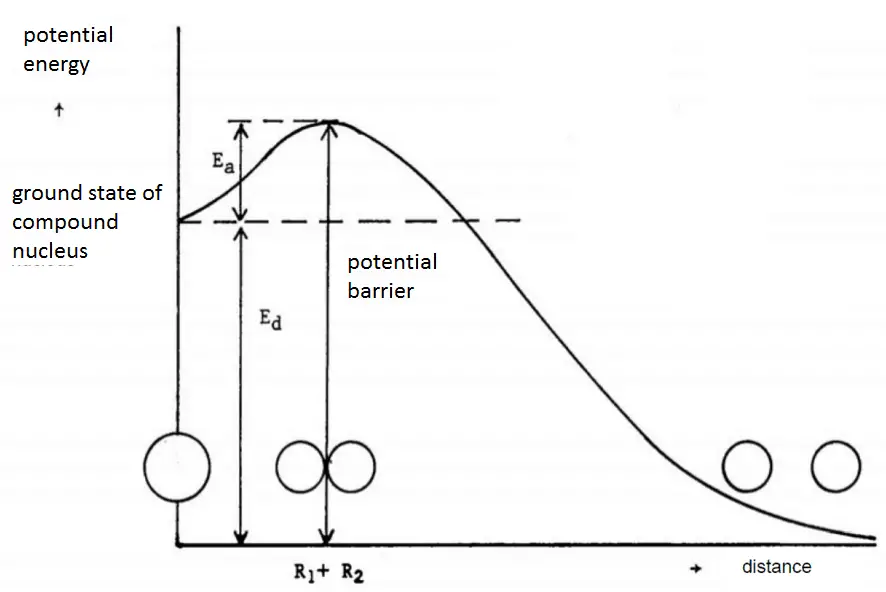
The amount of excitation energy required for fission to occur can be estimated from the magnitude of the electrostatic potential barrier and the dissociation energy of the fission.

In the figure, it is considered the potential energy of the fissioning nucleus as a function of the distance r between the two separating lobes. In order to deform the nucleus into a dumbbell shape, the sufficient kinetic or binding energy must be added to the system. This is due to the fact, nucleons attract one another and energy is required to increase the average distance between them. After the energy is added, the resulting nucleus is in an intermediate state with a larger potential energy than was the potential energy of original nucleus. The height of the potential barrier may be approximated given by:

Ec = Z1.Z2.e2 / (4.π.ε0.(R1+R2))

where R1 and R2 are the respective nuclear radii and ε0 is the permittivity of the vacuum. If this point is reached, the two lobes of the dumbbell begin to separate.

The dissociation energy Ed is equal to the difference between the binding energy of the compound nucleus to be fissioned and the sum of the binding energies of the fission fragments. The minimum activation energy Ea that has to be added to a nucleus to cause fission reaction is thus Ec – Ed.
Critical Energy - Threshold Energy
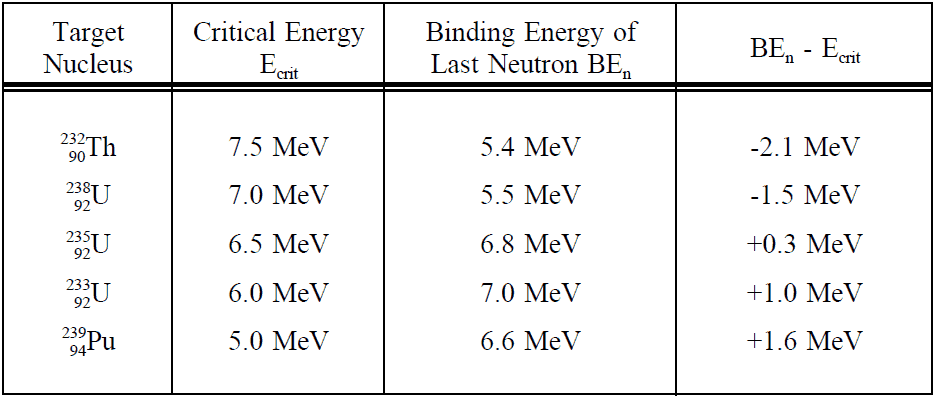
The minimum excitation energy required for fission to occur is known as the critical energy (Ec) or threshold energy.The activation energy Ea of nuclides with mass numbers below about 230 is very large, spontaneous fission of these nuclides does not occur. On the other hand nuclei with atomic numbers A > 260 have negative activation energies, so that these nuclei must undergo a decay or they can undergo spontaneous fission. The following table shows critical energies compared to binding energies of the last neutron of a number of nuclei.

All fissioning nuclei do not split in the same way. Although the mass of the initial nucleus is well defined in a reaction, the masses of resulting fission fragments are not. This is the reason there is no single Q-value, but what is usually referred to as the fission Q-value is actually an average of Q-values over all ways of fission.
Critical Energy to Binding Energy
This table shows critical energies compared to binding energies of the last neutron of a number of nuclei.For nuclei lighter than uranium the critical energies are considerably higher (e.g. Ec ~ 20MeV for 208Pb). This is the reason only the heaviest nuclei are of importance in nuclear engineering.

The excitation energy can be added to a nucleus by a neutron, but it is not the only way, how to induce fission. The excitation energy can be added also by bombardment with photons (photofission) or charged particles. In reactor engineering, the most attractive method of causing fission, however, is by forming a compound nucleus with the aid of a neutron.

In the case of neutron-induced fission reactions, an incident neutron provides additional energy to a target nucleus in the form of the kinetic energy and the nuclear binding energy. Neutrons have the principal advantage, they do not need to overcome the coulomb forces as in the case of charged particles.

It can be seen from the table that for fission of 238U or 232Th the neutron must have some additional kinetic energy (negative BEn – Ecrit value), while absorption of a neutron without kinetic energy can already cause fission of 235U (or 233U, 239Pu). For example, according to the table , the binding energy of the last neutron in 236U is 6.8 MeV (target nucleus is 235U), while the critical energy is only 6.5 MeV. Thus, when a thermal neutron is absorbed by 235U, the compound nucleus 236U is produced at about 0.3 MeV above the critical energy and the nucleus splits immediately. Nuclei such as 235U that lead to fission following the absorption of thermal neutron are called fissile nuclei.

For heavy nuclides with atomic number of higher than 90, most of fissile isotopes meet the fissile rule:

Fissile isotopes have 2 x Z – N = 43 ± 2 (example for 235U: 2 x 92 – 143 = 41)

where Z is number of protons and N is number of neutrons.
In general, the heavy nuclei with an odd number of neutrons (235U, 233U, 239Pu and 241Pu) can easily be split, because the neutron that is absorbed to form a compound nucleus with these nuclei is an ‘even’ neutron, so that the binding energy due to the pairing effect is large.

On the other hand, the heavy nuclei with an even number of neutrons (232Th, 238U, 240Pu and 242Pu) have a threshold energy (the kinetic energy) for fission by neutrons, because the absorbed neutron is an ‘odd’ neutron and this neutron makes relatively little binding energy available. For these nuclides fission is thus a threshold reaction.

For example, according to the table, the binding energy of the last neutron in 239U is only 5.5 MeV (target nucleus is 238U), while the critical energy is 7.0 MeV. Thus, when a thermal neutron is absorbed by 238U, fission cannot occur. In order to cause fission of 238U, the incident neutron must have additional kinetic energy. Nuclei such as 238U that lead to fission following the absorption of fast neutron are called fissionable nuclei. It must be noted, also a 208Pb nucleus may be fissioned when struck by a high energy neutron of about 20MeV, but this nucleus is not ordinarily said to be fissionable.

When a nucleus is excited above the potential barrier, it is not sure that fission will occur. Most of absorption reactions result in fission reaction (σf = 585 barns), but a minority results in radiative capture forming 236U. The radiative capture is a reaction, in which the compound nucleus decays to its ground state by gamma emission.The cross-section for radiative capture for thermal neutrons is about 99 barns (for 0.0253 eV neutron). Therefore about 15% of all absorption reactions result in radiative capture of neutron. About 85% of all absorption reactions result in fission.

Uranium absorption reaction

See also: Uranium 235 Fission

See also: Plutonium 239 Fission

See also:

Liquid Drop Model

See also:

Nuclear Fission

See also:

Energy Release

We hope, this article, Critical Energy – Threshold Energy for Fission, helps you. If so, give us a like in the sidebar. Main purpose of this website is to help the public to learn some interesting and important information about radiation and dosimeters.
What is Photoneutron – Definition

Photoneutrons are neutrons produced also in (γ, n) reactions and therefore they are usually referred to as photoneutrons. Photoneutron precursors can be also grouped by their decay constant. Periodic Table

Photoneutrons

In nuclear reactors the gamma radiation plays a significant role also in reactor kinetics and in a subcriticality control. Especially in nuclear reactors with D2O moderator (CANDU reactors) or with Be reflectors (some experimental reactors). Neutrons can be produced also in (γ, n) reactions and therefore they are usually referred to as photoneutrons.

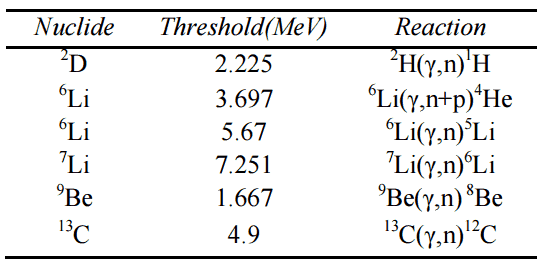
A high energy photon (gamma ray) can under certain conditions eject a neutron from a nucleus. It occurs when its energy exceeds the binding energy of the neutron in the nucleus. Most nuclei have binding energies in excess of 6 MeV, which is above the energy of most gamma rays from fission.On the other hand there are few nuclei with sufficiently low binding energy to be of practical interest. These are: 2D, 9Be, 6Li, 7Li and 13C. As can be seen from the table the lowest threshold have 9Be with 1.666 MeV and 2D with 2.226 MeV.

Photoneutron sources
Nuclides with low photodisintegration
threshold energies.

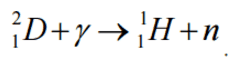
In case of deuterium, neutrons can be produced by the interaction of gamma rays (with a minimum energy of 2.22 MeV) with deuterium:Photoneutron - deuteriumBecause gamma rays can be emitted by fission products with certain delays, and the process is very similar to that through which a “true” delayed neutron is emitted, photoneutrons are usually treated no differently than regular delayed neutrons in the kinetic calculations. Photoneutron precursors can be also grouped by their decay constant, similarly to “real” precursors. The table below shows the relative importance of source neutrons in CANDU reactors by showing the makeup of the full power flux.Photoneutron balanceDespite the fact photoneutrons are of importance especially in CANDU reactors, deuterium nuclei are always present (~0.0156%) also in the light water of LWRs. Moreover the capture of neutrons in the hydrogen nucleus of the water molecules in the moderator yields small amounts of D2O. This enhances the heavy water concentration. Therefore also in LWRs kinetic calculations, photoneutrons from D2O are treated as additional groups of delayed neutrons having characteristic decay constants λj and effective group fractions.

After a nuclear reactor has been operated at full power for some time there will be a considerable build-up of gamma rays from the fission products. This high gamma flux from short-lived fission products will decrease rapidly after shutdown. In the long term the photoneutron source decreases with the decay of long-lived fission products that produce delayed high-energy gamma rays and the photoneutron source drops slowly, decreasing a little each day. The longest-lived fission product with gamma ray energy above the threshold is 140Ba with a half-life of 12.75 days.

The amount of fission products present in the fuel elements depends on how long has been the reactor operated before shut-down and at which power level has been the reactor operated before shut-down. Photoneutrons are usually major source in a reactor and ensure sufficient neutron flux on source range detectors when reactor is subcritical in long term shutdown.

In comparison with fission neutrons, that make a self-sustaining chain reaction possible, delayed neutrons make reactor control possible and photoneutrons are of importance at low power operation.

 
References:
Nuclear and Reactor Physics:
  1. J. R. Lamarsh, Introduction to Nuclear Reactor Theory, 2nd ed., Addison-Wesley, Reading, MA (1983).
  2. J. R. Lamarsh, A. J. Baratta, Introduction to Nuclear Engineering, 3d ed., Prentice-Hall, 2001, ISBN: 0-201-82498-1.
  3. W. M. Stacey, Nuclear Reactor Physics, John Wiley & Sons, 2001, ISBN: 0- 471-39127-1.
  4. Glasstone, Sesonske. Nuclear Reactor Engineering: Reactor Systems Engineering, Springer; 4th edition, 1994, ISBN: 978-0412985317
  5. W.S.C. Williams. Nuclear and Particle Physics. Clarendon Press; 1 edition, 1991, ISBN: 978-0198520467
  6. G.R.Keepin. Physics of Nuclear Kinetics. Addison-Wesley Pub. Co; 1st edition, 1965
  7. Robert Reed Burn, Introduction to Nuclear Reactor Operation, 1988.
  8. U.S. Department of Energy, Nuclear Physics and Reactor Theory. DOE Fundamentals Handbook, Volume 1 and 2. January 1993.

Advanced Reactor Physics:

  1. K. O. Ott, W. A. Bezella, Introductory Nuclear Reactor Statics, American Nuclear Society, Revised edition (1989), 1989, ISBN: 0-894-48033-2.
  2. K. O. Ott, R. J. Neuhold, Introductory Nuclear Reactor Dynamics, American Nuclear Society, 1985, ISBN: 0-894-48029-4.
  3. D. L. Hetrick, Dynamics of Nuclear Reactors, American Nuclear Society, 1993, ISBN: 0-894-48453-2.
  4. E. E. Lewis, W. F. Miller, Computational Methods of Neutron Transport, American Nuclear Society, 1993, ISBN: 0-894-48452-4.

See also:

Eight Groups

See also:

Delayed Neutrons

See also:

Energy Spectra

We hope, this article, Photoneutron, helps you. If so, give us a like in the sidebar. Main purpose of this website is to help the public to learn some interesting and important information about radiation and dosimeters.

What is Thermal Neutron – Definition

Thermal neutrons are neutrons in thermal equilibrium with a surrounding medium. Thermal neutron’s most probable energy at 17°C (62°F) is 0.025 eV (~2 km/s).

Thermal Neutron – Reactors

Free neutrons can be classified according to their kinetic energy. This energy is usually given in electron volts (eV). The term temperature can also describe this energy representing thermal equilibrium between a neutron and a medium with a certain temperature.

Thermal Neutrons are neutrons in thermal equilibrium with a surrounding medium of temperature 290K (17 °C or 62 °F). Most probable energy at 17°C (62°F) for Maxwellian distribution is 0.025 eV (~2 km/s). This part of neutron’s energy spectrum constitutes most important part of spectrum in thermal reactors.

Thermal neutrons have a different and often much larger effective neutron absorption cross-section (fission or radiative capture) for a given nuclide than fast neutrons. Therefore the criticality of a thermal reactor can be achieved with a much lower enrichment of nuclear fuel.

Moreover, thermal neutrons are in the 1/v region and the cross-section behaves according to the 1/v Law. In this region absorption cross-section increases as the velocity (kinetic energy) of the neutron decreases. Therefore the 1/v Law can be used to determine shift in absorbtion cross-section, if the neutron is in equilibrium with a surrounding medium. This phenomenon is due to the fact the nuclear force between the target nucleus and the neutron has a longer time to interact.

See also: Compound Nucleus Reactions

sigma_a sim frac{1}{v}}} sim frac{1}{sqrt{E}}}}} sim frac{1}{sqrt{T}}}}}

Example of cross- sections in 1/v region:

The absorbtion cross-section for 238U at 20°C = 293K (~0.0253 eV) is:

sigma_a(293K) = 2.68b .

The absorbtion cross-section for 238U at 1000°C = 1273K is equal to:

Neutron Cross-section - 1-v law

This cross-section reduction is caused only due to the shift of temperature of surrounding medium.

Neutron energies in thermal reactor
Distribution of kinetic energies of neutrons in the thermal reactor. The fission neutrons (fast flux) are immediately slowed down to the thermal energies via a process called neutron moderation.
Source: serc.carleton.edu
1/v Law
For thermal neutrons (in 1/v region), absorption cross sections increases as the velocity (kinetic energy) of the neutron decreases.
Source: JANIS 4.0

Thermal Neutron – Diffraction

Thermal neutrons are also widely used in neutron diffraction experiments. Neutron diffraction experiments use an elastic neutron scattering to determine the atomic (or magnetic) structure of a material. The neutron diffraction is based the fact that thermal or cold neutrons have the wavelengths similar to atomic spacings.

An examined sample (crystalline solids, gasses, liquids or amorphous materials) must be placed in a neutron beam of thermal (0.025 eV) or cold (neutrons in thermal equilibrium with very cold surroundings such as liquid deuterium) neutrons to obtain a diffraction pattern that provides information about the structure of the examined material. The neutron diffraction experiments are similar to X-ray diffraction experiments, but neutrons interact with matter differently. Photons (X-rays) interact primarily with the electrons surrounding (atomic electron cloud) a nucleus, but neutrons interact only with nuclei. Neither the electrons surrounding (atomic electron cloud) a nucleus nor the electric field caused by a positively charged nucleus affect a neutron’s flight. Due to their different properties, both methods together (neutron diffraction and X-ray diffraction) can provide complementary information about the structure of the material.

Neutron diffraction - applications
Simple scheme of neutron diffraction experiment.
Source: www.psi.ch

See also:

Neutron

Click edit button to change this text.

We hope, this article, Thermal Neutron, helps you. If so, give us a like in the sidebar. Main purpose of this website is to help the public to learn some interesting and important information about radiation and dosimeters.

What is Neutron Elastic Scattering – Definition

Neutron elastic scattering is the most important process for slowing down neutrons. Total kinetic energy of the system is conserved in elastic scattering. Periodic Table

Neutron Elastic Scattering

Generally, a neutron scattering reaction occurs when a target nucleus emits a single neutron after a neutron-nucleus interaction. In an elastic scattering reaction between a neutron and a target nucleus, there is no energy transferred into nuclear excitation. The elastic scattering conserves both momentum and kinetic energy of the “system”. It may be modeled as a billiard ball collision between a neutron and a nucleus.

σs
There is usually some transfer of kinetic energy from the incident neutron to the target nucleus. The target nucleus gains the exact amount of kinetic energy that the neutron loses. This interaction can take place via compound nucleus formation, but, in case of elastic scattering, a neutron emission returns the compound nucleus to the ground state of the original nucleus. Therefore the initial and final neutrons do not need to be necessarily the same. The elastic scattering can occur by way of two interaction mechanisms:
  • Potential scattering. In potential scattering, the neutron and the nucleus interact without neutron absorption and the formation of a compound nucleus. In fact, the incident neutron does not necessarily have to “touch” the nucleus and the neutron is scattered by the short range nuclear forces when it approaches close enough to the nucleus. Potential scattering occurs with incident neutrons that have an energy of up to about 1 MeV. It may be modeled as a billiard ball collision between a neutron and a nucleus.
  • Compound-elastic scattering. In some cases, if the kinetic energy of an incident neutron just right to form a resonance, the neutron may be absorbed and a compound nucleus may be formed. This interaction is more unusual and is also known as resonance elastic scattering. Due to formation of the compound nucleus, initial and final neutron are not the same.

Conservation of momentum and kinetic energy

conservation of momentum and energy

where:

mn = mass of the neutron
mT = mass of the target nucleus T
vn,i = initial neutron speed
vn,f = final neutron speed
vT,i = initial target speed
vT,f = final target speed

Key Characteristics of Elastic Scattering

  • Elastic scattering is the most important process for slowing down neutrons.
  • Total kinetic energy of the system is conserved in elastic scattering.
  • In this process, energy lost by the neutron is transferred to the recoiling nucleus.
  • Maximum energy transfer is occurred with an head-on collision.
  • Kinetic energy of the recoiled nucleus depends on the recoiled angle φ of the nucleus.
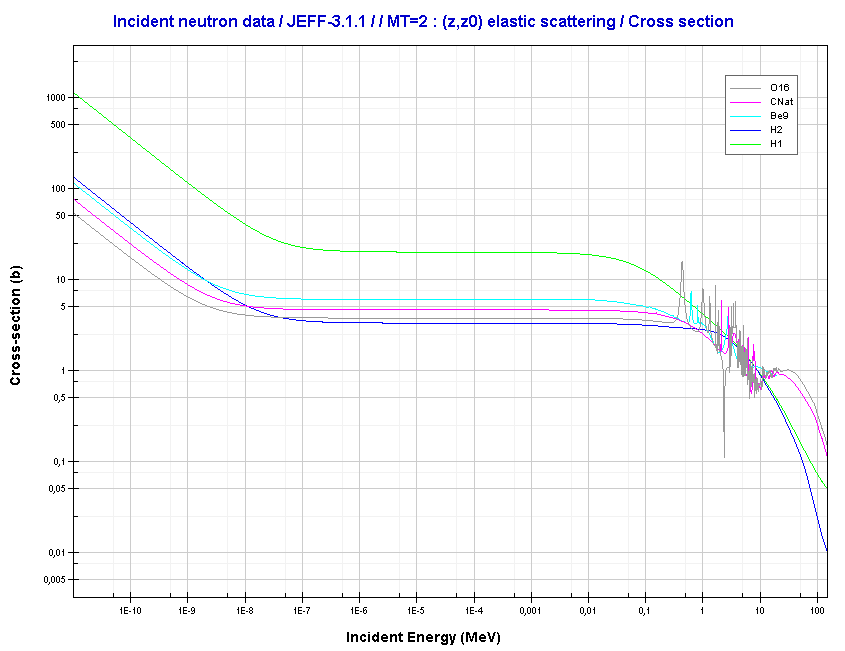
  • Elastic scattering cross-sections for light elements are more or less independent of neutron energy up to 1 MeV.
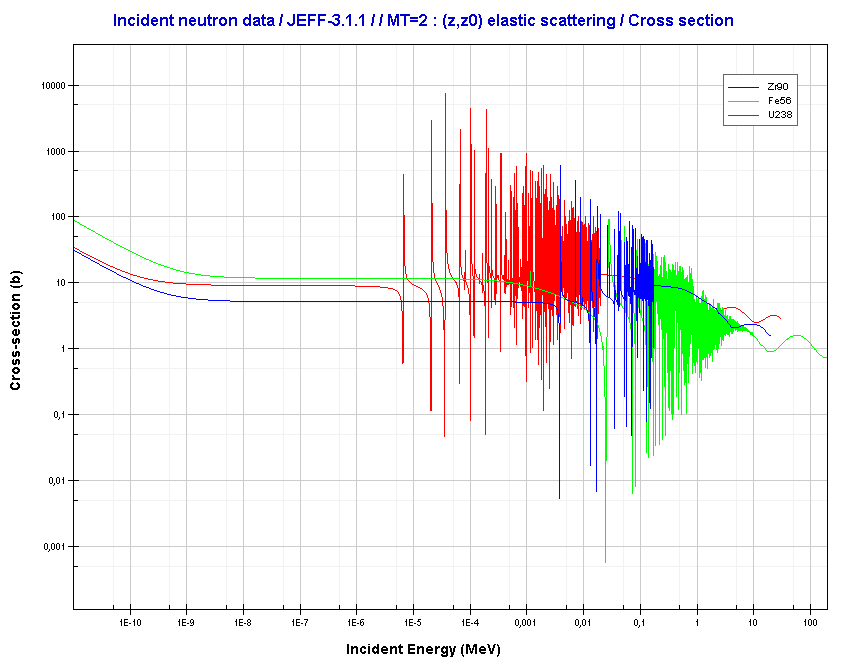
  • For intermediate and heavy elements, the elastic cross-section is constant at low energy with some specifics at higher energy.
  • A good approximation is, σs = const, for all elements, that are of importance.
  • At low energy, σs can be described by the one-level Breit-Wigner formula.
  • Nearly all elements have scattering cross-sections in the range of 2 to 20 barns.
  • The important exception is for water and heavy water.
  • If the kinetic energy of an incident neutron is large compared with the chemical binding energy of the atoms in a molecule, the chemical bound can be ignored.
  • If the kinetic energy of an incident neutron is of the order or less than the chemical binding energy, the cross-section of the molecule is not equal to the sum of cross-sections of its individual nuclei.
  • Scattering of slow neutrons by molecules is greater than by free nuclei.
  • Therefore one nucleus microscopic cross-sections do not describe the process correctly, while the macroscopic cross-section (Σs) has a precise meaning.
Scattering of slow neutrons by molecules is greater than by free nuclei.
If the kinetic energy of an incident neutron is large compared with the chemical binding energy of the atoms in a molecule, the chemical bound can be ignored.
If the kinetic energy of an incident neutron is of the order or less than the chemical binding energy, the cross-section of the molecule is not equal to the sum of cross-sections of its individual nuclei.
Elastic scattering of molecules.

Elastic Scattering Cross-section

To be an effective moderator, the probability of elastic reaction between neutron and the nucleus must be high. In terms of cross-sections, the elastic scattering cross section of a moderator’s nucleus must be high.

Elastic scattering cross-sections for light elements
Elastic scattering cross-sections for light elements are more or less independent of neutron energy up to 1 MeV.

Source: JANIS (Java-based Nuclear Data Information Software); The JEFF-3.1.1 Nuclear Data Library

Elastic scattering cross-sections for heavy elements
For intermediate and heavy elements, the elastic cross-section is constant at low energy with some specifics at higher energy.

Source: JANIS (Java-based Nuclear Data Information Software); The JEFF-3.1.1 Nuclear Data Library

Elastic Scattering and Neutron Moderators

As can be seen, a high elastic scattering cross-section is important, but does not describe comprehensively capabilities of moderators. In order to describe capabilities of a material to slow down neutrons, three new material variables must be defined:

  • The Average Logarithmic Energy Decrement (ξ)
  • The Macroscopic Slowing Down Power (MSDP)
  • The Moderating Ratio (MR)
Key properties of neutron moderators:
  • high cross-section for neutron scattering
  • high energy loss per collision
  • low cross-section for absorption
  • high melting and boiling point
  • high thermal conductivity
  • high specific heat capacity
  • low viscosity
  • low activity
  • low corrosive
  • cheap
 
Average Logarithmic Energy Decrement
During the scattering reaction, a fraction of the neutron’s kinetic energy is transferred to the nucleus. Using the laws of conservation of momentum and energy and the analogy of collisions of billiard balls for elastic scattering, it is possible to derive the following equation for the mass of target or moderator nucleus (M), energy of incident neutron (Ei) and the energy of scattered neutron (Es).

equation momentum energy

where A is the atomic mass number.

In case of the hydrogen (A = 1) as the target nucleus, the incident neutron can be completely stopped. But this works when the direction of the neutron is completely reversed (i.e. scattered at 180°). In reality, the direction of scattering ranges from 0 to 180 ° and the energy transferred also ranges from 0% to maximum. Therefore, the average energy of scattered neutron is taken as the average of energies with scattering angle 0 and 180°.

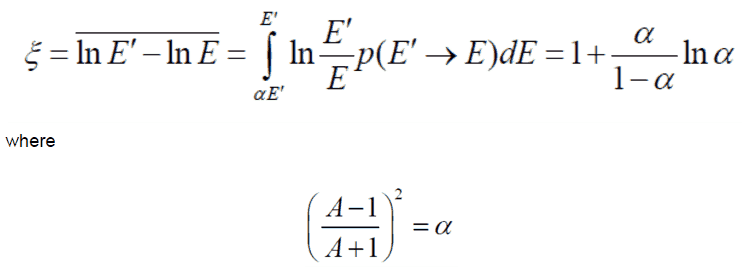
Moreover, it is useful to work with logarithmic quantities and therefore one defines the logarithmic energy decrement per collision (ξ) as a key material constant describing energy transfers during a neutron slowing down. ξ is not dependent on energy, only on A and is defined as follows:

logarithmic energy decrement - equation

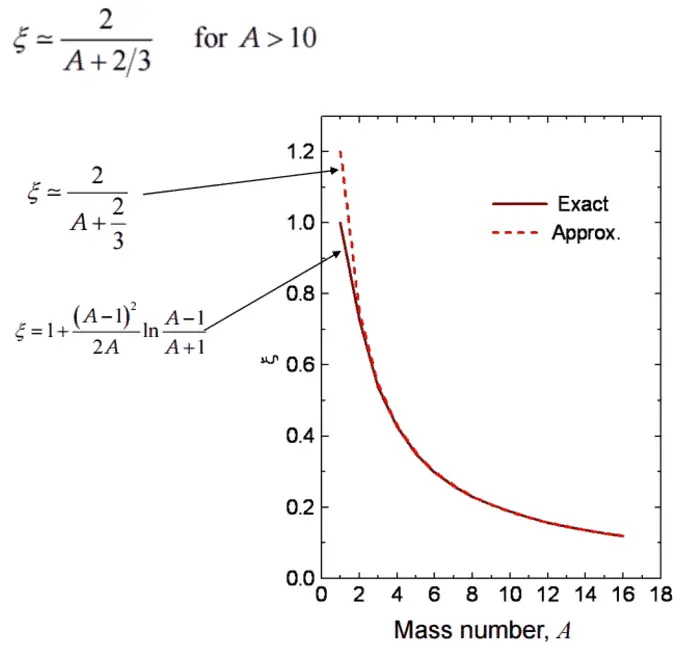
For heavy target nuclei, ξ may be approximated by following formula:
the logarithmic energy decrement per collision

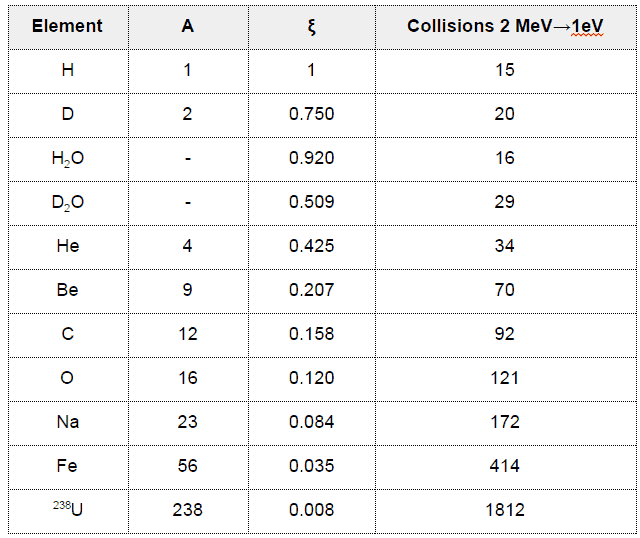
From these equations it is easy to determine the number of collisions required to slow down a neutron from, for example from 2 MeV to 1 eV.

Example:
Determine the number of collisions required for thermalization for the 2 MeV neutron in the carbon.
ξCARBON = 0.158
N(2MeV → 1eV) = ln 2⋅106/ξ =14.5/0.158 = 92

Table of average logarithmic energy decrement for some elements
Table of average logarithmic energy decrement for some elements.

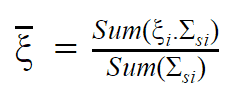
For a mixture of isotopes:

the logarithmic energy decrement for mixtures

Macroscopic Slowing Down Power
We have defined the probability of elastic scattering reaction, we have defined the average energy loss during the reaction. The product of these variables (the logarithmic energy decrement and the macroscopic cross section for scattering in the material) is the macroscopic slowing down power (MSDP).

MSDP = ξ . Σs

The MSDP describes the ability of a given material to slow down neutrons and indicates how rapidly a neutron will slow down in the material, but it does not fully reflect the effectiveness of the material as a moderator. In fact, the material with high MSDP can slow down neutrons with high efficiency, but it can be a poor moderator because of its high probability of absorbing neutrons. It is typical, for example, for boron, which has a high slowing down power but is absolutely inappropriate as a moderator.

The most complete measure of the effectiveness of a moderator is the Moderating Ratio (MR), where:

MR  = ξ . Σs/Σa

Table of macroscopic slowing down power MSDP for some materials.
Moderating Ratio
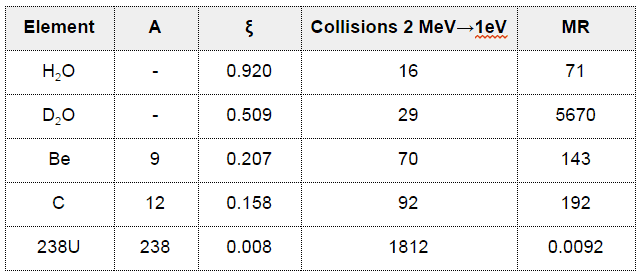
The moderating ratio or moderator quality is the most complete measure of the effectiveness of a moderator because it takes into account also the absorption effects. When absorption effects are high, most of the neutrons will be absorbed by moderator, leading to lower moderation or lower availability of thermal neutrons.

Therefore a higher ratio of MSDP to absorbtion cross sections ξ . Σs/Σa is desirable for effective moderation. This ratio is called the moderating ratio – MR and can be used as a criterion for comparison of different moderators.

Examples:

  • Light water has the highest ξ and σs among the moderators (resulting in the highest MSDP) shown in the table, but its moderating ratio is low due to its relatively higher absorption cross section.
  • On the other hand, heavy water has lower ξ and σs, but it has the highest moderating ratio owing to its lowest neutron absorption cross-section.
  • Graphite has much heavier nuclei than hydrogen in water, despite the fact graphite has much lower ξ and σs, it is better moderator than light water due to its lower absorption cross-section compared to that of light water.
Table of moderating ratios MR for some materials.
Table of moderating ratios for some materials.
 
References:
Nuclear and Reactor Physics:
  1. J. R. Lamarsh, Introduction to Nuclear Reactor Theory, 2nd ed., Addison-Wesley, Reading, MA (1983).
  2. J. R. Lamarsh, A. J. Baratta, Introduction to Nuclear Engineering, 3d ed., Prentice-Hall, 2001, ISBN: 0-201-82498-1.
  3. W. M. Stacey, Nuclear Reactor Physics, John Wiley & Sons, 2001, ISBN: 0- 471-39127-1.
  4. Glasstone, Sesonske. Nuclear Reactor Engineering: Reactor Systems Engineering, Springer; 4th edition, 1994, ISBN: 978-0412985317
  5. W.S.C. Williams. Nuclear and Particle Physics. Clarendon Press; 1 edition, 1991, ISBN: 978-0198520467
  6. G.R.Keepin. Physics of Nuclear Kinetics. Addison-Wesley Pub. Co; 1st edition, 1965
  7. Robert Reed Burn, Introduction to Nuclear Reactor Operation, 1988.
  8. U.S. Department of Energy, Nuclear Physics and Reactor Theory. DOE Fundamentals Handbook, Volume 1 and 2. January 1993.

Advanced Reactor Physics:

  1. K. O. Ott, W. A. Bezella, Introductory Nuclear Reactor Statics, American Nuclear Society, Revised edition (1989), 1989, ISBN: 0-894-48033-2.
  2. K. O. Ott, R. J. Neuhold, Introductory Nuclear Reactor Dynamics, American Nuclear Society, 1985, ISBN: 0-894-48029-4.
  3. D. L. Hetrick, Dynamics of Nuclear Reactors, American Nuclear Society, 1993, ISBN: 0-894-48453-2.
  4. E. E. Lewis, W. F. Miller, Computational Methods of Neutron Transport, American Nuclear Society, 1993, ISBN: 0-894-48452-4.

See also:

See also:

Neutron Reactions

See also:

We hope, this article, Neutron Elastic Scattering, helps you. If so, give us a like in the sidebar. Main purpose of this website is to help the public to learn some interesting and important information about radiation and dosimeters.

What is Neutron Inelastic Scattering – Definition

Inelastic scattering reaction is a collision between a neutron and a target nucleus. The nucleus remains in the excited state. Neutron Inelastic Scattering. Periodic Table

Neutron Inelastic Scattering

Generally, a neutron scattering reaction occurs when a target nucleus emits a single neutron after a neutron-nucleus interaction. In an elastic scattering reaction between a neutron and a target nucleus, there is no energy transferred into nuclear excitation.

σi
Besides, in an inelastic scattering reaction between a neutron and a target nucleus some energy of the incident neutron is absorbed to the recoiling nucleus and the nucleus remains in the excited state. Thus while momentum is conserved in an inelastic collision, kinetic energy of the “system” is not conserved.

In inelastic neutron scattering, the incident neutron is absorbed by the target nucleus and the interaction take place via compound nucleus formation. The compound nucleus emits then a neutron of lower kinetic energy which leaves the original nucleus in an excited state. The nucleus gives up excitation energy by emitting one or more gamma rays to reach its ground state. In comparison to elastic scattering reactions, it is not easy to write an expression for the average energy loss of inelastic scattering reactions because it depends on the energy levels within the target nucleus.

Inelastic scattering occurs above a threshold energy. This threshold energy is higher than the energy the first excited state of target nucleus (due to the laws of conservation) and it is given by following formula:

Et = ((A+1)/A)* ε1

where Et is known as the inelastic threshold energy and ε1 is the energy of the first excited state.

In general, the energy of the first excited state of nuclei decreases with increasing mass number. Therefore an inelastic scattering plays an important role in slowing down neutrons especially at high energies and by heavy nuclei. In calculations of a reactor inelastic scattering by light nuclei (such as oxygen with Et = 6.42 MeV) can ordinarily be ignored. Moreover, the hydrogen nucleus does not have excited states, so only an elastic scattering reaction can occur in that case.

On the other hand an inelastic scattering by uranium nuclei (especially by 238U) must be included. 238U is a major component of nuclear fuel in commercial power reactors, therefore its scattering data are one of the most important data in the neutron transport calculations in the reactor core.

See also: Inelastic Scattering and Capture Cross-section Data of Major Actinides in the Fast Neutron Region, INDC(NDS)-0597. IAEA, 12/2012.

Key Characteristics of Inelastic Scattering

  • During an inelastic scattering the neutron is absorbed and then re-emitted.
  • While momentum is conserved in an inelastic collision, kinetic energy of the “system” is not conserved.
  • Some energy of the incident neutron is absorbed to the recoiling nucleus and the nucleus remains in the excited state.
  • The nucleus gives up excitation energy by emitting one or more gamma rays.
  • General notation: A(n, n’)A* or A(n, 2n’)B; Example: 14O(n, n’)14O*.
  • Inelastic scattering is a threshold reaction and occurs above a threshold energy.
  • Inelastic scattering cross section is relatively small for light nuclei.
  • For hydrogen nucleus, inelastic scattering does not occur, because it does not have excited states.
  • Inelastic scattering plays an important role in slowing down neutrons especially at high energies and by heavy nuclei (e.g. 238U).
  • Inelastic scattering may be significant for heterogeneous reactors with highly enriched fuel (e.g. in fast neutron reactors).
Inelastic neutron scattering

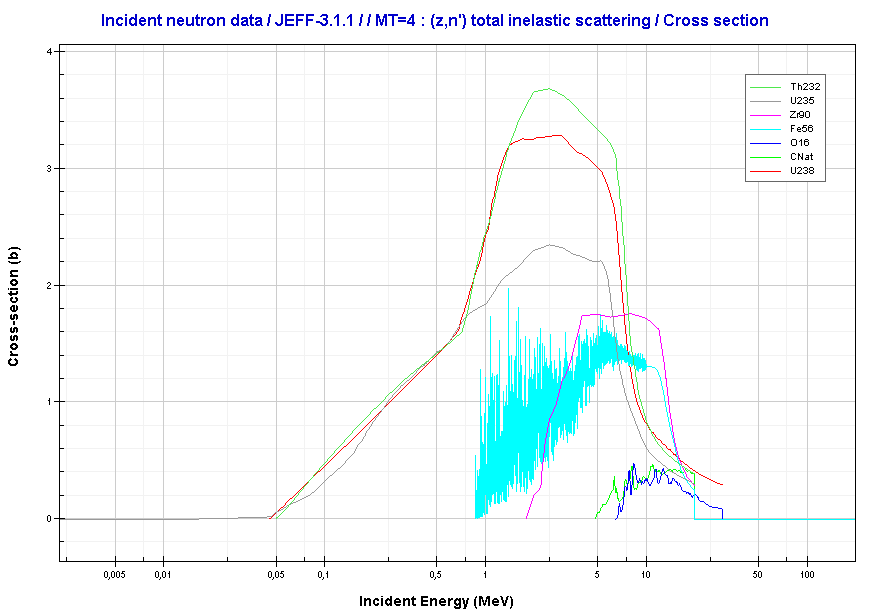
Inelastic Scattering Cross-section

Inelastic Neutron Scattering Cross-section
Inelastic neutron scattering cross sections.

Source: JANIS (Java-based Nuclear Data Information Software); The JEFF-3.1.1 Nuclear Data Library

 
References:
Nuclear and Reactor Physics:
  1. J. R. Lamarsh, Introduction to Nuclear Reactor Theory, 2nd ed., Addison-Wesley, Reading, MA (1983).
  2. J. R. Lamarsh, A. J. Baratta, Introduction to Nuclear Engineering, 3d ed., Prentice-Hall, 2001, ISBN: 0-201-82498-1.
  3. W. M. Stacey, Nuclear Reactor Physics, John Wiley & Sons, 2001, ISBN: 0- 471-39127-1.
  4. Glasstone, Sesonske. Nuclear Reactor Engineering: Reactor Systems Engineering, Springer; 4th edition, 1994, ISBN: 978-0412985317
  5. W.S.C. Williams. Nuclear and Particle Physics. Clarendon Press; 1 edition, 1991, ISBN: 978-0198520467
  6. G.R.Keepin. Physics of Nuclear Kinetics. Addison-Wesley Pub. Co; 1st edition, 1965
  7. Robert Reed Burn, Introduction to Nuclear Reactor Operation, 1988.
  8. U.S. Department of Energy, Nuclear Physics and Reactor Theory. DOE Fundamentals Handbook, Volume 1 and 2. January 1993.

Advanced Reactor Physics:

  1. K. O. Ott, W. A. Bezella, Introductory Nuclear Reactor Statics, American Nuclear Society, Revised edition (1989), 1989, ISBN: 0-894-48033-2.
  2. K. O. Ott, R. J. Neuhold, Introductory Nuclear Reactor Dynamics, American Nuclear Society, 1985, ISBN: 0-894-48029-4.
  3. D. L. Hetrick, Dynamics of Nuclear Reactors, American Nuclear Society, 1993, ISBN: 0-894-48453-2.
  4. E. E. Lewis, W. F. Miller, Computational Methods of Neutron Transport, American Nuclear Society, 1993, ISBN: 0-894-48452-4.

See also:

See also:

Neutron Reactions

See also:

We hope, this article, Neutron Inelastic Scattering, helps you. If so, give us a like in the sidebar. Main purpose of this website is to help the public to learn some interesting and important information about radiation and dosimeters.

What is Elastic and Inelastic Scattering – Definition

In an elastic scattering reaction, there is no energy transferred into nuclear excitation. Besides, in an inelastic scattering reaction nuclear excitation occurs. Periodic Table

Elastic vs. Inelastic Scattering of Neutrons

Generally, a neutron scattering reaction occurs when a target nucleus emits a single neutron after a neutron-nucleus interaction. In an elastic scattering reaction between a neutron and a target nucleus, there is no energy transferred into nuclear excitation.

Besides, in an inelastic scattering reaction between a neutron and a target nucleus some energy of the incident neutron is absorbed to the recoiling nucleus and the nucleus remains in the excited state. Thus while momentum is conserved in an inelastic collision, kinetic energy of the “system” is not conserved.

Key Characteristics of Elastic Scattering

See also: Neutron Elastic Scattering

  • Elastic scattering is the most important process for slowing down neutrons.
  • Total kinetic energy of the system is conserved in elastic scattering.
  • In this process, energy lost by the neutron is transferred to the recoiling nucleus.
  • Maximum energy transfer is occurred with an head-on collision.
  • Kinetic energy of the recoiled nucleus depends on the recoiled angle φ of the nucleus.
  • Elastic scattering cross-sections for light elements are more or less independent of neutron energy up to 1 MeV.
  • For intermediate and heavy elements, the elastic cross-section is constant at low energy with some specifics at higher energy.
  • A good approximation is, σs = const, for all elements, that are of importance.
  • At low energy, σs can be described by the one-level Breit-Wigner formula.
  • Nearly all elements have scattering cross-sections in the range of 2 to 20 barns.
  • The important exception is for water and heavy water.
  • If the kinetic energy of an incident neutron is large compared with the chemical binding energy of the atoms in a molecule, the chemical bound can be ignored.
  • If the kinetic energy of an incident neutron is of the order or less than the chemical binding energy, the cross-section of the molecule is not equal to the sum of cross-sections of its individual nuclei.
  • Scattering of slow neutrons by molecules is greater than by free nuclei.
  • Therefore one nucleus microscopic cross-sections do not describe the process correctly, while the macroscopic cross-section (Σs) has a precise meaning.

Key Characteristics of Inelastic Scattering

See also: Neutron Inelastic Scattering

  • During an inelastic scattering the neutron is absorbed and then re-emitted.
  • While momentum is conserved in an inelastic collision, kinetic energy of the “system” is not conserved.
  • Some energy of the incident neutron is absorbed to the recoiling nucleus and the nucleus remains in the excited state.
  • The nucleus gives up excitation energy by emitting one or more gamma rays.
  • General notation: A(n, n’)A* or A(n, 2n’)B; Example: 14O(n, n’)14O*.
  • Inelastic scattering is a threshold reaction and occurs above a threshold energy.
  • Inelastic scattering cross section is relatively small for light nuclei.
  • For hydrogen nucleus, inelastic scattering does not occur, because it does not have excited states.
  • Inelastic scattering plays an important role in slowing down neutrons especially at high energies and by heavy nuclei (e.g. 238U).
  • Inelastic scattering may be significant for heterogeneous reactors with highly enriched fuel (e.g. in fast neutron reactors).
 
References:
Nuclear and Reactor Physics:
  1. J. R. Lamarsh, Introduction to Nuclear Reactor Theory, 2nd ed., Addison-Wesley, Reading, MA (1983).
  2. J. R. Lamarsh, A. J. Baratta, Introduction to Nuclear Engineering, 3d ed., Prentice-Hall, 2001, ISBN: 0-201-82498-1.
  3. W. M. Stacey, Nuclear Reactor Physics, John Wiley & Sons, 2001, ISBN: 0- 471-39127-1.
  4. Glasstone, Sesonske. Nuclear Reactor Engineering: Reactor Systems Engineering, Springer; 4th edition, 1994, ISBN: 978-0412985317
  5. W.S.C. Williams. Nuclear and Particle Physics. Clarendon Press; 1 edition, 1991, ISBN: 978-0198520467
  6. G.R.Keepin. Physics of Nuclear Kinetics. Addison-Wesley Pub. Co; 1st edition, 1965
  7. Robert Reed Burn, Introduction to Nuclear Reactor Operation, 1988.
  8. U.S. Department of Energy, Nuclear Physics and Reactor Theory. DOE Fundamentals Handbook, Volume 1 and 2. January 1993.

Advanced Reactor Physics:

  1. K. O. Ott, W. A. Bezella, Introductory Nuclear Reactor Statics, American Nuclear Society, Revised edition (1989), 1989, ISBN: 0-894-48033-2.
  2. K. O. Ott, R. J. Neuhold, Introductory Nuclear Reactor Dynamics, American Nuclear Society, 1985, ISBN: 0-894-48029-4.
  3. D. L. Hetrick, Dynamics of Nuclear Reactors, American Nuclear Society, 1993, ISBN: 0-894-48453-2.
  4. E. E. Lewis, W. F. Miller, Computational Methods of Neutron Transport, American Nuclear Society, 1993, ISBN: 0-894-48452-4.

See also:

See also:

Elastic Scattering

See also:

We hope, this article, Elastic and Inelastic Scattering, helps you. If so, give us a like in the sidebar. Main purpose of this website is to help the public to learn some interesting and important information about radiation and dosimeters.

What is Key Characteristics of Inelastic Scattering – Definition

Key Characteristics of Inelastic Scattering are summarized here. Inelastic scattering conserves momentum, while the kinetic energy does not conserves. Periodic Table

Key Characteristics of Inelastic Scattering

  • During an inelastic scattering the neutron is absorbed and then re-emitted.
  • While momentum is conserved in an inelastic collision, kinetic energy of the “system” is not conserved.
  • Some energy of the incident neutron is absorbed to the recoiling nucleus and the nucleus remains in the excited state.
  • The nucleus gives up excitation energy by emitting one or more gamma rays.
  • General notation: A(n, n’)A* or A(n, 2n’)B; Example: 14O(n, n’)14O*.
  • Inelastic scattering is a threshold reaction and occurs above a threshold energy.
  • Inelastic scattering cross section is relatively small for light nuclei.
  • For hydrogen nucleus, inelastic scattering does not occur, because it does not have excited states.
  • Inelastic scattering plays an important role in slowing down neutrons especially at high energies and by heavy nuclei (e.g. 238U).
  • Inelastic scattering may be significant for heterogeneous reactors with highly enriched fuel (e.g. in fast neutron reactors).
Inelastic neutron scattering

Inelastic Scattering Cross-section

Inelastic Neutron Scattering Cross-section
Inelastic scattering plays an important role in slowing down neutrons especially at high energies and by heavy nuclei.
 
References:
Nuclear and Reactor Physics:
  1. J. R. Lamarsh, Introduction to Nuclear Reactor Theory, 2nd ed., Addison-Wesley, Reading, MA (1983).
  2. J. R. Lamarsh, A. J. Baratta, Introduction to Nuclear Engineering, 3d ed., Prentice-Hall, 2001, ISBN: 0-201-82498-1.
  3. W. M. Stacey, Nuclear Reactor Physics, John Wiley & Sons, 2001, ISBN: 0- 471-39127-1.
  4. Glasstone, Sesonske. Nuclear Reactor Engineering: Reactor Systems Engineering, Springer; 4th edition, 1994, ISBN: 978-0412985317
  5. W.S.C. Williams. Nuclear and Particle Physics. Clarendon Press; 1 edition, 1991, ISBN: 978-0198520467
  6. G.R.Keepin. Physics of Nuclear Kinetics. Addison-Wesley Pub. Co; 1st edition, 1965
  7. Robert Reed Burn, Introduction to Nuclear Reactor Operation, 1988.
  8. U.S. Department of Energy, Nuclear Physics and Reactor Theory. DOE Fundamentals Handbook, Volume 1 and 2. January 1993.

Advanced Reactor Physics:

  1. K. O. Ott, W. A. Bezella, Introductory Nuclear Reactor Statics, American Nuclear Society, Revised edition (1989), 1989, ISBN: 0-894-48033-2.
  2. K. O. Ott, R. J. Neuhold, Introductory Nuclear Reactor Dynamics, American Nuclear Society, 1985, ISBN: 0-894-48029-4.
  3. D. L. Hetrick, Dynamics of Nuclear Reactors, American Nuclear Society, 1993, ISBN: 0-894-48453-2.
  4. E. E. Lewis, W. F. Miller, Computational Methods of Neutron Transport, American Nuclear Society, 1993, ISBN: 0-894-48452-4.

See also:

See also:

Neutron Reactions

See also:

We hope, this article, Key Characteristics of Inelastic Scattering, helps you. If so, give us a like in the sidebar. Main purpose of this website is to help the public to learn some interesting and important information about radiation and dosimeters.

What is Inelastic Scattering Cross-section – Definition

Inelastic scattering cross section is relatively small for light nuclei, while is high especially at high energies and by heavy nuclei. Inelastic scattering cross section. Periodic Table

Inelastic Scattering Cross-section

Inelastic Neutron Scattering Cross-section
Inelastic scattering plays an important role in slowing down neutrons especially at high energies and by heavy nuclei.
 
References:
Nuclear and Reactor Physics:
  1. J. R. Lamarsh, Introduction to Nuclear Reactor Theory, 2nd ed., Addison-Wesley, Reading, MA (1983).
  2. J. R. Lamarsh, A. J. Baratta, Introduction to Nuclear Engineering, 3d ed., Prentice-Hall, 2001, ISBN: 0-201-82498-1.
  3. W. M. Stacey, Nuclear Reactor Physics, John Wiley & Sons, 2001, ISBN: 0- 471-39127-1.
  4. Glasstone, Sesonske. Nuclear Reactor Engineering: Reactor Systems Engineering, Springer; 4th edition, 1994, ISBN: 978-0412985317
  5. W.S.C. Williams. Nuclear and Particle Physics. Clarendon Press; 1 edition, 1991, ISBN: 978-0198520467
  6. G.R.Keepin. Physics of Nuclear Kinetics. Addison-Wesley Pub. Co; 1st edition, 1965
  7. Robert Reed Burn, Introduction to Nuclear Reactor Operation, 1988.
  8. U.S. Department of Energy, Nuclear Physics and Reactor Theory. DOE Fundamentals Handbook, Volume 1 and 2. January 1993.

Advanced Reactor Physics:

  1. K. O. Ott, W. A. Bezella, Introductory Nuclear Reactor Statics, American Nuclear Society, Revised edition (1989), 1989, ISBN: 0-894-48033-2.
  2. K. O. Ott, R. J. Neuhold, Introductory Nuclear Reactor Dynamics, American Nuclear Society, 1985, ISBN: 0-894-48029-4.
  3. D. L. Hetrick, Dynamics of Nuclear Reactors, American Nuclear Society, 1993, ISBN: 0-894-48453-2.
  4. E. E. Lewis, W. F. Miller, Computational Methods of Neutron Transport, American Nuclear Society, 1993, ISBN: 0-894-48452-4.

See also:

See also:

Inelastic Scattering

See also:

We hope, this article, Inelastic Scattering Cross-section, helps you. If so, give us a like in the sidebar. Main purpose of this website is to help the public to learn some interesting and important information about radiation and dosimeters.

What is Compound Nucleus Reaction – Definition

The compound nucleus reactions involve many nucleon-nucleon interactions. The compound nucleus model (idea of compound nucleus formation) was introduced by Niels Bohr in 1936. Periodic Table

Nuclear Reactions – Basic Classification

A nuclear reaction is considered to be the process in which two nuclear particles (two nuclei or a nucleus and a nucleon) interact to produce two or more nuclear particles or ˠ-rays (gamma rays). Thus, a nuclear reaction must cause a transformation of at least one nuclide to another. Sometimes if a nucleus interacts with another nucleus or particle without changing the nature of any nuclide, the process is referred to a nuclear scattering, rather than a nuclear reaction.

In order to understand the nature of nuclear reactions, the classification according to the time scale of of these reactions has to be introduced. Interaction time is critical for defining the reaction mechanism.

There are two extreme scenarios for nuclear reactions (not only neutron nuclear reactions):

  • A projectile and a target nucleus are within the range of nuclear forces for the very short time allowing for an interaction of a single nucleon only. These type of reactions are called the direct nuclear reactions.
  • A projectile and a target nucleus are within the range of nuclear forces for the time allowing for a large number of interactions between nucleons. These type of reactions are called the compound nucleus reactions.

In fact, there is always some non-direct (multiple internuclear interaction) component in all reactions, but the direct reactions have this component limited.

Compound Nucleus Reactions

 
What is the Compound Nucleus and the Nuclear Resonance?
There is no difference between the compound nucleus and the nuclear resonance.

The compound nucleus is the intermediate state formed in a compound nucleus reaction. It is normally one of the excited states of the nucleus formed by the combination of the incident particle and target nucleus. If a target nucleus X is bombarded with particles a, it is sometimes observed that the ensuing nuclear reaction takes place with appreciable probability only if the energy of the particle a is in the neighborhood of certain definite energy values. These energy values are referred to as resonance energies. The compound nuclei of these certain energies are reffered to as nuclear resonances. Resonances are usually found only at relatively low energies of the projectile. The widths of the resonances increase in general with increasing energies. At higher energies the widths may reach the order of the distances between resonances and then no resonances can be observed. The narrowest resonances are usually the compound states of heavy nuclei (such as fissionable nuclei) and thermal neutrons (usually in (n,γ) capture reactions). The observation of resonances is by no means restricted to neutron nuclear reactions.

The compound nucleus model (idea of compound nucleus formation) was introduced by Danish physicist Niels Bohr in 1936. This model assumes that incident particle and the target nucleus become indistinguishable after the collision and together constitute the particular excited state of nucleus – the compound nucleus. To become indistinguishable the projectile has to suffer collisions with constituent nucleons of the target nucleus until it has lost its incident energy. In fact many so these collisions lead to a complete thermal equilibrium inside the compound nucleus. The compound nucleus is excited by both the kinetic energy of the projectile and by the binding nuclear energy.

This compound system is a relatively long-lived intermediate state of particle-target composite system and from the definition, the compound nucleus must live for at least several times longer than is the time of transit of an incident particle across the nucleus (~10-22 s). The time scale of compound nucleus reactions is of the order of 10-18 s  –  10-16 s, but lifetimes as long as 10-14 s have been also observed.

Very important feature and a direct consequence of the thermal equilibrium inside a compound nucleus is the fact the mode of decay of compound nucleus does not depend on the way the compound nucleus is formed. The large number of collisions between nucleons leads to the loss of the information on the entrance channel from the system. The decay mechanism (exit channel) that dominates the decay of C* is determined by the excitation energy in C* and by the law of probability.compound nucleus reaction

These reactions can be considered as a two-stage processes.

  • The first stage is the formation of a compound nucleus expressed by σa+X➝C*
  • The second stage is the decay of a compound nucleus expressed by PC*➝b+Y
  • The result cross-section of certain reaction a+X➝[C*]➝b+Y is given by σ(a,b)= σa+X➝C* . PC*➝b+Y
Uranium absorption reaction
Absorption reaction of fissile 235U. The uncertainty of the exit channel is caused by “loss of memory” of resonance [236U].

Resonances

For the compound nucleus peaks in the cross-section are typical. Each peak is manifesting a particular compound state of nucleus. These peaks and the associated compound nuclei are usually called resonances. The behaviour of the cross-section between two resonances is usually strongly affected by the effect of nearby resonances.

Resonances (particular compound states) are mostly created in neutron nuclear reactions, but  it is by no means restricted to neutron nuclear reactions. The formation of resonances is caused by the quantum nature of nuclear forces. Each nuclear reaction is a transition between different quantum discrete states or energy levels. The discrete nature of energy transitions plays a key role. If the energy of the projectile (the sum of the Q value and the kinetic energy of the projectile) and the energy of target nucleus is equal to a compound nucleus at one of the excitation states, a resonance can be created and peak occurs in the cross section. For light nucleus, the allowable state density in this energy region is much lower and the “distance” between states is higher. For heavy nuclei, such as 238U, we can observe large resonance region in the neutron absorption cross-section.

It is obvious the compound states (resonances) are observed at low excitation energies. This is due to the fact, the energy gap between the states is large. At high excitation energy, the gap between two compound states is very small and the widths of resonances may reach the order of the distances between resonances. Therefore at high energies no resonances can be observed and the cross section in this energy region is continuous and smooth.

Compound state - resonance
Energy levels of compound state. For neutron absorption reaction on 238U the first resonance E1 corresponds to the excitation energy of 6.67eV. E0 is a base state of 239U.
ground state compound nucleus - excitation
The position of the energy levels during the formation of a compound nucleus. Ground state and energy states.
Resonance region - Compound Nucleus
Region of resonances of 238U nuclei.
Source: JANIS (Java-based Nuclear Data Information Software); The ENDF/B-VII.1 Nuclear Data Library

Direct Reactions vs. Compound Nucleus Reactions

Direct Reactions

  • The direct reactions are fast and involve a single-nucleon interaction.
  • The interaction time must be very short (~10-22 s).
  • The direct reactions require incident particle energy larger than ∼ 5 MeV/Ap. (Ap is the atomic mass number of a projectile)
  • Incident particles interact on the surface of a target nucleus rather than in the volume of a target nucleus.
  • Products of the direct reactions are not distributed isotropically in angle, but they are forward focused.
  • Direct reactions are of importance in measurements of nuclear structure.

Compound Nucleus Reactions

  • The compound nucleus is a relatively long-lived intermediate state of particle-target composite system.
  • The compound nucleus reactions involve many nucleon-nucleon interactions.
  • The large number of collisions between the nucleons leads to a thermal equilibrium inside the compound nucleus.
  • The time scale of compound nucleus reactions is of the order of 10-18 s – 10-16 s.
  • The compound nucleus reactions is usually created if the projectile has low energy.
  • Incident particles interact in the volume of a target nucleus.
  • Products of the compound nucleus reactions are distributed near isotropically in angle (the nucleus loses memory of how it was created – the Bohr’s hypothesis of independence).
  • The mode of decay of compound nucleus do not depend on the way the compound nucleus is formed.
  • Resonances in the cross-section are typical for the compound nucleus reaction.
 
References:
Nuclear and Reactor Physics:
  1. J. R. Lamarsh, Introduction to Nuclear Reactor Theory, 2nd ed., Addison-Wesley, Reading, MA (1983).
  2. J. R. Lamarsh, A. J. Baratta, Introduction to Nuclear Engineering, 3d ed., Prentice-Hall, 2001, ISBN: 0-201-82498-1.
  3. W. M. Stacey, Nuclear Reactor Physics, John Wiley & Sons, 2001, ISBN: 0- 471-39127-1.
  4. Glasstone, Sesonske. Nuclear Reactor Engineering: Reactor Systems Engineering, Springer; 4th edition, 1994, ISBN: 978-0412985317
  5. W.S.C. Williams. Nuclear and Particle Physics. Clarendon Press; 1 edition, 1991, ISBN: 978-0198520467
  6. G.R.Keepin. Physics of Nuclear Kinetics. Addison-Wesley Pub. Co; 1st edition, 1965

Advanced Reactor Physics:

  1. K. O. Ott, W. A. Bezella, Introductory Nuclear Reactor Statics, American Nuclear Society, Revised edition (1989), 1989, ISBN: 0-894-48033-2.
  2. K. O. Ott, R. J. Neuhold, Introductory Nuclear Reactor Dynamics, American Nuclear Society, 1985, ISBN: 0-894-48029-4.
  3. D. L. Hetrick, Dynamics of Nuclear Reactors, American Nuclear Society, 1993, ISBN: 0-894-48453-2.
  4. E. E. Lewis, W. F. Miller, Computational Methods of Neutron Transport, American Nuclear Society, 1993, ISBN: 0-894-48452-4.

See also:

See also:

Neutron Nuclear Reactions

See also:

We hope, this article, Compound Nucleus Reaction, helps you. If so, give us a like in the sidebar. Main purpose of this website is to help the public to learn some interesting and important information about radiation and dosimeters.

What is Cadmium – Definition

Cadmium is a naturally-occurring chemical element with atomic number 48. In nuclear industry cadmium is commonly used as a thermal neutron absorber. Periodic Table
Cadmium is a naturally-occurring chemical element with atomic number 48 which means there are 48 protons and 48 electrons in the atomic structure. The chemical symbol for cadmium is Cd. Cadmium was first discovered in 1817 by two German chemists – Friedrich Stromeyer and Karl Samuel Leberecht Hermann.

Natural cadmium consists of eight isotopes, 106Cd (1.3%),  108Cd (0.9%), 110Cd (12.5%), 111Cd (12.8%), 112Cd (24.3%), 113Cd (12.2%), 114Cd (28.7%) and 116Cd (7.5%). Two of them are radioactive isotopes with very long half-life (113Cd – 7.7 x 10¹⁵ y and 116Cd – 2.9 x 10¹⁹ y).

In nuclear industry cadmium is commonly used as a thermal neutron absorber due to very high neutron absorption cross-section of 113Cd. 113Cd has specific absorption cross-section. There is a cadmium cut-off energy (Cadmium edge) in the absorption cross-section. Only neutrons of kinetic energy below the cadmium cut-off energy (~0.5 eV) are strongly absorbed by 113Cd. Therefore cadmium is widely used to absorb thermal neutrons in a thermal neutron filters.

n+_{48}^{113}textrm{Cd}  {rightarrow} _{48}^{114}textrm{Cd^{star}} rightarrow  _{48}^{114}textrm{Cd} +gamma

Cadmium cut-off energy
Neutrons of kinetic energy below the cadmium cut-off energy (~0.5 eV) are strongly absorbed by 113-Cd.

Source: JANIS (Java-based Nuclear Data Information Software); The JEFF-3.1 Nuclear Data Library

See also:

Glossary

We hope, this article, Cadmium, helps you. If so, give us a like in the sidebar. Main purpose of this website is to help the public to learn some interesting and important information about radiation and dosimeters.