113Cd has specific absorption cross-section with cut-off energy (Cadmium edge). Neutrons of kinetic energy below the cadmium cut-off energy (~0.5 eV) are strongly absorbed by 113Cd. Periodic Table
113Cd has specific absorption cross-section. There is a cadmium cut-off energy (Cadmium edge) in the absorption cross-section. Only neutrons of kinetic energy below the cadmium cut-off energy (~0.5 eV) are strongly absorbed by 113Cd. Therefore cadmium is widely used to absorb thermal neutrons in a thermal neutron filters.
Neutrons of kinetic energy below the cadmium cut-off energy (~0.5 eV) are strongly absorbed by 113-Cd. Source: JANIS (Java-based Nuclear Data Information Software); The JEFF-3.1 Nuclear Data Library
See also:
Cadmium
We hope, this article, Cadmium 113 edge, helps you. If so, give us a like in the sidebar. Main purpose of this website is to help the public to learn some interesting and important information about radiation and dosimeters.
Boron is a naturally-occurring chemical element. Natural boron consists primarily of two stable isotopes, boron 11 and boron 10. 10B has high neutron cross-section. Periodic Table
Boron is a naturally-occurring chemical element with atomic number 5 which means there are 5 protons and 5 electrons in the atomic structure. The chemical symbol for boron is B. Significant concentrations of boron occur on the Earth in compounds known as the borate minerals. There are over 100 different borate minerals, but the most common are: borax, kernite, ulexite etc.
Natural boron consists primarily of two stable isotopes, 11B (80.1%) and 10B (19.9%). In nuclear industry boron is commonly used as a neutron absorber due to the high neutron cross-section of isotope 10B. Its (n,alpha) reaction cross-section for thermal neutrons is about 3840 barns (for 0.025 eV neutron). Isotope 11B has absorption cross-section for thermal neutrons about 0.005 barns (for 0.025 eV neutron). Most of (n,alpha) reactions of thermal neutrons are 10B(n,alpha)7Li reactions accompanied by 0.48 MeV gamma emission.
Moreover, isotope 10B has high (n,alpha) reaction cross-section along the entire neutron energy spectrum. The cross-sections of most other elements becomes very small at high energies as in the case of cadmium. The cross-section of 10B decreases monotonically with energy. For fast neutrons its cross-section is on the order of barns.
Boron as the neutron absorber has another positive property. The reaction products (after a neutron absorption), helium and lithium, are stable isotopes. Therefore there are minimal problems with decay heating of control rods or burnable absorbers used in the reactor core.
On the other hand production of helium may lead to significant increase in pressure (under rod cladding), when used as the absorbing material in control rods. Moreover 10B is the principal source of radioactive tritium in primary circuit of all PWRs (which use boric acid as a chemical shim), because reactions with neutrons can rarely lead to formation of radioactive tritium via:
Boron 10. Comparison of total cross-section and cross-section for (n,alpha) reactions. Source: JANIS (Java-based Nuclear Data Information Software); The JEFF-3.1.1 Nuclear Data Library
Boron letdown curve (chemical shim) and boron 10 depletion during a 12-month fuel cycle.
At the beginning of specific fuel cycle concentration of boric acid is highest. At the end of this cycle concentration of boric acid is almost zero and a reactor must be refueled, because there is no positive reactivity that can be inserted to compensate negative reactivity of fuel burnup (increase in reactor slagging).
Applications of boron based materials
Chemical shim. By chemical shim, we mean that boric acid is dissolved in the coolant/moderator. Chemical shim is used to long term reactivity control.
Control rods. Many control rods use isotope 10B as a neutron absorbing material.
Safety systems. The one of three primary objectives of nuclear reactor safety systems is to shutdown the reactor and maintain it in a shutdown condition. Therefore all safety systems (which must ensure subcriticality of the reactor after the transient) use high concentrations of boric acid.
Burnable absorbers. Isotope 10B is widely used as the integral burnable absorber. When compared to gadolinium absorber (another commonly used burnable material), 10B has an order of magnitude smaller cross-sections. Therefore 10B compensate reactivity longer, but not so heavily.
Converter in neutron detectors. Neutrons are not directly ionizing and they have usually to be converted into charged particles before they can be detected. Most common isotope for the neutron converter material is10B.
Boric Acid - Chemical Shim
By chemical shim, we mean that boric acid is dissolved in the coolant/moderator. Boric acid (molecular formula: H3BO3), is a white powder that is soluble in water. In pressurized water reactors, chemical shim (boric acid) is used to compensate an excess of reactivity of reactor core along the fuel burnup (long term reactivity control). At the beginning of specific fuel cycle concentration of boric acid is highest (see picture). At the end of this cycle concentration of boric acid is almost zero and a reactor must be refueled.
In certain cases also fine power changes can be controlled by chemical shim. If it is desired to increase power, then the boric acid concentration must be diluted, removing 10B from the reactor core and decreasing its poisoning effect. When compared with burnable absorbers (long term reactivity control) or with control rods (rapid reactivity control) the boric acid avoids the unevenness of neutron-flux density in the reactor core, because it is dissolved homogeneously in the coolant in entire reactor core. On the other hand high concentrations of boric acid may lead to positive moderator temperature coefficient and that is undesirable. In this case more burnable absorbers must be used.
Moreover this method is slow in controlling reactivity. Normally, it takes several minutes to change the concentration (dilute or borate) of the boric acid in the primary loop. For rapid changes of reactivity control rods must be used.
Boron 10 Depletion
Since the isotope 10B has a significantly higher neutron cross-section, the 10B depletes much more faster than 11B. Without the addition of fresh boron (19,9% of 10B) into the primary coolant system the enrichment of 10B in boric acid continuously decreases. In the result the enrichment of 10B at the end of the fuel cycle can be for example below 18% of 10B. This phenomenon must be considered in all the criticality calculations (e.g. shutdown margin calculations, estimated critical conditions or general core depletion calculations).
See also:
Glossary
We hope, this article, Boron 10, helps you. If so, give us a like in the sidebar. Main purpose of this website is to help the public to learn some interesting and important information about radiation and dosimeters.
Applications of Boron in Nuclear Power. Boron 10 is very good neutron absorber, therefore it has many applications in reactor control and generally in nuclear power. Periodic Table
Isotope 10B has many applications. Its (n,alpha) reaction cross-section for thermal neutrons is about 3840 barns (for 0.025 eV neutron) and therefore it is very good neutron absorber. In nuclear power mostly natural boron is used, but it is not an exception the use of enriched boron (by the isotope 10B). Boron as the neutron absorber has following applications:
Chemical shim. By chemical shim, we mean that boric acid is dissolved in the coolant/moderator. Chemical shim is used to long term reactivity control.
Control rods. Many control rods use isotope 10B as a neutron absorbing material.
Safety systems. The one of three primary objectives of nuclear reactor safety systems is to shutdown the reactor and maintain it in a shutdown condition. Therefore all safety systems (which must ensure subcriticality of the reactor after the transient) use high concentrations of boric acid.
Burnable absorbers. Isotope 10B is widely used as the integral burnable absorber. When compared to gadolinium absorber (another commonly used burnable material), 10B has an order of magnitude smaller cross-sections. Therefore 10B compensate reactivity longer, but not so heavily.
Converter in neutron detectors. Neutrons are not directly ionizing and they have usually to be converted into charged particles before they can be detected. Most common isotope for the neutron converter material is10B.
Most of (n,alpha) reactions of thermal neutrons are 10B(n,alpha)7Li reactions accompanied by 0.48 MeV gamma emission.
Boron 10. Comparison of total cross-section and cross-section for (n,alpha) reactions. Source: JANIS (Java-based Nuclear Data Information Software); The JEFF-3.1.1 Nuclear Data LibraryBoron letdown curve (chemical shim) and boron 10 depletion during a 12-month fuel cycle. At the beginning of specific fuel cycle concentration of boric acid is highest. At the end of this cycle concentration of boric acid is almost zero and a reactor must be refueled, because there is no positive reactivity that can be inserted to compensate negative reactivity of fuel burnup (increase in reactor slagging).
See also:
Boron 10
See also:
Boric Acid – Chemical Shim
We hope, this article, Application of Boron – Nuclear Power, helps you. If so, give us a like in the sidebar. Main purpose of this website is to help the public to learn some interesting and important information about radiation and dosimeters.
In PWRs, chemical shim (boric acid – H3BO3) is used to compensate an excess of reactivity of a reactor core. Chemical shim is boric acid dissolved in the coolant. Periodic Table
By chemical shim, we mean that boric acid is dissolved in the coolant/moderator. Boric acid (molecular formula: H3BO3), is a white powder that is soluble in water. In pressurized water reactors, chemical shim (boric acid) is used to compensate an excess of reactivity of reactor core along the fuel burnup (long term reactivity control). At the beginning of specific fuel cycle concentration of boric acid is highest (see picture). At the end of this cycle concentration of boric acid is almost zero and a reactor must be refueled.
In certain cases also fine power changes can be controlled by chemical shim. If it is desired to increase power, then the boric acid concentration must be diluted, removing 10B from the reactor core and decreasing its poisoning effect. When compared with burnable absorbers (long term reactivity control) or with control rods (rapid reactivity control) the boric acid avoids the unevenness of neutron-flux density in the reactor core, because it is dissolved homogeneously in the coolant in entire reactor core. On the other hand high concentrations of boric acid may lead to positive moderator temperature coefficient and that is undesirable. In this case more burnable absorbers must be used.
Moreover this method is slow in controlling reactivity. Normally, it takes several minutes to change the concentration (dilute or borate) of the boric acid in the primary loop. For rapid changes of reactivity control rods must be used.
Boron 10. Comparison of total cross-section and cross-section for (n,alpha) reactions. Source: JANIS (Java-based Nuclear Data Information Software); The JEFF-3.1.1 Nuclear Data LibraryBoron letdown curve (chemical shim) and boron 10 depletion during a 12-month fuel cycle. At the beginning of specific fuel cycle concentration of boric acid is highest. At the end of this cycle concentration of boric acid is almost zero and a reactor must be refueled, because there is no positive reactivity that can be inserted to compensate negative reactivity of fuel burnup (increase in reactor slagging).
See also:
Applications of Boron in Nuclear Power
See also:
Boron 10
See also:
Boron 10 Depletion
We hope, this article, Boric Acid – Chemical Shim, helps you. If so, give us a like in the sidebar. Main purpose of this website is to help the public to learn some interesting and important information about radiation and dosimeters.
Since the isotope 10B has a significantly higher neutron cross-section, the 10B depletes in a reactor core much more faster than 11B. Boron 10 Depletion. Periodic Table
Natural boron consists primarily of two stable isotopes, 11B (80.1%) and 10B (19.9%). In nuclear industry boron is commonly used as a neutron absorber due to the high neutron cross-section of isotope 10B. Its (n,alpha) reaction cross-section for thermal neutrons is about 3840 barns (for 0.025 eV neutron). Isotope 11B has absorption cross-section for thermal neutrons about 0.005 barns (for 0.025 eV neutron). Most of (n,alpha) reactions of thermal neutrons are 10B(n,alpha)7Li reactions accompanied by 0.48 MeV gamma emission.
Since the isotope 10B has a significantly higher neutron cross-section, the 10B depletes much more faster than 11B. Without the addition of fresh boron (19,9% of 10B) into the primary coolant system the enrichment of 10B in boric acid continuously decreases. In the result the enrichment of 10B at the end of the fuel cycle can be for example below 18% of 10B. This phenomenon must be considered in all the criticality calculations (e.g. shutdown margin calculations, estimated critical conditions or general core depletion calculations).
Boron 10. Comparison of total cross-section and cross-section for (n,alpha) reactions. Source: JANIS (Java-based Nuclear Data Information Software); The JEFF-3.1.1 Nuclear Data LibraryBoron letdown curve (chemical shim) and boron 10 depletion during a 12-month fuel cycle. At the beginning of specific fuel cycle concentration of boric acid is highest. At the end of this cycle concentration of boric acid is almost zero and a reactor must be refueled, because there is no positive reactivity that can be inserted to compensate negative reactivity of fuel burnup (increase in reactor slagging).
See also:
Boric Acid – Chemical Shim
See also:
Boron 10
See also:
H3BO3 Converter
We hope, this article, Boron 10 Depletion, helps you. If so, give us a like in the sidebar. Main purpose of this website is to help the public to learn some interesting and important information about radiation and dosimeters.
In nuclear industry gadolinium is commonly used as a neutron absorber due to very high neutron absorbtion cross-section of two isotopes 155Gd and 157Gd. Periodic Table
Gadolinium is a naturally-occurring chemical element with atomic number 64 which means there are 64 protons and 64 electrons in the atomic structure. The chemical symbol for gadolinium is Gd. Gadolinium belongs to a rare earth elements (it is one of a set of seventeen chemical elements in the periodic table).
Gadolinium was first discovered in 1880 by Jean Charles Galissard de Marignac. It is named for mineral (gadolinite), which is named for Finnish chemist Johan Gadolin.
Natural gadolinium consists of six stable isotopes, 154Gd (2.18%), 155Gd (14.8%), 156Gd (20.5%), 157Gd (15.7%), 158Gd (24.8%) and 160Gd (21.9%) and one radioisotope 152Gd (0.2%) with half-life of 1.1 x 10¹⁴ y.
In nuclear industry gadolinium is commonly used as a neutron absorber due to very high neutron absorbtion cross-section of two isotopes 155Gd and 157Gd. In fact their absorption cross-sections are the highest among all stable isotopes. 155Gd has 61 000 barns for thermal neutrons (for 0.025 eV neutron) and 157Gd has even 254 000 barns. For this reason gadolinium is widely used as a burnable absorber, which is commonly used in fresh fuel to compensate an excess of reactivity of reactor core. In comparison with another burnable absorbers gadolinium behaves like a completely black material. Therefore gadolinium is very effective in compensation of the excess of reactivity, but on the other hand an improper distribution of Gd-burnable absorbers may lead to unevenness of neutron-flux density in the reactor core.
Gadolinium 155 and 157. Comparison of radiative capture cross-sections. Source: JANIS (Java-based Nuclear Data Information Software); The JEFF-3.1.1 Nuclear Data LibraryThe effect of gadolinium burnable absorbers (BA) can be demonstrated on boron letdown curves. At the beginning of specific fuel cycle the critical concentration of boric acid in the reactor core without burnable absorbers (blue curve) significantly differs from the critical concentration of boric acid in the reactor core with burnable absorbers (red curve). The difference is dependent on the amount of BA used.
See also:
Glossary
We hope, this article, Gadolinium, helps you. If so, give us a like in the sidebar. Main purpose of this website is to help the public to learn some interesting and important information about radiation and dosimeters.
The study of neutron nuclear reactions and nuclear reactions in general is of paramount importance in physics of nuclear reactors. Neutron Nuclear Reactions
Neutron Nuclear Reactions
The study of neutron nuclear reactions and nuclear reactions in general is of paramount importance in physics of nuclear reactors. Progress in the understanding of nuclear reactions generally has occurred at a faster pace compared to similar studies of chemical reactions and generally a higher level of sophistication has been achieved.
Shortly after the neutron was discovered in 1932, it was quickly realized that neutrons might act to form a nuclear chain reaction. When nuclear fission was discovered in 1938, it became clear that, if a neutron induced fission reaction produces new free neutrons, that each of these neutrons might cause further fission reaction in a cascade known as a chain reaction. Therefore the calculations of nuclear reactors are determined by the transport of neutrons, their interaction with matter and their multiplication within a nuclear reactor.
Definition
A neutron nuclear reaction is considered to be the process in which neutron interacts with a nuclear particle to produce two or more nuclear particles or ˠ-rays (gamma rays). Thus, a neutron nuclear reaction must cause a transformation of the target nuclide to another nuclide. Sometimes if a nucleus interacts with another nucleus or particle without changing the nature of the nuclide, the process is referred to a nuclear scattering, rather than a neutron nuclear reaction.
In order to understand the nature of neutron nuclear reactions, the classification according to the time scale of of these reactions has to be introduced. Interaction time is critical for defining the reaction mechanism.
There are two extreme scenarios for nuclear reactions (not only neutron reactions):
A projectile and a target nucleus are within the range of nuclear forces for the very short time allowing for an interaction of a single nucleon only. These type of reactions are called the direct reactions.
A projectile and a target nucleus are within the range of nuclear forces for the time allowing for a large number of interactions between nucleons. These type of reactions are called the compound nucleus reactions.
In fact, there is always some non-direct (multiple internuclear interaction) component in all reactions, but the direct reactions have this component limited.
Basic characteristics of direct reactions:
The direct reactions are fast and involve a single-nucleon interaction.
The interaction time must be very short (~10-22 s).
The direct reactions require incident particle energy larger than ∼ 5 MeV/Ap. (Ap is the atomic mass number of a projectile)
Incident particles interact on the surface of a target nucleus rather than in the volume of a target nucleus.
Products of the direct reactions are not distributed isotropically in angle, but they are forward focused.
Direct reactions are of importance in measurements of nuclear structure.
Basic characteristics of compound nucleus reactions:
The compound nucleus is a relatively long-lived intermediate state of particle-target composite system.
The compound nucleus reactions involve many nucleon-nucleon interactions.
The large number of collisions between the nucleons leads to a thermal equilibrium inside the compound nucleus.
The time scale of compound nucleus reactions is of the order of 10-18 s – 10-16 s.
The compound nucleus reactions is usually created if the projectile has low energy.
Incident particles interact in the volume of a target nucleus.
Products of the compound nucleus reactions are distributed near isotropically in angle (the nucleus loses memory of how it was created – the Bohr’s hypothesis of independence).
The mode of decay of compound nucleus do not depend on the way the compound nucleus is formed.
Resonances in the cross-section are typical for the compound nucleus reaction.
Direct Nuclear Reactions
Nuclear reactions, that occur in a time comparable to the time of transit of an incident particle across the nucleus (~10-22 s), are called direct reactions. Interaction time is critical for defining the reaction mechanism. The very short interaction time allows for an interaction of a single nucleon only (in extreme cases). In fact, there is always some non-direct (a multiple internuclear interaction) component in all reactions, but the direct reactions have this component limited. To limit the time available for multiple internuclear interactions, the reaction have to occur at high energy.
Direct reactions have another property which is very important. Products of a direct reaction are not distributed isotropically in angle, but they are forward focused. This reflects the fact that the projectiles makes only one, or very few, collisions with nucleons in the target nucleus and its forward momentum is not transferred to an entire compound state.
The cross-sections for direct reactions vary smoothly and slowly with energy in contrast to the compound nucleus reactions and these cross-sections are comparable to the geometrical cross-sections of target nuclei.
Types of direct reactions:
Elastic scattering in which a passing particle and a targes stay in their ground states.
Inelastic scattering in which a passing particle changes its energy state. For example the (p, p’) reaction.
Transfer reactions in which one or more nucleons are transferred to the othes nucleus. These reactions are further classified to as:
Stripping reaction in which one or more nucleons are transferred to a target nucleus from passing particle. For example the neutron stripping in the (d, p) reaction.
Pick-up reaction in which one or more nucleons are transferred from a target nucleus to a passing particle. For example the neutron pick-up in the (p, d) reaction
Break-up reaction in which a breakup of a projectile into two or more fragments occurs.
Knock-out reaction in which a single nucleon or a light cluster is removed from the projectile by a collision with the target.
Example: This threshold reaction of fast neutron with an isotope 10B is one of the ways, how radioactive tritium in primary circuit of all PWRs is generated.
Compound Nuclear Reactions
The compound nucleus model (idea of compound nucleus formation) was introduced by Danish physicist Niels Bohr in 1936. This model assumes that incident particle and the target nucleus become indistinguishable after the collision and together constitute the particular excited state of nucleus – the compound nucleus. To become indistinguishable the projectile has to suffer collisions with constituent nucleons of the target nucleus until it has lost its incident energy. In fact many so these collisions lead to a complete thermal equilibrium inside the compound nucleus. The compound nucleus is excited by both the kinetic energy of the projectile and by the binding nuclear energy.
This compound system is a relatively long-lived intermediate state of particle-target composite system and from the definition, the compound nucleus must live for at least several times longer than is the time of transit of an incident particle across the nucleus (~10-22 s). The time scale of compound nucleus reactions is of the order of 10-18 s – 10-16 s, but lifetimes as long as 10-14 s have been also observed.
Very important feature and a direct consequence of the thermal equilibrium inside a compound nucleus is the fact the mode of decay of compound nucleus does not depend on the way the compound nucleus is formed. The large number of collisions between nucleons leads to the loss of the information on the entrance channel from the system. The decay mechanism (channel) that dominates the decay of C* is determined by the excitation energy in C*.
These reactions can be considered as a two-stage processes.
The first stage is the formation of a compound nucleus expressed by σa+X➝C*
The second stage is the decay of a compound nucleus expressed by PC*➝b+Y
The result cross-section of certain reaction a+X➝[C*]➝b+Y is given by σ(a,b)= σa+X➝C* . PC*➝b+Y
Absorption reaction of fissile 235U. The uncertainty of the exit channel is caused by “loss of memory” of resonance [236U].
For the compound nucleus peaks in the cross-section are typical. Each peak is manifesting a particular compound state of nucleus. These peaks and the associated compound nuclei are usually called resonances. The behaviour of the cross-section between two resonances is usually strongly affected by the effect of nearby resonances.
Energy levels of compound state. For neutron absorption reaction on 238U the first resonance E1 corresponds to the excitation energy of 6.67eV. E0 is a base state of 239U.
Resonances (particular compound states) are mostly created in neutron nuclear reactions, but it is by no means restricted to neutron nuclear reactions. The formation of resonances is caused by the quantum nature of nuclear forces. Each nuclear reaction is a transition between different quantum discrete states or energy levels. The discrete nature of energy transitions plays a key role. If the energy of the projectile (the sum of the Q value and the kinetic energy of the projectile) and the energy of target nucleus is equal to a compound nucleus at one of the excitation states, a resonance can be created and peak occurs in the cross section. For light nucleus, the allowable state density in this energy region is much lower and the “distance” between states is higher. For heavy nuclei, such as 238U, we can observe large resonance region in the neutron absorption cross-section.
It is obvious the compound states (resonances) are observed at low excitation energies. This is due to the fact, the energy gap between the states is large. At high excitation energy, the gap between two compound states is very small and the widths of resonances may reach the order of the distances between resonances. Therefore at high energies no resonances can be observed and the cross section in this energy region is continuous and smooth.
Region of resonances of 238U nuclei. Source: JANIS (Java-based Nuclear Data Information Software); The ENDF/B-VII.1 Nuclear Data Library
The ENDF/B-VII.1 Nuclear Data Library
Types of neutron-nuclear reactions
Elastic Scattering Reaction
Generally, a neutron scattering reaction occurs when a target nucleus emits a single neutron after a neutron-nucleus interaction. In an elastic scattering reaction between a neutron and a target nucleus, there is no energy transferred into nuclear excitation.
Inelastic Scattering Reaction
In an inelastic scattering reaction between a neutron and a target nucleus some energy of the incident neutron is absorbed to the recoiling nucleus and the nucleus remains in the excited state. Thus while momentum is conserved in an inelastic collision, kinetic energy of the “system” is not conserved.
Neutron Absorption
The neutron absorption reaction is the most important type of reactions that take place in a nuclear reactor. The absorption reactions are reactions, where the neutron is completely absorbed and compound nucleus is formed. This is the very important feature, because the mode of decay of such compound nucleus does not depend on the way the compound nucleus was formed. Therefore a variety of emissions or decays may follow. The most important absorption reactions are divided by the exit channel into two following reactions:
Radiative Capture. Most absorption reactions result in the loss of a neutron coupled with the production of one or more gamma rays. This is referred to as a capture reaction, and it is denoted by σγ.
Neutron-induced Fission Reaction. Some nuclei (fissionable nuclei) may undergo a fission event, leading to two or more fission fragments (nuclei of intermediate atomic weight) and a few neutrons. In a fissionable material, the neutron may simply be captured, or it may cause nuclear fission. For fissionable materials we thus divide the absorption cross section as σa = σγ + σf.
Radiative Capture
The neutron capture is one of the possible absorption reactions that may occur. In fact, for non-fissionable nuclei it is the only possible absorption reaction. Capture reactions result in the loss of a neutron coupled with the production of one or more gamma rays. This capture reaction is also referred to as a radiative capture or (n, γ) reaction, and its cross-section is denoted by σγ.
The radiative capture is a reaction, in which the incident neutron is completely absorbed and compound nucleus is formed. The compound nucleus then decays to its ground state by gamma emission. This process can occur at all incident neutron energies, but the probability of the interaction strongly depends on the incident neutron energy and also on the target energy (temperature). In fact the energy in the center-of-mass system determines this probability.
Nuclear Fission
Nuclear fission is a nuclear reaction in which the nucleus of an atom splits into smaller parts (lighter nuclei). The fission process often produces free neutrons and photons (in the form of gamma rays), and releases a large amount of energy. In nuclear physics, nuclear fission is either a nuclear reactionor a radioactive decay process. The case of decay process is called spontaneous fission and it is very rare process.
Neutron Emission
Although the neutron emission is usually associated with nuclear decay, it must be also mentioned in connection with neutron nuclear reactions. Some neutrons interacts with a target nucleus via a compound nucleus. Among these compound nucleus reactions are also reactions, in which a neutron is ejected from nucleus and they may be referred to as neutron emission reactions. The point is that compound nuclei lose its excitation energy in a way, which is identical to the radioactive decay. Very important feature is the fact the mode of decay of compound nucleus does not depend on the way the compound nucleus was formed.
Charged Particle Ejection
Charged particle reactions are usually associated with formation of a compound nucleus, which is excited to a high energy level, that such compound nucleus can eject a new charged particle while the incident neutron remains in the nucleus. After the new particle is ejected, the remaining nucleus is completely changed, but may or may not exist in an excited state depending upon the mass-energy balance of the reaction. This type of reaction is more common for charged particles as incident particles (such as alpha particles, protons, and so on).
The case of neutron-induced charged particle reactions is not so common, but there are some neutron-induced charged particle reactions, that are of importance in the reactivity control and also in the detection of neutrons.
[WpProQuiz 1]
References:
Nuclear and Reactor Physics:
J. R. Lamarsh, Introduction to Nuclear Reactor Theory, 2nd ed., Addison-Wesley, Reading, MA (1983).
J. R. Lamarsh, A. J. Baratta, Introduction to Nuclear Engineering, 3d ed., Prentice-Hall, 2001, ISBN: 0-201-82498-1.
W. M. Stacey, Nuclear Reactor Physics, John Wiley & Sons, 2001, ISBN: 0- 471-39127-1.
K. O. Ott, W. A. Bezella, Introductory Nuclear Reactor Statics, American Nuclear Society, Revised edition (1989), 1989, ISBN: 0-894-48033-2.
K. O. Ott, R. J. Neuhold, Introductory Nuclear Reactor Dynamics, American Nuclear Society, 1985, ISBN: 0-894-48029-4.
D. L. Hetrick, Dynamics of Nuclear Reactors, American Nuclear Society, 1993, ISBN: 0-894-48453-2.
E. E. Lewis, W. F. Miller, Computational Methods of Neutron Transport, American Nuclear Society, 1993, ISBN: 0-894-48452-4.
See also:
See also:
Nuclear Engineering Fundamentals
See also:
We hope, this article, Neutron Nuclear Reaction, helps you. If so, give us a like in the sidebar. Main purpose of this website is to help the public to learn some interesting and important information about radiation and dosimeters.
Nuclear reactions, that occur in a time comparable to the time of transit of an incident particle across the nucleus, are called direct nuclear reactions. Periodic Table
Nuclear Reactions – Basic Classification
A nuclear reaction is considered to be the process in which two nuclear particles (two nuclei or a nucleus and a nucleon) interact to produce two or more nuclear particles or ˠ-rays (gamma rays). Thus, a nuclear reaction must cause a transformation of at least one nuclide to another. Sometimes if a nucleus interacts with another nucleus or particle without changing the nature of any nuclide, the process is referred to a nuclear scattering, rather than a nuclear reaction.
In order to understand the nature of nuclear reactions, the classification according to the time scale of of these reactions has to be introduced. Interaction time is critical for defining the reaction mechanism.
A projectile and a target nucleus are within the range of nuclear forces for the very short time allowing for an interaction of a single nucleon only. These type of reactions are called the direct nuclear reactions.
A projectile and a target nucleus are within the range of nuclear forces for the time allowing for a large number of interactions between nucleons. These type of reactions are called the compound nucleus reactions.
In fact, there is always some non-direct (multiple internuclear interaction) component in all reactions, but the direct reactions have this component limited.
Direct Nuclear Reactions
Nuclear reactions, that occur in a time comparable to the time of transit of an incident particle across the nucleus (~10-22 s), are called direct nuclear reactions. Interaction time is critical for defining the reaction mechanism. The very short interaction time allows for an interaction of a single nucleon only (in extreme cases). In fact, there is always some non-direct (a multiple internuclear interaction) component in all reactions, but the direct reactions have this component limited. To limit the time available for multiple internuclear interactions, the reaction have to occur at high energy.
Direct reactions have another property which is very important. Products of a direct reaction are not distributed isotropically in angle, but they are forward focused. This reflects the fact that the projectiles makes only one, or very few, collisions with nucleons in the target nucleus and its forward momentum is not transferred to an entire compound state.
The cross-sections for direct reactions vary smoothly and slowly with energy in contrast to the compound nucleus reactions and these cross-sections are comparable to the geometrical cross-sections of target nuclei. Types of direct reactions:
Elastic scattering in which a passing particle and a targes stay in their ground states.
Inelastic scattering in which a passing particle changes its energy state. For example the (p, p’) reaction.
Transfer reactions in which one or more nucleons are transferred to the othes nucleus. These reactions are further classified to as:
Stripping reaction in which one or more nucleons are transferred to a target nucleus from passing particle. For example the neutron stripping in the (d, p) reaction.
Pick-up reaction in which one or more nucleons are transferred from a target nucleus to a passing particle. For example the neutron pick-up in the (p, d) reaction
Break-up reaction in which a breakup of a projectile into two or more fragments occurs.
Knock-out reaction in which a single nucleon or a light cluster is removed from the projectile by a collision with the target.
Example: This threshold reaction of fast neutron with an isotope 10B is one of the ways, how radioactive tritium in primary circuit of all PWRs is generated.
Direct Reactions vs. Compound Nucleus Reactions
Direct Reactions
The direct reactions are fast and involve a single-nucleon interaction.
The interaction time must be very short (~10-22 s).
The direct reactions require incident particle energy larger than ∼ 5 MeV/Ap. (Ap is the atomic mass number of a projectile)
Incident particles interact on the surface of a target nucleus rather than in the volume of a target nucleus.
Products of the direct reactions are not distributed isotropically in angle, but they are forward focused.
Direct reactions are of importance in measurements of nuclear structure.
The large number of collisions between the nucleons leads to a thermal equilibrium inside the compound nucleus.
The time scale of compound nucleus reactions is of the order of 10-18 s – 10-16 s.
The compound nucleus reactions is usually created if the projectile has low energy.
Incident particles interact in the volume of a target nucleus.
Products of the compound nucleus reactions are distributed near isotropically in angle (the nucleus loses memory of how it was created – the Bohr’s hypothesis of independence).
The mode of decay of compound nucleus do not depend on the way the compound nucleus is formed.
Resonances in the cross-section are typical for the compound nucleus reaction.
References:
Nuclear and Reactor Physics:
J. R. Lamarsh, Introduction to Nuclear Reactor Theory, 2nd ed., Addison-Wesley, Reading, MA (1983).
J. R. Lamarsh, A. J. Baratta, Introduction to Nuclear Engineering, 3d ed., Prentice-Hall, 2001, ISBN: 0-201-82498-1.
W. M. Stacey, Nuclear Reactor Physics, John Wiley & Sons, 2001, ISBN: 0- 471-39127-1.
K. O. Ott, W. A. Bezella, Introductory Nuclear Reactor Statics, American Nuclear Society, Revised edition (1989), 1989, ISBN: 0-894-48033-2.
K. O. Ott, R. J. Neuhold, Introductory Nuclear Reactor Dynamics, American Nuclear Society, 1985, ISBN: 0-894-48029-4.
D. L. Hetrick, Dynamics of Nuclear Reactors, American Nuclear Society, 1993, ISBN: 0-894-48453-2.
E. E. Lewis, W. F. Miller, Computational Methods of Neutron Transport, American Nuclear Society, 1993, ISBN: 0-894-48452-4.
See also:
See also:
Neutron Nuclear Reactions
See also:
We hope, this article, Direct Nuclear Reaction, helps you. If so, give us a like in the sidebar. Main purpose of this website is to help the public to learn some interesting and important information about radiation and dosimeters.
What is uranium 235 fission reaction? When uranium 235 undergoes fission, the nucleus splits into two smaller nuclei, along with a few neutrons. Periodic Table
Uranium 235 Fission
Uranium 235 is a fissile isotope and its fission cross-section for thermal neutrons is about 585 barns (for 0.0253 eV neutron). For fast neutrons its fission cross-section is on the order of barns. Most of absorption reactions result in fission reaction, but a minority results in radiative capture forming 236U. The cross-section for radiative capture for thermal neutrons is about 99 barns (for 0.0253 eV neutron). Therefore about 15% of all absorption reactions result in radiative capture of neutron. About 85% of all absorption reactions result in fission.
Typically, when uranium 235 nucleus undergoes fission, the nucleus splits into two smaller nuclei (triple fission can also rarely occur), along with a few neutrons (the average is 2.43 neutrons per fission by thermal neutron) and release of energy in the form of heat and gamma rays. The average of the fragment atomic mass is about 118, but very few fragments near that average are found. It is much more probable to break up into unequal fragments, and the most probable fragment masses are around mass 95 (Krypton) and 137 (Barium).
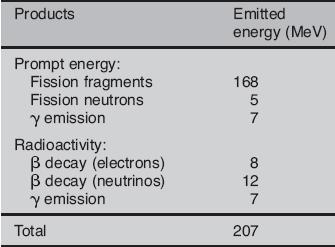
Most of the fission fragments are highly unstable (radioactive) nuclei and undergo further radioactive decays to stabilize itself. Therefore part of the released energy is radiated away from the reactor (See also: Reactor antineutrinos). On the other hand most of the energy released by one fission (~170MeV of total ~200MeV) appears as kinetic energy of these fission fragments. The fission fragments interact strongly with the surrounding atoms or molecules traveling at high speed, causing them to ionize. Creation of ion pairs requires energy, which is lost from the kinetic energy of the charged fission fragment causing it to decelerate. The positive ions and free electrons created by the passage of the charged fission fragment will then reunite, releasing energy in the form of heat (e.g. vibrational energy or rotational energy of atoms). This is the principle how fission fragments heat up fuel in the reactor core.
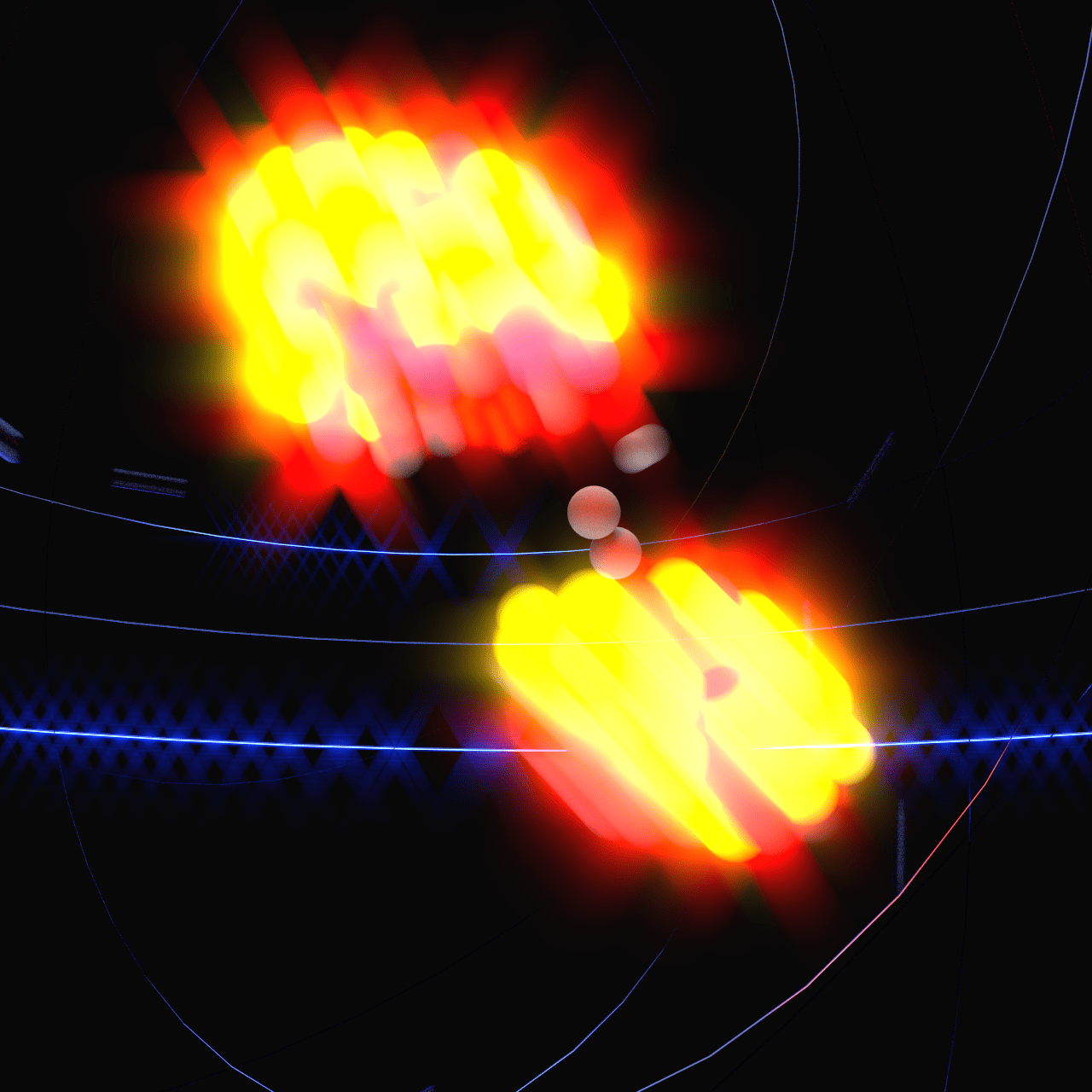
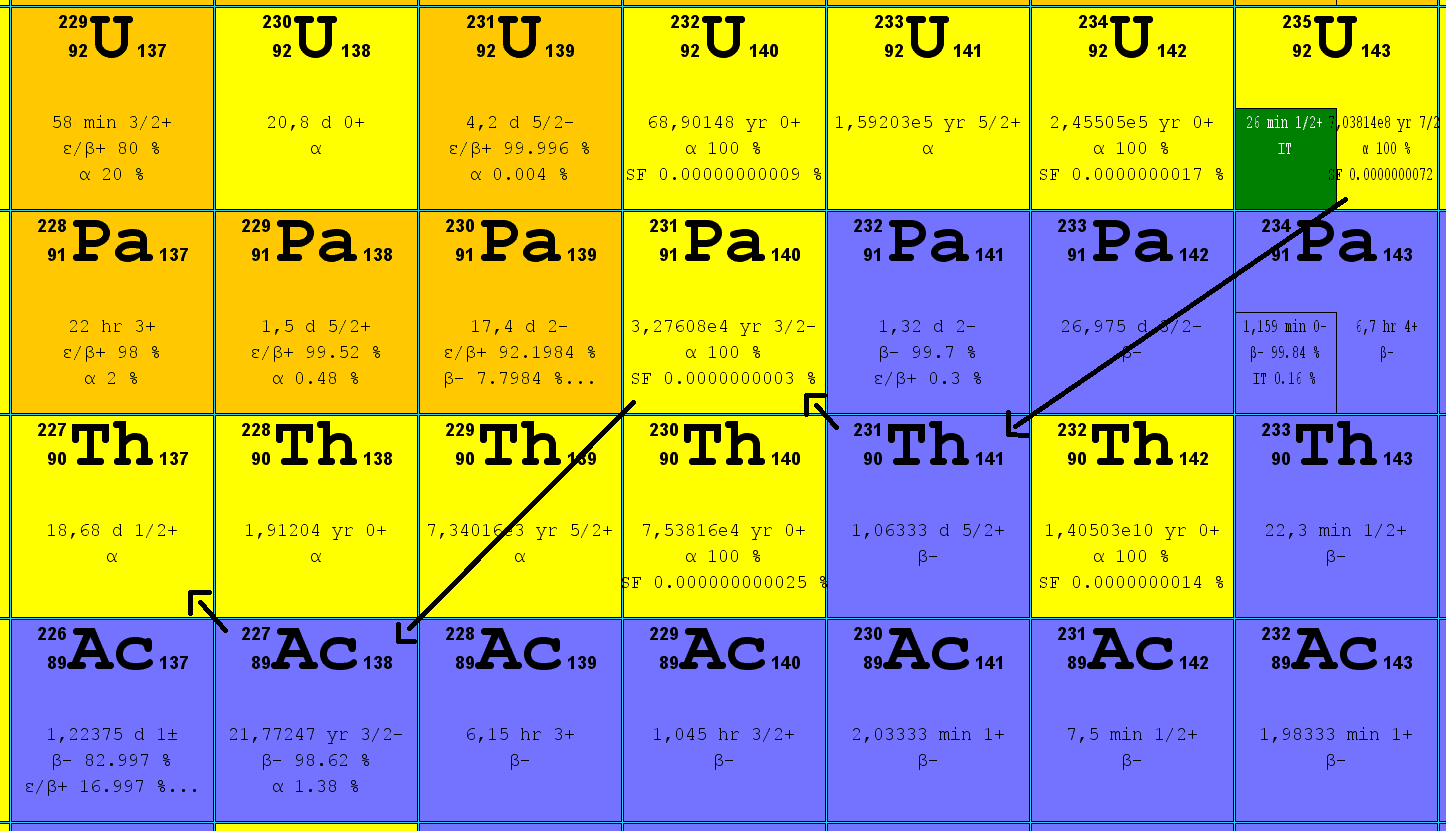
Source of nuclear data: JANIS (Java-based Nuclear Data Information Software); ENDF/B-VII.1Fission fragments after a nucleus fission. Fission fragments interact strongly with the surrounding atoms or molecules traveling at high speed, causing them to ionize.Uranium 235 decays via alpha decay into 231Pa.Uranium 235. Comparison of total fission cross-section and cross-section for radiative capture.
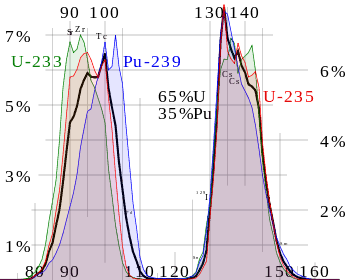
Fission fragment yield for different nuclei. The most probable fragment masses are around mass 95 (Krypton) and 137 (Barium).
Neutron production per one fast fission of uranium 235.
See also:
Uranium 235
We hope, this article, Uranium 235 Fission, helps you. If so, give us a like in the sidebar. Main purpose of this website is to help the public to learn some interesting and important information about radiation and dosimeters.
What is uranium 233 fission reaction? When uranium 233 undergoes fission, the nucleus splits into two smaller nuclei, along with a few neutrons. Periodic Table
Uranium 233 Fission
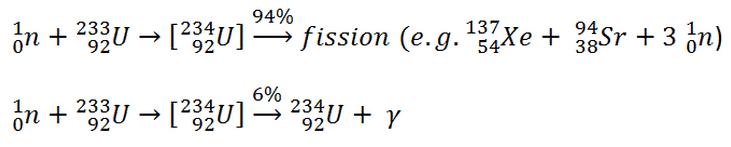
Uranium 233 is a very good fissile isotope and its fission cross-section for thermal neutrons is about 531 barns (for 0.0253 eV neutron). For fast neutrons its fission cross-section is on the order of barns. Most of absorption reactions result in fission reaction, but a minority results in radiative capture forming 234U. The cross-section for radiative capture for thermal neutrons is about 45 barns (for 0.0253 eV neutron). Therefore about 6% of all absorption reactions result in radiative capture of neutron. About 94% of all absorption reactions result in fission. The capture-to-fission ratio is much smaller than the other two major fissile fuels 235U and 239U.
Typically, when uranium 233 nucleus undergoes fission, the nucleus splits into two smaller nuclei (triple fission can also rarely occur), along with a few neutrons (the average is 2.48 neutrons per fission for thermal fission) and release of energy in the form of heat and gamma rays. The average of the fragment atomic mass is about 112, but very few fragments near that average are found. It is much more probable to break up into unequal fragments, and the most probable fragment masses are around mass 93 (strontium) and 137 (xenon).Most of the fission fragments are highly unstable (radioactive) nuclei and undergo further radioactive decays to stabilize itself, therefore part of the released energy is radiated away from the reactor (See also: Reactor antineutrinos). On the other hand most of the energy released by one fission (~168MeV of total ~200MeV) appears as kinetic energy of these fission fragments. The fission fragments interact strongly with the surrounding atoms or molecules traveling at high speed, causing them to ionize. Creation of ion pairs requires energy, which is lost from the kinetic energy of the charged fission fragment causing it to decelerate. The positive ions and free electrons created by the passage of the charged fission fragment will then reunite, releasing energy in the form of heat (e.g. vibrational energy or rotational energy of atoms). This is the principle how fission fragments heat up fuel in the reactor core.
Fission fragments after a nucleus fission. Fission fragments interact strongly with the surrounding atoms or molecules traveling at high speed, causing them to ionize.Source of nuclear data: JANIS (Java-based Nuclear Data Information Software); ENDF/B-VII.1Uranium 233. Comparison of total fission cross-section and cross-section for radiative capture.
Fission fragment yield for different nuclei. The most probable fragment masses are around mass 93 (Strontium) and 137 (Xenon).
Neutron production per one fast fission of uranium 233.
See also:
Uranium 233
We hope, this article, Uranium 233 Fission, helps you. If so, give us a like in the sidebar. Main purpose of this website is to help the public to learn some interesting and important information about radiation and dosimeters.
We use cookies to ensure that we give you the best experience on our website. If you continue to use this site we will assume that you are happy with it.Ok