What is Plutonium 240 – Definition

Plutonium 240 is a fertile isotope because its fission cross-section is very low in comparison with fissile isotopes. Isotope 240Pu is formed in a nuclear reactor. Periodic Table

Plutonium 240

240Pu is a fertile isotope because its fission cross-section is very low in comparison with fissile isotopes. Radiative capture of a neutron leads to the formation of fissile 241Pu similarly to 238U which radiative capture leads to the formation of fissile 239Pu.

It is a man-made isotope and can be found in an irradiated uranium fuel or in a spent uranium fuel. Isotope 240Pu is formed in a nuclear reactor from fissile isotope 239Pu. Absorption of a resonance or thermal neutron by the 239Pu nucleus yields 240Pu.  Trace amounts can be found in the nature. The isotope 240Pu is in a decay chain of the primordial isotope 244Pu.  These nuclei are present in the unalterable proportions of the radioactive equilibrium between 244Pu and 240Pu.

240Pu has relatively high radiative capture cross-section (about 290 barns for thermal neutrons).240Pu decays via alpha decay into 236U with half-life of 6560 years.

Fissile / Fertile Material Cross-sectionsFissile / Fertile Material Cross-sections. Comparison of total fission cross-sections.Source: JANIS (Java-based Nuclear Data Information Software); ENDF/B-VII.1
Fissile / Fertile Material Cross-sectionsPlutonium 240. Comparison of total fission cross-section and cross-section for radiative capture.  Source: JANIS (Java-based Nuclear Data Information Software); ENDF/B-VII.1
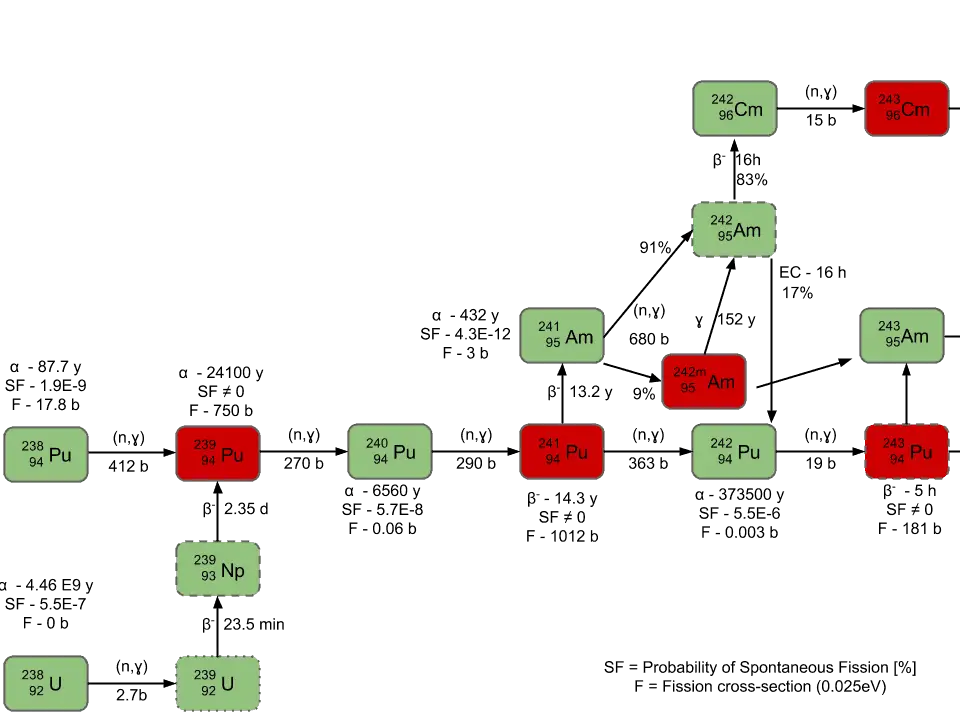
plutonium breedingSource of data: JANIS (Java-based Nuclear Data Information Software); The JEFF-3.1.1 Nuclear Data Library

See also:

Plutonium 239

See also:

Plutonium

See also:

Plutonium 241

We hope, this article, Plutonium 240, helps you. If so, give us a like in the sidebar. Main purpose of this website is to help the public to learn some interesting and important information about radiation and dosimeters.
What is Plutonium 241 – Definition

241Pu is a fissile isotope of plutonium. Isotope 241Pu is formed in a nuclear reactor from fertile isotope 240Pu. 241Pu decays via beta decay into 241Am. Periodic Table

Plutonium 241

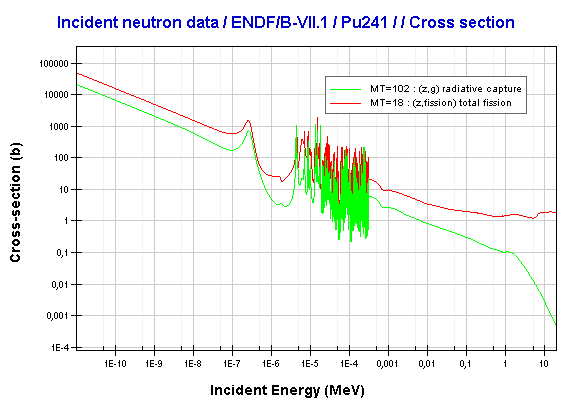
241Pu is a fissile isotope, which means 241Pu is capable of undergoing fission reaction after absorbing thermal neutron. Moreover 241Pu meets also alternative requirement that the amount of neutrons produced by fission of 241Pu (~2.94 per one fission by thermal neutron) is sufficient to sustain a nuclear fission chain reaction. Its fission cross-section for thermal neutrons is about 1012 barns (for 0.025 eV neutron). For fast neutrons its fission cross-section is on the order of barns.

Most of absorption reactions result in fission reaction, but a part of reactions result in radiative capture forming 242Pu. The cross-section for radiative capture for thermal neutrons is about 363 barns (for 0.025 eV neutron). Therefore about 74% of all absorption reactions result in radiative capture of neutron. About 26% of all absorption reactions result in fission.

It is a man-made isotope and can be found in an irradiated uranium fuel or in a spent uranium fuel. Isotope 241Pu is formed in a nuclear reactor from fertile isotope 240Pu. Absorption of a resonance or thermal neutron by the 240Pu nucleus yields 241Pu.241Pu decays via beta decay into 241Am with half-life of only 14.3 years. 241Am has relatively high cross-section for radiative capture for thermal neutrons (~680 barns – 0.025eV). This two phenomena (decrease in fissile isotope and increase in neutron absorber) cause slight decrease in reactivity of irradiated fuel when stored in a spent fuel pool.

Fissile / Fertile Material Cross-sectionsFissile / Fertile Material Cross-sections. Comparison of total fission cross-sections.Source: JANIS (Java-based Nuclear Data Information Software); ENDF/B-VII.1
Fissile / Fertile Material Cross-sectionsPlutonium 241. Comparison of total fission cross-section and cross-section for radiative capture.  Source: JANIS (Java-based Nuclear Data Information Software); ENDF/B-VII.1
plutonium breedingSource of data: JANIS (Java-based Nuclear Data Information Software); The JEFF-3.1.1 Nuclear Data Library

See also:

Plutonium 240

See also:

Plutonium

See also:

We hope, this article, Plutonium 241, helps you. If so, give us a like in the sidebar. Main purpose of this website is to help the public to learn some interesting and important information about radiation and dosimeters.

What is Thorium – Definition

What is Thorium. Thorium is a naturally-occurring chemical element with atomic number 90. The chemical symbol for thorium is Th. Periodic Table

What is Thorium

Thorium is a naturally-occurring chemical element with atomic number 90 which means there are 90 protons and 90 electrons in the atomic structure. The chemical symbol for thorium is Th. Thorium was discovered in 1828 by norwegian mineralogist Morten Thrane Esmark. Joens Jakob Berzelius, the swedish chemist, named it after Thor, the Norse god of thunder.

Thorium  is a naturally-occurring element and it is estimated to be about three times more abundant than uranium. Thorium is commonly found in monazite sands (rare earth metals containing phosphate mineral).

Thorium has 6 naturally occurring isotopes. All of these isotopes are unstable (radioactive), but only 232Th is relatively stable with half-life of 14 billion years, which is comparable to the age of the Earth (~4.5×10⁹ years). Isotope 232Th belongs to primordial nuclides and natural thorium consists primarily of isotope 232Th. Other isotopes (230Th, 229Th, 228Th, 234Th and 227Th) occur in nature as trace radioisotopes, which originate from decay of 232Th, 235U and 238U.

Fissile / Fertile Material Cross-sectionsFissile / Fertile Material Cross-sections. Comparison of total fission cross-sections.Source: JANIS (Java-based Nuclear Data Information Software); ENDF/B-VII.1Fissile / Fertile Material Cross-sectionsSource of data: JANIS (Java-based Nuclear Data Information Software); ENDF/B-VII.1

Thorium 232

Thorium 232, which alone makes up nearly all natural thorium, is the most common isotope of thorium in the nature. This isotope has the longest half-life (1.4 x 10¹⁰ years) of all isotopes with more than 83 protons. In fact, its half-life is considerably longer than the age of earth. Therefore 232Th belongs to primordial nuclides.

232Th decays via alpha decay into 228Ra . 232Th  occasionally decays by spontaneous fission with very low probability of 1.1 x 10-9 %.

232Th is a fertile isotope. 232Th is not capable of undergoing fission reaction after absorbing thermal neutron, on the other hand 232Th can be fissioned by fast neutron with energy higher than >1MeV. 232Th does not meet also alternative requirement to fissile materials. 232Th is not capable of sustaining a nuclear fission chain reaction, because too many of neutrons produced by fission of 232Th have lower energies than original neutron.

Isotope 232Th is key material in the thorium fuel cycle. Radiative capture of a neutron leads to the formation of fissile 233U. This process is called nuclear fuel breeding.

 
Uranium 233 breeding
n+_{90}^{232}textrm{Th}  {rightarrow} _{90}^{232}textrm{Th}+gamma rightarrow  _{91}^{233}textrm{Pa} rightarrow  _{92}^{233}textrm{U}

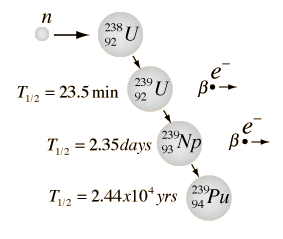
232Th is the predominant isotope of natural thorium. If this fertile material is loaded in the nuclear reactor, the nuclei of 232Th absorb a neutron and become nuclei of 233Th. The half-life of 233Th is approximately 21.8 minutes. 233Th decays (negative beta decay) to 233Pa (protactinium), whose half-life is 26.97 days. 233Pa decays (negative beta decay)  to 233U, that is very good fissile material. On the other hand proposed reactor designs must attempt to physically isolate the protactinium from further neutron capture before beta decay can occur.

See also:

Plutonium

See also:

Nuclear Fuel

See also:

We hope, this article, Thorium, helps you. If so, give us a like in the sidebar. Main purpose of this website is to help the public to learn some interesting and important information about radiation and dosimeters.
What is Thorium 232 – Definition

Thorium 232 is the most common isotope of thorium in the nature. 232Th is a fertile isotope, but is not capable of undergoing fission reaction after absorbing thermal neutron. Periodic Table

Thorium 232

Thorium 232, which alone makes up nearly all natural thorium, is the most common isotope of thorium in the nature. This isotope has the longest half-life (1.4 x 10¹⁰ years) of all isotopes with more than 83 protons. In fact, its half-life is considerably longer than the age of earth. Therefore 232Th belongs to primordial nuclides.232Th decays via alpha decay into 228Ra . 232Th  occasionally decays by spontaneous fission with very low probability of 1.1 x 10-9 %.

232Th is a fertile isotope. 232Th is not capable of undergoing fission reaction after absorbing thermal neutron, on the other hand 232Th can be fissioned by fast neutron with energy higher than >1MeV. 232Th does not meet also alternative requirement to fissile materials. 232Th is not capable of sustaining a nuclear fission chain reaction, because too many of neutrons produced by fission of 232Th have lower energies than original neutron.Isotope 232Th is key material in the thorium fuel cycle. Radiative capture of a neutron leads to the formation of fissile 233U. This process is called nuclear fuel breeding. 

Uranium 233 breeding
n+_{90}^{232}textrm{Th}  {rightarrow} _{90}^{232}textrm{Th}+gamma rightarrow  _{91}^{233}textrm{Pa} rightarrow  _{92}^{233}textrm{U}232Th is the predominant isotope of natural thorium. If this fertile material is loaded in the nuclear reactor, the nuclei of 232Th absorb a neutron and become nuclei of 233Th. The half-life of 233Th is approximately 21.8 minutes. 233Th decays (negative beta decay) to 233Pa (protactinium), whose half-life is 26.97 days. 233Pa decays (negative beta decay)  to 233U, that is very good fissile material. On the other hand proposed reactor designs must attempt to physically isolate the protactinium from further neutron capture before beta decay can occur.
What is Thorium
Thorium is a naturally-occurring chemical element with atomic number 90 which means there are 90 protons and 90 electrons in the atomic structure. The chemical symbol for thorium is Th. Thorium was discovered in 1828 by norwegian mineralogist Morten Thrane Esmark. Joens Jakob Berzelius, the swedish chemist, named it after Thor, the Norse god of thunder.Thorium  is a naturally-occurring element and it is estimated to be about three times more abundant than uranium. Thorium is commonly found in monazite sands (rare earth metals containing phosphate mineral).Thorium has 6 naturally occurring isotopes. All of these isotopes are unstable (radioactive), but only 232Th is relatively stable with half-life of 14 billion years, which is comparable to the age of the Earth (~4.5×10⁹ years). Isotope 232Th belongs to primordial nuclides and natural thorium consists primarily of isotope 232Th. Other isotopes (230Th, 229Th, 228Th, 234Th and 227Th) occur in nature as trace radioisotopes, which originate from decay of 232Th, 235U and 238U.

Fissile / Fertile Material Cross-sectionsFissile / Fertile Material Cross-sections. Comparison of total fission cross-sections.Source: JANIS (Java-based Nuclear Data Information Software); ENDF/B-VII.1Fissile / Fertile Material Cross-sectionsSource of data: JANIS (Java-based Nuclear Data Information Software); ENDF/B-VII.1

See above:See also:

Thorium

We hope, this article, Thorium 232, helps you. If so, give us a like in the sidebar. Main purpose of this website is to help the public to learn some interesting and important information about radiation and dosimeters.
What is Primordial Matter – Definition

Primordial nuclides are nuclides found on the Earth that have existed in their current form since before Earth was formed. Primordial nuclides. Periodic Table
Primordial matter consist of primordial nuclides. Primordial nuclides are nuclides found on the Earth that have existed in their current form since before Earth was formed. Primordial nuclides are residues from the Big Bang, from cosmogenic sources, and from ancient supernova explosions which occurred before the formation of the solar system. Only 288 such nuclides are known.

Bismuth, thorium, uranium and plutonium are primordial nuclides because they have half-lives long enough to still be found on the Earth, while all the others are produced either by radioactive decay or are synthesized in laboratories and nuclear reactors.

See also:

Glossary

We hope, this article, Primordial Matter, helps you. If so, give us a like in the sidebar. Main purpose of this website is to help the public to learn some interesting and important information about radiation and dosimeters.
What is Nuclear Breeding – Definition

The nuclear fuel breeding in the fuel cycle of all commercial light water reactors plays a significant role. The nuclear breeding permits the power reactor to operate longer. Periodic Table

Nuclear Fuel Breeding

All commercial light water reactors contains both fissile and fertile materials. For example, most PWRs use low enriched uranium fuel with enrichment of 235U up to 5%. Therefore more than 95% of content of fresh fuel is fertile isotope 238U. During fuel burnup the fertile materials (conversion of 238U to fissile 239Pu known as fuel breeding) partially replace fissile 235U, thus permitting the power reactor to operate longer before the amount of fissile material decreases to the point where reactor criticality is no longer manageable.

The fuel breeding in the fuel cycle of all commercial light water reactors plays a significant role. In recent years, the commercial power industry has been emphasizing high-burnup fuels (up to 60 – 70 GWd/tU), which are typically enriched to higher percentages of 235U (up to 5%). As burnup increases, a higher percentage of the total power produced in a reactor is due to the fuel bred inside the reactor. 

Effect of Fuel Temperature on Nuclear Breeding
In LWRs, the fuel temperature influences the rate of nuclear breeding (the breeding ratio). In principle, the increase is the fuel temperature affects primarily the resonance escape probability, which is connected with the phenomenon usually known as the Doppler broadening (primarily 238U).  The impact of this resonance capture reaction  on the neutron balance is evident, the neutron is lost and this effect decreases the effective multiplication factor. On the other hand, this capture leads to formation of unstable nuclei with higher neutron number. Such unstable nuclei undergo a nuclear decay, which may lead to formation of another fissile nuclei. This process is also referred to as the nuclear transmutation and is responsible for new fuel breeding in nuclear reactors.

From this point of view, the neutron is utilized much more effectively when captured by 238U than when captured by absorbator, because the effective multiplication factor must in every state equal to 1 (Note that in PWRs the boric acid is used to compensate an excess of reactivity of reactor core along thefuel cycle). In other words it is better to capture the neutron (lower an excess of reactivity) by 238U, rather than by 10B nuclei.

At HFP (hot full power) state, the fuel temperature is directly given by:

  • Local linear heat rate (W/cm), which is given by neutron flux distribution. See also: Power Distribution
  • Fuel-cladding gap. As the fuel burnup increases the fuel-cladding gap reduces. This reduction is caused by the swelling of the fuel pellets and cladding creep. Fuel pellets swelling occurs because fission gases cause the pellet to swell resulting in a larger volume of the pellet. At the same time, the cladding is distorted by outside pressure (known as the cladding creep). These two effects result in direct fuel-cladding contact (e.g. at burnup of 25 GWd/tU). The direct fuel-cladding contact causes a significant reduction in fuel temperature profile, because the overall thermal conductivity increases due to conductive heat transfer.
  • Core inlet temperature. Core inlet temperature is directly given by system parameters in steam generators. When steam generators are operated at approximately 6.0MPa, it means the saturation temperature is equal to 275.6 °C. Since there must be always ΔT (~15°C) between the primary circuit and the secondary circuit, the reactor coolant (in the cold leg)have about 290.6°C (at HFP) at the inlet of the core. As the system pressure increases, the core inlet temperature must also increase. This increase causes slight increase in fuel temperature.

It can be summarized, the fuel breeding is lower, when the reactor is operated at lower power levels. Note that, in order to lower the reactor power, additional absorbators must be inserted inside the core.  The fuel breeding is higher  (e.g. 1 EFPD surplus), when the core inlet temperature of the reactor coolant is higher (e.g. 1°C for 300 EFPDs). It must be added, the inlet temperature is limited and it cannot be changed arbitrarily.

At a burnup of 30 GWd/tU (gigawatt-days per metric ton of uranium), about 30% of the total energy released comes from bred plutonium. At 40 GWd/tU, that percentage increases to about forty percent. This corresponds to a breeding ratio for these reactors of about 0.4 to 0.5. That means, about half of the fissile fuel in these reactors is bred there. This effect extends the cycle length for such fuels to sometimes nearly twice what it would be otherwise. MOX fuel has a smaller breeding effect than 235U fuel and is thus more challenging and slightly less economic to use due to a quicker drop off in reactivity through cycle life. 
Plutonium 239 breeding
 n+_{92}^{238}textrm{U}  {rightarrow} _{92}^{239}textrm{U}+gamma rightarrow  _{93}^{239}textrm{Np} rightarrow  _{94}^{239}textrm{Pu} 

Neutron capture may also be used to create fissile 239Pu from 238U, which is the dominant constituent of naturally occurring uranium (99.28%). Absorption of a neutron in the 238U nucleus yields 239U. The half-life of 239U is approximately 23.5 minutes. 239U decays (negative beta decay) to 239Np (neptunium), whose half-life is 2.36 days. 239Np decays (negative beta decay)  to 239Pu.

Uranium 233 breeding
n+_{90}^{232}textrm{Th}  {rightarrow} _{90}^{232}textrm{Th}+gamma rightarrow  _{91}^{233}textrm{Pa} rightarrow  _{92}^{233}textrm{U}

232Th is the predominant isotope of natural thorium. If this fertile material is loaded in the nuclear reactor, the nuclei of 232Th absorb a neutron and become nuclei of 233Th. The half-life of 233Th is approximately 21.8 minutes. 233Th decays (negative beta decay) to 233Pa (protactinium), whose half-life is 26.97 days. 233Pa decays (negative beta decay)  to 233U, that is very good fissile material. On the other hand proposed reactor designs must attempt to physically isolate the protactinium from further neutron capture before beta decay can occur.

Comparison of cross-sections

Source: JANIS (Java-based nuclear information software)  http://www.oecd-nea.org/janis/

Fissile / Fertile Material Cross-sections
Source: JANIS (Java-based nuclear information software)
http://www.oecd-nea.org/janis/
Uranium 238. Comparison of total fission cross-section and cross-section for radiative capture.
Fissile / Fertile Material Cross-sections
Source: JANIS (Java-based nuclear information software)
http://www.oecd-nea.org/janis/
Thorium 232. Comparison of total fission cross-section and cross-section for radiative capture.

Pu-239 breeding. The uranium nucleus absorbs neutron, thus leads to Pu-239 breeding.

Conversion Factor – Breeding Ratio

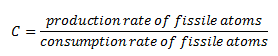
A quantity that characterizes this conversion of fertile into fissile material is known as the conversion factor. The conversion factor is defined as the ratio of fissile material created to fissile material consumed either by fission or absorption. If the ratio is greater than one, it is often referred to as the breeding ratio, for then the reactor is creating more fissile material than it is consuming.

Conversion Factor - Breeding Ratio - definition

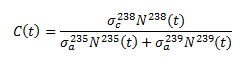
When C is unity, one new atom is produced per one atom consumed. It seems fertile material can be converted in the reactor indefinitely without adding new fuel, but in real reactors the content of fertile uranium 238 also decreases and fission products with significant absorption cross-section accumulates in the fuel as fuel burnup increases.

If we use a simplified model, which includes only uranium and plutonium-239, the conversion factor is:

Conversion Factor - Breeding Ratio - equation

This equation indicates that increased fuel enrichment results in a decreased value of C(0), the initial conversion factor. As the content of fissile material decreases with fuel burnup, the conversion factor increases. As this happens an increasing fraction of the fission comes from plutonium.

See also: Conversion Factor

See also:

Glossary

We hope, this article, Nuclear Breeding, helps you. If so, give us a like in the sidebar. Main purpose of this website is to help the public to learn some interesting and important information about radiation and dosimeters.
What is Uranium – Definition

What is uranium? Uranium is a naturally-occurring chemical element. The chemical symbol for uranium is U. Uranium is widely used as a nuclear fuel in nuclear reactors. Periodic Table

What is Uranium

What is uranium?

Uranium is a naturally-occurring chemical element with atomic number 92 which means there are 92 protons and 92 electrons in the atomic structure. The chemical symbol for uranium is U. Uranium was discovered in 1789 by Martin Klaproth in the mineral called pitchblende (uraninite). He named the newly discovered element after the planet Uranus, which had been discovered eight years earlier. It was first isolated as a metal in 1841 by Eugene-Melchior Peligot. Henri Becquerel discovered uranium to be radioactive in 1896. He discovered that uranium minerals could expose a photographic plate through another material. In fact he was the first to discover the process of radioactivity.

Uranium is commonly found  at low levels (a few ppm – parts per million) in all rocks, soil, water, plants, and animals (including humans). Uranium occurs also in seawater, and can be recovered from the ocean water. Significant concentrations of uranium occur in some substances such as uraninite (the most common uranium ore), phosphate rock deposits, and other minerals.

Natural uranium consists primarily of isotope 238U (99.28%), therefore the atomic mass of uranium element is close to the atomic mass of 238U isotope (238.03u).  Natural uranium also consists of two other isotopes: 235U (0.71%) and 234U (0.0054%). The abundance of  isotopes in the nature is caused by difference in the half-lifes. All three naturally-occurring isotopes of uranium (238U, 235U and 234U)  are unstable. On the other hand these isotopes belong to primordial nuclides, because their half-life is comparable to the age of the Earth (~4.5×10⁹ years for 238U). In nuclear reactors we have to consider three artificial isotopes, 236U, 233U and 232U. These are produced by transmutation in nuclear reactors from 235U and 232Th.

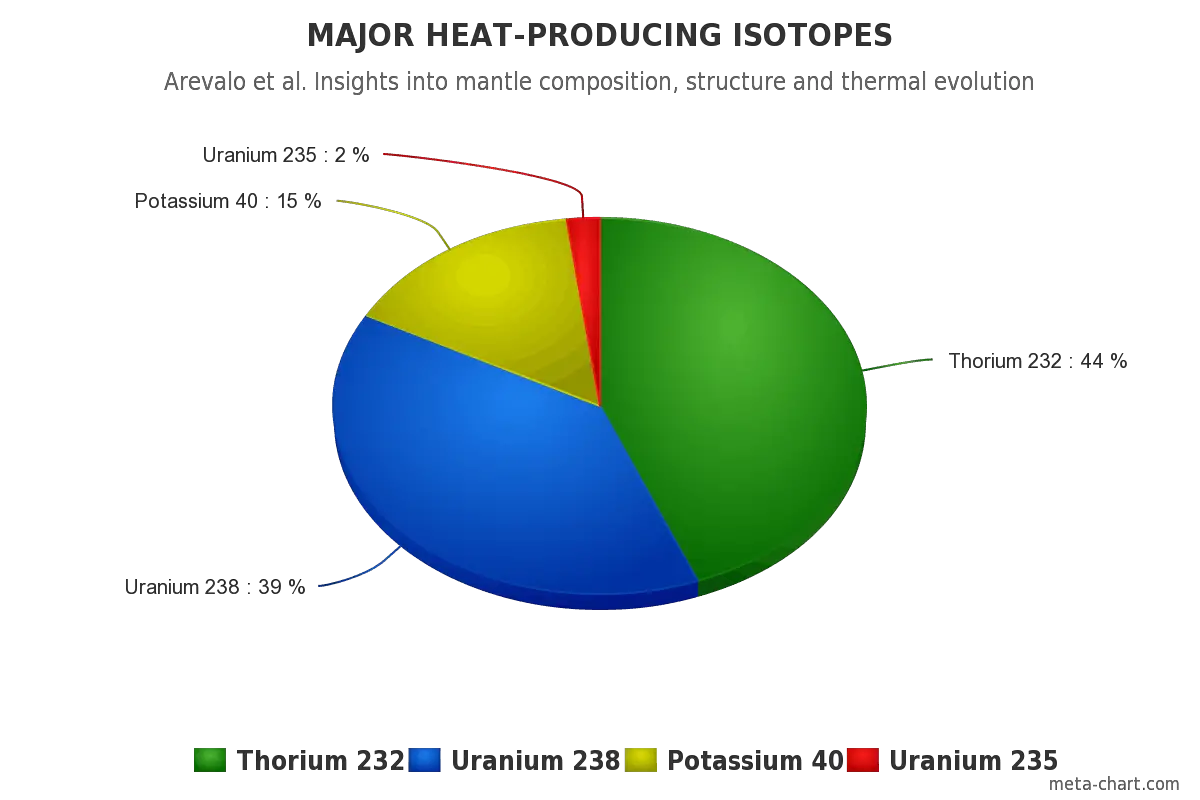
Major heat-producing isotopes.Share of major heat-producing isotopes on the heating of Earth’s core. Uranium 238 has important share of 39%.
Uranium 238 decay.
Uranium 235 decay.

Uraninite - the most common uranium ore.
Uraninite – the most common uranium ore.
Fissile / Fertile Material Cross-sectionsUranium 235. Comparison of total fission cross-section and cross-section for radiative capture.Source: JANIS (Java-based Nuclear Data Information Software); The JEFF-3.1.1 Nuclear Data Library
Fissile / Fertile Material Cross-sectionsUranium 238. Comparison of total fission cross-section and cross-section for radiative capture.Source: JANIS (Java-based Nuclear Data Information Software); The JEFF-3.1.1 Nuclear Data Library

See also:

Uranium

See also:

Isotopes of Uranium

We hope, this article, Uranium, helps you. If so, give us a like in the sidebar. Main purpose of this website is to help the public to learn some interesting and important information about radiation and dosimeters.
What is Isotopes of Uranium – Definition

Isotopes of Uranium. The naturally-occuring and artificial isotopes, which have to be considered in the fuel cycle of all commercial light water reactors, are summarized here. Periodic Table

Isotopes of Uranium

The main isotopes, which have to be considered in the fuel cycle of all commercial light water reactors, are:Naturally-occurring isotopes

  • 238U. 238U belongs to the group of fertile isotopes. 238U decays via alpha decay to 234Th with half-life of ~4.5×10⁹ years. 238U occasionally decays by spontaneous fission with probability of 0.000055%. Its specific activity is very low ~3.4×10⁻⁷ Ci/g.
  • 235U. 235U belongs to the group of fissile isotopes. In fact, 235U is the only existing fissile nucleus from naturally-occurring isotopes and therefore it is a highly strategic material. 235U decays via alpha decay (by way of thorium-231) into 231Pa with half-life of ~7×10⁸ years. 235U occasionally decays by spontaneous fission with very low probability of 0.0000000072%. Its specific activity is very low ~2.2×10⁻⁶ Ci/g.
  • 234U. 234U belongs to the group of fertile isotopes. 234U decays via alpha decay to 230Th with half-life of 246 000 years. 234U occasionally decays by spontaneous fission with very low probability of 0.0000000017%. Its specific activity is much higher ~0.0063 Ci/g.

Artificial isotopes

  • 233U. 233U belongs to the group of fissile isotopes. It is produced by neutron radiative capture in nuclear reactors containing thorium fuel. 233U decays via alpha decay into 229Th with half-life of 159 200 years. 233U occasionally decays by spontaneous fission with very low probability of 0.000000006%. Its specific activity is ~0.0098 Ci/g.
  • 236U. 236U is neither a fissile isotope, nor a fertile isotope. 236U is fissionable only by fast neutrons. Isotope 236U is formed in a nuclear reactor from fissile isotope 235U. 236U decays via alpha decay to 232Th with half-life of ~2.3×10⁷ years. 236U occasionally decays by spontaneous fission with very low probability of 0.00000009%. Its specific activity is ~6.5×10⁻⁵ Ci/g.
  • 232U. 232U belongs to the group of fertile isotopes. 232U is a side product in the thorium fuel cycle and also this isotope is a decay product of 236Pu in the uranium fuel. 232U decays via alpha decay to 228Th with half-life of 68.9 years. 232U very rarely decays by spontaneous fission. Its specific activity is very high ~22 Ci/g and its decay chain produces very penetrating gamma rays.
Comparison of total fission cross-section and cross-section for radiative capture.

Source: JANIS (Java-based Nuclear Data Information Software); The JEFF-3.1.1 Nuclear Data LibraryFissile / Fertile Material Cross-sectionsUranium 238. Comparison of total fission cross-section and cross-section for radiative capture.

Fissile / Fertile Material Cross-sectionsUranium 235. Comparison of total fission cross-section and cross-section for radiative capture.
Fissile / Fertile Material Cross-sectionsUranium 234. Comparison of total fission cross-section and cross-section for radiative capture.
Fissile / Fertile Material Cross-sectionsUranium 233. Comparison of total fission cross-section and cross-section for radiative capture.
Fissile / Fertile Material Cross-sectionsUranium 236. Comparison of total fission cross-section and cross-section for radiative capture.
Fissile / Fertile Material Cross-sectionsUranium 232. Comparison of total fission cross-section and cross-section for radiative capture.

See also:

What is Uranium?

See also:

Uranium

See also:

Uranium 238

We hope, this article, Isotopes of Uranium, helps you. If so, give us a like in the sidebar. Main purpose of this website is to help the public to learn some interesting and important information about radiation and dosimeters.
What is Decay Mode and Half-life of Uranium Isotopes – Definition

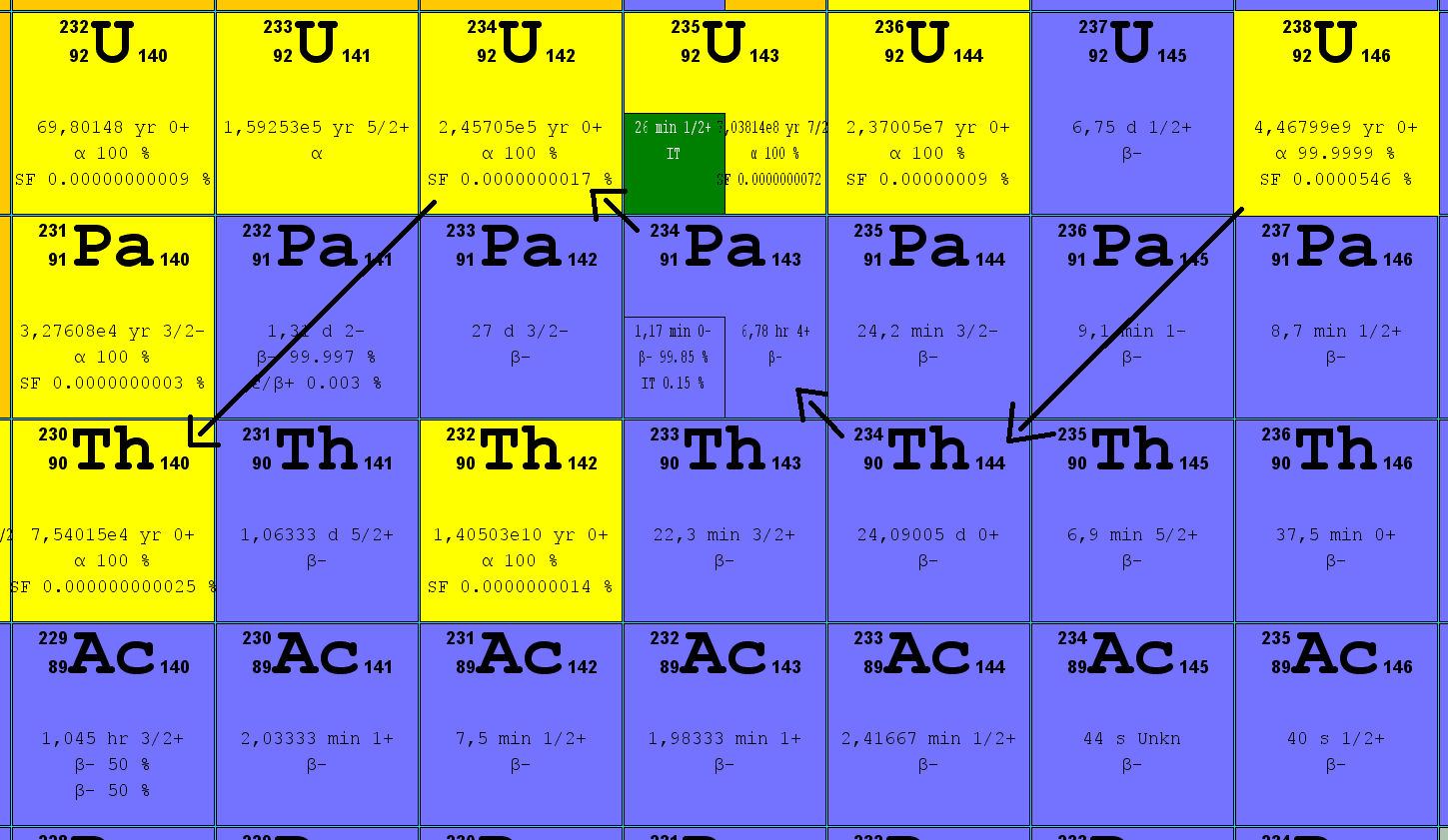
Decay mode and half-lifes of isotopes of uranium. Uranium 238, 235 have half-life comparable to the age of the Earth. Uranium 233, 236, 232 are man-made isotopes. Periodic Table

Decay mode and Half-lifes of Isotopes of Uranium

Natural uranium consists primarily of isotope 238U (99.28%), therefore the atomic mass of uranium element is close to the atomic mass of 238U isotope (238.03u).  Natural uranium also consists of two other isotopes: 235U (0.71%) and 234U (0.0054%). The abundance of  isotopes in the nature is caused by difference in the half-lifes. All three naturally-occurring isotopes of uranium (238U, 235U and 234U)  are unstable. On the other hand these isotopes (except 234U) belong to primordial nuclides, because their half-life is comparable to the age of the Earth (~4.5×10⁹ years for 238U). In nuclear reactors we have to consider three artificial isotopes, 236U, 233U and 232U. These are produced by transmutation in nuclear reactors from 235U and 232Th.

The main isotopes, which have to be considered in the fuel cycle of all commercial light water reactors, are:

Naturally-occurring isotopes

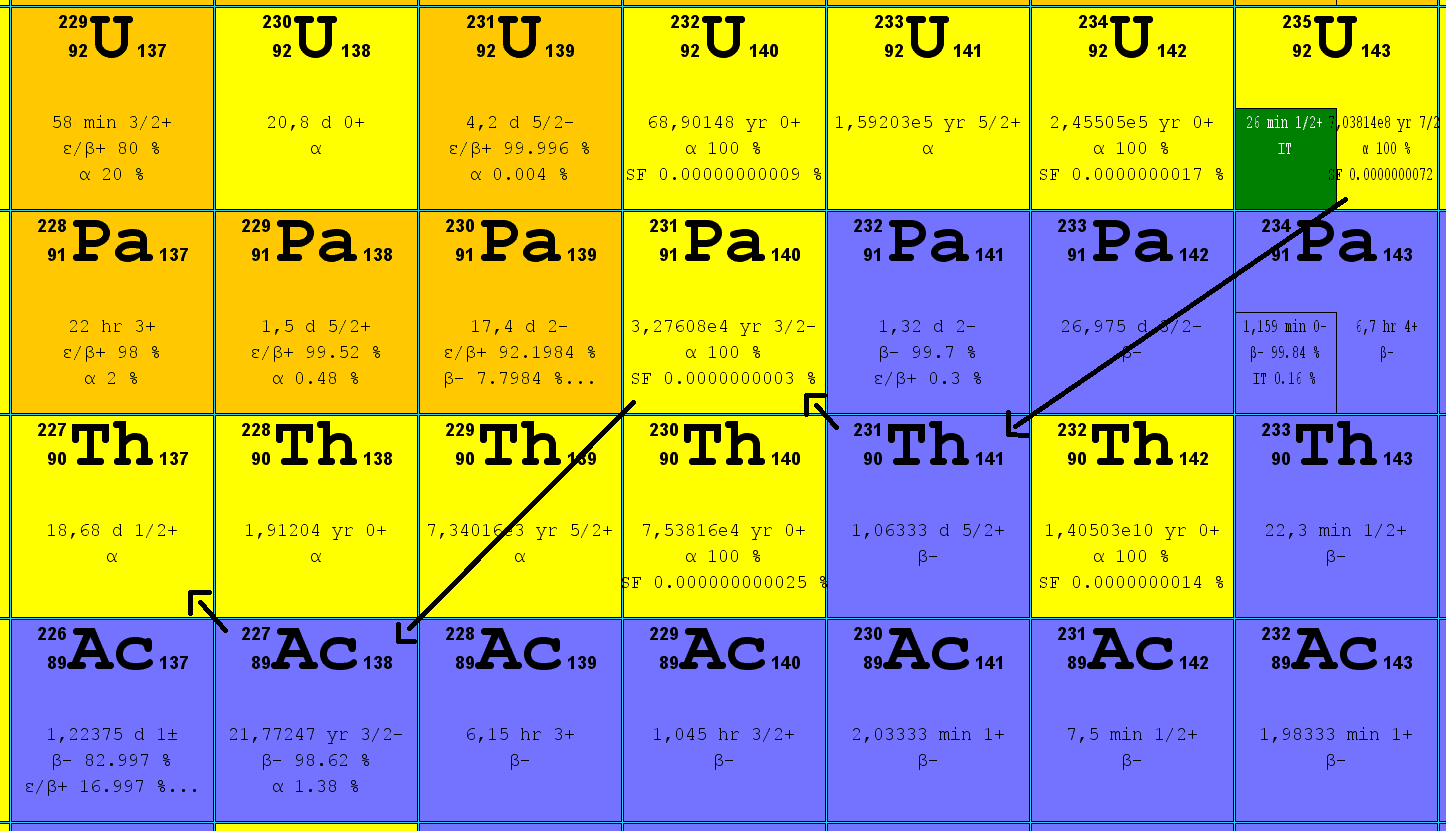
  • 238U. 238U decays via alpha decay to 234Th with half-life of ~4.5×10⁹ years. 238U occasionally decays by spontaneous fission with probability of 0.000055%. Its specific activity is very low ~3.4×10⁻⁷ Ci/g.
  • 235U. 235U decays via alpha decay (by way of thorium-231) into 231Pa with half-life of ~7×10⁸ years. 235U occasionally decays by spontaneous fission with very low probability of 0.0000000072%. Its specific activity is very low ~2.2×10⁻⁶ Ci/g.
  • 234U. 234U decays via alpha decay to 230Th with half-life of 246 000 years. 234U occasionally decays by spontaneous fission with very low probability of 0.0000000017%. Its specific activity is much higher ~0.0063 Ci/g.

Artificial isotopes

  • 233U. 233U decays via alpha decay into 229Th with half-life of 159 200 years. 233U occasionally decays by spontaneous fission with very low probability of 0.000000006%. Its specific activity is ~0.0098 Ci/g.
  • 236U. 236U decays via alpha decay to 232Th with half-life of ~2.3×10⁷ years. 236U occasionally decays by spontaneous fission with very low probability of 0.00000009%. Its specific activity is ~6.5×10⁻⁵ Ci/g.
  • 232U. 232U decays via alpha decay to 228Th with half-life of 68.9 years. 232U very rarely decays by spontaneous fission. Its specific activity is very high ~22 Ci/g and its decay chain produces very penetrating gamma rays.
Uranium 238 decay.Uranium 238 decay. Source: JANIS (Java-based Nuclear Data Information Software); The JEFF-3.1.1 Nuclear Data Library
Uranium 235 decay.Uranium 235 decay. Source: JANIS (Java-based Nuclear Data Information Software); The JEFF-3.1.1 Nuclear Data Library
Isotope Specific Activity
Uranium 232 22 Ci/g
Uranium 233 0.0098 Ci/g
Uranium 234 0.0063 Ci/g
Uranium 236 0.000065 Ci/g
Uranium 235 0.0000022 Ci/g
Uranium 238 0.00000034 Ci/g

Table of specific activities of isotopes of uranium.

See also:

Uranium 232

See also:

Uranium

See also:

Cross-sections of Uranium

We hope, this article, Decay Mode and Half-life of Uranium Isotopes, helps you. If so, give us a like in the sidebar. Main purpose of this website is to help the public to learn some interesting and important information about radiation and dosimeters.

What is Uranium in the Environment – Definition

Uranium contributes to low levels of natural background radiation in the environment.Uranium belongs to main sources of heat that keeps the Earth’s core liquid.

Natural Uranium

Natural uranium consists primarily of isotope 238U (99.28%), therefore the atomic mass of uranium element is close to the atomic mass of 238U isotope (238.03u).  Natural uranium also consists of two other isotopes: 235U (0.71%) and 234U (0.0054%). The abundance of  isotopes in the nature is caused by difference in the half-lifes. All three naturally-occurring isotopes of uranium (238U, 235U and 234U)  are unstable.

Uraninite - the most common uranium ore.
Uraninite – the most common uranium ore.

Uranium in the Environment

All three naturally-occurring isotopes of uranium (238U, 235U and 234U) have very long half-life (e.g. 4.47×10⁹ years for 238U). Because of this very long half-life uranium is weakly radioactive and contributes to low levels of natural background radiation in the environment. These isotopes are alpha radioactive (emitting alpha particle), but they can also rarely undergo a spontaneous fission. All naturally-occurring isotopes belong to primordial nuclides, because their half-life is comparable to the age of the Earth (~4.54×10⁹ years). Uranium has the second highest atomic mass of these primordial nuclides, lighter only than plutonium. Moreover the decay heat of uranium and its decay products (e.g. radon, radium etc.) contributes to heating of Earth’s core. Together with thorium and potassium-40 in the Earth’s mantle is thought that these elements are the main source of heat that keeps the Earth’s core liquid.

Major heat-producing isotopes.Share of major heat-producing isotopes on the heating of Earth’s core. Uranium 238 has important share of 39%.

See also:

Cross-sections of Uranium

See also:

Uranium

We hope, this article, Uranium in the Environment, helps you. If so, give us a like in the sidebar. Main purpose of this website is to help the public to learn some interesting and important information about radiation and dosimeters.