Cross-sections of naturally-occuring and artificial isotopes of uranium. Comparison of total fission cross-section and cross-section for radiative capture. Periodic Table
Naturally-occurring Isotopes of Uranium
The main naturally-occurring isotopes, which have to be considered in the fuel cycle of all commercial light water reactors, are:
235U. 235U belongs to the group of fissile isotopes. In fact, 235U is the only existing fissile nucleus from naturally-occurring isotopes and therefore it is a highly strategic material.
232U. 232U belongs to the group of fertile isotopes. 232U is a side product in the thorium fuel cycle and also this isotope is a decay product of 236Pu in the uranium fuel.
Cross-sections of Naturally-occurring Isotopes
Source: JANIS (Java-based Nuclear Data Information Software); The JEFF-3.1.1 Nuclear Data Library
Source: JANIS (Java-based Nuclear Data Information Software); The JEFF-3.1.1 Nuclear Data Library
Uranium 233. Comparison of total fission cross-section and cross-section for radiative capture.Uranium 236. Comparison of total fission cross-section and cross-section for radiative capture.Uranium 232. Comparison of total fission cross-section and cross-section for radiative capture.
Fissile / Fertile Material Cross-sections. Comparison of total fission cross-sections.
See also:
Half-life of Isotopes of Uranium
See also:
Uranium
See also:
Uranium in the Environment
We hope, this article, Cross-section of Uranium, helps you. If so, give us a like in the sidebar. Main purpose of this website is to help the public to learn some interesting and important information about radiation and dosimeters.
Uranium 238, which alone constitutes 99.28% of natural uranium is the most common isotope of uranium in the nature. Uranium 238 is a fertile isotope. Periodic Table
Uranium 238
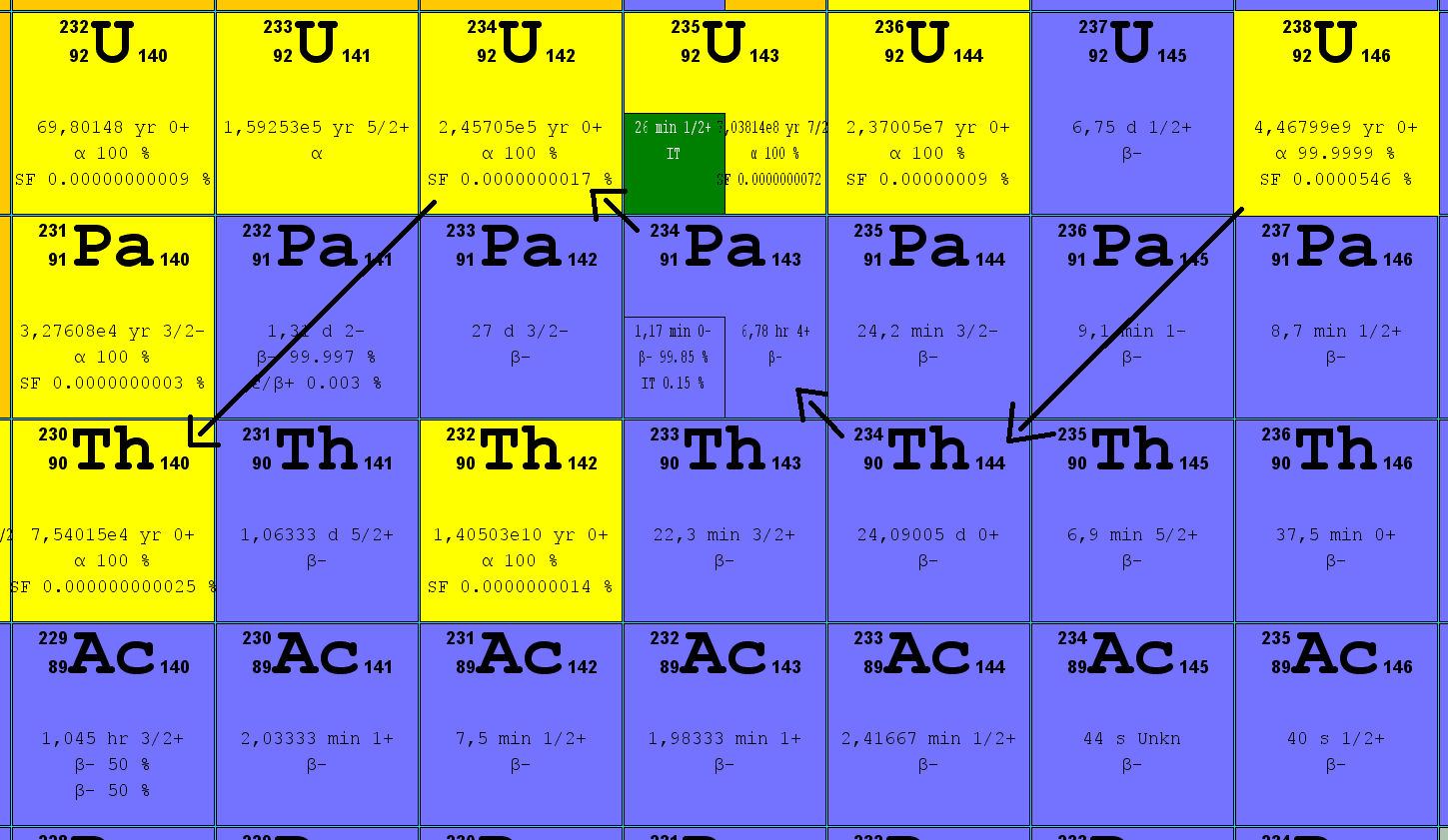
Uranium 238, which alone constitutes 99.28% of natural uranium is the most common isotope of uranium in the nature. This isotope has the longest half-life (4.47×10⁹ years) and therefore its abundance is so high. 238U belongs to primordial nuclides, because its half-life is comparable to the age of the Earth (~4.5×10⁹ years). For its very long half-life, it is still present in the Earth’s crust.238U decays via alpha decay (by way of thorium 234 and protactinium 234) into 234U. 238U occasionally decays by spontaneous fission with probability of 0.000055%.
238U is a fissionable isotope, but is not fissile isotope. 238U is not capable of undergoing fission reaction after absorbing thermal neutron, on the other hand 238U can be fissioned by fast neutron with energy higher than >1MeV. 238U does not meet also alternative requirement to fissile materials. 238U is not capable of sustaining a nuclear fission chain reaction, because too many of neutrons produced by fission of 238U have lower energies than original neutron.
238U belongs also to the group of fertile isotopes. Radiative capture of a neutron leads to the formation of fissile 239Pu. This is the way how 238U contributes to the operation of nuclear reactors and production of electricity through this plutonium. For example, at a burnup of 40GWd/tU, about 40% of the total energy released comes from bred plutonium. This corresponds to a breeding ratio for this fuel burnup of about 0.4 to 0.5. This effect extends the cycle length for such fuels to sometimes nearly twice what it would be otherwise.
Neutron capture may also be used to create fissile 239Pu from 238U, which is the dominant constituent of naturally occurring uranium (99.28%). Absorption of a neutron in the 238U nucleus yields 239U. The half-life of 239U is approximately 23.5 minutes. 239U decays (negative beta decay) to 239Np (neptunium), whose half-life is 2.36 days. 239Np decays (negative beta decay) to 239Pu.
Doppler broadening - inherent safety feature of uranium 238
The Doppler broadening of resonances is very important phanomenon, which improves reactor stability. The prompt temperature coefficient of most thermal reactors is negative, owing to the nuclear Doppler effect (fuel temperature coefficient – FTC). The broadening of uranium 238 resonances constitute fast acting negative feedback effect that is essential to ensure safe operation of all reactors.
In power reactors this effect acts as follows:
The reactor power increase (heating of a fuel) causes broadening of 238U resonances. This results in a higher probability of neutron absorbtion, thus causes negative reactivity insertion (reduction of reactor power).
In the thorium fuel cycle 232Th is analogous to 238U in the U-Pu fuel cycle, because it is the fertile component. Some of the radiative captures in 232Th are resonance events, so that the Doppler broadening role of 238U is similar.
Source of nuclear data: JANIS (Java-based Nuclear Data Information Software); ENDF/B-VII.1Uranium 238 decays via alpha decay (by way of thorium-234 and protactinium-234) into 234U.Uranium 238. Comparison of total fission cross-section and cross-section for radiative capture.Neutron production per one fast fission of uranium 238.
See also:
Isotopes of Uranium
See also:
Uranium
See also:
Uranium 235
Click edit button to change this text.
We hope, this article, Uranium 238, helps you. If so, give us a like in the sidebar. Main purpose of this website is to help the public to learn some interesting and important information about radiation and dosimeters.
Definition of uranium 234. Uranium 234, which alone constitutes only 0.0054% of natural uranium is a fertile isotope. 234U is a non-fissile isotope. Periodic Table
Uranium 234
Uranium 234, which alone constitutes only 0.0054% (54 parts per million) of natural uranium is the last naturally-occurring isotope of uranium. This isotope has the half-life of only 2.46×10⁵ years and therefore it do not belong to primordial nuclides (unlike 235U and 238U). On the other hand, this isotope is still present in the Earth’s crust, but this is due to the fact
234U is an indirect decay product of 238U. 238U decays via alpha decay (by way of thorium-234 and protactinium-234) into 234U. 234U decays via alpha decay into 230Th, except very small fraction (on the order of ppm) of nuclei which decays by spontaneous fission.
In a natural sample of uranium, these nuclei are present in the unalterable proportions of the radioactive equilibrium of the 238U filiation at a ratio of one atom of 234U for about 18 500 nuclei of 238U. As a result of this equilibrium these two isotopes (238U and 234U) contribute equally to the radioactivity of natural uranium.
Since an uranium enrichment is a separation of light isotopes from heavy isotopes, the uranium enrichment results also in enrichment of 234U. Therefore enriched uranium contains also more isotope 234U than natural uranium. On the other hand enrichment tails or also depleted uranium contains much less 234U. In nuclear reactors, which use enriched uranium as a fuel, such increased content of 234U is acceptable. An undesirable concentrations may be reached when using reprocessed uranium, because spent nuclear fuel may contain a much higher concentration of about 0.01% of 234U.
234U is a non-fissile isotope and it is therefore not capable of undergoing fission reaction after absorbing thermal neutron. 234U belongs to the group of fertile isotopes. Radiative capture of a neutron leads to the formation of fissile 235U similarly to 238U which radiative capture leads to the formation of fissile 239Pu. The radiative capture cross-section for 234U is about 100 barns for thermal neutrons and therefore 234U is converted to 235U more easily and therefore at a greater rate than 238U is to 239Pu (nuclei of 238U have a much smaller cross-section of 2 barns). On the other hand, the effect of 235U breeding is almost insignificant in comparison with the 239Pu breeding.
Source of nuclear data: JANIS (Java-based Nuclear Data Information Software); ENDF/B-VII.1Uranium 238 decays via alpha decay (by way of thorium-234 and protactinium-234) into 234U.Uranium 234. Comparison of total fission cross-section and cross-section for radiative capture.Residual 234U content as function of burnup level of PWR fuel.
Source: IAEA-TECDOC-1529 Management of Reprocessed Uranium
See also:
Uranium 235
See also:
Uranium
See also:
Uranium 233
We hope, this article, Uranium 234, helps you. If so, give us a like in the sidebar. Main purpose of this website is to help the public to learn some interesting and important information about radiation and dosimeters.
Definition of uranium 235. Uranium 235, which alone constitutes only 0.71% of natural uranium is a fissile isotope. 235U is a highly strategic fissile material. Periodic Table
Uranium 235
Uranium 235, which alone constitutes 0.72% of natural uranium is the second common isotope of uranium in the nature. This isotope has half-life of 7.04×10⁸ years (6.5 times shorter than the isotope 238) and therefore its abundance is lower than 238U (99.28%). 235U belongs to primordial nuclides, because its half-life is comparable to the age of the Earth (~4.5×10⁹ years). For its very long half-life, it is still present in the Earth’s crust.235U decays via alpha decay (by way of thorium-231) into 231Pa. 235U occasionally decays by spontaneous fission with very low probability of 0.0000000072%.
235U is a fissile isotope, which means 235U is capable of undergoing fission reaction after absorbing thermal neutron. Moreover, 235U meets also alternative requirement that the amount (~2.43 per one fission by thermal neutron) of neutrons produced by fission of 235U is sufficient to sustain a nuclear fission chain reaction. 235U was the first isotope that was found to be fissile. In fact, 235U is the only existing fissile nucleus from naturally-occurring isotopes and therefore is a highly strategic material. At the time of the formation of the Earth, 235U was 85 times more abundant. The 0.72% observed today are only a residue caused by the difference in the half-lifes of 235U and 238U. If mankind had been present at the beginning of the Earth, they would not have needed to enrich uranium, because the content of fissile 235U was significantly higher.
Uranium 235 Fission
Uranium 235 is a fissile isotope and its fission cross-section for thermal neutrons is about 585 barns (for 0.0253 eV neutron). For fast neutrons its fission cross-section is on the order of barns. Most of absorption reactions result in fission reaction, but a minority results in radiative capture forming 236U. The cross-section for radiative capture for thermal neutrons is about 99 barns (for 0.0253 eV neutron). Therefore about 15% of all absorption reactions result in radiative capture of neutron. About 85% of all absorption reactions result in fission.
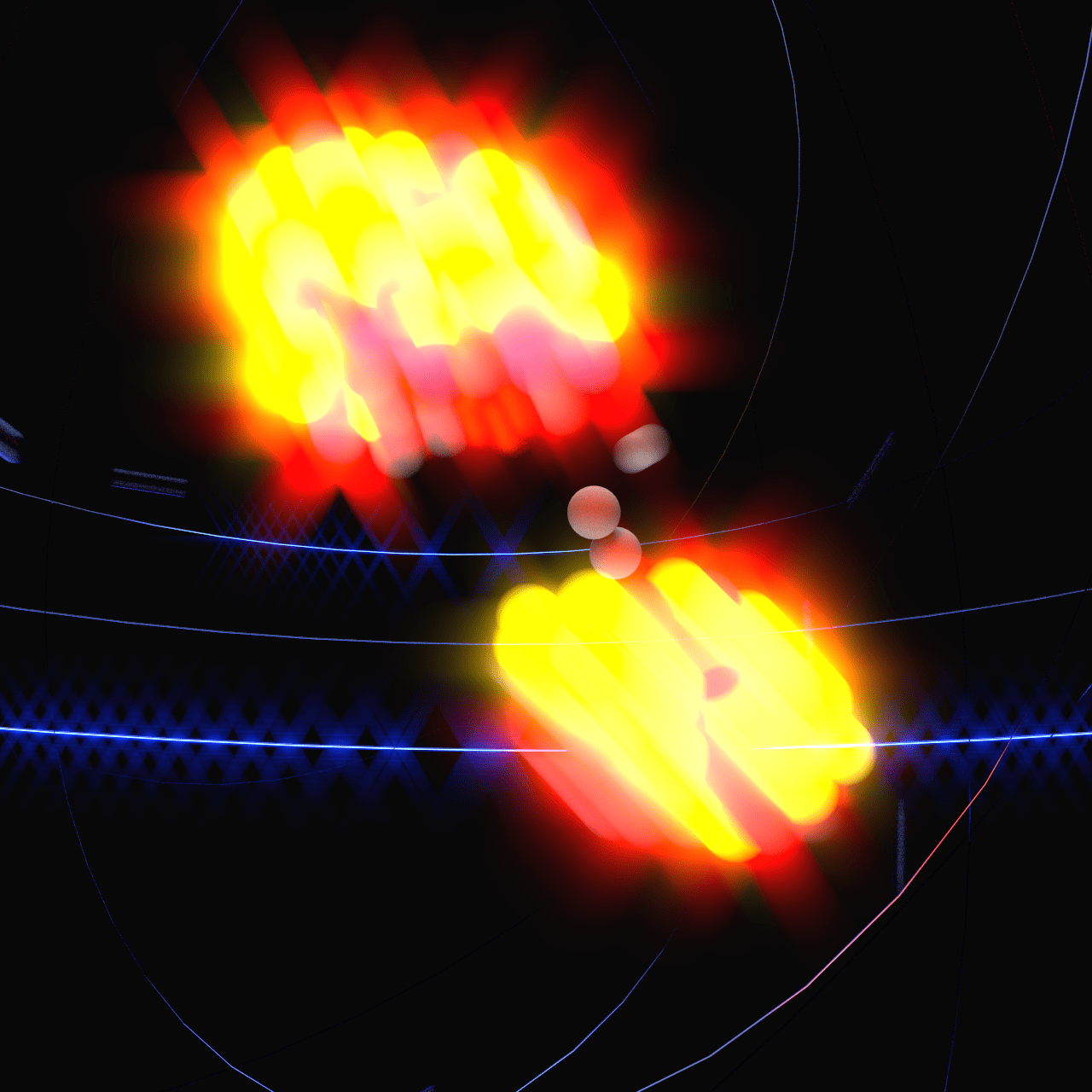
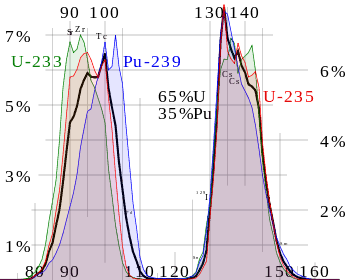
Typically, when uranium 235 nucleus undergoes fission, the nucleus splits into two smaller nuclei (triple fission can also rarely occur), along with a few neutrons (the average is 2.43 neutrons per fission by thermal neutron) and release of energy in the form of heat and gamma rays. The average of the fragment atomic mass is about 118, but very few fragments near that average are found. It is much more probable to break up into unequal fragments, and the most probable fragment masses are around mass 95 (Krypton) and 137 (Barium).
Most of the fission fragments are highly unstable (radioactive) nuclei and undergo further radioactive decays to stabilize itself. Therefore part of the released energy is radiated away from the reactor (See also: Reactor antineutrinos). On the other hand most of the energy released by one fission (~170MeV of total ~200MeV) appears as kinetic energy of these fission fragments. The fission fragments interact strongly with the surrounding atoms or molecules traveling at high speed, causing them to ionize. Creation of ion pairs requires energy, which is lost from the kinetic energy of the charged fission fragment causing it to decelerate. The positive ions and free electrons created by the passage of the charged fission fragment will then reunite, releasing energy in the form of heat (e.g. vibrational energy or rotational energy of atoms). This is the principle how fission fragments heat up fuel in the reactor core.
Source of nuclear data: JANIS (Java-based Nuclear Data Information Software); ENDF/B-VII.1Fission fragments after a nucleus fission. Fission fragments interact strongly with the surrounding atoms or molecules traveling at high speed, causing them to ionize.Uranium 235 decays via alpha decay into 231Pa.Uranium 235. Comparison of total fission cross-section and cross-section for radiative capture.235U content as a function of burnup level of a PWR fuel.
Source: IAEA-TECDOC-1529 Management of
Reprocessed UraniumNeutron production per one fast fission of uranium 235.Fission fragment yield for different nuclei. The most probable fragment masses are around mass 95 (Krypton) and 137 (Barium).
See also:
Uranium 238
See also:
Uranium
See also:
Uranium 234
We hope, this article, Uranium 235, helps you. If so, give us a like in the sidebar. Main purpose of this website is to help the public to learn some interesting and important information about radiation and dosimeters.
Definition of uranium 233. Uranium 233, is a key fissile isotope in the thorium fuel cycle. 233U is produced by radiative capture in nuclear reactors containing thorium 232. Periodic Table
Uranium 233
Uranium 233 is not naturally-occurring isotope of uranium. It is a man-made isotope and is key fissile isotope in the thorium fuel cycle. This isotope has half-life of 159,200 years. 233U is produced by neutron radiative capture in nuclear reactors containing thorium 232.
233U is a fissile isotope, which means 233U is capable of undergoing fission reaction after absorbing thermal neutron. Moreover 233U meets also alternative requirement that the amount (~2.48 per one fission by thermal neutron) of neutrons produced by fission of 233U is sufficient to sustain a nuclear fission chain reaction.
For the 233U nuclei, the number of fission neutrons produced per absorption in the fuel (the reproduction factor – η) is greater than 2.0 over a wide range of thermal neutron spectrum, unlike 235U and 239Pu. Therefore breeding can obtained with fast, epithermal or thermal spectra.
233U decays via alpha decay into 229Th. The decay chain of 233U itself is in the neptunium series.
Uranium 233 breeding
232Th is the predominant isotope of natural thorium. If this fertile material is loaded in the nuclear reactor, the nuclei of 232Th absorb a neutron and become nuclei of 233Th. The half-life of 233Th is approximately 21.8 minutes. 233Th decays (negative beta decay) to 233Pa (protactinium), whose half-life is 26.97 days. 233Pa decays (negative beta decay) to 233U, that is very good fissile material. On the other hand proposed reactor designs must attempt to physically isolate the protactinium from further neutron capture before beta decay can occur.
Uranium 233 Fission
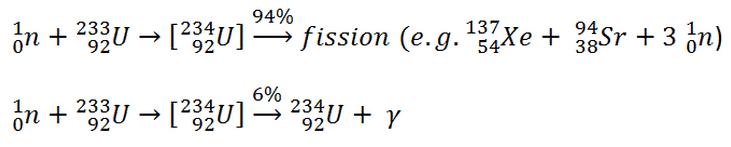
Uranium 233 is a very good fissile isotope and its fission cross-section for thermal neutrons is about 531 barns (for 0.0253 eV neutron). For fast neutrons its fission cross-section is on the order of barns. Most of absorption reactions result in fission reaction, but a minority results in radiative capture forming 234U. The cross-section for radiative capture for thermal neutrons is about 45 barns (for 0.0253 eV neutron). Therefore about 6% of all absorption reactions result in radiative capture of neutron. About 94% of all absorption reactions result in fission. The capture-to-fission ratio is much smaller than the other two major fissile fuels 235U and 239U.
Typically, when uranium 233 nucleus undergoes fission, the nucleus splits into two smaller nuclei (triple fission can also rarely occur), along with a few neutrons (the average is 2.48 neutrons per fission for thermal fission) and release of energy in the form of heat and gamma rays. The average of the fragment atomic mass is about 112, but very few fragments near that average are found. It is much more probable to break up into unequal fragments, and the most probable fragment masses are around mass 93 (strontium) and 137 (xenon).
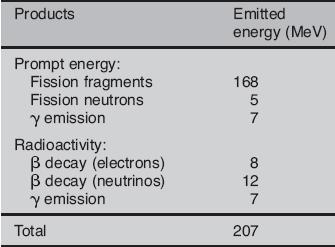
Most of the fission fragments are highly unstable (radioactive) nuclei and undergo further radioactive decays to stabilize itself, therefore part of the released energy is radiated away from the reactor (See also: Reactor antineutrinos). On the other hand most of the energy released by one fission (~168MeV of total ~200MeV) appears as kinetic energy of these fission fragments. The fission fragments interact strongly with the surrounding atoms or molecules traveling at high speed, causing them to ionize. Creation of ion pairs requires energy, which is lost from the kinetic energy of the charged fission fragment causing it to decelerate. The positive ions and free electrons created by the passage of the charged fission fragment will then reunite, releasing energy in the form of heat (e.g. vibrational energy or rotational energy of atoms). This is the principle how fission fragments heat up fuel in the reactor core.
Fission fragments after a nucleus fission. Fission fragments interact strongly with the surrounding atoms or molecules traveling at high speed, causing them to ionize.Source of nuclear data: JANIS (Java-based Nuclear Data Information Software); ENDF/B-VII.1Uranium 233. Comparison of total fission cross-section and cross-section for radiative capture.Neutron production per one fast fission of uranium 233.Fission fragment yield for different nuclei. The most probable fragment masses are around mass 93 (Strontium) and 137 (Xenon).
See also:
Uranium 234
See also:
Uranium
See also:
Uranium 236
We hope, this article, Uranium 233, helps you. If so, give us a like in the sidebar. Main purpose of this website is to help the public to learn some interesting and important information about radiation and dosimeters.
Definition of uranium 236. Uranium 236 is neither a fissile isotope nor fertile isotope. 236U can be found in spent nuclear fuel or in the reprocessed uranium. Periodic Table
Uranium 236
Uranium 236 is not naturally-occurring isotope of uranium. It is a man-made isotope, which can be found in spent nuclear fuel or in the reprocessed uranium. The presence of this isotope in a sample of uranium is evidence that the sample has been in a nuclear reactor. Isotope 236U is formed in a nuclear reactor from fissile isotope235U. Most of absorption reactions result in fission reaction, but a minority results in radiative capture forming 236U. The cross-section for radiative capture for thermal neutrons is about 99 barns (for 0.0253 eV neutron). Therefore about 15% of all absorption reactions result in radiative capture of neutron. About 85% of all absorption reactions result in fission.
This isotope has the half-life of 2.34×10⁷ years and has longer half-life than any other artificial actinide or fission product produced in nuclear reactors. 236U have about 190 times higher specific activity than the isotope 238U. This due to the fact 238U has the half-life about 190 times as long as 236U. This results in high contribution to radioactivity of reprocessed uranium. The amount of 236U present in spent nuclear fuel is directly proportional to the burnup levels and is dependent on initial 235U enrichment. For discharged fuel around 50 MWd/tU HM and enrichment of 4% of 235U it is typically around 0.5 wt%.
236U decays via alpha decay to 232Th. 236U occasionally decays by spontaneous fission with very low probability of 0.00000009%.
236U is neither a fissile isotope, nor a fertile isotope. 236U is fissionable only by fast neutrons. Radiative capture of a neutron leads to the formation of the isotope 237U, which quickly beta decays to the isotope 237Np. 237Np may absorb another neutron, thus results in formation of 238Np, which quickly beta decay to 238Pu. The presence of this isotope certainly does not contribute to the neutron economy. On the other hand the radiative capture cross-section for 236U is very low and this process does not happen quickly in a thermal reactor.
Source of nuclear data: JANIS (Java-based Nuclear Data Information Software); The JEFF-3.1.1 Nuclear Data LibraryUranium 236. Comparison of total fission cross-section and cross-section for radiative capture.236U content as a function of burnup level of a PWR fuel.
Source: IAEA-TECDOC-1529 Management of Reprocessed Uranium
See also:
Uranium 233
See also:
Uranium
See also:
Uranium 232
We hope, this article, Uranium 236, helps you. If so, give us a like in the sidebar. Main purpose of this website is to help the public to learn some interesting and important information about radiation and dosimeters.
Definition of uranium 232. Uranium 236 is a fissile isotope. It decays via alpha decay. It has half-life of 68.9 years, and therefore the specific activity is very high. Periodic Table
Uranium 232
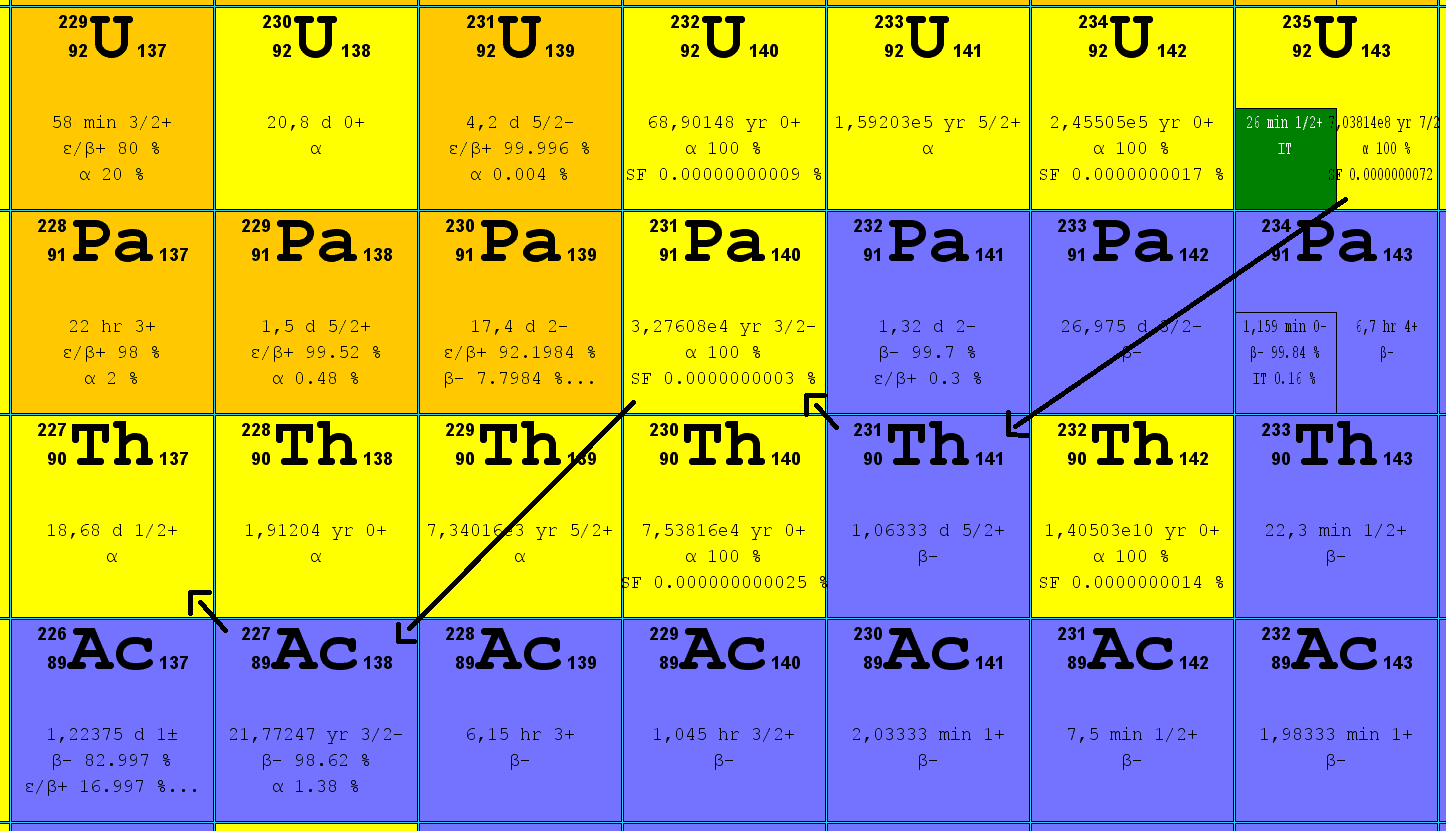
Uranium 232 is not naturally-occurring isotope of uranium. It is a man-made isotope and is a side product in the thorium fuel cycle and also this isotope is a decay product of 236Pu in the uranium fuel. 232U is produced from 235U and 232Th via two of the reaction chains shown below. The formation of this isotope in both reactions results from specific (n,2n) reactions in which an incoming neutron knocks two neutrons out of a target nucleus. 232U can also be produced by two successive single radiative captures of neutron starting with naturally-occurring isotope 230Th. 230Th is a decay product of 234U, which is in turn a decay product of 238U.
It is unusual, but 232U is a fissile isotope and it is therefore capable of undergoing fission reaction after absorbing thermal neutron. This feature plays no significant role in nuclear reactors, because the amount of 232U is negligible in terms of sustaining a nuclear fission chain reaction. 232U has a significant fission cross-section (75 barns for thermal neutrons) as well as radiative capture cross-section (73 barns for thermal neutrons). Therefore 232U also belongs to the group of fertile isotopes. Radiative capture of a neutron leads to the formation of fissile 233U.
The isotope 232U has another very important feature. 232U has a relatively short half-life of 68.9 years, and therefore the specific activity of 232U is much higher than specific activity of the isotope 238U. In addition the decay chain of 232U produces very penetrating gamma rays. The most important gamma emitter, accounting for about 85 percent of the total dose from 232U after 2 years, is thallium 208, that emits gamma rays of 2.6 MeV which are very energetic and highly penetrating. These intense radiations make handling of fissile 233U or reprocessed uranium contaminated with 232U far more dangerous than conventional fuels.
Reference: Kang, J.; Von Hippel, F. N. (2001). “U‐232 and the proliferation‐resistance of U‐233 in spent fuel”. Science & Global Security
Source of nuclear data: JANIS (Java-based Nuclear Data Information Software); The JEFF-3.1.1 Nuclear Data LibraryUranium 232. Comparison of total fission cross-section and cross-section for radiative capture.Uranium 232 decay chain. This decay chain produces very penetrating gamma rays.
See also:
Uranium 236
See also:
Uranium
See also:
Half-life of Isotopes of Uranium
We hope, this article, Uranium 232, helps you. If so, give us a like in the sidebar. Main purpose of this website is to help the public to learn some interesting and important information about radiation and dosimeters.
In the photoelectric effect, a photon undergoes an interaction with an electron which is bound in an atom. The photoelectric effect dominates at low-energies of gamma rays. Periodic Table
Photoelectric Effect
Albert Einstein and Photoelectric Effect / Discovery
The phenomenon, that a surface (typically alkali metals) when exposed to electromagnetic radiation (visible light) emits electrons, was discovered by Hertz and Hallwachs in 1887 during experiments with a spark-gap generator. Hertz found that the sensitivity of his spark-gap device can be increased by exposition to visible or ultraviolet light and that light obviously had some electrical effect. He did not further pursue investigation of this effect.Shortly after Hertz’s discovery in 1899, English physicist J.J.Thomson showed that UV light, which fall onto metal surface, trigger the emission of electrons from the surface. In 1902, Hungarian physicist Philipp Lenard made the first quantitative measurements of the photoelectric effect. He observed that the energy of individual emitted electrons increased with the frequency of the light (which is related to the color).
The luminiferous aether. It was hypothesised that the Earth moves through a “medium” of aether that carries light. It has been replaced in modern physics by the theory of relativity and quantum theory. Source: wikipedia.org
While this is interesting, it is hardly explainable by classical theory of electromagnetic radiation which assumed the existence of a stationary medium (the luminiferous aether) through which light propagated. Subsequent investigations into the photoelectric effect results in the fact that these explorations did not fit with the classical theory of electromagnetic radiation.In 1905, Albert Einstein published four groundbreaking papers on the photoelectric effect, Brownian motion, special relativity, and the equivalence of mass and energy. These papers were published in the Annalen der Physik journal and contributed significantly to the foundation of modern physics. In the paper on the photoelectric effect (“On a Heuristic Viewpoint Concerning the Production and Transformation of Light”) he solved the paradox by describing light as composed of discrete quanta (German: das Lichtquant), rather than continuous waves.This theory was builded on Max Planck’s blackbody radiation theory, which assumes that luminous energy can be absorbed or emitted only in discrete amounts, called quanta. The photon’s energy in each quantum of light is equal to its frequency (ν) multiplied by a constant known as Planck’s constant (h), or alternately, using the wavelength (λ) and the speed of light (c):
E=hc/λ=hν
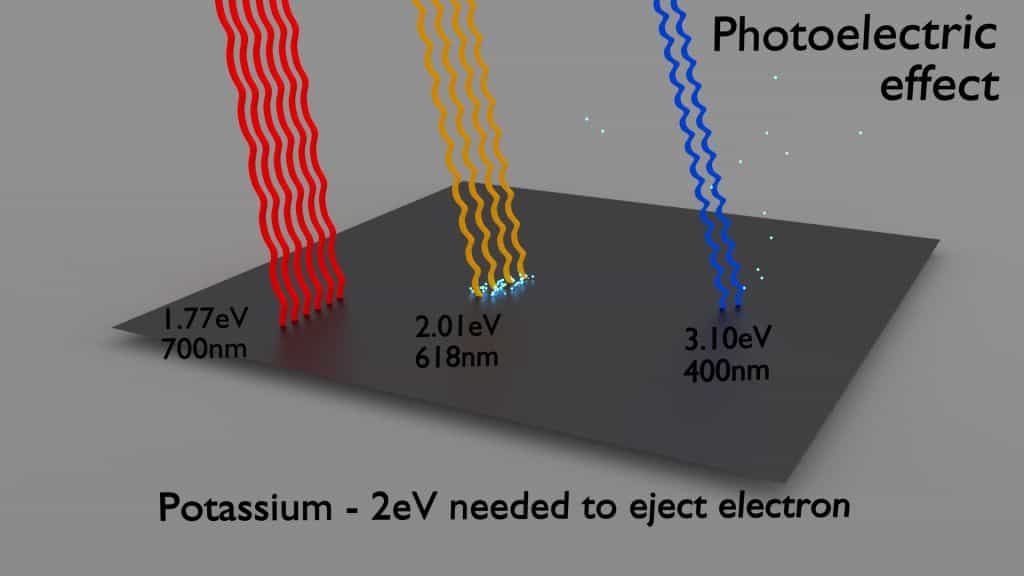
Photoelectric effect with photons from visible spectrum on potassium plate – threshold energy – 2eV
Each photon above a threshold frequency (specific for each material) has the needed energy to eject a single electron, creating the observed effect. Einstein’s theory predicts that the maximum kinetic energy of emitted electron is dependent only on the frequency of the incident light and not on its intensity. Shining twice as much light (high-intensity) results in twice as many photons, and more electrons releasing, but the maximum kinetic energy of those individual electrons remains the same. Experimentation in the photoelectric effect was carried out extensively by Robert Millikan in 1915, Robert Millikan showed that Einstein’s prediction was correct. This discovery contributed to the quantum revolution in physics and earned Einstein the Nobel Prize in Physics in 1921.
The photoelectric effect dominates at low-energies of gamma rays.
The photoelectric effect leads to the emission of photoelectrons from matter when light (photons) shines upon them.
The maximum energy an electron can receive in any one interaction is hν.
Electrons are only emitted by the photoelectric effect if photon reaches or exceeds a threshold energy.
A free electron (e.g. from atomic cloud) cannot absorb entire energy of the incident photon. This is a result of the need to conserve both momentum and energy.
The cross-section for the emission of n=1 (K-shell) photoelectrons is higher than that of n=2 (L-shell) photoelectrons. This is a result of the need to conserve momentum and energy.
Definition of Photoelectric effect
In the photoelectric effect, a photon undergoes an interaction with an electron which is bound in an atom. In this interaction the incident photon completely disappears and an energetic photoelectron is ejected by the atom from one of its bound shells. The kinetic energy of the ejected photoelectron (Ee) is equal to the incident photon energy (hν) minus the binding energy of the photoelectron in its original shell (Eb).
Ee=hν-Eb
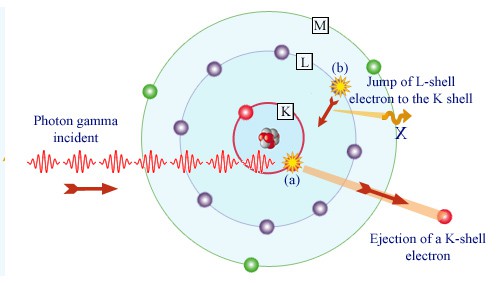
Therefore photoelectrons are only emitted by the photoelectric effect if photon reaches or exceeds a threshold energy – the binding energy of the electron – the work function of the material. For gamma rays with energies of more than hundreds keV, the photoelectron carries off the majority of the incident photon energy – hν.Following a photoelectric interaction, an ionized absorber atom is created with a vacancy in one of its bound shells. This vacancy is will be quickly filled by an electron from a shell with a lower binding energy (other shells) or through capture of a free electron from the material. The rearrangement of electrons from other shells creates another vacancy, which, in turn, is filled by an electron from an even lower binding energy shell. Therefore a cascade of more characteristic X-rays can be also generated. The probability of characteristic x-ray emission decreases as the atomic number of the absorber decreases. Sometimes , the emission of an Auger electron occurs.
Photoelectric effect with photons from visible spectrum on potassium plate – threshold energy – 2eV Gamma absorption by an atom. Source: laradioactivite.com/
Cross-Sections of Photoelectric Effect
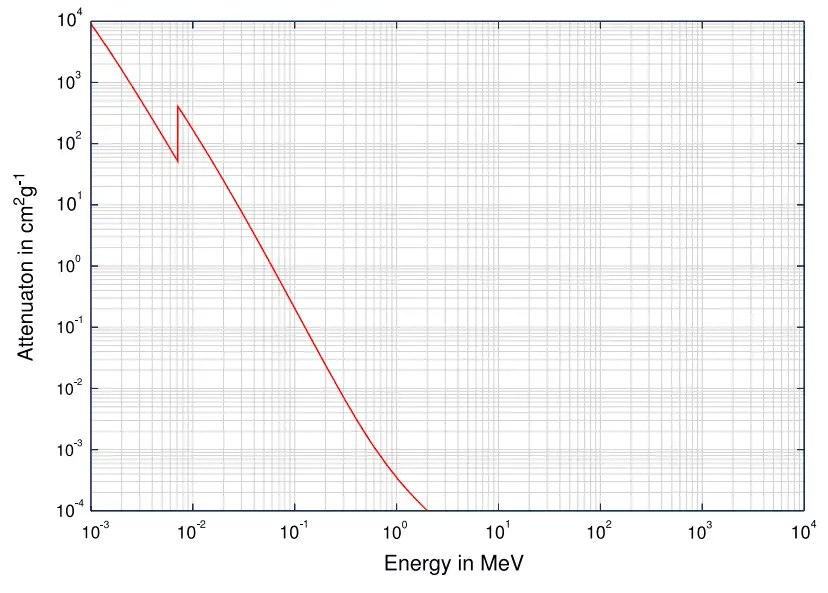
At small values of gamma ray energy the photoelectric effect dominates. The mechanism is also enhaced for materials of high atomic number Z. It is not simple to derive analytic expression for the probability of photoelectric absorption of gamma ray per atom over all ranges of gamma ray energies. The probability of photoelectric absorption per unit mass is approximately proportional to:
τ(photoelectric) = constant x ZN/E3.5
where Z is the atomic number, the exponent n varies between 4 and 5. E is the energy of the incident photon. The proportionality to higher powers of the atomic number Z is the main reason for using of high Z materials, such as lead or depleted uranium in gamma ray shields.Although the probability of the photoelectric absorption of gamma photon decreases, in general, with increasing photon energy, there are sharp discontinuities in the cross-section curve. These are called “absoption edges” and they correspond to the binding energies of electrons from atom’s bound shells. For photons with the energy just above the edge, the photon energy is just sufficient to undergo the photoelectric interaction with electron from bound shell, let say K-shell. The probability of such interaction is just above this edge much greater than that of photons of energy slightly below this edge. For gamma photons below this edge the interaction with electron from K-shell in energetically impossible and therefore the probability drops abruptly. These edges occur also at binding energies of electrons from other shells (L, M, N …..).
Cross section of photoelectric effect.
See also:
Characteristics of Gamma Rays
See also:
Interaction of Gamma Radiation with Matter
See also:
Compton Scattering
We hope, this article, Photoelectric Effect, helps you. If so, give us a like in the sidebar. Main purpose of this website is to help the public to learn some interesting and important information about radiation and dosimeters.
The pair production is a phenomenon of nature where energy is direct converted to matter. At high energies of gamma rays pair production dominates. Periodic Table
Positron-Electron Pair Production
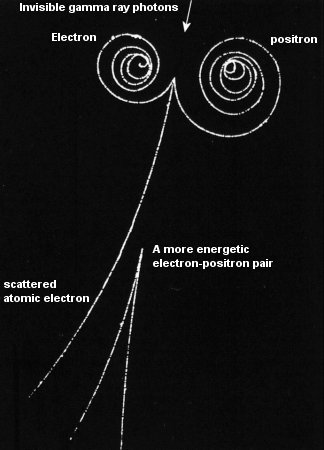
In general, pair production is a phenomenon of nature where energy is direct converted to matter. The phenomenon of pair production can be view two different ways. One way is as a particle and antiparticle and the other is as a particle and a hole. The first way can be represented by formation of electron and positron, from a packet of electromagnetic energy (high energy photon – gamma ray) traveling through matter. It is one of the possible ways in which gamma rays interact with matter. At high energies this interaction dominates. In order for electron-positron pair production to occur, the electromagnetic energy of the photon must be above a threshold energy, which is equivalent to the rest mass of two electrons. The threshold energy (the total rest mass of produced particles) for electron-positron pair production is equal to 1.02MeV (2 x 0.511MeV) because the rest mass of a single electron is equivalent to 0.511MeV of energy.If the original photon’s energy is greater than 1.02MeV, any energy above 1.02MeV is according to the conservation law split between the kinetic energy of motion of the two particles.The presence of an electric field of a heavy atom such as lead or uranium is essential in order to satisfy conservation of momentum and energy. In order to satisfy both conservation of momentum and energy, the atomic nucleus must receive some momentum. Therefore a photon pair production in free space cannot occur.Moreover, the positron is the anti-particle of the electron, so when a positron comes to rest, it interacts with another electron, resulting in the annihilation of the both particles and the complete conversion of their rest mass back to pure energy (according to the E=mc2 formula) in the form of two oppositely directed 0.511 MeV gamma rays (photons). The pair production phenomenon is therefore connected with creation and destruction of matter in one reaction.
Positron-Electron Pair Production – Cross-Section
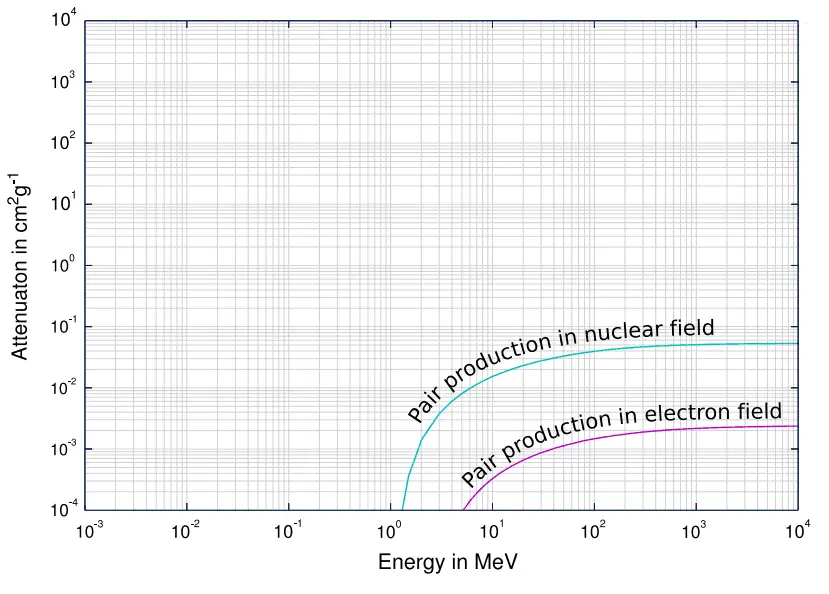
The probability of pair production, characterized by cross section, is a very complicated function based on quantum mechanics. In general the cross section increases approximately with the square of atomic number (σp ~ Z2) and increases with photon energy, but this dependence is much more complex.
Cross section of pair production in nuclear field and electron field.
See also:
Compton Scattering
See also:
Interaction of Gamma Radiation with Matter
See also:
Attenuation
We hope, this article, Positron-Electron Pair Production, helps you. If so, give us a like in the sidebar. Main purpose of this website is to help the public to learn some interesting and important information about radiation and dosimeters.
Gamma Ray Attenuation describes attenuation of monoenergetic gamma rays collimated into a narrow beam and their passage through the material. Periodic Table
The total cross-section of interaction of a gamma rays with an atom is equal to the sum of all three mentioned partial cross-sections:σ = σf + σC + σp
σf – Photoelectric effect
σC – Compton scattering
σp – Pair production
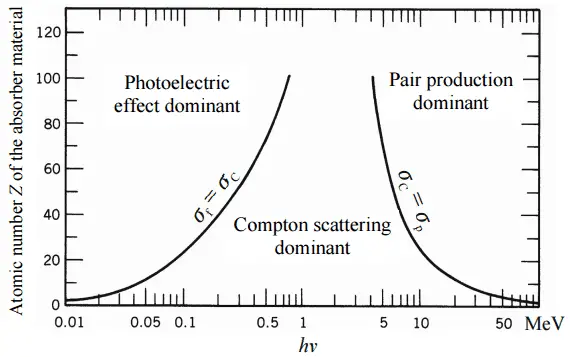
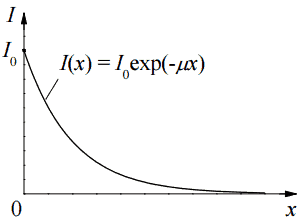
Depending on the gamma ray energy and the absorber material, one of the three partial cross-sections may become much larger than the other two. At small values of gamma ray energy the photoelectric effect dominates. Compton scattering dominates at intermediate energies. The compton scattering also increases with decreasing atomic number of matter, therefore the interval of domination is wider for light nuclei. Finally, electron-positron pair production dominates at high energies.Based on the definition of interaction cross-section, the dependence of gamma rays intensity on thickness of absorber material can be derived. If monoenergetic gamma rays are collimated into a narrow beam and if the detector behind the material only detects the gamma rays that passed through that material without any kind of interaction with this material, then the dependence should be simple exponential attenuation of gamma rays. Each of these interactions removes the photon from the beam either by absorbtion or by scattering away from the detector direction. Therefore the interactions can be characterized by a fixed probability of occurance per unit path length in the absorber. The sum of these probabilities is called the linear attenuation coefficient:
μ = τ(photoelectric) + σ(Compton) + κ(pair)
The relative importance of various processes of gamma radiation interaction with matter.
Linear Attenuation Coefficient
The attenuation of gamma radiation can be then described by the following equation.
I=I0.e-μx
, where I is intensity after attenuation, Io is incident intensity, μ is the linear attenuation coefficient (cm-1), and physical thickness of absorber (cm).
Dependence of gamma radiation intensity on absorber thickness
The materials listed in the table beside are air, water and a different elements from carbon (Z=6) through to lead (Z=82) and their linear attenuation coefficients are given for three gamma ray energies. There are two main features of the linear attenuation coefficient:
The linear attenuation coefficient increases as the atomic number of the absorber increases.
The linear attenuation coefficient for all materials decreases with the energy of the gamma rays.
Half Value Layer
The half value layer expresses the thickness of absorbing material needed for reduction of the incident radiation intensity by a factor of two. There are two main features of the half value layer:
The half value layer decreases as the atomic number of the absorber increases. For example 35 m of air is needed to reduce the intensity of a 100 keV gamma ray beam by a factor of two whereas just 0.12 mm of lead can do the same thing.
The half value layer for all materials increases with the energy of the gamma rays. For example from 0.26 cm for iron at 100 keV to about 1.06 cm at 500 keV.
Mass Attenuation Coefficient
When characterizing an absorbing material, we can use sometimes the mass attenuation coefficient. The mass attenuation coefficient is defined as the ratio of the linear attenuation coefficient and absorber density (μ/ρ). The attenuation of gamma radiation can be then described by the following equation:
I=I0.e-(μ/ρ).ρl
, where ρ is the material density, (μ/ρ) is the mass attenuation coefficient and ρ.l is the mass thickness. The measurement unit used for the mass attenuation coefficient cm2g-1.For intermediate energies the Compton scattering dominates and different absorbers have approximately equal mass attenuation coefficients. This is due to the fact that cross section of Compton scattering is proportional to the Z (atomic number) and therefore the coefficient is proportional to the material density ρ. At small values of gamma ray energy or at high values of gamma ray energy, where the coefficient is proportional to higher powers of the atomic number Z (for photoelectric effect σf ~ Z5; for pair production σp ~ Z2), the attenuation coefficient μ is not a constant.
Example:
How much water schielding do you require, if you want to reduce the intensity of a 500 keV monoenergetic gamma ray beam (narrow beam) to 1% of its incident intensity? The half value layer for 500 keV gamma rays in water is 7.15 cm and the linear attenuation coefficient for 500 keV gamma rays in water is 0.097 cm-1.The question is quite simple and can be described by following equation:If the half value layer for water is 7.15 cm, the linear attenuation coefficient is:Now we can use the exponential attenuation equation:thereforeSo the required thickness of water is about 47.5 cm. This is relatively large thickness and it is caused by small atomic numbers of hydrogen and oxygen. If we calculate the same problem for lead (Pb), we obtain the thickness x=2.8cm.
Linear Attenuation Coefficients
Table of Linear Attenuation Coefficients (in cm-1) for a different materials at gamma ray energies of 100, 200 and 500 keV.
We use cookies to ensure that we give you the best experience on our website. If you continue to use this site we will assume that you are happy with it.Ok
 Uranium 238. Comparison of total fission cross-section and cross-section for radiative capture.
 Uranium 235. Comparison of total fission cross-section and cross-section for radiative capture.
 </aUranium 234. Comparison of total fission cross-section and cross-section for radiative capture.
 Uranium 233. Comparison of total fission cross-section and cross-section for radiative capture.
 Uranium 236. Comparison of total fission cross-section and cross-section for radiative capture.
 Uranium 232. Comparison of total fission cross-section and cross-section for radiative capture.
 Fissile / Fertile Material Cross-sections. Comparison of total fission cross-sections.