Beryllium – Thermal Conductivity

Periodic Table of Elements - thermal conductivity
1
H

Hydrogen

0.1805 W/m K

2
He

Helium

0.1513 W/m K

3
Li

Lithium

85 W/m K

4
Be

Beryllium

190 W/m K

5
B

Boron

27 W/m K

6
C

Carbon

140 W/m K

7
N

Nitrogen

0.0258 W/m K

8
O

Oxygen

0.0266 W/m K

9
F

Fluorine

0.0277 W/m K

10
Ne

Neon

0.0491 W/m K

11
Na

Sodium

140 W/m K

12
Mg

Magnesium

160 W/m K

13
Al

Aluminium

235 W/m K

14
Si

Silicon

150 W/m K

15
P

Phosphorus

0.236 W/m K

16
S

Sulfur

0.205 W/m K

17
Cl

Chlorine

0.0089 W/m K

18
Ar

Argon

0.0177 W/m K

19
K

Potassium

100 W/m K

20
Ca

Calcium

200 W/m K

21
Sc

Scandium

16 W/m K

22
Ti

Titanium

22 W/m K

23
V

Vanadium

31 W/m K

24
Cr

Chromium

94 W/m K

25
Mn

Manganese

7.8 W/m K

26
Fe

Iron

80 W/m K

27
Co

Cobalt

100 W/m K

28
Ni

Nickel

91 W/m K

29
Cu

Copper

400 W/m K

30
Zn

Zinc

120 W/m K

31
Ga

Gallium

29 W/m K

32
Ge

Germanium

60 W/m K

33
As

Arsenic

50 W/m K

34
Se

Selenium

0.52 W/m K

35
Br

Bromine

0.12 W/m K

36
Kr

Krypton

0.0094 W/m K

37
Rb

Rubidium

58 W/m K

38
Sr

Strontium

35 W/m K

39
Y

Yttrium

17 W/m K

40
Zr

Zirconium

23 W/m K

41
Nb

Niobium

54 W/m K

42
Mo

Molybdenum

139 W/m K

43
Tc

Technetium

51 W/m K

44
Ru

Ruthenium

120 W/m K

45
Rh

Rhodium

150 W/m K

46
Pd

Palladium

72 W/m K

47
Ag

Silver

430 W/m K

48
Cd

Cadmium

97 W/m K

49
In

Indium

82 W/m K

50
Sn

Tin

67 W/m K

51
Sb

Antimony

24 W/m K

52
Te

Tellurium

3 W/m K

53
I

Iodine

0.449 W/m K

54
Xe

Xenon

0.0057 W/m K

55
Cs

Caesium

36 W/m K

56
Ba

Barium

18 W/m K

57-71


Lanthanoids


72
Hf

Hafnium

23 W/m K

73
Ta

Tantalum

57 W/m K

74
W

Tungsten

170 W/m K

75
Re

Rhenium

48 W/m K

76
Os

Osmium

88 W/m K

77
Ir

Iridium

150 W/m K

78
Pt

Platinum

72 W/m K

79
Au

Gold

320 W/m K

80
Hg

Mercury

8.3 W/m K

81
Tl

Thallium

46 W/m K

82
Pb

Lead

35 W/m K

83
Bi

Bismuth

8 W/m K

84
Po

Polonium


85
At

Astatine

2 W/m K

86
Rn

Radon

0.0036 W/m K

87
Fr

Francium


88
Ra

Radium

19 W/m K

89-103


Actinoids


104
Rf

Rutherfordium


105
Db

Dubnium


106
Sg

Seaborgium


107
Bh

Bohrium


108
Hs

Hassium


109
Mt

Meitnerium


110
Ds

Darmstadtium


111
Rg

Roentgenium


112
Cn

Copernicium


113
Nh

Nihonium


114
Fl

Flerovium


115
Mc

Moscovium


116
Lv

Livermorium


117
Ts

Tennessine


118
Og

Oganesson


57
La

Lanthanum

13 W/m K

58
Ce

Cerium

11 W/m K

59
Pr

Praseodymium

13 W/m K

60
Nd

Neodymium

17 W/m K

61
Pm

Promethium

15 W/m K

62
Sm

Samarium

13 W/m K

63
Eu

Europium

14 W/m K

64
Gd

Gadolinium

11 W/m K

65
Tb

Terbium

11 W/m K

66
Dy

Dysprosium

11 W/m K

67
Ho

Holmium

16 W/m K

68
Er

Erbium

15 W/m K

69
Th

Thulium

17 W/m K

70
Yb

Ytterbium

39 W/m K

71
Lu

Lutetium

16 W/m K

89
Ac

Actinium

12 W/m K

90
Th

Thorium

54 W/m K

91
Pa

Protactinium

47 W/m K

92
U

Uranium

27 W/m K

93
Np

Neptunium

6 W/m K

94
Pu

Plutonium

6 W/m K

95
Am

Americium

10 W/m K

96
Cm

Curium


97
Bk

Berkelium

10 W/m K

98
Cf

Californium


99
Es

Einsteinium


100
Fm

Fermium


101
Md

Mendelevium


102
No

Nobelium


103
Lr

Lawrencium


Beryllium – Thermal Conductivity

Thermal conductivity of Beryllium is 200 W/(m·K).

The heat transfer characteristics of a solid material are measured by a property called the thermal conductivity, k (or λ), measured in W/m.K. It is a measure of a substance’s ability to transfer heat through a material by conduction. Note that Fourier’s law applies for all matter, regardless of its state (solid, liquid, or gas), therefore, it is also defined for liquids and gases.

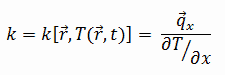
The thermal conductivity of most liquids and solids varies with temperature. For vapors, it also depends upon pressure. In general:
thermal conductivity - definition

Most materials are very nearly homogeneous, therefore we can usually write k = k (T). Similar definitions are associated with thermal conductivities in the y- and z-directions (ky, kz), but for an isotropic material the thermal conductivity is independent of the direction of transfer, kx = ky = kz = k.


Thermal Conductivity of Metals

Transport of thermal energy in solids may be generally due to two effects:
  • the migration of free electrons
  • lattice vibrational waves (phonons)

When electrons and phonons carry thermal energy leading to conduction heat transfer in a solid, the thermal conductivity may be expressed as:

k = ke + kph
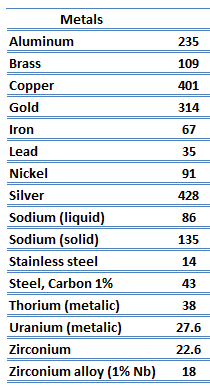
thermal conductivity - metalsMetals are solids and as such they possess crystalline structure where the ions (nuclei with their surrounding shells of core electrons) occupy translationally equivalent positions in the crystal lattice. Metals in general have high electrical conductivity, high thermal conductivity, and high density. Accordingly, transport of thermal energy may be due to two effects:

  • the migration of free electrons
  • lattice vibrational waves (phonons).

When electrons and phonons carry thermal energy leading to conduction heat transfer in a solid, the thermal conductivity may be expressed as:

k = ke + kph

The unique feature of metals as far as their structure is concerned is the presence of charge carriers, specifically electrons. The electrical and thermal conductivities of metals originate from the fact that their outer electrons are delocalized. Their contribution to the thermal conductivity is referred to as the electronic thermal conductivity, ke. In fact, in pure metals such as gold, silver, copper, and aluminum, the heat current associated with the flow of electrons by far exceeds a small contribution due to the flow of phonons. In contrast, for alloys, the contribution of kph to k is no longer negligible.

Thermal Conductivity of Nonmetals
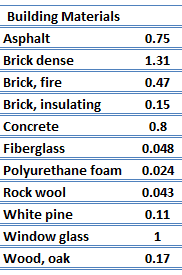
thermal conductivity - building materialsFor nonmetallic solids, k is determined primarily by kph, which increases as the frequency of interactions between the atoms and the lattice decreases. In fact, lattice thermal conduction is the dominant thermal conduction mechanism in nonmetals, if not the only one. In solids, atoms vibrate about their equilibrium positions (crystal lattice). The vibrations of atoms are not independent of each other, but are rather strongly coupled with neighboring atoms. The regularity of the lattice arrangement has an important effect on kph, with crystalline (well-ordered) materials like quartz having a higher thermal conductivity than amorphous materials like glass. At sufficiently high temperatures kph ∝ 1/T.

The quanta of the crystal vibrational field are referred to as ‘‘phonons.’’ A phonon is a collective excitation in a periodic, elastic arrangement of atoms or molecules in condensed matter, like solids and some liquids. Phonons play a major role in many of the physical properties of condensed matter, like thermal conductivity and electrical conductivity. In fact, for crystalline, nonmetallic solids such as diamond, kph can be quite large, exceeding values of k associated with good conductors, such as aluminum. In particular, diamond has the highest hardness and thermal conductivity (k = 1000 W/m.K) of any bulk material.


Thermal Conductivity of Liquids and Gases

In physics, a fluid is a substance that continually deforms (flows) under an applied shear stress. Fluids are a subset of the phases of matter and include liquids, gases, plasmas and, to some extent, plastic solids. Because the intermolecular spacing is much larger and the motion of the molecules is more random for the fluid state than for the solid state, thermal energy transport is less effective. The thermal conductivity of gases and liquids is therefore generally smaller than that of solids. In liquids, the thermal conduction is caused by atomic or molecular diffusion. In gases, the thermal conduction is caused by diffusion of molecules from higher energy level to the lower level.

Thermal Conductivity of Gases
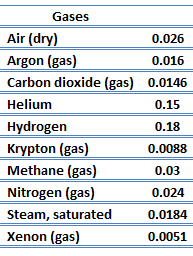
thermal conductivity - gasesThe effect of temperature, pressure, and chemical species on the thermal conductivity of a gas may be explained in terms of the kinetic theory of gases. Air and other gases are generally good insulators, in the absence of convection. Therefore, many insulating materials (e.g.polystyrene) function simply by having a large number of gas-filled pockets which prevent large-scale convection. Alternation of gas pocket and solid material causes that the heat must be transferred through many interfaces causing rapid decrease in heat transfer coefficient.

The thermal conductivity of gases is directly proportional to the density of the gas, the mean molecular speed, and especially to the mean free path of molecule. The mean free path also depends on the diameter of the molecule, with larger molecules more likely to experience collisions than small molecules, which is the average distance traveled by an energy carrier (a molecule) before experiencing a collision. Light gases, such as hydrogen and helium typically have high thermal conductivity. Dense gases such as xenon and dichlorodifluoromethane have low thermal conductivity.

In general, the thermal conductivity of gases increases with increasing temperature.

Thermal Conductivity of Liquids

As was written, in liquids, the thermal conduction is caused by atomic or molecular diffusion, but physical mechanisms for explaining the thermal conductivity of liquids are not well understood. Liquids tend to have better thermal conductivity than gases, and the ability to flow makes a liquid suitable for removing excess heat from mechanical components. The heat can be removed by channeling the liquid through a heat exchanger. The coolants used in nuclear reactors include water or liquid metals, such as sodium or lead.

The thermal conductivity of nonmetallic liquids generally decreases with increasing temperature.

–

Lithium – Thermal Conductivity

Periodic Table of Elements - thermal conductivity
1
H

Hydrogen

0.1805 W/m K

2
He

Helium

0.1513 W/m K

3
Li

Lithium

85 W/m K

4
Be

Beryllium

190 W/m K

5
B

Boron

27 W/m K

6
C

Carbon

140 W/m K

7
N

Nitrogen

0.0258 W/m K

8
O

Oxygen

0.0266 W/m K

9
F

Fluorine

0.0277 W/m K

10
Ne

Neon

0.0491 W/m K

11
Na

Sodium

140 W/m K

12
Mg

Magnesium

160 W/m K

13
Al

Aluminium

235 W/m K

14
Si

Silicon

150 W/m K

15
P

Phosphorus

0.236 W/m K

16
S

Sulfur

0.205 W/m K

17
Cl

Chlorine

0.0089 W/m K

18
Ar

Argon

0.0177 W/m K

19
K

Potassium

100 W/m K

20
Ca

Calcium

200 W/m K

21
Sc

Scandium

16 W/m K

22
Ti

Titanium

22 W/m K

23
V

Vanadium

31 W/m K

24
Cr

Chromium

94 W/m K

25
Mn

Manganese

7.8 W/m K

26
Fe

Iron

80 W/m K

27
Co

Cobalt

100 W/m K

28
Ni

Nickel

91 W/m K

29
Cu

Copper

400 W/m K

30
Zn

Zinc

120 W/m K

31
Ga

Gallium

29 W/m K

32
Ge

Germanium

60 W/m K

33
As

Arsenic

50 W/m K

34
Se

Selenium

0.52 W/m K

35
Br

Bromine

0.12 W/m K

36
Kr

Krypton

0.0094 W/m K

37
Rb

Rubidium

58 W/m K

38
Sr

Strontium

35 W/m K

39
Y

Yttrium

17 W/m K

40
Zr

Zirconium

23 W/m K

41
Nb

Niobium

54 W/m K

42
Mo

Molybdenum

139 W/m K

43
Tc

Technetium

51 W/m K

44
Ru

Ruthenium

120 W/m K

45
Rh

Rhodium

150 W/m K

46
Pd

Palladium

72 W/m K

47
Ag

Silver

430 W/m K

48
Cd

Cadmium

97 W/m K

49
In

Indium

82 W/m K

50
Sn

Tin

67 W/m K

51
Sb

Antimony

24 W/m K

52
Te

Tellurium

3 W/m K

53
I

Iodine

0.449 W/m K

54
Xe

Xenon

0.0057 W/m K

55
Cs

Caesium

36 W/m K

56
Ba

Barium

18 W/m K

57-71


Lanthanoids


72
Hf

Hafnium

23 W/m K

73
Ta

Tantalum

57 W/m K

74
W

Tungsten

170 W/m K

75
Re

Rhenium

48 W/m K

76
Os

Osmium

88 W/m K

77
Ir

Iridium

150 W/m K

78
Pt

Platinum

72 W/m K

79
Au

Gold

320 W/m K

80
Hg

Mercury

8.3 W/m K

81
Tl

Thallium

46 W/m K

82
Pb

Lead

35 W/m K

83
Bi

Bismuth

8 W/m K

84
Po

Polonium


85
At

Astatine

2 W/m K

86
Rn

Radon

0.0036 W/m K

87
Fr

Francium


88
Ra

Radium

19 W/m K

89-103


Actinoids


104
Rf

Rutherfordium


105
Db

Dubnium


106
Sg

Seaborgium


107
Bh

Bohrium


108
Hs

Hassium


109
Mt

Meitnerium


110
Ds

Darmstadtium


111
Rg

Roentgenium


112
Cn

Copernicium


113
Nh

Nihonium


114
Fl

Flerovium


115
Mc

Moscovium


116
Lv

Livermorium


117
Ts

Tennessine


118
Og

Oganesson


57
La

Lanthanum

13 W/m K

58
Ce

Cerium

11 W/m K

59
Pr

Praseodymium

13 W/m K

60
Nd

Neodymium

17 W/m K

61
Pm

Promethium

15 W/m K

62
Sm

Samarium

13 W/m K

63
Eu

Europium

14 W/m K

64
Gd

Gadolinium

11 W/m K

65
Tb

Terbium

11 W/m K

66
Dy

Dysprosium

11 W/m K

67
Ho

Holmium

16 W/m K

68
Er

Erbium

15 W/m K

69
Th

Thulium

17 W/m K

70
Yb

Ytterbium

39 W/m K

71
Lu

Lutetium

16 W/m K

89
Ac

Actinium

12 W/m K

90
Th

Thorium

54 W/m K

91
Pa

Protactinium

47 W/m K

92
U

Uranium

27 W/m K

93
Np

Neptunium

6 W/m K

94
Pu

Plutonium

6 W/m K

95
Am

Americium

10 W/m K

96
Cm

Curium


97
Bk

Berkelium

10 W/m K

98
Cf

Californium


99
Es

Einsteinium


100
Fm

Fermium


101
Md

Mendelevium


102
No

Nobelium


103
Lr

Lawrencium


Lithium – Thermal Conductivity

Thermal conductivity of Lithium is 85 W/(m·K).

The heat transfer characteristics of a solid material are measured by a property called the thermal conductivity, k (or λ), measured in W/m.K. It is a measure of a substance’s ability to transfer heat through a material by conduction. Note that Fourier’s law applies for all matter, regardless of its state (solid, liquid, or gas), therefore, it is also defined for liquids and gases.

The thermal conductivity of most liquids and solids varies with temperature. For vapors, it also depends upon pressure. In general:

thermal conductivity - definition

Most materials are very nearly homogeneous, therefore we can usually write k = k (T). Similar definitions are associated with thermal conductivities in the y- and z-directions (ky, kz), but for an isotropic material the thermal conductivity is independent of the direction of transfer, kx = ky = kz = k.


Thermal Conductivity of Metals

Transport of thermal energy in solids may be generally due to two effects:
  • the migration of free electrons
  • lattice vibrational waves (phonons)

When electrons and phonons carry thermal energy leading to conduction heat transfer in a solid, the thermal conductivity may be expressed as:

k = ke + kph

thermal conductivity - metalsMetals are solids and as such they possess crystalline structure where the ions (nuclei with their surrounding shells of core electrons) occupy translationally equivalent positions in the crystal lattice. Metals in general have high electrical conductivity, high thermal conductivity, and high density. Accordingly, transport of thermal energy may be due to two effects:

  • the migration of free electrons
  • lattice vibrational waves (phonons).

When electrons and phonons carry thermal energy leading to conduction heat transfer in a solid, the thermal conductivity may be expressed as:

k = ke + kph

The unique feature of metals as far as their structure is concerned is the presence of charge carriers, specifically electrons. The electrical and thermal conductivities of metals originate from the fact that their outer electrons are delocalized. Their contribution to the thermal conductivity is referred to as the electronic thermal conductivity, ke. In fact, in pure metals such as gold, silver, copper, and aluminum, the heat current associated with the flow of electrons by far exceeds a small contribution due to the flow of phonons. In contrast, for alloys, the contribution of kph to k is no longer negligible.

Thermal Conductivity of Nonmetals

thermal conductivity - building materialsFor nonmetallic solids, k is determined primarily by kph, which increases as the frequency of interactions between the atoms and the lattice decreases. In fact, lattice thermal conduction is the dominant thermal conduction mechanism in nonmetals, if not the only one. In solids, atoms vibrate about their equilibrium positions (crystal lattice). The vibrations of atoms are not independent of each other, but are rather strongly coupled with neighboring atoms. The regularity of the lattice arrangement has an important effect on kph, with crystalline (well-ordered) materials like quartz having a higher thermal conductivity than amorphous materials like glass. At sufficiently high temperatures kph ∝ 1/T.

The quanta of the crystal vibrational field are referred to as ‘‘phonons.’’ A phonon is a collective excitation in a periodic, elastic arrangement of atoms or molecules in condensed matter, like solids and some liquids. Phonons play a major role in many of the physical properties of condensed matter, like thermal conductivity and electrical conductivity. In fact, for crystalline, nonmetallic solids such as diamond, kph can be quite large, exceeding values of k associated with good conductors, such as aluminum. In particular, diamond has the highest hardness and thermal conductivity (k = 1000 W/m.K) of any bulk material.


Thermal Conductivity of Liquids and Gases

In physics, a fluid is a substance that continually deforms (flows) under an applied shear stress. Fluids are a subset of the phases of matter and include liquids, gases, plasmas and, to some extent, plastic solids. Because the intermolecular spacing is much larger and the motion of the molecules is more random for the fluid state than for the solid state, thermal energy transport is less effective. The thermal conductivity of gases and liquids is therefore generally smaller than that of solids. In liquids, the thermal conduction is caused by atomic or molecular diffusion. In gases, the thermal conduction is caused by diffusion of molecules from higher energy level to the lower level.

Thermal Conductivity of Gases

thermal conductivity - gasesThe effect of temperature, pressure, and chemical species on the thermal conductivity of a gas may be explained in terms of the kinetic theory of gases. Air and other gases are generally good insulators, in the absence of convection. Therefore, many insulating materials (e.g.polystyrene) function simply by having a large number of gas-filled pockets which prevent large-scale convection. Alternation of gas pocket and solid material causes that the heat must be transferred through many interfaces causing rapid decrease in heat transfer coefficient.

The thermal conductivity of gases is directly proportional to the density of the gas, the mean molecular speed, and especially to the mean free path of molecule. The mean free path also depends on the diameter of the molecule, with larger molecules more likely to experience collisions than small molecules, which is the average distance traveled by an energy carrier (a molecule) before experiencing a collision. Light gases, such as hydrogen and helium typically have high thermal conductivity. Dense gases such as xenon and dichlorodifluoromethane have low thermal conductivity.

In general, the thermal conductivity of gases increases with increasing temperature.

Thermal Conductivity of Liquids

As was written, in liquids, the thermal conduction is caused by atomic or molecular diffusion, but physical mechanisms for explaining the thermal conductivity of liquids are not well understood. Liquids tend to have better thermal conductivity than gases, and the ability to flow makes a liquid suitable for removing excess heat from mechanical components. The heat can be removed by channeling the liquid through a heat exchanger. The coolants used in nuclear reactors include water or liquid metals, such as sodium or lead.

The thermal conductivity of nonmetallic liquids generally decreases with increasing temperature.

–
Helium – Thermal Conductivity

Periodic Table of Elements - thermal conductivity
1
H

Hydrogen

0.1805 W/m K

2
He

Helium

0.1513 W/m K

3
Li

Lithium

85 W/m K

4
Be

Beryllium

190 W/m K

5
B

Boron

27 W/m K

6
C

Carbon

140 W/m K

7
N

Nitrogen

0.0258 W/m K

8
O

Oxygen

0.0266 W/m K

9
F

Fluorine

0.0277 W/m K

10
Ne

Neon

0.0491 W/m K

11
Na

Sodium

140 W/m K

12
Mg

Magnesium

160 W/m K

13
Al

Aluminium

235 W/m K

14
Si

Silicon

150 W/m K

15
P

Phosphorus

0.236 W/m K

16
S

Sulfur

0.205 W/m K

17
Cl

Chlorine

0.0089 W/m K

18
Ar

Argon

0.0177 W/m K

19
K

Potassium

100 W/m K

20
Ca

Calcium

200 W/m K

21
Sc

Scandium

16 W/m K

22
Ti

Titanium

22 W/m K

23
V

Vanadium

31 W/m K

24
Cr

Chromium

94 W/m K

25
Mn

Manganese

7.8 W/m K

26
Fe

Iron

80 W/m K

27
Co

Cobalt

100 W/m K

28
Ni

Nickel

91 W/m K

29
Cu

Copper

400 W/m K

30
Zn

Zinc

120 W/m K

31
Ga

Gallium

29 W/m K

32
Ge

Germanium

60 W/m K

33
As

Arsenic

50 W/m K

34
Se

Selenium

0.52 W/m K

35
Br

Bromine

0.12 W/m K

36
Kr

Krypton

0.0094 W/m K

37
Rb

Rubidium

58 W/m K

38
Sr

Strontium

35 W/m K

39
Y

Yttrium

17 W/m K

40
Zr

Zirconium

23 W/m K

41
Nb

Niobium

54 W/m K

42
Mo

Molybdenum

139 W/m K

43
Tc

Technetium

51 W/m K

44
Ru

Ruthenium

120 W/m K

45
Rh

Rhodium

150 W/m K

46
Pd

Palladium

72 W/m K

47
Ag

Silver

430 W/m K

48
Cd

Cadmium

97 W/m K

49
In

Indium

82 W/m K

50
Sn

Tin

67 W/m K

51
Sb

Antimony

24 W/m K

52
Te

Tellurium

3 W/m K

53
I

Iodine

0.449 W/m K

54
Xe

Xenon

0.0057 W/m K

55
Cs

Caesium

36 W/m K

56
Ba

Barium

18 W/m K

57-71


Lanthanoids


72
Hf

Hafnium

23 W/m K

73
Ta

Tantalum

57 W/m K

74
W

Tungsten

170 W/m K

75
Re

Rhenium

48 W/m K

76
Os

Osmium

88 W/m K

77
Ir

Iridium

150 W/m K

78
Pt

Platinum

72 W/m K

79
Au

Gold

320 W/m K

80
Hg

Mercury

8.3 W/m K

81
Tl

Thallium

46 W/m K

82
Pb

Lead

35 W/m K

83
Bi

Bismuth

8 W/m K

84
Po

Polonium


85
At

Astatine

2 W/m K

86
Rn

Radon

0.0036 W/m K

87
Fr

Francium


88
Ra

Radium

19 W/m K

89-103


Actinoids


104
Rf

Rutherfordium


105
Db

Dubnium


106
Sg

Seaborgium


107
Bh

Bohrium


108
Hs

Hassium


109
Mt

Meitnerium


110
Ds

Darmstadtium


111
Rg

Roentgenium


112
Cn

Copernicium


113
Nh

Nihonium


114
Fl

Flerovium


115
Mc

Moscovium


116
Lv

Livermorium


117
Ts

Tennessine


118
Og

Oganesson


57
La

Lanthanum

13 W/m K

58
Ce

Cerium

11 W/m K

59
Pr

Praseodymium

13 W/m K

60
Nd

Neodymium

17 W/m K

61
Pm

Promethium

15 W/m K

62
Sm

Samarium

13 W/m K

63
Eu

Europium

14 W/m K

64
Gd

Gadolinium

11 W/m K

65
Tb

Terbium

11 W/m K

66
Dy

Dysprosium

11 W/m K

67
Ho

Holmium

16 W/m K

68
Er

Erbium

15 W/m K

69
Th

Thulium

17 W/m K

70
Yb

Ytterbium

39 W/m K

71
Lu

Lutetium

16 W/m K

89
Ac

Actinium

12 W/m K

90
Th

Thorium

54 W/m K

91
Pa

Protactinium

47 W/m K

92
U

Uranium

27 W/m K

93
Np

Neptunium

6 W/m K

94
Pu

Plutonium

6 W/m K

95
Am

Americium

10 W/m K

96
Cm

Curium


97
Bk

Berkelium

10 W/m K

98
Cf

Californium


99
Es

Einsteinium


100
Fm

Fermium


101
Md

Mendelevium


102
No

Nobelium


103
Lr

Lawrencium


Helium – Thermal Conductivity

Thermal conductivity of Helium is 0.1513 W/(m·K).

The heat transfer characteristics of a solid material are measured by a property called the thermal conductivity, k (or λ), measured in W/m.K. It is a measure of a substance’s ability to transfer heat through a material by conduction. Note that Fourier’s law applies for all matter, regardless of its state (solid, liquid, or gas), therefore, it is also defined for liquids and gases.

The thermal conductivity of most liquids and solids varies with temperature. For vapors, it also depends upon pressure. In general:

thermal conductivity - definition

Most materials are very nearly homogeneous, therefore we can usually write k = k (T). Similar definitions are associated with thermal conductivities in the y- and z-directions (ky, kz), but for an isotropic material the thermal conductivity is independent of the direction of transfer, kx = ky = kz = k.


Thermal Conductivity of Metals

Transport of thermal energy in solids may be generally due to two effects:
  • the migration of free electrons
  • lattice vibrational waves (phonons)

When electrons and phonons carry thermal energy leading to conduction heat transfer in a solid, the thermal conductivity may be expressed as:

k = ke + kph

thermal conductivity - metalsMetals are solids and as such they possess crystalline structure where the ions (nuclei with their surrounding shells of core electrons) occupy translationally equivalent positions in the crystal lattice. Metals in general have high electrical conductivity, high thermal conductivity, and high density. Accordingly, transport of thermal energy may be due to two effects:

  • the migration of free electrons
  • lattice vibrational waves (phonons).

When electrons and phonons carry thermal energy leading to conduction heat transfer in a solid, the thermal conductivity may be expressed as:

k = ke + kph

The unique feature of metals as far as their structure is concerned is the presence of charge carriers, specifically electrons. The electrical and thermal conductivities of metals originate from the fact that their outer electrons are delocalized. Their contribution to the thermal conductivity is referred to as the electronic thermal conductivity, ke. In fact, in pure metals such as gold, silver, copper, and aluminum, the heat current associated with the flow of electrons by far exceeds a small contribution due to the flow of phonons. In contrast, for alloys, the contribution of kph to k is no longer negligible.

Thermal Conductivity of Nonmetals

thermal conductivity - building materialsFor nonmetallic solids, k is determined primarily by kph, which increases as the frequency of interactions between the atoms and the lattice decreases. In fact, lattice thermal conduction is the dominant thermal conduction mechanism in nonmetals, if not the only one. In solids, atoms vibrate about their equilibrium positions (crystal lattice). The vibrations of atoms are not independent of each other, but are rather strongly coupled with neighboring atoms. The regularity of the lattice arrangement has an important effect on kph, with crystalline (well-ordered) materials like quartz having a higher thermal conductivity than amorphous materials like glass. At sufficiently high temperatures kph ∝ 1/T.

The quanta of the crystal vibrational field are referred to as ‘‘phonons.’’ A phonon is a collective excitation in a periodic, elastic arrangement of atoms or molecules in condensed matter, like solids and some liquids. Phonons play a major role in many of the physical properties of condensed matter, like thermal conductivity and electrical conductivity. In fact, for crystalline, nonmetallic solids such as diamond, kph can be quite large, exceeding values of k associated with good conductors, such as aluminum. In particular, diamond has the highest hardness and thermal conductivity (k = 1000 W/m.K) of any bulk material.


Thermal Conductivity of Liquids and Gases

In physics, a fluid is a substance that continually deforms (flows) under an applied shear stress. Fluids are a subset of the phases of matter and include liquids, gases, plasmas and, to some extent, plastic solids. Because the intermolecular spacing is much larger and the motion of the molecules is more random for the fluid state than for the solid state, thermal energy transport is less effective. The thermal conductivity of gases and liquids is therefore generally smaller than that of solids. In liquids, the thermal conduction is caused by atomic or molecular diffusion. In gases, the thermal conduction is caused by diffusion of molecules from higher energy level to the lower level.

Thermal Conductivity of Gases

thermal conductivity - gasesThe effect of temperature, pressure, and chemical species on the thermal conductivity of a gas may be explained in terms of the kinetic theory of gases. Air and other gases are generally good insulators, in the absence of convection. Therefore, many insulating materials (e.g.polystyrene) function simply by having a large number of gas-filled pockets which prevent large-scale convection. Alternation of gas pocket and solid material causes that the heat must be transferred through many interfaces causing rapid decrease in heat transfer coefficient.

The thermal conductivity of gases is directly proportional to the density of the gas, the mean molecular speed, and especially to the mean free path of molecule. The mean free path also depends on the diameter of the molecule, with larger molecules more likely to experience collisions than small molecules, which is the average distance traveled by an energy carrier (a molecule) before experiencing a collision. Light gases, such as hydrogen and helium typically have high thermal conductivity. Dense gases such as xenon and dichlorodifluoromethane have low thermal conductivity.

In general, the thermal conductivity of gases increases with increasing temperature.

Thermal Conductivity of Liquids

As was written, in liquids, the thermal conduction is caused by atomic or molecular diffusion, but physical mechanisms for explaining the thermal conductivity of liquids are not well understood. Liquids tend to have better thermal conductivity than gases, and the ability to flow makes a liquid suitable for removing excess heat from mechanical components. The heat can be removed by channeling the liquid through a heat exchanger. The coolants used in nuclear reactors include water or liquid metals, such as sodium or lead.

The thermal conductivity of nonmetallic liquids generally decreases with increasing temperature.

–
Hydrogen – Thermal Conductivity

Periodic Table of Elements - thermal conductivity
1
H

Hydrogen

0.1805 W/m K

2
He

Helium

0.1513 W/m K

3
Li

Lithium

85 W/m K

4
Be

Beryllium

190 W/m K

5
B

Boron

27 W/m K

6
C

Carbon

140 W/m K

7
N

Nitrogen

0.0258 W/m K

8
O

Oxygen

0.0266 W/m K

9
F

Fluorine

0.0277 W/m K

10
Ne

Neon

0.0491 W/m K

11
Na

Sodium

140 W/m K

12
Mg

Magnesium

160 W/m K

13
Al

Aluminium

235 W/m K

14
Si

Silicon

150 W/m K

15
P

Phosphorus

0.236 W/m K

16
S

Sulfur

0.205 W/m K

17
Cl

Chlorine

0.0089 W/m K

18
Ar

Argon

0.0177 W/m K

19
K

Potassium

100 W/m K

20
Ca

Calcium

200 W/m K

21
Sc

Scandium

16 W/m K

22
Ti

Titanium

22 W/m K

23
V

Vanadium

31 W/m K

24
Cr

Chromium

94 W/m K

25
Mn

Manganese

7.8 W/m K

26
Fe

Iron

80 W/m K

27
Co

Cobalt

100 W/m K

28
Ni

Nickel

91 W/m K

29
Cu

Copper

400 W/m K

30
Zn

Zinc

120 W/m K

31
Ga

Gallium

29 W/m K

32
Ge

Germanium

60 W/m K

33
As

Arsenic

50 W/m K

34
Se

Selenium

0.52 W/m K

35
Br

Bromine

0.12 W/m K

36
Kr

Krypton

0.0094 W/m K

37
Rb

Rubidium

58 W/m K

38
Sr

Strontium

35 W/m K

39
Y

Yttrium

17 W/m K

40
Zr

Zirconium

23 W/m K

41
Nb

Niobium

54 W/m K

42
Mo

Molybdenum

139 W/m K

43
Tc

Technetium

51 W/m K

44
Ru

Ruthenium

120 W/m K

45
Rh

Rhodium

150 W/m K

46
Pd

Palladium

72 W/m K

47
Ag

Silver

430 W/m K

48
Cd

Cadmium

97 W/m K

49
In

Indium

82 W/m K

50
Sn

Tin

67 W/m K

51
Sb

Antimony

24 W/m K

52
Te

Tellurium

3 W/m K

53
I

Iodine

0.449 W/m K

54
Xe

Xenon

0.0057 W/m K

55
Cs

Caesium

36 W/m K

56
Ba

Barium

18 W/m K

57-71


Lanthanoids


72
Hf

Hafnium

23 W/m K

73
Ta

Tantalum

57 W/m K

74
W

Tungsten

170 W/m K

75
Re

Rhenium

48 W/m K

76
Os

Osmium

88 W/m K

77
Ir

Iridium

150 W/m K

78
Pt

Platinum

72 W/m K

79
Au

Gold

320 W/m K

80
Hg

Mercury

8.3 W/m K

81
Tl

Thallium

46 W/m K

82
Pb

Lead

35 W/m K

83
Bi

Bismuth

8 W/m K

84
Po

Polonium


85
At

Astatine

2 W/m K

86
Rn

Radon

0.0036 W/m K

87
Fr

Francium


88
Ra

Radium

19 W/m K

89-103


Actinoids


104
Rf

Rutherfordium


105
Db

Dubnium


106
Sg

Seaborgium


107
Bh

Bohrium


108
Hs

Hassium


109
Mt

Meitnerium


110
Ds

Darmstadtium


111
Rg

Roentgenium


112
Cn

Copernicium


113
Nh

Nihonium


114
Fl

Flerovium


115
Mc

Moscovium


116
Lv

Livermorium


117
Ts

Tennessine


118
Og

Oganesson


57
La

Lanthanum

13 W/m K

58
Ce

Cerium

11 W/m K

59
Pr

Praseodymium

13 W/m K

60
Nd

Neodymium

17 W/m K

61
Pm

Promethium

15 W/m K

62
Sm

Samarium

13 W/m K

63
Eu

Europium

14 W/m K

64
Gd

Gadolinium

11 W/m K

65
Tb

Terbium

11 W/m K

66
Dy

Dysprosium

11 W/m K

67
Ho

Holmium

16 W/m K

68
Er

Erbium

15 W/m K

69
Th

Thulium

17 W/m K

70
Yb

Ytterbium

39 W/m K

71
Lu

Lutetium

16 W/m K

89
Ac

Actinium

12 W/m K

90
Th

Thorium

54 W/m K

91
Pa

Protactinium

47 W/m K

92
U

Uranium

27 W/m K

93
Np

Neptunium

6 W/m K

94
Pu

Plutonium

6 W/m K

95
Am

Americium

10 W/m K

96
Cm

Curium


97
Bk

Berkelium

10 W/m K

98
Cf

Californium


99
Es

Einsteinium


100
Fm

Fermium


101
Md

Mendelevium


102
No

Nobelium


103
Lr

Lawrencium


Hydrogen – Thermal Conductivity

Thermal conductivity of Hydrogen is 0.1805 W/(m·K).

The heat transfer characteristics of a solid material are measured by a property called the thermal conductivity, k (or λ), measured in W/m.K. It is a measure of a substance’s ability to transfer heat through a material by conduction. Note that Fourier’s law applies for all matter, regardless of its state (solid, liquid, or gas), therefore, it is also defined for liquids and gases.

The thermal conductivity of most liquids and solids varies with temperature. For vapors, it also depends upon pressure. In general:

thermal conductivity - definition

Most materials are very nearly homogeneous, therefore we can usually write k = k (T). Similar definitions are associated with thermal conductivities in the y- and z-directions (ky, kz), but for an isotropic material the thermal conductivity is independent of the direction of transfer, kx = ky = kz = k.


Thermal Conductivity of Metals

Transport of thermal energy in solids may be generally due to two effects:
  • the migration of free electrons
  • lattice vibrational waves (phonons)

When electrons and phonons carry thermal energy leading to conduction heat transfer in a solid, the thermal conductivity may be expressed as:

k = ke + kph

thermal conductivity - metalsMetals are solids and as such they possess crystalline structure where the ions (nuclei with their surrounding shells of core electrons) occupy translationally equivalent positions in the crystal lattice. Metals in general have high electrical conductivity, high thermal conductivity, and high density. Accordingly, transport of thermal energy may be due to two effects:

  • the migration of free electrons
  • lattice vibrational waves (phonons).

When electrons and phonons carry thermal energy leading to conduction heat transfer in a solid, the thermal conductivity may be expressed as:

k = ke + kph

The unique feature of metals as far as their structure is concerned is the presence of charge carriers, specifically electrons. The electrical and thermal conductivities of metals originate from the fact that their outer electrons are delocalized. Their contribution to the thermal conductivity is referred to as the electronic thermal conductivity, ke. In fact, in pure metals such as gold, silver, copper, and aluminum, the heat current associated with the flow of electrons by far exceeds a small contribution due to the flow of phonons. In contrast, for alloys, the contribution of kph to k is no longer negligible.

Thermal Conductivity of Nonmetals

thermal conductivity - building materialsFor nonmetallic solids, k is determined primarily by kph, which increases as the frequency of interactions between the atoms and the lattice decreases. In fact, lattice thermal conduction is the dominant thermal conduction mechanism in nonmetals, if not the only one. In solids, atoms vibrate about their equilibrium positions (crystal lattice). The vibrations of atoms are not independent of each other, but are rather strongly coupled with neighboring atoms. The regularity of the lattice arrangement has an important effect on kph, with crystalline (well-ordered) materials like quartz having a higher thermal conductivity than amorphous materials like glass. At sufficiently high temperatures kph ∝ 1/T.

The quanta of the crystal vibrational field are referred to as ‘‘phonons.’’ A phonon is a collective excitation in a periodic, elastic arrangement of atoms or molecules in condensed matter, like solids and some liquids. Phonons play a major role in many of the physical properties of condensed matter, like thermal conductivity and electrical conductivity. In fact, for crystalline, nonmetallic solids such as diamond, kph can be quite large, exceeding values of k associated with good conductors, such as aluminum. In particular, diamond has the highest hardness and thermal conductivity (k = 1000 W/m.K) of any bulk material.


Thermal Conductivity of Liquids and Gases

In physics, a fluid is a substance that continually deforms (flows) under an applied shear stress. Fluids are a subset of the phases of matter and include liquids, gases, plasmas and, to some extent, plastic solids. Because the intermolecular spacing is much larger and the motion of the molecules is more random for the fluid state than for the solid state, thermal energy transport is less effective. The thermal conductivity of gases and liquids is therefore generally smaller than that of solids. In liquids, the thermal conduction is caused by atomic or molecular diffusion. In gases, the thermal conduction is caused by diffusion of molecules from higher energy level to the lower level.

Thermal Conductivity of Gases

thermal conductivity - gasesThe effect of temperature, pressure, and chemical species on the thermal conductivity of a gas may be explained in terms of the kinetic theory of gases. Air and other gases are generally good insulators, in the absence of convection. Therefore, many insulating materials (e.g.polystyrene) function simply by having a large number of gas-filled pockets which prevent large-scale convection. Alternation of gas pocket and solid material causes that the heat must be transferred through many interfaces causing rapid decrease in heat transfer coefficient.

The thermal conductivity of gases is directly proportional to the density of the gas, the mean molecular speed, and especially to the mean free path of molecule. The mean free path also depends on the diameter of the molecule, with larger molecules more likely to experience collisions than small molecules, which is the average distance traveled by an energy carrier (a molecule) before experiencing a collision. Light gases, such as hydrogen and helium typically have high thermal conductivity. Dense gases such as xenon and dichlorodifluoromethane have low thermal conductivity.

In general, the thermal conductivity of gases increases with increasing temperature.

Thermal Conductivity of Liquids

As was written, in liquids, the thermal conduction is caused by atomic or molecular diffusion, but physical mechanisms for explaining the thermal conductivity of liquids are not well understood. Liquids tend to have better thermal conductivity than gases, and the ability to flow makes a liquid suitable for removing excess heat from mechanical components. The heat can be removed by channeling the liquid through a heat exchanger. The coolants used in nuclear reactors include water or liquid metals, such as sodium or lead.

The thermal conductivity of nonmetallic liquids generally decreases with increasing temperature.

–

Oganesson – Thermal Expansion Coefficient

Periodic Table of Elements - thermal expansion
1
H

Hydrogen


2
He

Helium


3
Li

Lithium

46 µm/(m·K)

4
Be

Beryllium

11.3 µm/(m·K)

5
B

Boron

5-7 µm/(m·K)

6
C

Carbon

0.8 µm/(m·K)

7
N

Nitrogen


8
O

Oxygen


9
F

Fluorine


10
Ne

Neon


11
Na

Sodium

71 µm/(m·K)

12
Mg

Magnesium

24.8 µm/(m·K)

13
Al

Aluminium

23.1 µm/(m·K)

14
Si

Silicon

2.6 µm/(m·K)

15
P

Phosphorus


16
S

Sulfur


17
Cl

Chlorine


18
Ar

Argon


19
K

Potassium

83 µm/(m·K)

20
Ca

Calcium

22.3 µm/(m·K)

21
Sc

Scandium

10.2 µm/(m·K)

22
Ti

Titanium

8.6 µm/(m·K)

23
V

Vanadium

8.4 µm/(m·K)

24
Cr

Chromium

4.9 µm/(m·K)

25
Mn

Manganese

21.7 µm/(m·K)

26
Fe

Iron

11.8 µm/(m·K)

27
Co

Cobalt

13 µm/(m·K)

28
Ni

Nickel

13.4 µm/(m·K)

29
Cu

Copper

16.5 µm/(m·K)

30
Zn

Zinc

30.2 µm/(m·K)

31
Ga

Gallium

18 µm/(m·K)

32
Ge

Germanium

6 µm/(m·K)

33
As

Arsenic

5.6 µm/(m·K)

34
Se

Selenium

37 µm/(m·K)

35
Br

Bromine


36
Kr

Krypton


37
Rb

Rubidium

90 µm/(m·K)

38
Sr

Strontium

22.5 µm/(m·K)

39
Y

Yttrium

10.6 µm/(m·K)

40
Zr

Zirconium

5.7 µm/(m·K)

41
Nb

Niobium

7.3 µm/(m·K)

42
Mo

Molybdenum

4.8 µm/(m·K)

43
Tc

Technetium

7.1 µm/(m·K)

44
Ru

Ruthenium

6.4 µm/(m·K)

45
Rh

Rhodium

8.2 µm/(m·K)

46
Pd

Palladium

11.8 µm/(m·K)

47
Ag

Silver

18.9 µm/(m·K)

48
Cd

Cadmium

30.8 µm/(m·K)

49
In

Indium

32.1 µm/(m·K)

50
Sn

Tin

22 µm/(m·K)

51
Sb

Antimony

11 µm/(m·K)

52
Te

Tellurium

18 µm/(m·K)

53
I

Iodine


54
Xe

Xenon


55
Cs

Caesium

97 µm/(m·K)

56
Ba

Barium

20.6 µm/(m·K)

57-71


Lanthanoids


72
Hf

Hafnium

5.9 µm/(m·K)

73
Ta

Tantalum

6.3 µm/(m·K)

74
W

Tungsten

4.5 µm/(m·K)

75
Re

Rhenium

6.2 µm/(m·K)

76
Os

Osmium

5.1 µm/(m·K)

77
Ir

Iridium

6.4 µm/(m·K)

78
Pt

Platinum

8.8 µm/(m·K)

79
Au

Gold

14.2 µm/(m·K)

80
Hg

Mercury

60.4 µm/(m·K)

81
Tl

Thallium

29.9 µm/(m·K)

82
Pb

Lead

28.9 µm/(m·K)

83
Bi

Bismuth

13.4 µm/(m·K)

84
Po

Polonium

23.5 µm/(m·K)

85
At

Astatine


86
Rn

Radon


87
Fr

Francium


88
Ra

Radium


89-103


Actinoids


104
Rf

Rutherfordium


105
Db

Dubnium


106
Sg

Seaborgium


107
Bh

Bohrium


108
Hs

Hassium


109
Mt

Meitnerium


110
Ds

Darmstadtium


111
Rg

Roentgenium


112
Cn

Copernicium


113
Nh

Nihonium


114
Fl

Flerovium


115
Mc

Moscovium


116
Lv

Livermorium


117
Ts

Tennessine


118
Og

Oganesson


57
La

Lanthanum

12.1 µm/(m·K)

58
Ce

Cerium

6.3 µm/(m·K)

59
Pr

Praseodymium

6.7 µm/(m·K)

60
Nd

Neodymium

9.6 µm/(m·K)

61
Pm

Promethium

9 µm/(m·K)

62
Sm

Samarium

12.7 µm/(m·K)

63
Eu

Europium

35 µm/(m·K)

64
Gd

Gadolinium

9.4 µm/(m·K)

65
Tb

Terbium

10.3 µm/(m·K)

66
Dy

Dysprosium

9.9 µm/(m·K)

67
Ho

Holmium

11.2 µm/(m·K)

68
Er

Erbium

12.2 µm/(m·K)

69
Th

Thulium

13.3 µm/(m·K)

70
Yb

Ytterbium

26.3 µm/(m·K)

71
Lu

Lutetium

9.9 µm/(m·K)

89
Ac

Actinium


90
Th

Thorium

11 µm/(m·K)

91
Pa

Protactinium

10 µm/(m·K)

92
U

Uranium

13.9 µm/(m·K)

93
Np

Neptunium


94
Pu

Plutonium

46.7 µm/(m·K)

95
Am

Americium


96
Cm

Curium


97
Bk

Berkelium


98
Cf

Californium


99
Es

Einsteinium


100
Fm

Fermium


101
Md

Mendelevium


102
No

Nobelium


103
Lr

Lawrencium


Coefficient of Thermal Expansion of Oganesson

Linear thermal expansion coefficient of Oganesson is — µm/(m·K)

Thermal expansion is generally the tendency of matter to change its dimensions in response to a change in temperature. It is usually expressed as a fractional change in length or volume per unit temperature change. Thermal expansion is common for solids, liquids and for gases. Unlike gases or liquids, solid materials tend to keep their shape when undergoing thermal expansion. A linear expansion coefficient is usually employed in describing the expansion of a solid, while a volume expansion coefficient is more useful for a liquid or a gas.

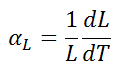
The linear thermal expansion coefficient is defined as:

linear thermal expansion coefficient

where L is a particular length measurement and dL/dT is the rate of change of that linear dimension per unit change in temperature.

The volumetric thermal expansion coefficient is the most basic thermal expansion coefficient, and the most relevant for fluids. In general, substances expand or contract when their temperature changes, with expansion or contraction occurring in all directions.

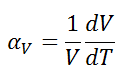
The volumetric thermal expansion coefficient is defined as:

volumetric thermal expansion coefficient

where L is the volume of the material and dV/dT is the rate of change of that volume per unit change in temperature.

In a solid or liquid, there is a dynamic balance between the cohesive forces holding the atoms or molecules together and the conditions created by temperature. Therefore higher temperatures imply greater distance between atoms. Different materials have different bonding forces and therefore different expansion coefficients. If a crystalline solid is isometric (has the same structural configuration throughout), the expansion will be uniform in all dimensions of the crystal. For these materials, the area and volumetric thermal expansion coefficient are, respectively, approximately twice and three times larger than the linear thermal expansion coefficient (αV = 3αL). If it is not isometric, there may be different expansion coefficients for different crystallographic directions, and the crystal will change shape as the temperature changes.

–

Tennessine – Thermal Expansion Coefficient

Periodic Table of Elements - thermal expansion
1
H

Hydrogen


2
He

Helium


3
Li

Lithium

46 µm/(m·K)

4
Be

Beryllium

11.3 µm/(m·K)

5
B

Boron

5-7 µm/(m·K)

6
C

Carbon

0.8 µm/(m·K)

7
N

Nitrogen


8
O

Oxygen


9
F

Fluorine


10
Ne

Neon


11
Na

Sodium

71 µm/(m·K)

12
Mg

Magnesium

24.8 µm/(m·K)

13
Al

Aluminium

23.1 µm/(m·K)

14
Si

Silicon

2.6 µm/(m·K)

15
P

Phosphorus


16
S

Sulfur


17
Cl

Chlorine


18
Ar

Argon


19
K

Potassium

83 µm/(m·K)

20
Ca

Calcium

22.3 µm/(m·K)

21
Sc

Scandium

10.2 µm/(m·K)

22
Ti

Titanium

8.6 µm/(m·K)

23
V

Vanadium

8.4 µm/(m·K)

24
Cr

Chromium

4.9 µm/(m·K)

25
Mn

Manganese

21.7 µm/(m·K)

26
Fe

Iron

11.8 µm/(m·K)

27
Co

Cobalt

13 µm/(m·K)

28
Ni

Nickel

13.4 µm/(m·K)

29
Cu

Copper

16.5 µm/(m·K)

30
Zn

Zinc

30.2 µm/(m·K)

31
Ga

Gallium

18 µm/(m·K)

32
Ge

Germanium

6 µm/(m·K)

33
As

Arsenic

5.6 µm/(m·K)

34
Se

Selenium

37 µm/(m·K)

35
Br

Bromine


36
Kr

Krypton


37
Rb

Rubidium

90 µm/(m·K)

38
Sr

Strontium

22.5 µm/(m·K)

39
Y

Yttrium

10.6 µm/(m·K)

40
Zr

Zirconium

5.7 µm/(m·K)

41
Nb

Niobium

7.3 µm/(m·K)

42
Mo

Molybdenum

4.8 µm/(m·K)

43
Tc

Technetium

7.1 µm/(m·K)

44
Ru

Ruthenium

6.4 µm/(m·K)

45
Rh

Rhodium

8.2 µm/(m·K)

46
Pd

Palladium

11.8 µm/(m·K)

47
Ag

Silver

18.9 µm/(m·K)

48
Cd

Cadmium

30.8 µm/(m·K)

49
In

Indium

32.1 µm/(m·K)

50
Sn

Tin

22 µm/(m·K)

51
Sb

Antimony

11 µm/(m·K)

52
Te

Tellurium

18 µm/(m·K)

53
I

Iodine


54
Xe

Xenon


55
Cs

Caesium

97 µm/(m·K)

56
Ba

Barium

20.6 µm/(m·K)

57-71


Lanthanoids


72
Hf

Hafnium

5.9 µm/(m·K)

73
Ta

Tantalum

6.3 µm/(m·K)

74
W

Tungsten

4.5 µm/(m·K)

75
Re

Rhenium

6.2 µm/(m·K)

76
Os

Osmium

5.1 µm/(m·K)

77
Ir

Iridium

6.4 µm/(m·K)

78
Pt

Platinum

8.8 µm/(m·K)

79
Au

Gold

14.2 µm/(m·K)

80
Hg

Mercury

60.4 µm/(m·K)

81
Tl

Thallium

29.9 µm/(m·K)

82
Pb

Lead

28.9 µm/(m·K)

83
Bi

Bismuth

13.4 µm/(m·K)

84
Po

Polonium

23.5 µm/(m·K)

85
At

Astatine


86
Rn

Radon


87
Fr

Francium


88
Ra

Radium


89-103


Actinoids


104
Rf

Rutherfordium


105
Db

Dubnium


106
Sg

Seaborgium


107
Bh

Bohrium


108
Hs

Hassium


109
Mt

Meitnerium


110
Ds

Darmstadtium


111
Rg

Roentgenium


112
Cn

Copernicium


113
Nh

Nihonium


114
Fl

Flerovium


115
Mc

Moscovium


116
Lv

Livermorium


117
Ts

Tennessine


118
Og

Oganesson


57
La

Lanthanum

12.1 µm/(m·K)

58
Ce

Cerium

6.3 µm/(m·K)

59
Pr

Praseodymium

6.7 µm/(m·K)

60
Nd

Neodymium

9.6 µm/(m·K)

61
Pm

Promethium

9 µm/(m·K)

62
Sm

Samarium

12.7 µm/(m·K)

63
Eu

Europium

35 µm/(m·K)

64
Gd

Gadolinium

9.4 µm/(m·K)

65
Tb

Terbium

10.3 µm/(m·K)

66
Dy

Dysprosium

9.9 µm/(m·K)

67
Ho

Holmium

11.2 µm/(m·K)

68
Er

Erbium

12.2 µm/(m·K)

69
Th

Thulium

13.3 µm/(m·K)

70
Yb

Ytterbium

26.3 µm/(m·K)

71
Lu

Lutetium

9.9 µm/(m·K)

89
Ac

Actinium


90
Th

Thorium

11 µm/(m·K)

91
Pa

Protactinium

10 µm/(m·K)

92
U

Uranium

13.9 µm/(m·K)

93
Np

Neptunium


94
Pu

Plutonium

46.7 µm/(m·K)

95
Am

Americium


96
Cm

Curium


97
Bk

Berkelium


98
Cf

Californium


99
Es

Einsteinium


100
Fm

Fermium


101
Md

Mendelevium


102
No

Nobelium


103
Lr

Lawrencium


Coefficient of Thermal Expansion of Tennessine

Linear thermal expansion coefficient of Tennessine is — µm/(m·K)

Thermal expansion is generally the tendency of matter to change its dimensions in response to a change in temperature. It is usually expressed as a fractional change in length or volume per unit temperature change. Thermal expansion is common for solids, liquids and for gases. Unlike gases or liquids, solid materials tend to keep their shape when undergoing thermal expansion. A linear expansion coefficient is usually employed in describing the expansion of a solid, while a volume expansion coefficient is more useful for a liquid or a gas.

The linear thermal expansion coefficient is defined as:

linear thermal expansion coefficient

where L is a particular length measurement and dL/dT is the rate of change of that linear dimension per unit change in temperature.

The volumetric thermal expansion coefficient is the most basic thermal expansion coefficient, and the most relevant for fluids. In general, substances expand or contract when their temperature changes, with expansion or contraction occurring in all directions.

The volumetric thermal expansion coefficient is defined as:

volumetric thermal expansion coefficient

where L is the volume of the material and dV/dT is the rate of change of that volume per unit change in temperature.

In a solid or liquid, there is a dynamic balance between the cohesive forces holding the atoms or molecules together and the conditions created by temperature. Therefore higher temperatures imply greater distance between atoms. Different materials have different bonding forces and therefore different expansion coefficients. If a crystalline solid is isometric (has the same structural configuration throughout), the expansion will be uniform in all dimensions of the crystal. For these materials, the area and volumetric thermal expansion coefficient are, respectively, approximately twice and three times larger than the linear thermal expansion coefficient (αV = 3αL). If it is not isometric, there may be different expansion coefficients for different crystallographic directions, and the crystal will change shape as the temperature changes.

–

Livermorium – Thermal Expansion Coefficient

Periodic Table of Elements - thermal expansion
1
H

Hydrogen


2
He

Helium


3
Li

Lithium

46 µm/(m·K)

4
Be

Beryllium

11.3 µm/(m·K)

5
B

Boron

5-7 µm/(m·K)

6
C

Carbon

0.8 µm/(m·K)

7
N

Nitrogen


8
O

Oxygen


9
F

Fluorine


10
Ne

Neon


11
Na

Sodium

71 µm/(m·K)

12
Mg

Magnesium

24.8 µm/(m·K)

13
Al

Aluminium

23.1 µm/(m·K)

14
Si

Silicon

2.6 µm/(m·K)

15
P

Phosphorus


16
S

Sulfur


17
Cl

Chlorine


18
Ar

Argon


19
K

Potassium

83 µm/(m·K)

20
Ca

Calcium

22.3 µm/(m·K)

21
Sc

Scandium

10.2 µm/(m·K)

22
Ti

Titanium

8.6 µm/(m·K)

23
V

Vanadium

8.4 µm/(m·K)

24
Cr

Chromium

4.9 µm/(m·K)

25
Mn

Manganese

21.7 µm/(m·K)

26
Fe

Iron

11.8 µm/(m·K)

27
Co

Cobalt

13 µm/(m·K)

28
Ni

Nickel

13.4 µm/(m·K)

29
Cu

Copper

16.5 µm/(m·K)

30
Zn

Zinc

30.2 µm/(m·K)

31
Ga

Gallium

18 µm/(m·K)

32
Ge

Germanium

6 µm/(m·K)

33
As

Arsenic

5.6 µm/(m·K)

34
Se

Selenium

37 µm/(m·K)

35
Br

Bromine


36
Kr

Krypton


37
Rb

Rubidium

90 µm/(m·K)

38
Sr

Strontium

22.5 µm/(m·K)

39
Y

Yttrium

10.6 µm/(m·K)

40
Zr

Zirconium

5.7 µm/(m·K)

41
Nb

Niobium

7.3 µm/(m·K)

42
Mo

Molybdenum

4.8 µm/(m·K)

43
Tc

Technetium

7.1 µm/(m·K)

44
Ru

Ruthenium

6.4 µm/(m·K)

45
Rh

Rhodium

8.2 µm/(m·K)

46
Pd

Palladium

11.8 µm/(m·K)

47
Ag

Silver

18.9 µm/(m·K)

48
Cd

Cadmium

30.8 µm/(m·K)

49
In

Indium

32.1 µm/(m·K)

50
Sn

Tin

22 µm/(m·K)

51
Sb

Antimony

11 µm/(m·K)

52
Te

Tellurium

18 µm/(m·K)

53
I

Iodine


54
Xe

Xenon


55
Cs

Caesium

97 µm/(m·K)

56
Ba

Barium

20.6 µm/(m·K)

57-71


Lanthanoids


72
Hf

Hafnium

5.9 µm/(m·K)

73
Ta

Tantalum

6.3 µm/(m·K)

74
W

Tungsten

4.5 µm/(m·K)

75
Re

Rhenium

6.2 µm/(m·K)

76
Os

Osmium

5.1 µm/(m·K)

77
Ir

Iridium

6.4 µm/(m·K)

78
Pt

Platinum

8.8 µm/(m·K)

79
Au

Gold

14.2 µm/(m·K)

80
Hg

Mercury

60.4 µm/(m·K)

81
Tl

Thallium

29.9 µm/(m·K)

82
Pb

Lead

28.9 µm/(m·K)

83
Bi

Bismuth

13.4 µm/(m·K)

84
Po

Polonium

23.5 µm/(m·K)

85
At

Astatine


86
Rn

Radon


87
Fr

Francium


88
Ra

Radium


89-103


Actinoids


104
Rf

Rutherfordium


105
Db

Dubnium


106
Sg

Seaborgium


107
Bh

Bohrium


108
Hs

Hassium


109
Mt

Meitnerium


110
Ds

Darmstadtium


111
Rg

Roentgenium


112
Cn

Copernicium


113
Nh

Nihonium


114
Fl

Flerovium


115
Mc

Moscovium


116
Lv

Livermorium


117
Ts

Tennessine


118
Og

Oganesson


57
La

Lanthanum

12.1 µm/(m·K)

58
Ce

Cerium

6.3 µm/(m·K)

59
Pr

Praseodymium

6.7 µm/(m·K)

60
Nd

Neodymium

9.6 µm/(m·K)

61
Pm

Promethium

9 µm/(m·K)

62
Sm

Samarium

12.7 µm/(m·K)

63
Eu

Europium

35 µm/(m·K)

64
Gd

Gadolinium

9.4 µm/(m·K)

65
Tb

Terbium

10.3 µm/(m·K)

66
Dy

Dysprosium

9.9 µm/(m·K)

67
Ho

Holmium

11.2 µm/(m·K)

68
Er

Erbium

12.2 µm/(m·K)

69
Th

Thulium

13.3 µm/(m·K)

70
Yb

Ytterbium

26.3 µm/(m·K)

71
Lu

Lutetium

9.9 µm/(m·K)

89
Ac

Actinium


90
Th

Thorium

11 µm/(m·K)

91
Pa

Protactinium

10 µm/(m·K)

92
U

Uranium

13.9 µm/(m·K)

93
Np

Neptunium


94
Pu

Plutonium

46.7 µm/(m·K)

95
Am

Americium


96
Cm

Curium


97
Bk

Berkelium


98
Cf

Californium


99
Es

Einsteinium


100
Fm

Fermium


101
Md

Mendelevium


102
No

Nobelium


103
Lr

Lawrencium


Coefficient of Thermal Expansion of Livermorium

Linear thermal expansion coefficient of Livermorium is — µm/(m·K)

Thermal expansion is generally the tendency of matter to change its dimensions in response to a change in temperature. It is usually expressed as a fractional change in length or volume per unit temperature change. Thermal expansion is common for solids, liquids and for gases. Unlike gases or liquids, solid materials tend to keep their shape when undergoing thermal expansion. A linear expansion coefficient is usually employed in describing the expansion of a solid, while a volume expansion coefficient is more useful for a liquid or a gas.

The linear thermal expansion coefficient is defined as:

linear thermal expansion coefficient

where L is a particular length measurement and dL/dT is the rate of change of that linear dimension per unit change in temperature.

The volumetric thermal expansion coefficient is the most basic thermal expansion coefficient, and the most relevant for fluids. In general, substances expand or contract when their temperature changes, with expansion or contraction occurring in all directions.

The volumetric thermal expansion coefficient is defined as:

volumetric thermal expansion coefficient

where L is the volume of the material and dV/dT is the rate of change of that volume per unit change in temperature.

In a solid or liquid, there is a dynamic balance between the cohesive forces holding the atoms or molecules together and the conditions created by temperature. Therefore higher temperatures imply greater distance between atoms. Different materials have different bonding forces and therefore different expansion coefficients. If a crystalline solid is isometric (has the same structural configuration throughout), the expansion will be uniform in all dimensions of the crystal. For these materials, the area and volumetric thermal expansion coefficient are, respectively, approximately twice and three times larger than the linear thermal expansion coefficient (αV = 3αL). If it is not isometric, there may be different expansion coefficients for different crystallographic directions, and the crystal will change shape as the temperature changes.

–

Moscovium – Thermal Expansion Coefficient

Periodic Table of Elements - thermal expansion
1
H

Hydrogen


2
He

Helium


3
Li

Lithium

46 µm/(m·K)

4
Be

Beryllium

11.3 µm/(m·K)

5
B

Boron

5-7 µm/(m·K)

6
C

Carbon

0.8 µm/(m·K)

7
N

Nitrogen


8
O

Oxygen


9
F

Fluorine


10
Ne

Neon


11
Na

Sodium

71 µm/(m·K)

12
Mg

Magnesium

24.8 µm/(m·K)

13
Al

Aluminium

23.1 µm/(m·K)

14
Si

Silicon

2.6 µm/(m·K)

15
P

Phosphorus


16
S

Sulfur


17
Cl

Chlorine


18
Ar

Argon


19
K

Potassium

83 µm/(m·K)

20
Ca

Calcium

22.3 µm/(m·K)

21
Sc

Scandium

10.2 µm/(m·K)

22
Ti

Titanium

8.6 µm/(m·K)

23
V

Vanadium

8.4 µm/(m·K)

24
Cr

Chromium

4.9 µm/(m·K)

25
Mn

Manganese

21.7 µm/(m·K)

26
Fe

Iron

11.8 µm/(m·K)

27
Co

Cobalt

13 µm/(m·K)

28
Ni

Nickel

13.4 µm/(m·K)

29
Cu

Copper

16.5 µm/(m·K)

30
Zn

Zinc

30.2 µm/(m·K)

31
Ga

Gallium

18 µm/(m·K)

32
Ge

Germanium

6 µm/(m·K)

33
As

Arsenic

5.6 µm/(m·K)

34
Se

Selenium

37 µm/(m·K)

35
Br

Bromine


36
Kr

Krypton


37
Rb

Rubidium

90 µm/(m·K)

38
Sr

Strontium

22.5 µm/(m·K)

39
Y

Yttrium

10.6 µm/(m·K)

40
Zr

Zirconium

5.7 µm/(m·K)

41
Nb

Niobium

7.3 µm/(m·K)

42
Mo

Molybdenum

4.8 µm/(m·K)

43
Tc

Technetium

7.1 µm/(m·K)

44
Ru

Ruthenium

6.4 µm/(m·K)

45
Rh

Rhodium

8.2 µm/(m·K)

46
Pd

Palladium

11.8 µm/(m·K)

47
Ag

Silver

18.9 µm/(m·K)

48
Cd

Cadmium

30.8 µm/(m·K)

49
In

Indium

32.1 µm/(m·K)

50
Sn

Tin

22 µm/(m·K)

51
Sb

Antimony

11 µm/(m·K)

52
Te

Tellurium

18 µm/(m·K)

53
I

Iodine


54
Xe

Xenon


55
Cs

Caesium

97 µm/(m·K)

56
Ba

Barium

20.6 µm/(m·K)

57-71


Lanthanoids


72
Hf

Hafnium

5.9 µm/(m·K)

73
Ta

Tantalum

6.3 µm/(m·K)

74
W

Tungsten

4.5 µm/(m·K)

75
Re

Rhenium

6.2 µm/(m·K)

76
Os

Osmium

5.1 µm/(m·K)

77
Ir

Iridium

6.4 µm/(m·K)

78
Pt

Platinum

8.8 µm/(m·K)

79
Au

Gold

14.2 µm/(m·K)

80
Hg

Mercury

60.4 µm/(m·K)

81
Tl

Thallium

29.9 µm/(m·K)

82
Pb

Lead

28.9 µm/(m·K)

83
Bi

Bismuth

13.4 µm/(m·K)

84
Po

Polonium

23.5 µm/(m·K)

85
At

Astatine


86
Rn

Radon


87
Fr

Francium


88
Ra

Radium


89-103


Actinoids


104
Rf

Rutherfordium


105
Db

Dubnium


106
Sg

Seaborgium


107
Bh

Bohrium


108
Hs

Hassium


109
Mt

Meitnerium


110
Ds

Darmstadtium


111
Rg

Roentgenium


112
Cn

Copernicium


113
Nh

Nihonium


114
Fl

Flerovium


115
Mc

Moscovium


116
Lv

Livermorium


117
Ts

Tennessine


118
Og

Oganesson


57
La

Lanthanum

12.1 µm/(m·K)

58
Ce

Cerium

6.3 µm/(m·K)

59
Pr

Praseodymium

6.7 µm/(m·K)

60
Nd

Neodymium

9.6 µm/(m·K)

61
Pm

Promethium

9 µm/(m·K)

62
Sm

Samarium

12.7 µm/(m·K)

63
Eu

Europium

35 µm/(m·K)

64
Gd

Gadolinium

9.4 µm/(m·K)

65
Tb

Terbium

10.3 µm/(m·K)

66
Dy

Dysprosium

9.9 µm/(m·K)

67
Ho

Holmium

11.2 µm/(m·K)

68
Er

Erbium

12.2 µm/(m·K)

69
Th

Thulium

13.3 µm/(m·K)

70
Yb

Ytterbium

26.3 µm/(m·K)

71
Lu

Lutetium

9.9 µm/(m·K)

89
Ac

Actinium


90
Th

Thorium

11 µm/(m·K)

91
Pa

Protactinium

10 µm/(m·K)

92
U

Uranium

13.9 µm/(m·K)

93
Np

Neptunium


94
Pu

Plutonium

46.7 µm/(m·K)

95
Am

Americium


96
Cm

Curium


97
Bk

Berkelium


98
Cf

Californium


99
Es

Einsteinium


100
Fm

Fermium


101
Md

Mendelevium


102
No

Nobelium


103
Lr

Lawrencium


Coefficient of Thermal Expansion of Moscovium

Linear thermal expansion coefficient of Moscovium is — µm/(m·K)

Thermal expansion is generally the tendency of matter to change its dimensions in response to a change in temperature. It is usually expressed as a fractional change in length or volume per unit temperature change. Thermal expansion is common for solids, liquids and for gases. Unlike gases or liquids, solid materials tend to keep their shape when undergoing thermal expansion. A linear expansion coefficient is usually employed in describing the expansion of a solid, while a volume expansion coefficient is more useful for a liquid or a gas.

The linear thermal expansion coefficient is defined as:

linear thermal expansion coefficient

where L is a particular length measurement and dL/dT is the rate of change of that linear dimension per unit change in temperature.

The volumetric thermal expansion coefficient is the most basic thermal expansion coefficient, and the most relevant for fluids. In general, substances expand or contract when their temperature changes, with expansion or contraction occurring in all directions.

The volumetric thermal expansion coefficient is defined as:

volumetric thermal expansion coefficient

where L is the volume of the material and dV/dT is the rate of change of that volume per unit change in temperature.

In a solid or liquid, there is a dynamic balance between the cohesive forces holding the atoms or molecules together and the conditions created by temperature. Therefore higher temperatures imply greater distance between atoms. Different materials have different bonding forces and therefore different expansion coefficients. If a crystalline solid is isometric (has the same structural configuration throughout), the expansion will be uniform in all dimensions of the crystal. For these materials, the area and volumetric thermal expansion coefficient are, respectively, approximately twice and three times larger than the linear thermal expansion coefficient (αV = 3αL). If it is not isometric, there may be different expansion coefficients for different crystallographic directions, and the crystal will change shape as the temperature changes.

–

Flerovium – Thermal Expansion Coefficient

Periodic Table of Elements - thermal expansion
1
H

Hydrogen


2
He

Helium


3
Li

Lithium

46 µm/(m·K)

4
Be

Beryllium

11.3 µm/(m·K)

5
B

Boron

5-7 µm/(m·K)

6
C

Carbon

0.8 µm/(m·K)

7
N

Nitrogen


8
O

Oxygen


9
F

Fluorine


10
Ne

Neon


11
Na

Sodium

71 µm/(m·K)

12
Mg

Magnesium

24.8 µm/(m·K)

13
Al

Aluminium

23.1 µm/(m·K)

14
Si

Silicon

2.6 µm/(m·K)

15
P

Phosphorus


16
S

Sulfur


17
Cl

Chlorine


18
Ar

Argon


19
K

Potassium

83 µm/(m·K)

20
Ca

Calcium

22.3 µm/(m·K)

21
Sc

Scandium

10.2 µm/(m·K)

22
Ti

Titanium

8.6 µm/(m·K)

23
V

Vanadium

8.4 µm/(m·K)

24
Cr

Chromium

4.9 µm/(m·K)

25
Mn

Manganese

21.7 µm/(m·K)

26
Fe

Iron

11.8 µm/(m·K)

27
Co

Cobalt

13 µm/(m·K)

28
Ni

Nickel

13.4 µm/(m·K)

29
Cu

Copper

16.5 µm/(m·K)

30
Zn

Zinc

30.2 µm/(m·K)

31
Ga

Gallium

18 µm/(m·K)

32
Ge

Germanium

6 µm/(m·K)

33
As

Arsenic

5.6 µm/(m·K)

34
Se

Selenium

37 µm/(m·K)

35
Br

Bromine


36
Kr

Krypton


37
Rb

Rubidium

90 µm/(m·K)

38
Sr

Strontium

22.5 µm/(m·K)

39
Y

Yttrium

10.6 µm/(m·K)

40
Zr

Zirconium

5.7 µm/(m·K)

41
Nb

Niobium

7.3 µm/(m·K)

42
Mo

Molybdenum

4.8 µm/(m·K)

43
Tc

Technetium

7.1 µm/(m·K)

44
Ru

Ruthenium

6.4 µm/(m·K)

45
Rh

Rhodium

8.2 µm/(m·K)

46
Pd

Palladium

11.8 µm/(m·K)

47
Ag

Silver

18.9 µm/(m·K)

48
Cd

Cadmium

30.8 µm/(m·K)

49
In

Indium

32.1 µm/(m·K)

50
Sn

Tin

22 µm/(m·K)

51
Sb

Antimony

11 µm/(m·K)

52
Te

Tellurium

18 µm/(m·K)

53
I

Iodine


54
Xe

Xenon


55
Cs

Caesium

97 µm/(m·K)

56
Ba

Barium

20.6 µm/(m·K)

57-71


Lanthanoids


72
Hf

Hafnium

5.9 µm/(m·K)

73
Ta

Tantalum

6.3 µm/(m·K)

74
W

Tungsten

4.5 µm/(m·K)

75
Re

Rhenium

6.2 µm/(m·K)

76
Os

Osmium

5.1 µm/(m·K)

77
Ir

Iridium

6.4 µm/(m·K)

78
Pt

Platinum

8.8 µm/(m·K)

79
Au

Gold

14.2 µm/(m·K)

80
Hg

Mercury

60.4 µm/(m·K)

81
Tl

Thallium

29.9 µm/(m·K)

82
Pb

Lead

28.9 µm/(m·K)

83
Bi

Bismuth

13.4 µm/(m·K)

84
Po

Polonium

23.5 µm/(m·K)

85
At

Astatine


86
Rn

Radon


87
Fr

Francium


88
Ra

Radium


89-103


Actinoids


104
Rf

Rutherfordium


105
Db

Dubnium


106
Sg

Seaborgium


107
Bh

Bohrium


108
Hs

Hassium


109
Mt

Meitnerium


110
Ds

Darmstadtium


111
Rg

Roentgenium


112
Cn

Copernicium


113
Nh

Nihonium


114
Fl

Flerovium


115
Mc

Moscovium


116
Lv

Livermorium


117
Ts

Tennessine


118
Og

Oganesson


57
La

Lanthanum

12.1 µm/(m·K)

58
Ce

Cerium

6.3 µm/(m·K)

59
Pr

Praseodymium

6.7 µm/(m·K)

60
Nd

Neodymium

9.6 µm/(m·K)

61
Pm

Promethium

9 µm/(m·K)

62
Sm

Samarium

12.7 µm/(m·K)

63
Eu

Europium

35 µm/(m·K)

64
Gd

Gadolinium

9.4 µm/(m·K)

65
Tb

Terbium

10.3 µm/(m·K)

66
Dy

Dysprosium

9.9 µm/(m·K)

67
Ho

Holmium

11.2 µm/(m·K)

68
Er

Erbium

12.2 µm/(m·K)

69
Th

Thulium

13.3 µm/(m·K)

70
Yb

Ytterbium

26.3 µm/(m·K)

71
Lu

Lutetium

9.9 µm/(m·K)

89
Ac

Actinium


90
Th

Thorium

11 µm/(m·K)

91
Pa

Protactinium

10 µm/(m·K)

92
U

Uranium

13.9 µm/(m·K)

93
Np

Neptunium


94
Pu

Plutonium

46.7 µm/(m·K)

95
Am

Americium


96
Cm

Curium


97
Bk

Berkelium


98
Cf

Californium


99
Es

Einsteinium


100
Fm

Fermium


101
Md

Mendelevium


102
No

Nobelium


103
Lr

Lawrencium


Coefficient of Thermal Expansion of Flerovium

Linear thermal expansion coefficient of Flerovium is — µm/(m·K)

Thermal expansion is generally the tendency of matter to change its dimensions in response to a change in temperature. It is usually expressed as a fractional change in length or volume per unit temperature change. Thermal expansion is common for solids, liquids and for gases. Unlike gases or liquids, solid materials tend to keep their shape when undergoing thermal expansion. A linear expansion coefficient is usually employed in describing the expansion of a solid, while a volume expansion coefficient is more useful for a liquid or a gas.

The linear thermal expansion coefficient is defined as:

linear thermal expansion coefficient

where L is a particular length measurement and dL/dT is the rate of change of that linear dimension per unit change in temperature.

The volumetric thermal expansion coefficient is the most basic thermal expansion coefficient, and the most relevant for fluids. In general, substances expand or contract when their temperature changes, with expansion or contraction occurring in all directions.

The volumetric thermal expansion coefficient is defined as:

volumetric thermal expansion coefficient

where L is the volume of the material and dV/dT is the rate of change of that volume per unit change in temperature.

In a solid or liquid, there is a dynamic balance between the cohesive forces holding the atoms or molecules together and the conditions created by temperature. Therefore higher temperatures imply greater distance between atoms. Different materials have different bonding forces and therefore different expansion coefficients. If a crystalline solid is isometric (has the same structural configuration throughout), the expansion will be uniform in all dimensions of the crystal. For these materials, the area and volumetric thermal expansion coefficient are, respectively, approximately twice and three times larger than the linear thermal expansion coefficient (αV = 3αL). If it is not isometric, there may be different expansion coefficients for different crystallographic directions, and the crystal will change shape as the temperature changes.

–

Nihonium – Thermal Expansion Coefficient

Periodic Table of Elements - thermal expansion
1
H

Hydrogen


2
He

Helium


3
Li

Lithium

46 µm/(m·K)

4
Be

Beryllium

11.3 µm/(m·K)

5
B

Boron

5-7 µm/(m·K)

6
C

Carbon

0.8 µm/(m·K)

7
N

Nitrogen


8
O

Oxygen


9
F

Fluorine


10
Ne

Neon


11
Na

Sodium

71 µm/(m·K)

12
Mg

Magnesium

24.8 µm/(m·K)

13
Al

Aluminium

23.1 µm/(m·K)

14
Si

Silicon

2.6 µm/(m·K)

15
P

Phosphorus


16
S

Sulfur


17
Cl

Chlorine


18
Ar

Argon


19
K

Potassium

83 µm/(m·K)

20
Ca

Calcium

22.3 µm/(m·K)

21
Sc

Scandium

10.2 µm/(m·K)

22
Ti

Titanium

8.6 µm/(m·K)

23
V

Vanadium

8.4 µm/(m·K)

24
Cr

Chromium

4.9 µm/(m·K)

25
Mn

Manganese

21.7 µm/(m·K)

26
Fe

Iron

11.8 µm/(m·K)

27
Co

Cobalt

13 µm/(m·K)

28
Ni

Nickel

13.4 µm/(m·K)

29
Cu

Copper

16.5 µm/(m·K)

30
Zn

Zinc

30.2 µm/(m·K)

31
Ga

Gallium

18 µm/(m·K)

32
Ge

Germanium

6 µm/(m·K)

33
As

Arsenic

5.6 µm/(m·K)

34
Se

Selenium

37 µm/(m·K)

35
Br

Bromine


36
Kr

Krypton


37
Rb

Rubidium

90 µm/(m·K)

38
Sr

Strontium

22.5 µm/(m·K)

39
Y

Yttrium

10.6 µm/(m·K)

40
Zr

Zirconium

5.7 µm/(m·K)

41
Nb

Niobium

7.3 µm/(m·K)

42
Mo

Molybdenum

4.8 µm/(m·K)

43
Tc

Technetium

7.1 µm/(m·K)

44
Ru

Ruthenium

6.4 µm/(m·K)

45
Rh

Rhodium

8.2 µm/(m·K)

46
Pd

Palladium

11.8 µm/(m·K)

47
Ag

Silver

18.9 µm/(m·K)

48
Cd

Cadmium

30.8 µm/(m·K)

49
In

Indium

32.1 µm/(m·K)

50
Sn

Tin

22 µm/(m·K)

51
Sb

Antimony

11 µm/(m·K)

52
Te

Tellurium

18 µm/(m·K)

53
I

Iodine


54
Xe

Xenon


55
Cs

Caesium

97 µm/(m·K)

56
Ba

Barium

20.6 µm/(m·K)

57-71


Lanthanoids


72
Hf

Hafnium

5.9 µm/(m·K)

73
Ta

Tantalum

6.3 µm/(m·K)

74
W

Tungsten

4.5 µm/(m·K)

75
Re

Rhenium

6.2 µm/(m·K)

76
Os

Osmium

5.1 µm/(m·K)

77
Ir

Iridium

6.4 µm/(m·K)

78
Pt

Platinum

8.8 µm/(m·K)

79
Au

Gold

14.2 µm/(m·K)

80
Hg

Mercury

60.4 µm/(m·K)

81
Tl

Thallium

29.9 µm/(m·K)

82
Pb

Lead

28.9 µm/(m·K)

83
Bi

Bismuth

13.4 µm/(m·K)

84
Po

Polonium

23.5 µm/(m·K)

85
At

Astatine


86
Rn

Radon


87
Fr

Francium


88
Ra

Radium


89-103


Actinoids


104
Rf

Rutherfordium


105
Db

Dubnium


106
Sg

Seaborgium


107
Bh

Bohrium


108
Hs

Hassium


109
Mt

Meitnerium


110
Ds

Darmstadtium


111
Rg

Roentgenium


112
Cn

Copernicium


113
Nh

Nihonium


114
Fl

Flerovium


115
Mc

Moscovium


116
Lv

Livermorium


117
Ts

Tennessine


118
Og

Oganesson


57
La

Lanthanum

12.1 µm/(m·K)

58
Ce

Cerium

6.3 µm/(m·K)

59
Pr

Praseodymium

6.7 µm/(m·K)

60
Nd

Neodymium

9.6 µm/(m·K)

61
Pm

Promethium

9 µm/(m·K)

62
Sm

Samarium

12.7 µm/(m·K)

63
Eu

Europium

35 µm/(m·K)

64
Gd

Gadolinium

9.4 µm/(m·K)

65
Tb

Terbium

10.3 µm/(m·K)

66
Dy

Dysprosium

9.9 µm/(m·K)

67
Ho

Holmium

11.2 µm/(m·K)

68
Er

Erbium

12.2 µm/(m·K)

69
Th

Thulium

13.3 µm/(m·K)

70
Yb

Ytterbium

26.3 µm/(m·K)

71
Lu

Lutetium

9.9 µm/(m·K)

89
Ac

Actinium


90
Th

Thorium

11 µm/(m·K)

91
Pa

Protactinium

10 µm/(m·K)

92
U

Uranium

13.9 µm/(m·K)

93
Np

Neptunium


94
Pu

Plutonium

46.7 µm/(m·K)

95
Am

Americium


96
Cm

Curium


97
Bk

Berkelium


98
Cf

Californium


99
Es

Einsteinium


100
Fm

Fermium


101
Md

Mendelevium


102
No

Nobelium


103
Lr

Lawrencium


Coefficient of Thermal Expansion of Nihonium

Linear thermal expansion coefficient of Nihonium is — µm/(m·K)

Thermal expansion is generally the tendency of matter to change its dimensions in response to a change in temperature. It is usually expressed as a fractional change in length or volume per unit temperature change. Thermal expansion is common for solids, liquids and for gases. Unlike gases or liquids, solid materials tend to keep their shape when undergoing thermal expansion. A linear expansion coefficient is usually employed in describing the expansion of a solid, while a volume expansion coefficient is more useful for a liquid or a gas.

The linear thermal expansion coefficient is defined as:

linear thermal expansion coefficient

where L is a particular length measurement and dL/dT is the rate of change of that linear dimension per unit change in temperature.

The volumetric thermal expansion coefficient is the most basic thermal expansion coefficient, and the most relevant for fluids. In general, substances expand or contract when their temperature changes, with expansion or contraction occurring in all directions.

The volumetric thermal expansion coefficient is defined as:

volumetric thermal expansion coefficient

where L is the volume of the material and dV/dT is the rate of change of that volume per unit change in temperature.

In a solid or liquid, there is a dynamic balance between the cohesive forces holding the atoms or molecules together and the conditions created by temperature. Therefore higher temperatures imply greater distance between atoms. Different materials have different bonding forces and therefore different expansion coefficients. If a crystalline solid is isometric (has the same structural configuration throughout), the expansion will be uniform in all dimensions of the crystal. For these materials, the area and volumetric thermal expansion coefficient are, respectively, approximately twice and three times larger than the linear thermal expansion coefficient (αV = 3αL). If it is not isometric, there may be different expansion coefficients for different crystallographic directions, and the crystal will change shape as the temperature changes.

–