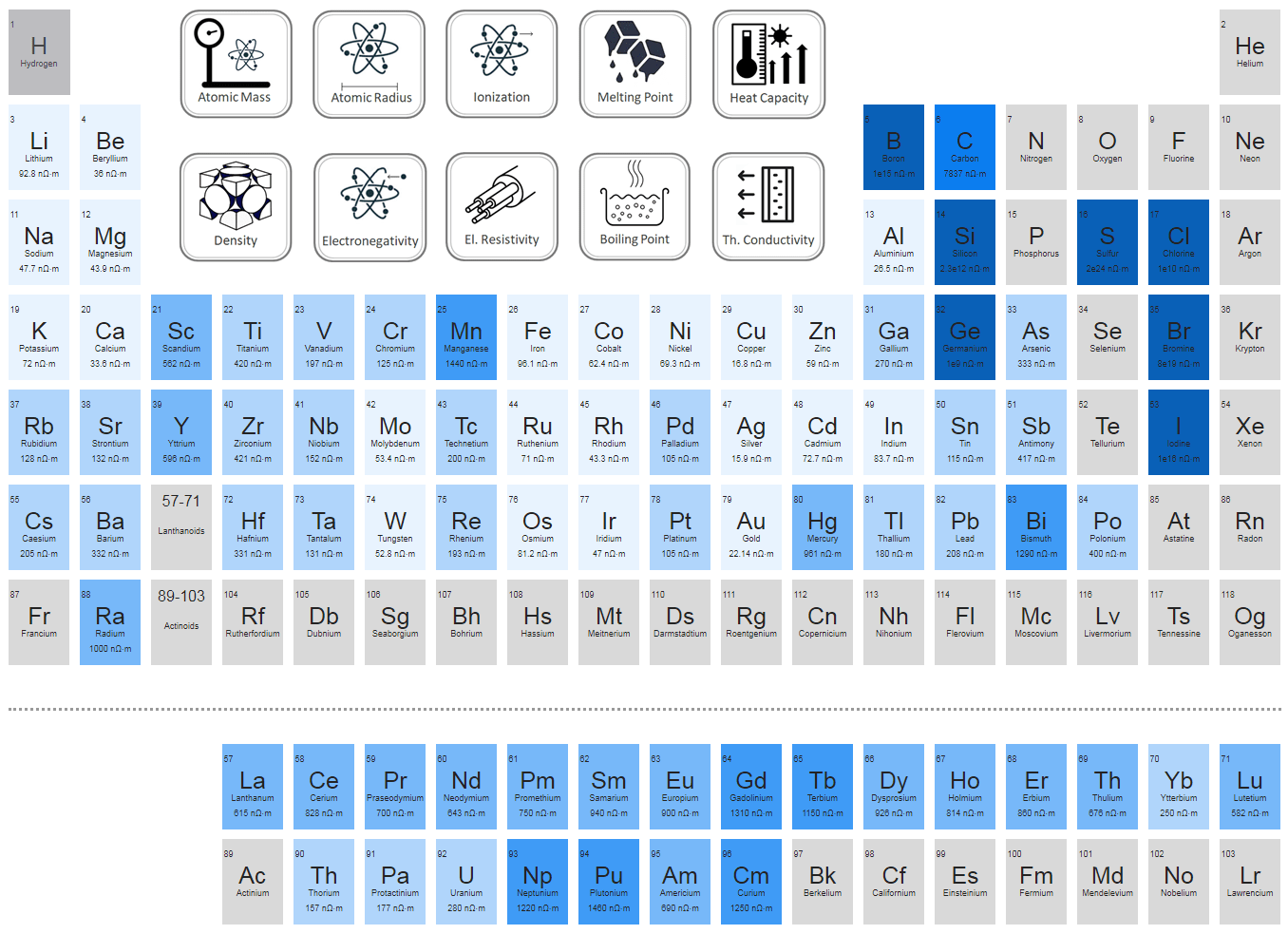
Carbon – Electrical Resistivity and Electrical Conductivity

Periodic Table of Elements - electrical resistivity
1
H

Hydrogen


2
He

Helium


3
Li

Lithium

92.8 nΩ⋅m

4
Be

Beryllium

36 nΩ⋅m

5
B

Boron

1e15 nΩ⋅m

6
C

Carbon

7837 nΩ⋅m

7
N

Nitrogen


8
O

Oxygen


9
F

Fluorine


10
Ne

Neon


11
Na

Sodium

47.7 nΩ⋅m

12
Mg

Magnesium

43.9 nΩ⋅m

13
Al

Aluminium

26.5 nΩ⋅m

14
Si

Silicon

2.3e12 nΩ⋅m

15
P

Phosphorus


16
S

Sulfur

2e24 nΩ⋅m

17
Cl

Chlorine

1e10 nΩ⋅m

18
Ar

Argon


19
K

Potassium

72 nΩ⋅m

20
Ca

Calcium

33.6 nΩ⋅m

21
Sc

Scandium

562 nΩ⋅m

22
Ti

Titanium

420 nΩ⋅m

23
V

Vanadium

197 nΩ⋅m

24
Cr

Chromium

125 nΩ⋅m

25
Mn

Manganese

1440 nΩ⋅m

26
Fe

Iron

96.1 nΩ⋅m

27
Co

Cobalt

62.4 nΩ⋅m

28
Ni

Nickel

69.3 nΩ⋅m

29
Cu

Copper

16.8 nΩ⋅m

30
Zn

Zinc

59 nΩ⋅m

31
Ga

Gallium

270 nΩ⋅m

32
Ge

Germanium

1e9 nΩ⋅m

33
As

Arsenic

333 nΩ⋅m

34
Se

Selenium


35
Br

Bromine

8e19 nΩ⋅m

36
Kr

Krypton


37
Rb

Rubidium

128 nΩ⋅m

38
Sr

Strontium

132 nΩ⋅m

39
Y

Yttrium

596 nΩ⋅m

40
Zr

Zirconium

421 nΩ⋅m

41
Nb

Niobium

152 nΩ⋅m

42
Mo

Molybdenum

53.4 nΩ⋅m

43
Tc

Technetium

200 nΩ⋅m

44
Ru

Ruthenium

71 nΩ⋅m

45
Rh

Rhodium

43.3 nΩ⋅m

46
Pd

Palladium

105 nΩ⋅m

47
Ag

Silver

15.9 nΩ⋅m

48
Cd

Cadmium

72.7 nΩ⋅m

49
In

Indium

83.7 nΩ⋅m

50
Sn

Tin

115 nΩ⋅m

51
Sb

Antimony

417 nΩ⋅m

52
Te

Tellurium


53
I

Iodine

1e16 nΩ⋅m

54
Xe

Xenon


55
Cs

Caesium

205 nΩ⋅m

56
Ba

Barium

332 nΩ⋅m

57-71


Lanthanoids


72
Hf

Hafnium

331 nΩ⋅m

73
Ta

Tantalum

131 nΩ⋅m

74
W

Tungsten

52.8 nΩ⋅m

75
Re

Rhenium

193 nΩ⋅m

76
Os

Osmium

81.2 nΩ⋅m

77
Ir

Iridium

47 nΩ⋅m

78
Pt

Platinum

105 nΩ⋅m

79
Au

Gold

22.14 nΩ⋅m

80
Hg

Mercury

961 nΩ⋅m

81
Tl

Thallium

180 nΩ⋅m

82
Pb

Lead

208 nΩ⋅m

83
Bi

Bismuth

1290 nΩ⋅m

84
Po

Polonium

400 nΩ⋅m

85
At

Astatine


86
Rn

Radon


87
Fr

Francium


88
Ra

Radium

1000 nΩ⋅m

89-103


Actinoids


104
Rf

Rutherfordium


105
Db

Dubnium


106
Sg

Seaborgium


107
Bh

Bohrium


108
Hs

Hassium


109
Mt

Meitnerium


110
Ds

Darmstadtium


111
Rg

Roentgenium


112
Cn

Copernicium


113
Nh

Nihonium


114
Fl

Flerovium


115
Mc

Moscovium


116
Lv

Livermorium


117
Ts

Tennessine


118
Og

Oganesson


57
La

Lanthanum

615 nΩ⋅m

58
Ce

Cerium

828 nΩ⋅m

59
Pr

Praseodymium

700 nΩ⋅m

60
Nd

Neodymium

643 nΩ⋅m

61
Pm

Promethium

750 nΩ⋅m

62
Sm

Samarium

940 nΩ⋅m

63
Eu

Europium

900 nΩ⋅m

64
Gd

Gadolinium

1310 nΩ⋅m

65
Tb

Terbium

1150 nΩ⋅m

66
Dy

Dysprosium

926 nΩ⋅m

67
Ho

Holmium

814 nΩ⋅m

68
Er

Erbium

860 nΩ⋅m

69
Th

Thulium

676 nΩ⋅m

70
Yb

Ytterbium

250 nΩ⋅m

71
Lu

Lutetium

582 nΩ⋅m

89
Ac

Actinium


90
Th

Thorium

157 nΩ⋅m

91
Pa

Protactinium

177 nΩ⋅m

92
U

Uranium

280 nΩ⋅m

93
Np

Neptunium

1220 nΩ⋅m

94
Pu

Plutonium

1460 nΩ⋅m

95
Am

Americium

690 nΩ⋅m

96
Cm

Curium

1250 nΩ⋅m

97
Bk

Berkelium


98
Cf

Californium


99
Es

Einsteinium


100
Fm

Fermium


101
Md

Mendelevium


102
No

Nobelium


103
Lr

Lawrencium


Carbon – Electrical Resistivity and Electrical Conductivity

Electrical resistivity of Carbon is 7837 nΩ·m.

Electrical resistivity and its converse, electrical conductivity, is a fundamental property of a material that quantifies how strongly it resists or conducts the flow of electric current. A low resistivity indicates a material that readily allows the flow of electric current. The symbol of resistivity is usually the Greek letter ρ (rho). The SI unit of electrical resistivity is the ohm-metre (Ω⋅m). Note that, electrical resistivity is not the same as electrical resistance. Electrical resistance is expressed in Ohms. While resistivity is a material property, resistance is the property of an object.

Conductors – Semiconductors – Resistors

Substances in which electricity can flow are called conductors. Conductors are made of high-conductivity materials such as metals, in particular copper and aluminium.

Insulators, on the other hand, are made of a wide variety of materials depending on factors such as the desired resistance.

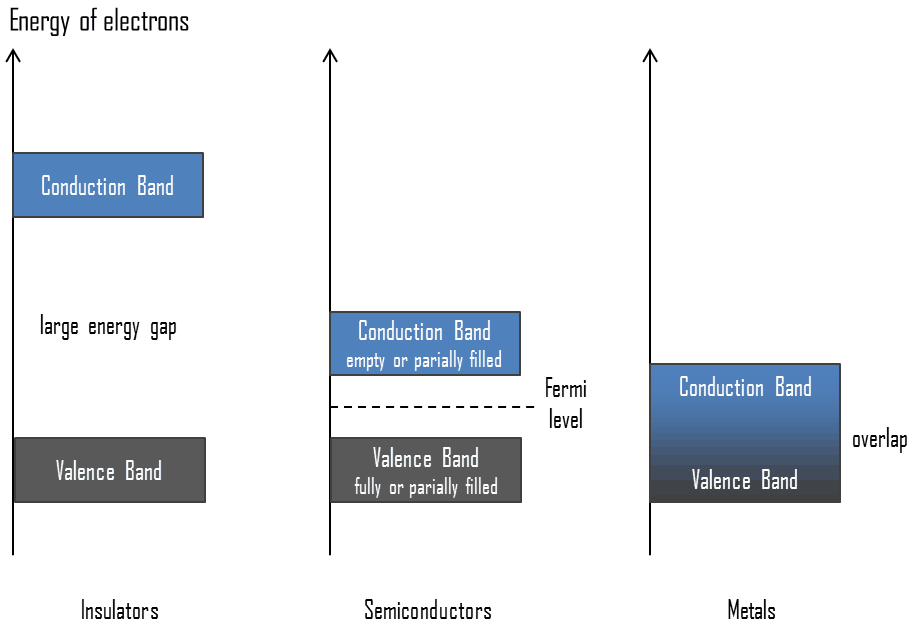
Semiconductors are materials, inorganic or organic, which have the ability to control their conduction depending on chemical structure, temperature, illumination, and presence of dopants. The name semiconductor comes from the fact that these materials  have an electrical conductivity between that of a metal, like copper, gold, etc. and an insulator, such as glass. They have an energy gap less than 4eV (about 1eV). In solid-state physics, this energy gap or band gap is an energy range between valence band and conduction band where electron states are forbidden. In contrast to conductors, electrons in a semiconductor must obtain energy (e.g. from ionizing radiation) to cross the band gap and to reach the conduction band.

To understand the difference between metals, semiconductors and electrical insulators, we have to define the following terms from solid-state physics:
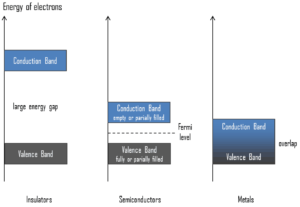
  • Valence Band - Conduction Band - Band GapValence Band. In solid-state physics, the valence band and conduction band are the bands closest to the Fermi level and thus determine the electrical conductivity of the solid. In electrical insulators and semiconductors, the valence band is the highest range of electron energies in which electrons are normally present at absolute zero temperature. For example, a silicon atom has fourteen electrons. In the ground state, they are arranged in the electron configuration [Ne]3s23p2. Of these, four are valence electrons, occupying the 3s orbital and two of the 3p orbitals. The distinction between the valence and conduction bands is meaningless in metals, because conduction occurs in one or more partially filled bands that take on the properties of both the valence and conduction bands.
  • Conduction Band. In solid-state physics, the valence band and conduction band are the bands closest to the Fermi level and thus determine the electrical conductivity of the solid. In electrical insulators and semiconductors, the conduction band is the lowest range of vacant electronic states. On a graph of the electronic band structure of a material, the valence band is located below the Fermi level, while the conduction band is located above it. In semiconductors, electrons may reach the conduction band, when they are excited, for example, by ionizing radiation (i.e. they must obtain energy higher than Egap). For example, diamond is a wide-band gap semiconductor (Egap = 5.47 eV) with high potential as an electronic device material in many devices. On the other side, germanium has a small band gap energy (Egap = 0.67 eV), which requires to operate the detector at cryogenic temperatures. The distinction between the valence and conduction bands is meaningless in metals, because conduction occurs in one or more partially filled bands that take on the properties of both the valence and conduction bands.
  • Band Gap. In solid-state physics, the energy gap or the band gap is an energy range between valence band and conduction band where electron states are forbidden. In contrast to conductors, electrons in a semiconductor must obtain energy (e.g. from ionizing radiation) to cross the band gap and to reach the conduction band. Band gaps are naturally different for different materials. For example, diamond is a wide-band gap semiconductor (Egap = 5.47 eV) with high potential as an electronic device material in many devices. On the other side, germanium has a small band gap energy (Egap = 0.67 eV), which requires to operate the detector at cryogenic temperatures.
  • Fermi Level. The term “Fermi level” comes from Fermi-Dirac statistics, which describes a distribution of particles over energy states in systems consisting of fermions (electrons) that obey the Pauli exclusion principle. Since they cannot exist in identical energy states, Fermi level is the term used to describe the top of the collection of electron energy levels at absolute zero temperature. The Fermi level is the surface of Fermi sea at absolute zero where no electrons will have enough energy to rise above the surface. In metals, the Fermi level lies in the hypothetical conduction band giving rise to free conduction electrons. In semiconductors the position of the Fermi level is within the band gap, approximately in the middle of the band gap.
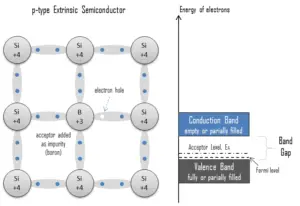
  • extrinsic - doped semiconductor - p-type - acceptorElectron-hole Pair. In the semiconductor, free charge carriers are electrons and electron holes(electron-hole pairs). Electrons and holes are created by excitation of electron from valence band to the conduction band. An electron hole (often simply called a hole) is the lack of an electron at a position where one could exist in an atom or atomic lattice. It is one of the two types of charge carriers that are responsible for creating electric current in semiconducting materials. Since in a normal atom or crystal lattice the negative charge of the electrons is balanced by the positive charge of the atomic nuclei, the absence of an electron leaves a net positive charge at the hole’s location. Positively charged holes can move from atom to atom in semiconducting materials as electrons leave their positions. When an electron meets with a hole, they recombine and these free carriers effectively vanish. The recombination means an electron which has been excited from the valence band to the conduction band falls back to the empty state in the valence band, known as the holes.
–
Boron – Electrical Resistivity and Electrical Conductivity

Periodic Table of Elements - electrical resistivity
1
H

Hydrogen


2
He

Helium


3
Li

Lithium

92.8 nΩ⋅m

4
Be

Beryllium

36 nΩ⋅m

5
B

Boron

1e15 nΩ⋅m

6
C

Carbon

7837 nΩ⋅m

7
N

Nitrogen


8
O

Oxygen


9
F

Fluorine


10
Ne

Neon


11
Na

Sodium

47.7 nΩ⋅m

12
Mg

Magnesium

43.9 nΩ⋅m

13
Al

Aluminium

26.5 nΩ⋅m

14
Si

Silicon

2.3e12 nΩ⋅m

15
P

Phosphorus


16
S

Sulfur

2e24 nΩ⋅m

17
Cl

Chlorine

1e10 nΩ⋅m

18
Ar

Argon


19
K

Potassium

72 nΩ⋅m

20
Ca

Calcium

33.6 nΩ⋅m

21
Sc

Scandium

562 nΩ⋅m

22
Ti

Titanium

420 nΩ⋅m

23
V

Vanadium

197 nΩ⋅m

24
Cr

Chromium

125 nΩ⋅m

25
Mn

Manganese

1440 nΩ⋅m

26
Fe

Iron

96.1 nΩ⋅m

27
Co

Cobalt

62.4 nΩ⋅m

28
Ni

Nickel

69.3 nΩ⋅m

29
Cu

Copper

16.8 nΩ⋅m

30
Zn

Zinc

59 nΩ⋅m

31
Ga

Gallium

270 nΩ⋅m

32
Ge

Germanium

1e9 nΩ⋅m

33
As

Arsenic

333 nΩ⋅m

34
Se

Selenium


35
Br

Bromine

8e19 nΩ⋅m

36
Kr

Krypton


37
Rb

Rubidium

128 nΩ⋅m

38
Sr

Strontium

132 nΩ⋅m

39
Y

Yttrium

596 nΩ⋅m

40
Zr

Zirconium

421 nΩ⋅m

41
Nb

Niobium

152 nΩ⋅m

42
Mo

Molybdenum

53.4 nΩ⋅m

43
Tc

Technetium

200 nΩ⋅m

44
Ru

Ruthenium

71 nΩ⋅m

45
Rh

Rhodium

43.3 nΩ⋅m

46
Pd

Palladium

105 nΩ⋅m

47
Ag

Silver

15.9 nΩ⋅m

48
Cd

Cadmium

72.7 nΩ⋅m

49
In

Indium

83.7 nΩ⋅m

50
Sn

Tin

115 nΩ⋅m

51
Sb

Antimony

417 nΩ⋅m

52
Te

Tellurium


53
I

Iodine

1e16 nΩ⋅m

54
Xe

Xenon


55
Cs

Caesium

205 nΩ⋅m

56
Ba

Barium

332 nΩ⋅m

57-71


Lanthanoids


72
Hf

Hafnium

331 nΩ⋅m

73
Ta

Tantalum

131 nΩ⋅m

74
W

Tungsten

52.8 nΩ⋅m

75
Re

Rhenium

193 nΩ⋅m

76
Os

Osmium

81.2 nΩ⋅m

77
Ir

Iridium

47 nΩ⋅m

78
Pt

Platinum

105 nΩ⋅m

79
Au

Gold

22.14 nΩ⋅m

80
Hg

Mercury

961 nΩ⋅m

81
Tl

Thallium

180 nΩ⋅m

82
Pb

Lead

208 nΩ⋅m

83
Bi

Bismuth

1290 nΩ⋅m

84
Po

Polonium

400 nΩ⋅m

85
At

Astatine


86
Rn

Radon


87
Fr

Francium


88
Ra

Radium

1000 nΩ⋅m

89-103


Actinoids


104
Rf

Rutherfordium


105
Db

Dubnium


106
Sg

Seaborgium


107
Bh

Bohrium


108
Hs

Hassium


109
Mt

Meitnerium


110
Ds

Darmstadtium


111
Rg

Roentgenium


112
Cn

Copernicium


113
Nh

Nihonium


114
Fl

Flerovium


115
Mc

Moscovium


116
Lv

Livermorium


117
Ts

Tennessine


118
Og

Oganesson


57
La

Lanthanum

615 nΩ⋅m

58
Ce

Cerium

828 nΩ⋅m

59
Pr

Praseodymium

700 nΩ⋅m

60
Nd

Neodymium

643 nΩ⋅m

61
Pm

Promethium

750 nΩ⋅m

62
Sm

Samarium

940 nΩ⋅m

63
Eu

Europium

900 nΩ⋅m

64
Gd

Gadolinium

1310 nΩ⋅m

65
Tb

Terbium

1150 nΩ⋅m

66
Dy

Dysprosium

926 nΩ⋅m

67
Ho

Holmium

814 nΩ⋅m

68
Er

Erbium

860 nΩ⋅m

69
Th

Thulium

676 nΩ⋅m

70
Yb

Ytterbium

250 nΩ⋅m

71
Lu

Lutetium

582 nΩ⋅m

89
Ac

Actinium


90
Th

Thorium

157 nΩ⋅m

91
Pa

Protactinium

177 nΩ⋅m

92
U

Uranium

280 nΩ⋅m

93
Np

Neptunium

1220 nΩ⋅m

94
Pu

Plutonium

1460 nΩ⋅m

95
Am

Americium

690 nΩ⋅m

96
Cm

Curium

1250 nΩ⋅m

97
Bk

Berkelium


98
Cf

Californium


99
Es

Einsteinium


100
Fm

Fermium


101
Md

Mendelevium


102
No

Nobelium


103
Lr

Lawrencium


Boron – Electrical Resistivity and Electrical Conductivity

Electrical resistivity of Boron is ~E15 nΩ·m.

Electrical resistivity and its converse, electrical conductivity, is a fundamental property of a material that quantifies how strongly it resists or conducts the flow of electric current. A low resistivity indicates a material that readily allows the flow of electric current. The symbol of resistivity is usually the Greek letter ρ (rho). The SI unit of electrical resistivity is the ohm-metre (Ω⋅m). Note that, electrical resistivity is not the same as electrical resistance. Electrical resistance is expressed in Ohms. While resistivity is a material property, resistance is the property of an object.

Conductors – Semiconductors – Resistors

Substances in which electricity can flow are called conductors. Conductors are made of high-conductivity materials such as metals, in particular copper and aluminium.

Insulators, on the other hand, are made of a wide variety of materials depending on factors such as the desired resistance.

Semiconductors are materials, inorganic or organic, which have the ability to control their conduction depending on chemical structure, temperature, illumination, and presence of dopants. The name semiconductor comes from the fact that these materials  have an electrical conductivity between that of a metal, like copper, gold, etc. and an insulator, such as glass. They have an energy gap less than 4eV (about 1eV). In solid-state physics, this energy gap or band gap is an energy range between valence band and conduction band where electron states are forbidden. In contrast to conductors, electrons in a semiconductor must obtain energy (e.g. from ionizing radiation) to cross the band gap and to reach the conduction band.

To understand the difference between metals, semiconductors and electrical insulators, we have to define the following terms from solid-state physics:

  • Valence Band - Conduction Band - Band GapValence Band. In solid-state physics, the valence band and conduction band are the bands closest to the Fermi level and thus determine the electrical conductivity of the solid. In electrical insulators and semiconductors, the valence band is the highest range of electron energies in which electrons are normally present at absolute zero temperature. For example, a silicon atom has fourteen electrons. In the ground state, they are arranged in the electron configuration [Ne]3s23p2. Of these, four are valence electrons, occupying the 3s orbital and two of the 3p orbitals. The distinction between the valence and conduction bands is meaningless in metals, because conduction occurs in one or more partially filled bands that take on the properties of both the valence and conduction bands.
  • Conduction Band. In solid-state physics, the valence band and conduction band are the bands closest to the Fermi level and thus determine the electrical conductivity of the solid. In electrical insulators and semiconductors, the conduction band is the lowest range of vacant electronic states. On a graph of the electronic band structure of a material, the valence band is located below the Fermi level, while the conduction band is located above it. In semiconductors, electrons may reach the conduction band, when they are excited, for example, by ionizing radiation (i.e. they must obtain energy higher than Egap). For example, diamond is a wide-band gap semiconductor (Egap = 5.47 eV) with high potential as an electronic device material in many devices. On the other side, germanium has a small band gap energy (Egap = 0.67 eV), which requires to operate the detector at cryogenic temperatures. The distinction between the valence and conduction bands is meaningless in metals, because conduction occurs in one or more partially filled bands that take on the properties of both the valence and conduction bands.
  • Band Gap. In solid-state physics, the energy gap or the band gap is an energy range between valence band and conduction band where electron states are forbidden. In contrast to conductors, electrons in a semiconductor must obtain energy (e.g. from ionizing radiation) to cross the band gap and to reach the conduction band. Band gaps are naturally different for different materials. For example, diamond is a wide-band gap semiconductor (Egap = 5.47 eV) with high potential as an electronic device material in many devices. On the other side, germanium has a small band gap energy (Egap = 0.67 eV), which requires to operate the detector at cryogenic temperatures.
  • Fermi Level. The term “Fermi level” comes from Fermi-Dirac statistics, which describes a distribution of particles over energy states in systems consisting of fermions (electrons) that obey the Pauli exclusion principle. Since they cannot exist in identical energy states, Fermi level is the term used to describe the top of the collection of electron energy levels at absolute zero temperature. The Fermi level is the surface of Fermi sea at absolute zero where no electrons will have enough energy to rise above the surface. In metals, the Fermi level lies in the hypothetical conduction band giving rise to free conduction electrons. In semiconductors the position of the Fermi level is within the band gap, approximately in the middle of the band gap.
  • extrinsic - doped semiconductor - p-type - acceptorElectron-hole Pair. In the semiconductor, free charge carriers are electrons and electron holes(electron-hole pairs). Electrons and holes are created by excitation of electron from valence band to the conduction band. An electron hole (often simply called a hole) is the lack of an electron at a position where one could exist in an atom or atomic lattice. It is one of the two types of charge carriers that are responsible for creating electric current in semiconducting materials. Since in a normal atom or crystal lattice the negative charge of the electrons is balanced by the positive charge of the atomic nuclei, the absence of an electron leaves a net positive charge at the hole’s location. Positively charged holes can move from atom to atom in semiconducting materials as electrons leave their positions. When an electron meets with a hole, they recombine and these free carriers effectively vanish. The recombination means an electron which has been excited from the valence band to the conduction band falls back to the empty state in the valence band, known as the holes.

–

Beryllium – Electrical Resistivity and Electrical Conductivity

Periodic Table of Elements - electrical resistivity
1
H

Hydrogen


2
He

Helium


3
Li

Lithium

92.8 nΩ⋅m

4
Be

Beryllium

36 nΩ⋅m

5
B

Boron

1e15 nΩ⋅m

6
C

Carbon

7837 nΩ⋅m

7
N

Nitrogen


8
O

Oxygen


9
F

Fluorine


10
Ne

Neon


11
Na

Sodium

47.7 nΩ⋅m

12
Mg

Magnesium

43.9 nΩ⋅m

13
Al

Aluminium

26.5 nΩ⋅m

14
Si

Silicon

2.3e12 nΩ⋅m

15
P

Phosphorus


16
S

Sulfur

2e24 nΩ⋅m

17
Cl

Chlorine

1e10 nΩ⋅m

18
Ar

Argon


19
K

Potassium

72 nΩ⋅m

20
Ca

Calcium

33.6 nΩ⋅m

21
Sc

Scandium

562 nΩ⋅m

22
Ti

Titanium

420 nΩ⋅m

23
V

Vanadium

197 nΩ⋅m

24
Cr

Chromium

125 nΩ⋅m

25
Mn

Manganese

1440 nΩ⋅m

26
Fe

Iron

96.1 nΩ⋅m

27
Co

Cobalt

62.4 nΩ⋅m

28
Ni

Nickel

69.3 nΩ⋅m

29
Cu

Copper

16.8 nΩ⋅m

30
Zn

Zinc

59 nΩ⋅m

31
Ga

Gallium

270 nΩ⋅m

32
Ge

Germanium

1e9 nΩ⋅m

33
As

Arsenic

333 nΩ⋅m

34
Se

Selenium


35
Br

Bromine

8e19 nΩ⋅m

36
Kr

Krypton


37
Rb

Rubidium

128 nΩ⋅m

38
Sr

Strontium

132 nΩ⋅m

39
Y

Yttrium

596 nΩ⋅m

40
Zr

Zirconium

421 nΩ⋅m

41
Nb

Niobium

152 nΩ⋅m

42
Mo

Molybdenum

53.4 nΩ⋅m

43
Tc

Technetium

200 nΩ⋅m

44
Ru

Ruthenium

71 nΩ⋅m

45
Rh

Rhodium

43.3 nΩ⋅m

46
Pd

Palladium

105 nΩ⋅m

47
Ag

Silver

15.9 nΩ⋅m

48
Cd

Cadmium

72.7 nΩ⋅m

49
In

Indium

83.7 nΩ⋅m

50
Sn

Tin

115 nΩ⋅m

51
Sb

Antimony

417 nΩ⋅m

52
Te

Tellurium


53
I

Iodine

1e16 nΩ⋅m

54
Xe

Xenon


55
Cs

Caesium

205 nΩ⋅m

56
Ba

Barium

332 nΩ⋅m

57-71


Lanthanoids


72
Hf

Hafnium

331 nΩ⋅m

73
Ta

Tantalum

131 nΩ⋅m

74
W

Tungsten

52.8 nΩ⋅m

75
Re

Rhenium

193 nΩ⋅m

76
Os

Osmium

81.2 nΩ⋅m

77
Ir

Iridium

47 nΩ⋅m

78
Pt

Platinum

105 nΩ⋅m

79
Au

Gold

22.14 nΩ⋅m

80
Hg

Mercury

961 nΩ⋅m

81
Tl

Thallium

180 nΩ⋅m

82
Pb

Lead

208 nΩ⋅m

83
Bi

Bismuth

1290 nΩ⋅m

84
Po

Polonium

400 nΩ⋅m

85
At

Astatine


86
Rn

Radon


87
Fr

Francium


88
Ra

Radium

1000 nΩ⋅m

89-103


Actinoids


104
Rf

Rutherfordium


105
Db

Dubnium


106
Sg

Seaborgium


107
Bh

Bohrium


108
Hs

Hassium


109
Mt

Meitnerium


110
Ds

Darmstadtium


111
Rg

Roentgenium


112
Cn

Copernicium


113
Nh

Nihonium


114
Fl

Flerovium


115
Mc

Moscovium


116
Lv

Livermorium


117
Ts

Tennessine


118
Og

Oganesson


57
La

Lanthanum

615 nΩ⋅m

58
Ce

Cerium

828 nΩ⋅m

59
Pr

Praseodymium

700 nΩ⋅m

60
Nd

Neodymium

643 nΩ⋅m

61
Pm

Promethium

750 nΩ⋅m

62
Sm

Samarium

940 nΩ⋅m

63
Eu

Europium

900 nΩ⋅m

64
Gd

Gadolinium

1310 nΩ⋅m

65
Tb

Terbium

1150 nΩ⋅m

66
Dy

Dysprosium

926 nΩ⋅m

67
Ho

Holmium

814 nΩ⋅m

68
Er

Erbium

860 nΩ⋅m

69
Th

Thulium

676 nΩ⋅m

70
Yb

Ytterbium

250 nΩ⋅m

71
Lu

Lutetium

582 nΩ⋅m

89
Ac

Actinium


90
Th

Thorium

157 nΩ⋅m

91
Pa

Protactinium

177 nΩ⋅m

92
U

Uranium

280 nΩ⋅m

93
Np

Neptunium

1220 nΩ⋅m

94
Pu

Plutonium

1460 nΩ⋅m

95
Am

Americium

690 nΩ⋅m

96
Cm

Curium

1250 nΩ⋅m

97
Bk

Berkelium


98
Cf

Californium


99
Es

Einsteinium


100
Fm

Fermium


101
Md

Mendelevium


102
No

Nobelium


103
Lr

Lawrencium


Beryllium – Electrical Resistivity and Electrical Conductivity

Electrical resistivity of Beryllium is 36 nΩ·m.

Electrical resistivity and its converse, electrical conductivity, is a fundamental property of a material that quantifies how strongly it resists or conducts the flow of electric current. A low resistivity indicates a material that readily allows the flow of electric current. The symbol of resistivity is usually the Greek letter ρ (rho). The SI unit of electrical resistivity is the ohm-metre (Ω⋅m). Note that, electrical resistivity is not the same as electrical resistance. Electrical resistance is expressed in Ohms. While resistivity is a material property, resistance is the property of an object.

Conductors – Semiconductors – Resistors

Substances in which electricity can flow are called conductors. Conductors are made of high-conductivity materials such as metals, in particular copper and aluminium.

Insulators, on the other hand, are made of a wide variety of materials depending on factors such as the desired resistance.

Semiconductors are materials, inorganic or organic, which have the ability to control their conduction depending on chemical structure, temperature, illumination, and presence of dopants. The name semiconductor comes from the fact that these materials  have an electrical conductivity between that of a metal, like copper, gold, etc. and an insulator, such as glass. They have an energy gap less than 4eV (about 1eV). In solid-state physics, this energy gap or band gap is an energy range between valence band and conduction band where electron states are forbidden. In contrast to conductors, electrons in a semiconductor must obtain energy (e.g. from ionizing radiation) to cross the band gap and to reach the conduction band.

To understand the difference between metals, semiconductors and electrical insulators, we have to define the following terms from solid-state physics:

  • Valence Band - Conduction Band - Band GapValence Band. In solid-state physics, the valence band and conduction band are the bands closest to the Fermi level and thus determine the electrical conductivity of the solid. In electrical insulators and semiconductors, the valence band is the highest range of electron energies in which electrons are normally present at absolute zero temperature. For example, a silicon atom has fourteen electrons. In the ground state, they are arranged in the electron configuration [Ne]3s23p2. Of these, four are valence electrons, occupying the 3s orbital and two of the 3p orbitals. The distinction between the valence and conduction bands is meaningless in metals, because conduction occurs in one or more partially filled bands that take on the properties of both the valence and conduction bands.
  • Conduction Band. In solid-state physics, the valence band and conduction band are the bands closest to the Fermi level and thus determine the electrical conductivity of the solid. In electrical insulators and semiconductors, the conduction band is the lowest range of vacant electronic states. On a graph of the electronic band structure of a material, the valence band is located below the Fermi level, while the conduction band is located above it. In semiconductors, electrons may reach the conduction band, when they are excited, for example, by ionizing radiation (i.e. they must obtain energy higher than Egap). For example, diamond is a wide-band gap semiconductor (Egap = 5.47 eV) with high potential as an electronic device material in many devices. On the other side, germanium has a small band gap energy (Egap = 0.67 eV), which requires to operate the detector at cryogenic temperatures. The distinction between the valence and conduction bands is meaningless in metals, because conduction occurs in one or more partially filled bands that take on the properties of both the valence and conduction bands.
  • Band Gap. In solid-state physics, the energy gap or the band gap is an energy range between valence band and conduction band where electron states are forbidden. In contrast to conductors, electrons in a semiconductor must obtain energy (e.g. from ionizing radiation) to cross the band gap and to reach the conduction band. Band gaps are naturally different for different materials. For example, diamond is a wide-band gap semiconductor (Egap = 5.47 eV) with high potential as an electronic device material in many devices. On the other side, germanium has a small band gap energy (Egap = 0.67 eV), which requires to operate the detector at cryogenic temperatures.
  • Fermi Level. The term “Fermi level” comes from Fermi-Dirac statistics, which describes a distribution of particles over energy states in systems consisting of fermions (electrons) that obey the Pauli exclusion principle. Since they cannot exist in identical energy states, Fermi level is the term used to describe the top of the collection of electron energy levels at absolute zero temperature. The Fermi level is the surface of Fermi sea at absolute zero where no electrons will have enough energy to rise above the surface. In metals, the Fermi level lies in the hypothetical conduction band giving rise to free conduction electrons. In semiconductors the position of the Fermi level is within the band gap, approximately in the middle of the band gap.
  • extrinsic - doped semiconductor - p-type - acceptorElectron-hole Pair. In the semiconductor, free charge carriers are electrons and electron holes(electron-hole pairs). Electrons and holes are created by excitation of electron from valence band to the conduction band. An electron hole (often simply called a hole) is the lack of an electron at a position where one could exist in an atom or atomic lattice. It is one of the two types of charge carriers that are responsible for creating electric current in semiconducting materials. Since in a normal atom or crystal lattice the negative charge of the electrons is balanced by the positive charge of the atomic nuclei, the absence of an electron leaves a net positive charge at the hole’s location. Positively charged holes can move from atom to atom in semiconducting materials as electrons leave their positions. When an electron meets with a hole, they recombine and these free carriers effectively vanish. The recombination means an electron which has been excited from the valence band to the conduction band falls back to the empty state in the valence band, known as the holes.

–

Lithium – Electrical Resistivity and Electrical Conductivity

Periodic Table of Elements - electrical resistivity
1
H

Hydrogen


2
He

Helium


3
Li

Lithium

92.8 nΩ⋅m

4
Be

Beryllium

36 nΩ⋅m

5
B

Boron

1e15 nΩ⋅m

6
C

Carbon

7837 nΩ⋅m

7
N

Nitrogen


8
O

Oxygen


9
F

Fluorine


10
Ne

Neon


11
Na

Sodium

47.7 nΩ⋅m

12
Mg

Magnesium

43.9 nΩ⋅m

13
Al

Aluminium

26.5 nΩ⋅m

14
Si

Silicon

2.3e12 nΩ⋅m

15
P

Phosphorus


16
S

Sulfur

2e24 nΩ⋅m

17
Cl

Chlorine

1e10 nΩ⋅m

18
Ar

Argon


19
K

Potassium

72 nΩ⋅m

20
Ca

Calcium

33.6 nΩ⋅m

21
Sc

Scandium

562 nΩ⋅m

22
Ti

Titanium

420 nΩ⋅m

23
V

Vanadium

197 nΩ⋅m

24
Cr

Chromium

125 nΩ⋅m

25
Mn

Manganese

1440 nΩ⋅m

26
Fe

Iron

96.1 nΩ⋅m

27
Co

Cobalt

62.4 nΩ⋅m

28
Ni

Nickel

69.3 nΩ⋅m

29
Cu

Copper

16.8 nΩ⋅m

30
Zn

Zinc

59 nΩ⋅m

31
Ga

Gallium

270 nΩ⋅m

32
Ge

Germanium

1e9 nΩ⋅m

33
As

Arsenic

333 nΩ⋅m

34
Se

Selenium


35
Br

Bromine

8e19 nΩ⋅m

36
Kr

Krypton


37
Rb

Rubidium

128 nΩ⋅m

38
Sr

Strontium

132 nΩ⋅m

39
Y

Yttrium

596 nΩ⋅m

40
Zr

Zirconium

421 nΩ⋅m

41
Nb

Niobium

152 nΩ⋅m

42
Mo

Molybdenum

53.4 nΩ⋅m

43
Tc

Technetium

200 nΩ⋅m

44
Ru

Ruthenium

71 nΩ⋅m

45
Rh

Rhodium

43.3 nΩ⋅m

46
Pd

Palladium

105 nΩ⋅m

47
Ag

Silver

15.9 nΩ⋅m

48
Cd

Cadmium

72.7 nΩ⋅m

49
In

Indium

83.7 nΩ⋅m

50
Sn

Tin

115 nΩ⋅m

51
Sb

Antimony

417 nΩ⋅m

52
Te

Tellurium


53
I

Iodine

1e16 nΩ⋅m

54
Xe

Xenon


55
Cs

Caesium

205 nΩ⋅m

56
Ba

Barium

332 nΩ⋅m

57-71


Lanthanoids


72
Hf

Hafnium

331 nΩ⋅m

73
Ta

Tantalum

131 nΩ⋅m

74
W

Tungsten

52.8 nΩ⋅m

75
Re

Rhenium

193 nΩ⋅m

76
Os

Osmium

81.2 nΩ⋅m

77
Ir

Iridium

47 nΩ⋅m

78
Pt

Platinum

105 nΩ⋅m

79
Au

Gold

22.14 nΩ⋅m

80
Hg

Mercury

961 nΩ⋅m

81
Tl

Thallium

180 nΩ⋅m

82
Pb

Lead

208 nΩ⋅m

83
Bi

Bismuth

1290 nΩ⋅m

84
Po

Polonium

400 nΩ⋅m

85
At

Astatine


86
Rn

Radon


87
Fr

Francium


88
Ra

Radium

1000 nΩ⋅m

89-103


Actinoids


104
Rf

Rutherfordium


105
Db

Dubnium


106
Sg

Seaborgium


107
Bh

Bohrium


108
Hs

Hassium


109
Mt

Meitnerium


110
Ds

Darmstadtium


111
Rg

Roentgenium


112
Cn

Copernicium


113
Nh

Nihonium


114
Fl

Flerovium


115
Mc

Moscovium


116
Lv

Livermorium


117
Ts

Tennessine


118
Og

Oganesson


57
La

Lanthanum

615 nΩ⋅m

58
Ce

Cerium

828 nΩ⋅m

59
Pr

Praseodymium

700 nΩ⋅m

60
Nd

Neodymium

643 nΩ⋅m

61
Pm

Promethium

750 nΩ⋅m

62
Sm

Samarium

940 nΩ⋅m

63
Eu

Europium

900 nΩ⋅m

64
Gd

Gadolinium

1310 nΩ⋅m

65
Tb

Terbium

1150 nΩ⋅m

66
Dy

Dysprosium

926 nΩ⋅m

67
Ho

Holmium

814 nΩ⋅m

68
Er

Erbium

860 nΩ⋅m

69
Th

Thulium

676 nΩ⋅m

70
Yb

Ytterbium

250 nΩ⋅m

71
Lu

Lutetium

582 nΩ⋅m

89
Ac

Actinium


90
Th

Thorium

157 nΩ⋅m

91
Pa

Protactinium

177 nΩ⋅m

92
U

Uranium

280 nΩ⋅m

93
Np

Neptunium

1220 nΩ⋅m

94
Pu

Plutonium

1460 nΩ⋅m

95
Am

Americium

690 nΩ⋅m

96
Cm

Curium

1250 nΩ⋅m

97
Bk

Berkelium


98
Cf

Californium


99
Es

Einsteinium


100
Fm

Fermium


101
Md

Mendelevium


102
No

Nobelium


103
Lr

Lawrencium


Lithium – Electrical Resistivity and Electrical Conductivity

Electrical resistivity of Lithium is 92.8 nΩ·m.

Electrical resistivity and its converse, electrical conductivity, is a fundamental property of a material that quantifies how strongly it resists or conducts the flow of electric current. A low resistivity indicates a material that readily allows the flow of electric current. The symbol of resistivity is usually the Greek letter ρ (rho). The SI unit of electrical resistivity is the ohm-metre (Ω⋅m). Note that, electrical resistivity is not the same as electrical resistance. Electrical resistance is expressed in Ohms. While resistivity is a material property, resistance is the property of an object.

Conductors – Semiconductors – Resistors

Substances in which electricity can flow are called conductors. Conductors are made of high-conductivity materials such as metals, in particular copper and aluminium.

Insulators, on the other hand, are made of a wide variety of materials depending on factors such as the desired resistance.

Semiconductors are materials, inorganic or organic, which have the ability to control their conduction depending on chemical structure, temperature, illumination, and presence of dopants. The name semiconductor comes from the fact that these materials  have an electrical conductivity between that of a metal, like copper, gold, etc. and an insulator, such as glass. They have an energy gap less than 4eV (about 1eV). In solid-state physics, this energy gap or band gap is an energy range between valence band and conduction band where electron states are forbidden. In contrast to conductors, electrons in a semiconductor must obtain energy (e.g. from ionizing radiation) to cross the band gap and to reach the conduction band.

To understand the difference between metals, semiconductors and electrical insulators, we have to define the following terms from solid-state physics:

  • Valence Band - Conduction Band - Band GapValence Band. In solid-state physics, the valence band and conduction band are the bands closest to the Fermi level and thus determine the electrical conductivity of the solid. In electrical insulators and semiconductors, the valence band is the highest range of electron energies in which electrons are normally present at absolute zero temperature. For example, a silicon atom has fourteen electrons. In the ground state, they are arranged in the electron configuration [Ne]3s23p2. Of these, four are valence electrons, occupying the 3s orbital and two of the 3p orbitals. The distinction between the valence and conduction bands is meaningless in metals, because conduction occurs in one or more partially filled bands that take on the properties of both the valence and conduction bands.
  • Conduction Band. In solid-state physics, the valence band and conduction band are the bands closest to the Fermi level and thus determine the electrical conductivity of the solid. In electrical insulators and semiconductors, the conduction band is the lowest range of vacant electronic states. On a graph of the electronic band structure of a material, the valence band is located below the Fermi level, while the conduction band is located above it. In semiconductors, electrons may reach the conduction band, when they are excited, for example, by ionizing radiation (i.e. they must obtain energy higher than Egap). For example, diamond is a wide-band gap semiconductor (Egap = 5.47 eV) with high potential as an electronic device material in many devices. On the other side, germanium has a small band gap energy (Egap = 0.67 eV), which requires to operate the detector at cryogenic temperatures. The distinction between the valence and conduction bands is meaningless in metals, because conduction occurs in one or more partially filled bands that take on the properties of both the valence and conduction bands.
  • Band Gap. In solid-state physics, the energy gap or the band gap is an energy range between valence band and conduction band where electron states are forbidden. In contrast to conductors, electrons in a semiconductor must obtain energy (e.g. from ionizing radiation) to cross the band gap and to reach the conduction band. Band gaps are naturally different for different materials. For example, diamond is a wide-band gap semiconductor (Egap = 5.47 eV) with high potential as an electronic device material in many devices. On the other side, germanium has a small band gap energy (Egap = 0.67 eV), which requires to operate the detector at cryogenic temperatures.
  • Fermi Level. The term “Fermi level” comes from Fermi-Dirac statistics, which describes a distribution of particles over energy states in systems consisting of fermions (electrons) that obey the Pauli exclusion principle. Since they cannot exist in identical energy states, Fermi level is the term used to describe the top of the collection of electron energy levels at absolute zero temperature. The Fermi level is the surface of Fermi sea at absolute zero where no electrons will have enough energy to rise above the surface. In metals, the Fermi level lies in the hypothetical conduction band giving rise to free conduction electrons. In semiconductors the position of the Fermi level is within the band gap, approximately in the middle of the band gap.
  • extrinsic - doped semiconductor - p-type - acceptorElectron-hole Pair. In the semiconductor, free charge carriers are electrons and electron holes(electron-hole pairs). Electrons and holes are created by excitation of electron from valence band to the conduction band. An electron hole (often simply called a hole) is the lack of an electron at a position where one could exist in an atom or atomic lattice. It is one of the two types of charge carriers that are responsible for creating electric current in semiconducting materials. Since in a normal atom or crystal lattice the negative charge of the electrons is balanced by the positive charge of the atomic nuclei, the absence of an electron leaves a net positive charge at the hole’s location. Positively charged holes can move from atom to atom in semiconducting materials as electrons leave their positions. When an electron meets with a hole, they recombine and these free carriers effectively vanish. The recombination means an electron which has been excited from the valence band to the conduction band falls back to the empty state in the valence band, known as the holes.

–

Helium – Electrical Resistivity and Electrical Conductivity

Periodic Table of Elements - electrical resistivity
1
H

Hydrogen


2
He

Helium


3
Li

Lithium

92.8 nΩ⋅m

4
Be

Beryllium

36 nΩ⋅m

5
B

Boron

1e15 nΩ⋅m

6
C

Carbon

7837 nΩ⋅m

7
N

Nitrogen


8
O

Oxygen


9
F

Fluorine


10
Ne

Neon


11
Na

Sodium

47.7 nΩ⋅m

12
Mg

Magnesium

43.9 nΩ⋅m

13
Al

Aluminium

26.5 nΩ⋅m

14
Si

Silicon

2.3e12 nΩ⋅m

15
P

Phosphorus


16
S

Sulfur

2e24 nΩ⋅m

17
Cl

Chlorine

1e10 nΩ⋅m

18
Ar

Argon


19
K

Potassium

72 nΩ⋅m

20
Ca

Calcium

33.6 nΩ⋅m

21
Sc

Scandium

562 nΩ⋅m

22
Ti

Titanium

420 nΩ⋅m

23
V

Vanadium

197 nΩ⋅m

24
Cr

Chromium

125 nΩ⋅m

25
Mn

Manganese

1440 nΩ⋅m

26
Fe

Iron

96.1 nΩ⋅m

27
Co

Cobalt

62.4 nΩ⋅m

28
Ni

Nickel

69.3 nΩ⋅m

29
Cu

Copper

16.8 nΩ⋅m

30
Zn

Zinc

59 nΩ⋅m

31
Ga

Gallium

270 nΩ⋅m

32
Ge

Germanium

1e9 nΩ⋅m

33
As

Arsenic

333 nΩ⋅m

34
Se

Selenium


35
Br

Bromine

8e19 nΩ⋅m

36
Kr

Krypton


37
Rb

Rubidium

128 nΩ⋅m

38
Sr

Strontium

132 nΩ⋅m

39
Y

Yttrium

596 nΩ⋅m

40
Zr

Zirconium

421 nΩ⋅m

41
Nb

Niobium

152 nΩ⋅m

42
Mo

Molybdenum

53.4 nΩ⋅m

43
Tc

Technetium

200 nΩ⋅m

44
Ru

Ruthenium

71 nΩ⋅m

45
Rh

Rhodium

43.3 nΩ⋅m

46
Pd

Palladium

105 nΩ⋅m

47
Ag

Silver

15.9 nΩ⋅m

48
Cd

Cadmium

72.7 nΩ⋅m

49
In

Indium

83.7 nΩ⋅m

50
Sn

Tin

115 nΩ⋅m

51
Sb

Antimony

417 nΩ⋅m

52
Te

Tellurium


53
I

Iodine

1e16 nΩ⋅m

54
Xe

Xenon


55
Cs

Caesium

205 nΩ⋅m

56
Ba

Barium

332 nΩ⋅m

57-71


Lanthanoids


72
Hf

Hafnium

331 nΩ⋅m

73
Ta

Tantalum

131 nΩ⋅m

74
W

Tungsten

52.8 nΩ⋅m

75
Re

Rhenium

193 nΩ⋅m

76
Os

Osmium

81.2 nΩ⋅m

77
Ir

Iridium

47 nΩ⋅m

78
Pt

Platinum

105 nΩ⋅m

79
Au

Gold

22.14 nΩ⋅m

80
Hg

Mercury

961 nΩ⋅m

81
Tl

Thallium

180 nΩ⋅m

82
Pb

Lead

208 nΩ⋅m

83
Bi

Bismuth

1290 nΩ⋅m

84
Po

Polonium

400 nΩ⋅m

85
At

Astatine


86
Rn

Radon


87
Fr

Francium


88
Ra

Radium

1000 nΩ⋅m

89-103


Actinoids


104
Rf

Rutherfordium


105
Db

Dubnium


106
Sg

Seaborgium


107
Bh

Bohrium


108
Hs

Hassium


109
Mt

Meitnerium


110
Ds

Darmstadtium


111
Rg

Roentgenium


112
Cn

Copernicium


113
Nh

Nihonium


114
Fl

Flerovium


115
Mc

Moscovium


116
Lv

Livermorium


117
Ts

Tennessine


118
Og

Oganesson


57
La

Lanthanum

615 nΩ⋅m

58
Ce

Cerium

828 nΩ⋅m

59
Pr

Praseodymium

700 nΩ⋅m

60
Nd

Neodymium

643 nΩ⋅m

61
Pm

Promethium

750 nΩ⋅m

62
Sm

Samarium

940 nΩ⋅m

63
Eu

Europium

900 nΩ⋅m

64
Gd

Gadolinium

1310 nΩ⋅m

65
Tb

Terbium

1150 nΩ⋅m

66
Dy

Dysprosium

926 nΩ⋅m

67
Ho

Holmium

814 nΩ⋅m

68
Er

Erbium

860 nΩ⋅m

69
Th

Thulium

676 nΩ⋅m

70
Yb

Ytterbium

250 nΩ⋅m

71
Lu

Lutetium

582 nΩ⋅m

89
Ac

Actinium


90
Th

Thorium

157 nΩ⋅m

91
Pa

Protactinium

177 nΩ⋅m

92
U

Uranium

280 nΩ⋅m

93
Np

Neptunium

1220 nΩ⋅m

94
Pu

Plutonium

1460 nΩ⋅m

95
Am

Americium

690 nΩ⋅m

96
Cm

Curium

1250 nΩ⋅m

97
Bk

Berkelium


98
Cf

Californium


99
Es

Einsteinium


100
Fm

Fermium


101
Md

Mendelevium


102
No

Nobelium


103
Lr

Lawrencium


Helium – Electrical Resistivity and Electrical Conductivity

Electrical resistivity of Helium is — nΩ·m.

Electrical resistivity and its converse, electrical conductivity, is a fundamental property of a material that quantifies how strongly it resists or conducts the flow of electric current. A low resistivity indicates a material that readily allows the flow of electric current. The symbol of resistivity is usually the Greek letter ρ (rho). The SI unit of electrical resistivity is the ohm-metre (Ω⋅m). Note that, electrical resistivity is not the same as electrical resistance. Electrical resistance is expressed in Ohms. While resistivity is a material property, resistance is the property of an object.

Conductors – Semiconductors – Resistors

Substances in which electricity can flow are called conductors. Conductors are made of high-conductivity materials such as metals, in particular copper and aluminium.

Insulators, on the other hand, are made of a wide variety of materials depending on factors such as the desired resistance.

Semiconductors are materials, inorganic or organic, which have the ability to control their conduction depending on chemical structure, temperature, illumination, and presence of dopants. The name semiconductor comes from the fact that these materials  have an electrical conductivity between that of a metal, like copper, gold, etc. and an insulator, such as glass. They have an energy gap less than 4eV (about 1eV). In solid-state physics, this energy gap or band gap is an energy range between valence band and conduction band where electron states are forbidden. In contrast to conductors, electrons in a semiconductor must obtain energy (e.g. from ionizing radiation) to cross the band gap and to reach the conduction band.

To understand the difference between metals, semiconductors and electrical insulators, we have to define the following terms from solid-state physics:

  • Valence Band - Conduction Band - Band GapValence Band. In solid-state physics, the valence band and conduction band are the bands closest to the Fermi level and thus determine the electrical conductivity of the solid. In electrical insulators and semiconductors, the valence band is the highest range of electron energies in which electrons are normally present at absolute zero temperature. For example, a silicon atom has fourteen electrons. In the ground state, they are arranged in the electron configuration [Ne]3s23p2. Of these, four are valence electrons, occupying the 3s orbital and two of the 3p orbitals. The distinction between the valence and conduction bands is meaningless in metals, because conduction occurs in one or more partially filled bands that take on the properties of both the valence and conduction bands.
  • Conduction Band. In solid-state physics, the valence band and conduction band are the bands closest to the Fermi level and thus determine the electrical conductivity of the solid. In electrical insulators and semiconductors, the conduction band is the lowest range of vacant electronic states. On a graph of the electronic band structure of a material, the valence band is located below the Fermi level, while the conduction band is located above it. In semiconductors, electrons may reach the conduction band, when they are excited, for example, by ionizing radiation (i.e. they must obtain energy higher than Egap). For example, diamond is a wide-band gap semiconductor (Egap = 5.47 eV) with high potential as an electronic device material in many devices. On the other side, germanium has a small band gap energy (Egap = 0.67 eV), which requires to operate the detector at cryogenic temperatures. The distinction between the valence and conduction bands is meaningless in metals, because conduction occurs in one or more partially filled bands that take on the properties of both the valence and conduction bands.
  • Band Gap. In solid-state physics, the energy gap or the band gap is an energy range between valence band and conduction band where electron states are forbidden. In contrast to conductors, electrons in a semiconductor must obtain energy (e.g. from ionizing radiation) to cross the band gap and to reach the conduction band. Band gaps are naturally different for different materials. For example, diamond is a wide-band gap semiconductor (Egap = 5.47 eV) with high potential as an electronic device material in many devices. On the other side, germanium has a small band gap energy (Egap = 0.67 eV), which requires to operate the detector at cryogenic temperatures.
  • Fermi Level. The term “Fermi level” comes from Fermi-Dirac statistics, which describes a distribution of particles over energy states in systems consisting of fermions (electrons) that obey the Pauli exclusion principle. Since they cannot exist in identical energy states, Fermi level is the term used to describe the top of the collection of electron energy levels at absolute zero temperature. The Fermi level is the surface of Fermi sea at absolute zero where no electrons will have enough energy to rise above the surface. In metals, the Fermi level lies in the hypothetical conduction band giving rise to free conduction electrons. In semiconductors the position of the Fermi level is within the band gap, approximately in the middle of the band gap.
  • extrinsic - doped semiconductor - p-type - acceptorElectron-hole Pair. In the semiconductor, free charge carriers are electrons and electron holes(electron-hole pairs). Electrons and holes are created by excitation of electron from valence band to the conduction band. An electron hole (often simply called a hole) is the lack of an electron at a position where one could exist in an atom or atomic lattice. It is one of the two types of charge carriers that are responsible for creating electric current in semiconducting materials. Since in a normal atom or crystal lattice the negative charge of the electrons is balanced by the positive charge of the atomic nuclei, the absence of an electron leaves a net positive charge at the hole’s location. Positively charged holes can move from atom to atom in semiconducting materials as electrons leave their positions. When an electron meets with a hole, they recombine and these free carriers effectively vanish. The recombination means an electron which has been excited from the valence band to the conduction band falls back to the empty state in the valence band, known as the holes.

–

Hydrogen – Electrical Resistivity and Electrical Conductivity

Periodic Table of Elements - electrical resistivity
1
H

Hydrogen


2
He

Helium


3
Li

Lithium

92.8 nΩ⋅m

4
Be

Beryllium

36 nΩ⋅m

5
B

Boron

1e15 nΩ⋅m

6
C

Carbon

7837 nΩ⋅m

7
N

Nitrogen


8
O

Oxygen


9
F

Fluorine


10
Ne

Neon


11
Na

Sodium

47.7 nΩ⋅m

12
Mg

Magnesium

43.9 nΩ⋅m

13
Al

Aluminium

26.5 nΩ⋅m

14
Si

Silicon

2.3e12 nΩ⋅m

15
P

Phosphorus


16
S

Sulfur

2e24 nΩ⋅m

17
Cl

Chlorine

1e10 nΩ⋅m

18
Ar

Argon


19
K

Potassium

72 nΩ⋅m

20
Ca

Calcium

33.6 nΩ⋅m

21
Sc

Scandium

562 nΩ⋅m

22
Ti

Titanium

420 nΩ⋅m

23
V

Vanadium

197 nΩ⋅m

24
Cr

Chromium

125 nΩ⋅m

25
Mn

Manganese

1440 nΩ⋅m

26
Fe

Iron

96.1 nΩ⋅m

27
Co

Cobalt

62.4 nΩ⋅m

28
Ni

Nickel

69.3 nΩ⋅m

29
Cu

Copper

16.8 nΩ⋅m

30
Zn

Zinc

59 nΩ⋅m

31
Ga

Gallium

270 nΩ⋅m

32
Ge

Germanium

1e9 nΩ⋅m

33
As

Arsenic

333 nΩ⋅m

34
Se

Selenium


35
Br

Bromine

8e19 nΩ⋅m

36
Kr

Krypton


37
Rb

Rubidium

128 nΩ⋅m

38
Sr

Strontium

132 nΩ⋅m

39
Y

Yttrium

596 nΩ⋅m

40
Zr

Zirconium

421 nΩ⋅m

41
Nb

Niobium

152 nΩ⋅m

42
Mo

Molybdenum

53.4 nΩ⋅m

43
Tc

Technetium

200 nΩ⋅m

44
Ru

Ruthenium

71 nΩ⋅m

45
Rh

Rhodium

43.3 nΩ⋅m

46
Pd

Palladium

105 nΩ⋅m

47
Ag

Silver

15.9 nΩ⋅m

48
Cd

Cadmium

72.7 nΩ⋅m

49
In

Indium

83.7 nΩ⋅m

50
Sn

Tin

115 nΩ⋅m

51
Sb

Antimony

417 nΩ⋅m

52
Te

Tellurium


53
I

Iodine

1e16 nΩ⋅m

54
Xe

Xenon


55
Cs

Caesium

205 nΩ⋅m

56
Ba

Barium

332 nΩ⋅m

57-71


Lanthanoids


72
Hf

Hafnium

331 nΩ⋅m

73
Ta

Tantalum

131 nΩ⋅m

74
W

Tungsten

52.8 nΩ⋅m

75
Re

Rhenium

193 nΩ⋅m

76
Os

Osmium

81.2 nΩ⋅m

77
Ir

Iridium

47 nΩ⋅m

78
Pt

Platinum

105 nΩ⋅m

79
Au

Gold

22.14 nΩ⋅m

80
Hg

Mercury

961 nΩ⋅m

81
Tl

Thallium

180 nΩ⋅m

82
Pb

Lead

208 nΩ⋅m

83
Bi

Bismuth

1290 nΩ⋅m

84
Po

Polonium

400 nΩ⋅m

85
At

Astatine


86
Rn

Radon


87
Fr

Francium


88
Ra

Radium

1000 nΩ⋅m

89-103


Actinoids


104
Rf

Rutherfordium


105
Db

Dubnium


106
Sg

Seaborgium


107
Bh

Bohrium


108
Hs

Hassium


109
Mt

Meitnerium


110
Ds

Darmstadtium


111
Rg

Roentgenium


112
Cn

Copernicium


113
Nh

Nihonium


114
Fl

Flerovium


115
Mc

Moscovium


116
Lv

Livermorium


117
Ts

Tennessine


118
Og

Oganesson


57
La

Lanthanum

615 nΩ⋅m

58
Ce

Cerium

828 nΩ⋅m

59
Pr

Praseodymium

700 nΩ⋅m

60
Nd

Neodymium

643 nΩ⋅m

61
Pm

Promethium

750 nΩ⋅m

62
Sm

Samarium

940 nΩ⋅m

63
Eu

Europium

900 nΩ⋅m

64
Gd

Gadolinium

1310 nΩ⋅m

65
Tb

Terbium

1150 nΩ⋅m

66
Dy

Dysprosium

926 nΩ⋅m

67
Ho

Holmium

814 nΩ⋅m

68
Er

Erbium

860 nΩ⋅m

69
Th

Thulium

676 nΩ⋅m

70
Yb

Ytterbium

250 nΩ⋅m

71
Lu

Lutetium

582 nΩ⋅m

89
Ac

Actinium


90
Th

Thorium

157 nΩ⋅m

91
Pa

Protactinium

177 nΩ⋅m

92
U

Uranium

280 nΩ⋅m

93
Np

Neptunium

1220 nΩ⋅m

94
Pu

Plutonium

1460 nΩ⋅m

95
Am

Americium

690 nΩ⋅m

96
Cm

Curium

1250 nΩ⋅m

97
Bk

Berkelium


98
Cf

Californium


99
Es

Einsteinium


100
Fm

Fermium


101
Md

Mendelevium


102
No

Nobelium


103
Lr

Lawrencium


Hydrogen – Electrical Resistivity and Electrical Conductivity

Electrical resistivity of Hydrogen is — nΩ·m.

Electrical resistivity and its converse, electrical conductivity, is a fundamental property of a material that quantifies how strongly it resists or conducts the flow of electric current. A low resistivity indicates a material that readily allows the flow of electric current. The symbol of resistivity is usually the Greek letter ρ (rho). The SI unit of electrical resistivity is the ohm-metre (Ω⋅m). Note that, electrical resistivity is not the same as electrical resistance. Electrical resistance is expressed in Ohms. While resistivity is a material property, resistance is the property of an object.

Conductors – Semiconductors – Resistors

Substances in which electricity can flow are called conductors. Conductors are made of high-conductivity materials such as metals, in particular copper and aluminium.

Insulators, on the other hand, are made of a wide variety of materials depending on factors such as the desired resistance.

Semiconductors are materials, inorganic or organic, which have the ability to control their conduction depending on chemical structure, temperature, illumination, and presence of dopants. The name semiconductor comes from the fact that these materials  have an electrical conductivity between that of a metal, like copper, gold, etc. and an insulator, such as glass. They have an energy gap less than 4eV (about 1eV). In solid-state physics, this energy gap or band gap is an energy range between valence band and conduction band where electron states are forbidden. In contrast to conductors, electrons in a semiconductor must obtain energy (e.g. from ionizing radiation) to cross the band gap and to reach the conduction band.

To understand the difference between metals, semiconductors and electrical insulators, we have to define the following terms from solid-state physics:

  • Valence Band - Conduction Band - Band GapValence Band. In solid-state physics, the valence band and conduction band are the bands closest to the Fermi level and thus determine the electrical conductivity of the solid. In electrical insulators and semiconductors, the valence band is the highest range of electron energies in which electrons are normally present at absolute zero temperature. For example, a silicon atom has fourteen electrons. In the ground state, they are arranged in the electron configuration [Ne]3s23p2. Of these, four are valence electrons, occupying the 3s orbital and two of the 3p orbitals. The distinction between the valence and conduction bands is meaningless in metals, because conduction occurs in one or more partially filled bands that take on the properties of both the valence and conduction bands.
  • Conduction Band. In solid-state physics, the valence band and conduction band are the bands closest to the Fermi level and thus determine the electrical conductivity of the solid. In electrical insulators and semiconductors, the conduction band is the lowest range of vacant electronic states. On a graph of the electronic band structure of a material, the valence band is located below the Fermi level, while the conduction band is located above it. In semiconductors, electrons may reach the conduction band, when they are excited, for example, by ionizing radiation (i.e. they must obtain energy higher than Egap). For example, diamond is a wide-band gap semiconductor (Egap = 5.47 eV) with high potential as an electronic device material in many devices. On the other side, germanium has a small band gap energy (Egap = 0.67 eV), which requires to operate the detector at cryogenic temperatures. The distinction between the valence and conduction bands is meaningless in metals, because conduction occurs in one or more partially filled bands that take on the properties of both the valence and conduction bands.
  • Band Gap. In solid-state physics, the energy gap or the band gap is an energy range between valence band and conduction band where electron states are forbidden. In contrast to conductors, electrons in a semiconductor must obtain energy (e.g. from ionizing radiation) to cross the band gap and to reach the conduction band. Band gaps are naturally different for different materials. For example, diamond is a wide-band gap semiconductor (Egap = 5.47 eV) with high potential as an electronic device material in many devices. On the other side, germanium has a small band gap energy (Egap = 0.67 eV), which requires to operate the detector at cryogenic temperatures.
  • Fermi Level. The term “Fermi level” comes from Fermi-Dirac statistics, which describes a distribution of particles over energy states in systems consisting of fermions (electrons) that obey the Pauli exclusion principle. Since they cannot exist in identical energy states, Fermi level is the term used to describe the top of the collection of electron energy levels at absolute zero temperature. The Fermi level is the surface of Fermi sea at absolute zero where no electrons will have enough energy to rise above the surface. In metals, the Fermi level lies in the hypothetical conduction band giving rise to free conduction electrons. In semiconductors the position of the Fermi level is within the band gap, approximately in the middle of the band gap.
  • extrinsic - doped semiconductor - p-type - acceptorElectron-hole Pair. In the semiconductor, free charge carriers are electrons and electron holes(electron-hole pairs). Electrons and holes are created by excitation of electron from valence band to the conduction band. An electron hole (often simply called a hole) is the lack of an electron at a position where one could exist in an atom or atomic lattice. It is one of the two types of charge carriers that are responsible for creating electric current in semiconducting materials. Since in a normal atom or crystal lattice the negative charge of the electrons is balanced by the positive charge of the atomic nuclei, the absence of an electron leaves a net positive charge at the hole’s location. Positively charged holes can move from atom to atom in semiconducting materials as electrons leave their positions. When an electron meets with a hole, they recombine and these free carriers effectively vanish. The recombination means an electron which has been excited from the valence band to the conduction band falls back to the empty state in the valence band, known as the holes.

–

Oganesson – Electron Configuration and Oxidation States – Og

Oganesson is a chemical element with atomic number 118 which means there are 118 protons and 118 electrons in the atomic structure. The chemical symbol for Oganesson is Og.

Electron Configuration and Oxidation States of Oganesson

Electron configuration of Oganesson is [Rn] 5f14 6d10 7s2 7p6 ?.

Possible oxidation states are +2,+4.

Electron Configuration

The periodic table is a tabular display of the chemical elements organized on the basis of their atomic numbers, electron configurations, and chemical properties. The electron configuration is the distribution of electrons of an atom or molecule (or other physical structure) in atomic or molecular orbitals. Knowledge of the electron configuration of different atoms is useful in understanding the structure of the periodic table of elements.

Every solid, liquid, gas, and plasma is composed of neutral or ionized atoms. The chemical properties of the atom are determined by the number of protons, in fact, by number and arrangement of electrons. The configuration of these electrons follows from the principles of quantum mechanics. The number of electrons in each element’s electron shells, particularly the outermost valence shell, is the primary factor in determining its chemical bonding behavior. In the periodic table, the elements are listed in order of increasing atomic number Z.

It is the Pauli exclusion principle that requires the electrons in an atom to occupy different energy levels instead of them all condensing in the ground state. The ordering of the electrons in the ground state of multielectron atoms, starts with the lowest energy state (ground state) and moves progressively from there up the energy scale until each of the atom’s electrons has been assigned a unique set of quantum numbers. This fact has key implications for the building up of the periodic table of elements.

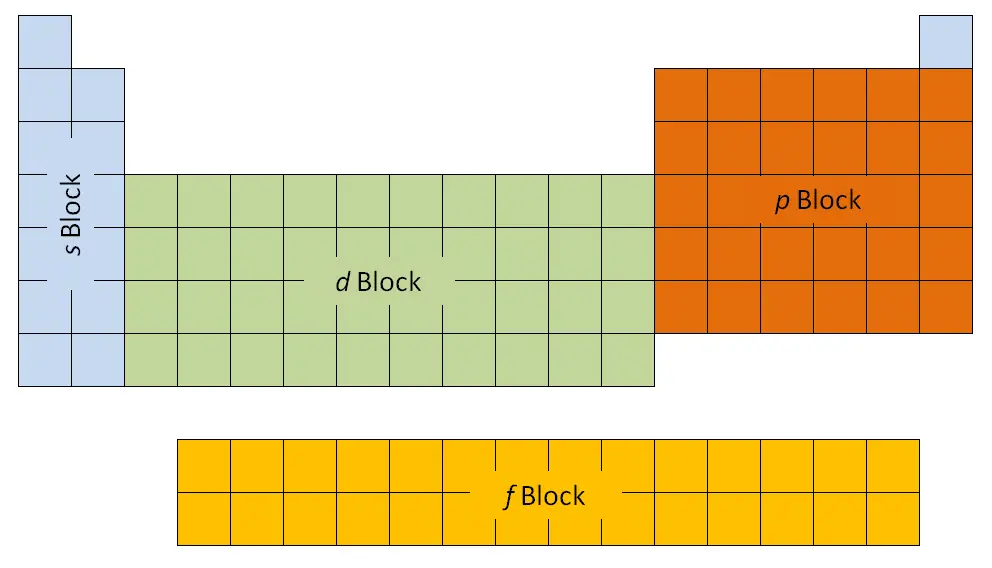
electron configuration - blocks - elementsThe first two columns on the left side of the periodic table are where the s subshells are being occupied. Because of this, the first two rows of the periodic table are labeled the s block. Similarly, the p block are the right-most six columns of the periodic table, the d block is the middle 10 columns of the periodic table, while the f block is the 14-column section that is normally depicted as detached from the main body of the periodic table. It could be part of the main body, but then the periodic table would be rather long and cumbersome.

For atoms with many electrons, this notation can become lengthy and so an abbreviated notation is used. The electron configuration can be visualized as the core electrons, equivalent to the noble gas of the preceding period, and the valence electrons (e.g. [Xe] 6s2 for barium).

Oxidation States

Oxidation states are typically represented by integers which may be positive, zero, or negative. Most elements have more than one possible oxidation state. For example, carbon has nine possible integer oxidation states from −4 to +4.

The current IUPAC Gold Book definition of oxidation state is:

“Oxidation state of an atom is the charge of this atom after ionic approximation of its heteronuclear bonds…”

and the term oxidation number is nearly synonymous. An element that is not combined with any other different elements has an oxidation state of 0. Oxidation state 0 occurs for all elements – it is simply the element in its elemental form. An atom of an element in a compound will have a positive oxidation state if it has had electrons removed. Similarly, adding electrons results in a negative oxidation state. We have also distinguish between the possible and common oxidation states of every element. For example, silicon has nine possible integer oxidation states from −4 to +4, but only -4, 0 and +4 are common oxidation states.

Periodic Table of Elements - electron configuration
1
H

Hydrogen

1s1

2
He

Helium

1s2

3
Li

Lithium

[He] 2s1

4
Be

Beryllium

[He] 2s2

5
B

Boron

[He] 2s2 2p1

6
C

Carbon

[He] 2s2 2p2

7
N

Nitrogen

[He] 2s2 2p3

8
O

Oxygen

[He] 2s2 2p4

9
F

Fluorine

[He] 2s2 2p5

10
Ne

Neon

[He] 2s2 2p6

11
Na

Sodium

[Ne] 3s1

12
Mg

Magnesium

[Ne] 3s2

13
Al

Aluminium

[Ne] 3s2 3p1

14
Si

Silicon

[Ne] 3s2 3p2

15
P

Phosphorus

[Ne] 3s2 3p3

16
S

Sulfur

[Ne] 3s2 3p4

17
Cl

Chlorine

[Ne] 3s2 3p5

18
Ar

Argon

[Ne] 3s2 3p6

19
K

Potassium

[Ar] 4s1

20
Ca

Calcium

[Ar] 4s2

21
Sc

Scandium

[Ar] 3d1 4s2

22
Ti

Titanium

[Ar] 3d2 4s2

23
V

Vanadium

[Ar] 3d3 4s2

24
Cr

Chromium

[Ar] 3d5 4s1

25
Mn

Manganese

[Ar] 3d5 4s2

26
Fe

Iron

[Ar] 3d6 4s2

27
Co

Cobalt

[Ar] 3d7 4s2

28
Ni

Nickel

[Ar] 3d8 4s2

29
Cu

Copper

[Ar] 3d10 4s1

30
Zn

Zinc

[Ar] 3d10 4s2

31
Ga

Gallium

[Ar] 3d10 4s2 4p1

32
Ge

Germanium

[Ar] 3d10 4s2 4p2

33
As

Arsenic

[Ar] 3d10 4s2 4p3

34
Se

Selenium

[Ar] 3d10 4s2 4p4

35
Br

Bromine

[Ar] 3d10 4s2 4p5

36
Kr

Krypton

[Ar] 3d10 4s2 4p6

37
Rb

Rubidium

[Kr] 5s1

38
Sr

Strontium

[Kr] 5s2

39
Y

Yttrium

[Kr] 4d1 5s2

40
Zr

Zirconium

[Kr] 4d2 5s2

41
Nb

Niobium

[Kr] 4d4 5s1

42
Mo

Molybdenum

[Kr] 4d5 5s1

43
Tc

Technetium

[Kr] 4d5 5s2

44
Ru

Ruthenium

[Kr] 4d7 5s1

45
Rh

Rhodium

[Kr] 4d8 5s1

46
Pd

Palladium

[Kr] 4d10

47
Ag

Silver

[Kr] 4d10 5s1

48
Cd

Cadmium

[Kr] 4d10 5s2

49
In

Indium

[Kr] 4d10 5s2 5p1

50
Sn

Tin

[Kr] 4d10 5s2 5p2

51
Sb

Antimony

[Kr] 4d10 5s2 5p3

52
Te

Tellurium

[Kr] 4d10 5s2 5p4

53
I

Iodine

[Kr] 4d10 5s2 5p5

54
Xe

Xenon

[Kr] 4d10 5s2 5p6

55
Cs

Caesium

[Xe] 6s1

56
Ba

Barium

[Xe] 6s2

57-71


Lanthanoids


72
Hf

Hafnium

[Xe] 4f14 5d2 6s2

73
Ta

Tantalum

[Xe] 4f14 5d3 6s2

74
W

Tungsten

[Xe] 4f14 5d4 6s2

75
Re

Rhenium

[Xe] 4f14 5d5 6s2

76
Os

Osmium

[Xe] 4f14 5d6 6s2

77
Ir

Iridium

[Xe] 4f14 5d7 6s2

78
Pt

Platinum

[Xe] 4f14 5d9 6s1

79
Au

Gold

[Xe] 4f14 5d10 6s1

80
Hg

Mercury

[Xe] 4f14 5d10 6s2

81
Tl

Thallium

[Hg] 6p1

82
Pb

Lead

[Hg] 6p2

83
Bi

Bismuth

[Hg] 6p3

84
Po

Polonium

[Hg] 6p4

85
At

Astatine

[Hg] 6p5

86
Rn

Radon

[Hg] 6p6

87
Fr

Francium

[Rn] 7s1

88
Ra

Radium

[Rn] 7s2

89-103


Actinoids


104
Rf

Rutherfordium

[Rn] 5f14 6d2 7s2

105
Db

Dubnium

[Rn] 5f14 6d3 7s2

106
Sg

Seaborgium

[Rn] 5f14 6d4 7s2

107
Bh

Bohrium

[Rn] 5f14 6d5 7s2

108
Hs

Hassium

[Rn] 5f14 6d6 7s2

109
Mt

Meitnerium

[Rn] 5f14 6d7 7s2

110
Ds

Darmstadtium

[Rn] 5f14 6d8 7s2

111
Rg

Roentgenium

[Rn] 5f14 6d9 7s2

112
Cn

Copernicium

[Rn] 5f14 6d10 7s2

113
Nh

Nihonium

[Rn] 5f14 6d10 7s2 7p1

114
Fl

Flerovium

[Rn] 5f14 6d10 7s2 7p2

115
Mc

Moscovium

[Rn] 5f14 6d10 7s2 7p3

116
Lv

Livermorium

[Rn] 5f14 6d10 7s2 7p4

117
Ts

Tennessine

[Rn] 5f14 6d10 7s2 7p5

118
Og

Oganesson

[Rn] 5f14 6d10 7s2 7p6

57
La

Lanthanum

[Xe] 5d1 6s2

58
Ce

Cerium

[Xe] 4f1 5d1 6s2

59
Pr

Praseodymium

[Xe] 4f3 6s2

60
Nd

Neodymium

[Xe] 4f4 6s2

61
Pm

Promethium

[Xe] 4f5 6s2

62
Sm

Samarium

[Xe] 4f6 6s2

63
Eu

Europium

[Xe] 4f7 6s2

64
Gd

Gadolinium

[Xe] 4f7 5d1 6s2

65
Tb

Terbium

[Xe] 4f9 6s2

66
Dy

Dysprosium

[Xe] 4f10 6s2

67
Ho

Holmium

[Xe] 4f11 6s2

68
Er

Erbium

[Xe] 4f12 6s2

69
Th

Thulium

[Xe] 4f13 6s2

70
Yb

Ytterbium

[Xe] 4f14 6s2

71
Lu

Lutetium

[Xe] 4f14 5d1 6s2

89
Ac

Actinium

[Rn] 6d1 7s2

90
Th

Thorium

[Rn] 6d2 7s2

91
Pa

Protactinium

[Rn] 5f2 6d1 7s2

92
U

Uranium

[Rn] 5f3 6d1 7s2

93
Np

Neptunium

[Rn] 5f4 6d1 7s2

94
Pu

Plutonium

[Rn] 5f6 7s2

95
Am

Americium

[Rn] 5f7 7s2

96
Cm

Curium

[Rn] 5f7 6d 7s2

97
Bk

Berkelium

[Rn] 5f9 7s2

98
Cf

Californium

[Rn] 5f10 7s2

99
Es

Einsteinium

[Rn] 5f11 7s2

100
Fm

Fermium

[Rn] 5f12 7s2

101
Md

Mendelevium

[Rn] 5f13 7s2

102
No

Nobelium

[Rn] 5f14 7s2

103
Lr

Lawrencium

[Rn] 5f14 7s2 7p1

–

Tennessine – Electron Configuration and Oxidation States – Ts

Tennessine is a chemical element with atomic number 117 which means there are 117 protons and 117 electrons in the atomic structure. The chemical symbol for Tennessine is Ts.

Electron Configuration and Oxidation States of Tennessine

Electron configuration of Tennessine is [Rn] 5f14 6d10 7s2 7p5 ?.

Possible oxidation states are +1,+3.

Electron Configuration

The periodic table is a tabular display of the chemical elements organized on the basis of their atomic numbers, electron configurations, and chemical properties. The electron configuration is the distribution of electrons of an atom or molecule (or other physical structure) in atomic or molecular orbitals. Knowledge of the electron configuration of different atoms is useful in understanding the structure of the periodic table of elements.

Every solid, liquid, gas, and plasma is composed of neutral or ionized atoms. The chemical properties of the atom are determined by the number of protons, in fact, by number and arrangement of electrons. The configuration of these electrons follows from the principles of quantum mechanics. The number of electrons in each element’s electron shells, particularly the outermost valence shell, is the primary factor in determining its chemical bonding behavior. In the periodic table, the elements are listed in order of increasing atomic number Z.

It is the Pauli exclusion principle that requires the electrons in an atom to occupy different energy levels instead of them all condensing in the ground state. The ordering of the electrons in the ground state of multielectron atoms, starts with the lowest energy state (ground state) and moves progressively from there up the energy scale until each of the atom’s electrons has been assigned a unique set of quantum numbers. This fact has key implications for the building up of the periodic table of elements.

electron configuration - blocks - elementsThe first two columns on the left side of the periodic table are where the s subshells are being occupied. Because of this, the first two rows of the periodic table are labeled the s block. Similarly, the p block are the right-most six columns of the periodic table, the d block is the middle 10 columns of the periodic table, while the f block is the 14-column section that is normally depicted as detached from the main body of the periodic table. It could be part of the main body, but then the periodic table would be rather long and cumbersome.

For atoms with many electrons, this notation can become lengthy and so an abbreviated notation is used. The electron configuration can be visualized as the core electrons, equivalent to the noble gas of the preceding period, and the valence electrons (e.g. [Xe] 6s2 for barium).

Oxidation States

Oxidation states are typically represented by integers which may be positive, zero, or negative. Most elements have more than one possible oxidation state. For example, carbon has nine possible integer oxidation states from −4 to +4.

The current IUPAC Gold Book definition of oxidation state is:

“Oxidation state of an atom is the charge of this atom after ionic approximation of its heteronuclear bonds…”

and the term oxidation number is nearly synonymous. An element that is not combined with any other different elements has an oxidation state of 0. Oxidation state 0 occurs for all elements – it is simply the element in its elemental form. An atom of an element in a compound will have a positive oxidation state if it has had electrons removed. Similarly, adding electrons results in a negative oxidation state. We have also distinguish between the possible and common oxidation states of every element. For example, silicon has nine possible integer oxidation states from −4 to +4, but only -4, 0 and +4 are common oxidation states.

Periodic Table of Elements - electron configuration
1
H

Hydrogen

1s1

2
He

Helium

1s2

3
Li

Lithium

[He] 2s1

4
Be

Beryllium

[He] 2s2

5
B

Boron

[He] 2s2 2p1

6
C

Carbon

[He] 2s2 2p2

7
N

Nitrogen

[He] 2s2 2p3

8
O

Oxygen

[He] 2s2 2p4

9
F

Fluorine

[He] 2s2 2p5

10
Ne

Neon

[He] 2s2 2p6

11
Na

Sodium

[Ne] 3s1

12
Mg

Magnesium

[Ne] 3s2

13
Al

Aluminium

[Ne] 3s2 3p1

14
Si

Silicon

[Ne] 3s2 3p2

15
P

Phosphorus

[Ne] 3s2 3p3

16
S

Sulfur

[Ne] 3s2 3p4

17
Cl

Chlorine

[Ne] 3s2 3p5

18
Ar

Argon

[Ne] 3s2 3p6

19
K

Potassium

[Ar] 4s1

20
Ca

Calcium

[Ar] 4s2

21
Sc

Scandium

[Ar] 3d1 4s2

22
Ti

Titanium

[Ar] 3d2 4s2

23
V

Vanadium

[Ar] 3d3 4s2

24
Cr

Chromium

[Ar] 3d5 4s1

25
Mn

Manganese

[Ar] 3d5 4s2

26
Fe

Iron

[Ar] 3d6 4s2

27
Co

Cobalt

[Ar] 3d7 4s2

28
Ni

Nickel

[Ar] 3d8 4s2

29
Cu

Copper

[Ar] 3d10 4s1

30
Zn

Zinc

[Ar] 3d10 4s2

31
Ga

Gallium

[Ar] 3d10 4s2 4p1

32
Ge

Germanium

[Ar] 3d10 4s2 4p2

33
As

Arsenic

[Ar] 3d10 4s2 4p3

34
Se

Selenium

[Ar] 3d10 4s2 4p4

35
Br

Bromine

[Ar] 3d10 4s2 4p5

36
Kr

Krypton

[Ar] 3d10 4s2 4p6

37
Rb

Rubidium

[Kr] 5s1

38
Sr

Strontium

[Kr] 5s2

39
Y

Yttrium

[Kr] 4d1 5s2

40
Zr

Zirconium

[Kr] 4d2 5s2

41
Nb

Niobium

[Kr] 4d4 5s1

42
Mo

Molybdenum

[Kr] 4d5 5s1

43
Tc

Technetium

[Kr] 4d5 5s2

44
Ru

Ruthenium

[Kr] 4d7 5s1

45
Rh

Rhodium

[Kr] 4d8 5s1

46
Pd

Palladium

[Kr] 4d10

47
Ag

Silver

[Kr] 4d10 5s1

48
Cd

Cadmium

[Kr] 4d10 5s2

49
In

Indium

[Kr] 4d10 5s2 5p1

50
Sn

Tin

[Kr] 4d10 5s2 5p2

51
Sb

Antimony

[Kr] 4d10 5s2 5p3

52
Te

Tellurium

[Kr] 4d10 5s2 5p4

53
I

Iodine

[Kr] 4d10 5s2 5p5

54
Xe

Xenon

[Kr] 4d10 5s2 5p6

55
Cs

Caesium

[Xe] 6s1

56
Ba

Barium

[Xe] 6s2

57-71


Lanthanoids


72
Hf

Hafnium

[Xe] 4f14 5d2 6s2

73
Ta

Tantalum

[Xe] 4f14 5d3 6s2

74
W

Tungsten

[Xe] 4f14 5d4 6s2

75
Re

Rhenium

[Xe] 4f14 5d5 6s2

76
Os

Osmium

[Xe] 4f14 5d6 6s2

77
Ir

Iridium

[Xe] 4f14 5d7 6s2

78
Pt

Platinum

[Xe] 4f14 5d9 6s1

79
Au

Gold

[Xe] 4f14 5d10 6s1

80
Hg

Mercury

[Xe] 4f14 5d10 6s2

81
Tl

Thallium

[Hg] 6p1

82
Pb

Lead

[Hg] 6p2

83
Bi

Bismuth

[Hg] 6p3

84
Po

Polonium

[Hg] 6p4

85
At

Astatine

[Hg] 6p5

86
Rn

Radon

[Hg] 6p6

87
Fr

Francium

[Rn] 7s1

88
Ra

Radium

[Rn] 7s2

89-103


Actinoids


104
Rf

Rutherfordium

[Rn] 5f14 6d2 7s2

105
Db

Dubnium

[Rn] 5f14 6d3 7s2

106
Sg

Seaborgium

[Rn] 5f14 6d4 7s2

107
Bh

Bohrium

[Rn] 5f14 6d5 7s2

108
Hs

Hassium

[Rn] 5f14 6d6 7s2

109
Mt

Meitnerium

[Rn] 5f14 6d7 7s2

110
Ds

Darmstadtium

[Rn] 5f14 6d8 7s2

111
Rg

Roentgenium

[Rn] 5f14 6d9 7s2

112
Cn

Copernicium

[Rn] 5f14 6d10 7s2

113
Nh

Nihonium

[Rn] 5f14 6d10 7s2 7p1

114
Fl

Flerovium

[Rn] 5f14 6d10 7s2 7p2

115
Mc

Moscovium

[Rn] 5f14 6d10 7s2 7p3

116
Lv

Livermorium

[Rn] 5f14 6d10 7s2 7p4

117
Ts

Tennessine

[Rn] 5f14 6d10 7s2 7p5

118
Og

Oganesson

[Rn] 5f14 6d10 7s2 7p6

57
La

Lanthanum

[Xe] 5d1 6s2

58
Ce

Cerium

[Xe] 4f1 5d1 6s2

59
Pr

Praseodymium

[Xe] 4f3 6s2

60
Nd

Neodymium

[Xe] 4f4 6s2

61
Pm

Promethium

[Xe] 4f5 6s2

62
Sm

Samarium

[Xe] 4f6 6s2

63
Eu

Europium

[Xe] 4f7 6s2

64
Gd

Gadolinium

[Xe] 4f7 5d1 6s2

65
Tb

Terbium

[Xe] 4f9 6s2

66
Dy

Dysprosium

[Xe] 4f10 6s2

67
Ho

Holmium

[Xe] 4f11 6s2

68
Er

Erbium

[Xe] 4f12 6s2

69
Th

Thulium

[Xe] 4f13 6s2

70
Yb

Ytterbium

[Xe] 4f14 6s2

71
Lu

Lutetium

[Xe] 4f14 5d1 6s2

89
Ac

Actinium

[Rn] 6d1 7s2

90
Th

Thorium

[Rn] 6d2 7s2

91
Pa

Protactinium

[Rn] 5f2 6d1 7s2

92
U

Uranium

[Rn] 5f3 6d1 7s2

93
Np

Neptunium

[Rn] 5f4 6d1 7s2

94
Pu

Plutonium

[Rn] 5f6 7s2

95
Am

Americium

[Rn] 5f7 7s2

96
Cm

Curium

[Rn] 5f7 6d 7s2

97
Bk

Berkelium

[Rn] 5f9 7s2

98
Cf

Californium

[Rn] 5f10 7s2

99
Es

Einsteinium

[Rn] 5f11 7s2

100
Fm

Fermium

[Rn] 5f12 7s2

101
Md

Mendelevium

[Rn] 5f13 7s2

102
No

Nobelium

[Rn] 5f14 7s2

103
Lr

Lawrencium

[Rn] 5f14 7s2 7p1

–

Livermorium – Electron Configuration and Oxidation States – Lv

Livermorium is a chemical element with atomic number 116 which means there are 116 protons and 116 electrons in the atomic structure. The chemical symbol for Livermorium is Lv.

Electron Configuration and Oxidation States of Livermorium

Electron configuration of Livermorium is [Rn] 5f14 6d10 7s2 7p4 ?.

Possible oxidation states are +2.

Electron Configuration

The periodic table is a tabular display of the chemical elements organized on the basis of their atomic numbers, electron configurations, and chemical properties. The electron configuration is the distribution of electrons of an atom or molecule (or other physical structure) in atomic or molecular orbitals. Knowledge of the electron configuration of different atoms is useful in understanding the structure of the periodic table of elements.

Every solid, liquid, gas, and plasma is composed of neutral or ionized atoms. The chemical properties of the atom are determined by the number of protons, in fact, by number and arrangement of electrons. The configuration of these electrons follows from the principles of quantum mechanics. The number of electrons in each element’s electron shells, particularly the outermost valence shell, is the primary factor in determining its chemical bonding behavior. In the periodic table, the elements are listed in order of increasing atomic number Z.

It is the Pauli exclusion principle that requires the electrons in an atom to occupy different energy levels instead of them all condensing in the ground state. The ordering of the electrons in the ground state of multielectron atoms, starts with the lowest energy state (ground state) and moves progressively from there up the energy scale until each of the atom’s electrons has been assigned a unique set of quantum numbers. This fact has key implications for the building up of the periodic table of elements.

electron configuration - blocks - elementsThe first two columns on the left side of the periodic table are where the s subshells are being occupied. Because of this, the first two rows of the periodic table are labeled the s block. Similarly, the p block are the right-most six columns of the periodic table, the d block is the middle 10 columns of the periodic table, while the f block is the 14-column section that is normally depicted as detached from the main body of the periodic table. It could be part of the main body, but then the periodic table would be rather long and cumbersome.

For atoms with many electrons, this notation can become lengthy and so an abbreviated notation is used. The electron configuration can be visualized as the core electrons, equivalent to the noble gas of the preceding period, and the valence electrons (e.g. [Xe] 6s2 for barium).

Oxidation States

Oxidation states are typically represented by integers which may be positive, zero, or negative. Most elements have more than one possible oxidation state. For example, carbon has nine possible integer oxidation states from −4 to +4.

The current IUPAC Gold Book definition of oxidation state is:

“Oxidation state of an atom is the charge of this atom after ionic approximation of its heteronuclear bonds…”

and the term oxidation number is nearly synonymous. An element that is not combined with any other different elements has an oxidation state of 0. Oxidation state 0 occurs for all elements – it is simply the element in its elemental form. An atom of an element in a compound will have a positive oxidation state if it has had electrons removed. Similarly, adding electrons results in a negative oxidation state. We have also distinguish between the possible and common oxidation states of every element. For example, silicon has nine possible integer oxidation states from −4 to +4, but only -4, 0 and +4 are common oxidation states.

Periodic Table of Elements - electron configuration
1
H

Hydrogen

1s1

2
He

Helium

1s2

3
Li

Lithium

[He] 2s1

4
Be

Beryllium

[He] 2s2

5
B

Boron

[He] 2s2 2p1

6
C

Carbon

[He] 2s2 2p2

7
N

Nitrogen

[He] 2s2 2p3

8
O

Oxygen

[He] 2s2 2p4

9
F

Fluorine

[He] 2s2 2p5

10
Ne

Neon

[He] 2s2 2p6

11
Na

Sodium

[Ne] 3s1

12
Mg

Magnesium

[Ne] 3s2

13
Al

Aluminium

[Ne] 3s2 3p1

14
Si

Silicon

[Ne] 3s2 3p2

15
P

Phosphorus

[Ne] 3s2 3p3

16
S

Sulfur

[Ne] 3s2 3p4

17
Cl

Chlorine

[Ne] 3s2 3p5

18
Ar

Argon

[Ne] 3s2 3p6

19
K

Potassium

[Ar] 4s1

20
Ca

Calcium

[Ar] 4s2

21
Sc

Scandium

[Ar] 3d1 4s2

22
Ti

Titanium

[Ar] 3d2 4s2

23
V

Vanadium

[Ar] 3d3 4s2

24
Cr

Chromium

[Ar] 3d5 4s1

25
Mn

Manganese

[Ar] 3d5 4s2

26
Fe

Iron

[Ar] 3d6 4s2

27
Co

Cobalt

[Ar] 3d7 4s2

28
Ni

Nickel

[Ar] 3d8 4s2

29
Cu

Copper

[Ar] 3d10 4s1

30
Zn

Zinc

[Ar] 3d10 4s2

31
Ga

Gallium

[Ar] 3d10 4s2 4p1

32
Ge

Germanium

[Ar] 3d10 4s2 4p2

33
As

Arsenic

[Ar] 3d10 4s2 4p3

34
Se

Selenium

[Ar] 3d10 4s2 4p4

35
Br

Bromine

[Ar] 3d10 4s2 4p5

36
Kr

Krypton

[Ar] 3d10 4s2 4p6

37
Rb

Rubidium

[Kr] 5s1

38
Sr

Strontium

[Kr] 5s2

39
Y

Yttrium

[Kr] 4d1 5s2

40
Zr

Zirconium

[Kr] 4d2 5s2

41
Nb

Niobium

[Kr] 4d4 5s1

42
Mo

Molybdenum

[Kr] 4d5 5s1

43
Tc

Technetium

[Kr] 4d5 5s2

44
Ru

Ruthenium

[Kr] 4d7 5s1

45
Rh

Rhodium

[Kr] 4d8 5s1

46
Pd

Palladium

[Kr] 4d10

47
Ag

Silver

[Kr] 4d10 5s1

48
Cd

Cadmium

[Kr] 4d10 5s2

49
In

Indium

[Kr] 4d10 5s2 5p1

50
Sn

Tin

[Kr] 4d10 5s2 5p2

51
Sb

Antimony

[Kr] 4d10 5s2 5p3

52
Te

Tellurium

[Kr] 4d10 5s2 5p4

53
I

Iodine

[Kr] 4d10 5s2 5p5

54
Xe

Xenon

[Kr] 4d10 5s2 5p6

55
Cs

Caesium

[Xe] 6s1

56
Ba

Barium

[Xe] 6s2

57-71


Lanthanoids


72
Hf

Hafnium

[Xe] 4f14 5d2 6s2

73
Ta

Tantalum

[Xe] 4f14 5d3 6s2

74
W

Tungsten

[Xe] 4f14 5d4 6s2

75
Re

Rhenium

[Xe] 4f14 5d5 6s2

76
Os

Osmium

[Xe] 4f14 5d6 6s2

77
Ir

Iridium

[Xe] 4f14 5d7 6s2

78
Pt

Platinum

[Xe] 4f14 5d9 6s1

79
Au

Gold

[Xe] 4f14 5d10 6s1

80
Hg

Mercury

[Xe] 4f14 5d10 6s2

81
Tl

Thallium

[Hg] 6p1

82
Pb

Lead

[Hg] 6p2

83
Bi

Bismuth

[Hg] 6p3

84
Po

Polonium

[Hg] 6p4

85
At

Astatine

[Hg] 6p5

86
Rn

Radon

[Hg] 6p6

87
Fr

Francium

[Rn] 7s1

88
Ra

Radium

[Rn] 7s2

89-103


Actinoids


104
Rf

Rutherfordium

[Rn] 5f14 6d2 7s2

105
Db

Dubnium

[Rn] 5f14 6d3 7s2

106
Sg

Seaborgium

[Rn] 5f14 6d4 7s2

107
Bh

Bohrium

[Rn] 5f14 6d5 7s2

108
Hs

Hassium

[Rn] 5f14 6d6 7s2

109
Mt

Meitnerium

[Rn] 5f14 6d7 7s2

110
Ds

Darmstadtium

[Rn] 5f14 6d8 7s2

111
Rg

Roentgenium

[Rn] 5f14 6d9 7s2

112
Cn

Copernicium

[Rn] 5f14 6d10 7s2

113
Nh

Nihonium

[Rn] 5f14 6d10 7s2 7p1

114
Fl

Flerovium

[Rn] 5f14 6d10 7s2 7p2

115
Mc

Moscovium

[Rn] 5f14 6d10 7s2 7p3

116
Lv

Livermorium

[Rn] 5f14 6d10 7s2 7p4

117
Ts

Tennessine

[Rn] 5f14 6d10 7s2 7p5

118
Og

Oganesson

[Rn] 5f14 6d10 7s2 7p6

57
La

Lanthanum

[Xe] 5d1 6s2

58
Ce

Cerium

[Xe] 4f1 5d1 6s2

59
Pr

Praseodymium

[Xe] 4f3 6s2

60
Nd

Neodymium

[Xe] 4f4 6s2

61
Pm

Promethium

[Xe] 4f5 6s2

62
Sm

Samarium

[Xe] 4f6 6s2

63
Eu

Europium

[Xe] 4f7 6s2

64
Gd

Gadolinium

[Xe] 4f7 5d1 6s2

65
Tb

Terbium

[Xe] 4f9 6s2

66
Dy

Dysprosium

[Xe] 4f10 6s2

67
Ho

Holmium

[Xe] 4f11 6s2

68
Er

Erbium

[Xe] 4f12 6s2

69
Th

Thulium

[Xe] 4f13 6s2

70
Yb

Ytterbium

[Xe] 4f14 6s2

71
Lu

Lutetium

[Xe] 4f14 5d1 6s2

89
Ac

Actinium

[Rn] 6d1 7s2

90
Th

Thorium

[Rn] 6d2 7s2

91
Pa

Protactinium

[Rn] 5f2 6d1 7s2

92
U

Uranium

[Rn] 5f3 6d1 7s2

93
Np

Neptunium

[Rn] 5f4 6d1 7s2

94
Pu

Plutonium

[Rn] 5f6 7s2

95
Am

Americium

[Rn] 5f7 7s2

96
Cm

Curium

[Rn] 5f7 6d 7s2

97
Bk

Berkelium

[Rn] 5f9 7s2

98
Cf

Californium

[Rn] 5f10 7s2

99
Es

Einsteinium

[Rn] 5f11 7s2

100
Fm

Fermium

[Rn] 5f12 7s2

101
Md

Mendelevium

[Rn] 5f13 7s2

102
No

Nobelium

[Rn] 5f14 7s2

103
Lr

Lawrencium

[Rn] 5f14 7s2 7p1

–

Moscovium – Electron Configuration and Oxidation States – Mc

Moscovium is a chemical element with atomic number 115 which means there are 115 protons and 115 electrons in the atomic structure. The chemical symbol for Moscovium is Mc.

Electron Configuration and Oxidation States of Moscovium

Electron configuration of Moscovium is [Rn] 5f14 6d10 7s2 7p3 ?.

Possible oxidation states are +1,+3.

Electron Configuration

The periodic table is a tabular display of the chemical elements organized on the basis of their atomic numbers, electron configurations, and chemical properties. The electron configuration is the distribution of electrons of an atom or molecule (or other physical structure) in atomic or molecular orbitals. Knowledge of the electron configuration of different atoms is useful in understanding the structure of the periodic table of elements.

Every solid, liquid, gas, and plasma is composed of neutral or ionized atoms. The chemical properties of the atom are determined by the number of protons, in fact, by number and arrangement of electrons. The configuration of these electrons follows from the principles of quantum mechanics. The number of electrons in each element’s electron shells, particularly the outermost valence shell, is the primary factor in determining its chemical bonding behavior. In the periodic table, the elements are listed in order of increasing atomic number Z.

It is the Pauli exclusion principle that requires the electrons in an atom to occupy different energy levels instead of them all condensing in the ground state. The ordering of the electrons in the ground state of multielectron atoms, starts with the lowest energy state (ground state) and moves progressively from there up the energy scale until each of the atom’s electrons has been assigned a unique set of quantum numbers. This fact has key implications for the building up of the periodic table of elements.

electron configuration - blocks - elementsThe first two columns on the left side of the periodic table are where the s subshells are being occupied. Because of this, the first two rows of the periodic table are labeled the s block. Similarly, the p block are the right-most six columns of the periodic table, the d block is the middle 10 columns of the periodic table, while the f block is the 14-column section that is normally depicted as detached from the main body of the periodic table. It could be part of the main body, but then the periodic table would be rather long and cumbersome.

For atoms with many electrons, this notation can become lengthy and so an abbreviated notation is used. The electron configuration can be visualized as the core electrons, equivalent to the noble gas of the preceding period, and the valence electrons (e.g. [Xe] 6s2 for barium).

Oxidation States

Oxidation states are typically represented by integers which may be positive, zero, or negative. Most elements have more than one possible oxidation state. For example, carbon has nine possible integer oxidation states from −4 to +4.

The current IUPAC Gold Book definition of oxidation state is:

“Oxidation state of an atom is the charge of this atom after ionic approximation of its heteronuclear bonds…”

and the term oxidation number is nearly synonymous. An element that is not combined with any other different elements has an oxidation state of 0. Oxidation state 0 occurs for all elements – it is simply the element in its elemental form. An atom of an element in a compound will have a positive oxidation state if it has had electrons removed. Similarly, adding electrons results in a negative oxidation state. We have also distinguish between the possible and common oxidation states of every element. For example, silicon has nine possible integer oxidation states from −4 to +4, but only -4, 0 and +4 are common oxidation states.

Periodic Table of Elements - electron configuration
1
H

Hydrogen

1s1

2
He

Helium

1s2

3
Li

Lithium

[He] 2s1

4
Be

Beryllium

[He] 2s2

5
B

Boron

[He] 2s2 2p1

6
C

Carbon

[He] 2s2 2p2

7
N

Nitrogen

[He] 2s2 2p3

8
O

Oxygen

[He] 2s2 2p4

9
F

Fluorine

[He] 2s2 2p5

10
Ne

Neon

[He] 2s2 2p6

11
Na

Sodium

[Ne] 3s1

12
Mg

Magnesium

[Ne] 3s2

13
Al

Aluminium

[Ne] 3s2 3p1

14
Si

Silicon

[Ne] 3s2 3p2

15
P

Phosphorus

[Ne] 3s2 3p3

16
S

Sulfur

[Ne] 3s2 3p4

17
Cl

Chlorine

[Ne] 3s2 3p5

18
Ar

Argon

[Ne] 3s2 3p6

19
K

Potassium

[Ar] 4s1

20
Ca

Calcium

[Ar] 4s2

21
Sc

Scandium

[Ar] 3d1 4s2

22
Ti

Titanium

[Ar] 3d2 4s2

23
V

Vanadium

[Ar] 3d3 4s2

24
Cr

Chromium

[Ar] 3d5 4s1

25
Mn

Manganese

[Ar] 3d5 4s2

26
Fe

Iron

[Ar] 3d6 4s2

27
Co

Cobalt

[Ar] 3d7 4s2

28
Ni

Nickel

[Ar] 3d8 4s2

29
Cu

Copper

[Ar] 3d10 4s1

30
Zn

Zinc

[Ar] 3d10 4s2

31
Ga

Gallium

[Ar] 3d10 4s2 4p1

32
Ge

Germanium

[Ar] 3d10 4s2 4p2

33
As

Arsenic

[Ar] 3d10 4s2 4p3

34
Se

Selenium

[Ar] 3d10 4s2 4p4

35
Br

Bromine

[Ar] 3d10 4s2 4p5

36
Kr

Krypton

[Ar] 3d10 4s2 4p6

37
Rb

Rubidium

[Kr] 5s1

38
Sr

Strontium

[Kr] 5s2

39
Y

Yttrium

[Kr] 4d1 5s2

40
Zr

Zirconium

[Kr] 4d2 5s2

41
Nb

Niobium

[Kr] 4d4 5s1

42
Mo

Molybdenum

[Kr] 4d5 5s1

43
Tc

Technetium

[Kr] 4d5 5s2

44
Ru

Ruthenium

[Kr] 4d7 5s1

45
Rh

Rhodium

[Kr] 4d8 5s1

46
Pd

Palladium

[Kr] 4d10

47
Ag

Silver

[Kr] 4d10 5s1

48
Cd

Cadmium

[Kr] 4d10 5s2

49
In

Indium

[Kr] 4d10 5s2 5p1

50
Sn

Tin

[Kr] 4d10 5s2 5p2

51
Sb

Antimony

[Kr] 4d10 5s2 5p3

52
Te

Tellurium

[Kr] 4d10 5s2 5p4

53
I

Iodine

[Kr] 4d10 5s2 5p5

54
Xe

Xenon

[Kr] 4d10 5s2 5p6

55
Cs

Caesium

[Xe] 6s1

56
Ba

Barium

[Xe] 6s2

57-71


Lanthanoids


72
Hf

Hafnium

[Xe] 4f14 5d2 6s2

73
Ta

Tantalum

[Xe] 4f14 5d3 6s2

74
W

Tungsten

[Xe] 4f14 5d4 6s2

75
Re

Rhenium

[Xe] 4f14 5d5 6s2

76
Os

Osmium

[Xe] 4f14 5d6 6s2

77
Ir

Iridium

[Xe] 4f14 5d7 6s2

78
Pt

Platinum

[Xe] 4f14 5d9 6s1

79
Au

Gold

[Xe] 4f14 5d10 6s1

80
Hg

Mercury

[Xe] 4f14 5d10 6s2

81
Tl

Thallium

[Hg] 6p1

82
Pb

Lead

[Hg] 6p2

83
Bi

Bismuth

[Hg] 6p3

84
Po

Polonium

[Hg] 6p4

85
At

Astatine

[Hg] 6p5

86
Rn

Radon

[Hg] 6p6

87
Fr

Francium

[Rn] 7s1

88
Ra

Radium

[Rn] 7s2

89-103


Actinoids


104
Rf

Rutherfordium

[Rn] 5f14 6d2 7s2

105
Db

Dubnium

[Rn] 5f14 6d3 7s2

106
Sg

Seaborgium

[Rn] 5f14 6d4 7s2

107
Bh

Bohrium

[Rn] 5f14 6d5 7s2

108
Hs

Hassium

[Rn] 5f14 6d6 7s2

109
Mt

Meitnerium

[Rn] 5f14 6d7 7s2

110
Ds

Darmstadtium

[Rn] 5f14 6d8 7s2

111
Rg

Roentgenium

[Rn] 5f14 6d9 7s2

112
Cn

Copernicium

[Rn] 5f14 6d10 7s2

113
Nh

Nihonium

[Rn] 5f14 6d10 7s2 7p1

114
Fl

Flerovium

[Rn] 5f14 6d10 7s2 7p2

115
Mc

Moscovium

[Rn] 5f14 6d10 7s2 7p3

116
Lv

Livermorium

[Rn] 5f14 6d10 7s2 7p4

117
Ts

Tennessine

[Rn] 5f14 6d10 7s2 7p5

118
Og

Oganesson

[Rn] 5f14 6d10 7s2 7p6

57
La

Lanthanum

[Xe] 5d1 6s2

58
Ce

Cerium

[Xe] 4f1 5d1 6s2

59
Pr

Praseodymium

[Xe] 4f3 6s2

60
Nd

Neodymium

[Xe] 4f4 6s2

61
Pm

Promethium

[Xe] 4f5 6s2

62
Sm

Samarium

[Xe] 4f6 6s2

63
Eu

Europium

[Xe] 4f7 6s2

64
Gd

Gadolinium

[Xe] 4f7 5d1 6s2

65
Tb

Terbium

[Xe] 4f9 6s2

66
Dy

Dysprosium

[Xe] 4f10 6s2

67
Ho

Holmium

[Xe] 4f11 6s2

68
Er

Erbium

[Xe] 4f12 6s2

69
Th

Thulium

[Xe] 4f13 6s2

70
Yb

Ytterbium

[Xe] 4f14 6s2

71
Lu

Lutetium

[Xe] 4f14 5d1 6s2

89
Ac

Actinium

[Rn] 6d1 7s2

90
Th

Thorium

[Rn] 6d2 7s2

91
Pa

Protactinium

[Rn] 5f2 6d1 7s2

92
U

Uranium

[Rn] 5f3 6d1 7s2

93
Np

Neptunium

[Rn] 5f4 6d1 7s2

94
Pu

Plutonium

[Rn] 5f6 7s2

95
Am

Americium

[Rn] 5f7 7s2

96
Cm

Curium

[Rn] 5f7 6d 7s2

97
Bk

Berkelium

[Rn] 5f9 7s2

98
Cf

Californium

[Rn] 5f10 7s2

99
Es

Einsteinium

[Rn] 5f11 7s2

100
Fm

Fermium

[Rn] 5f12 7s2

101
Md

Mendelevium

[Rn] 5f13 7s2

102
No

Nobelium

[Rn] 5f14 7s2

103
Lr

Lawrencium

[Rn] 5f14 7s2 7p1

–