Beryllium – Density – Be

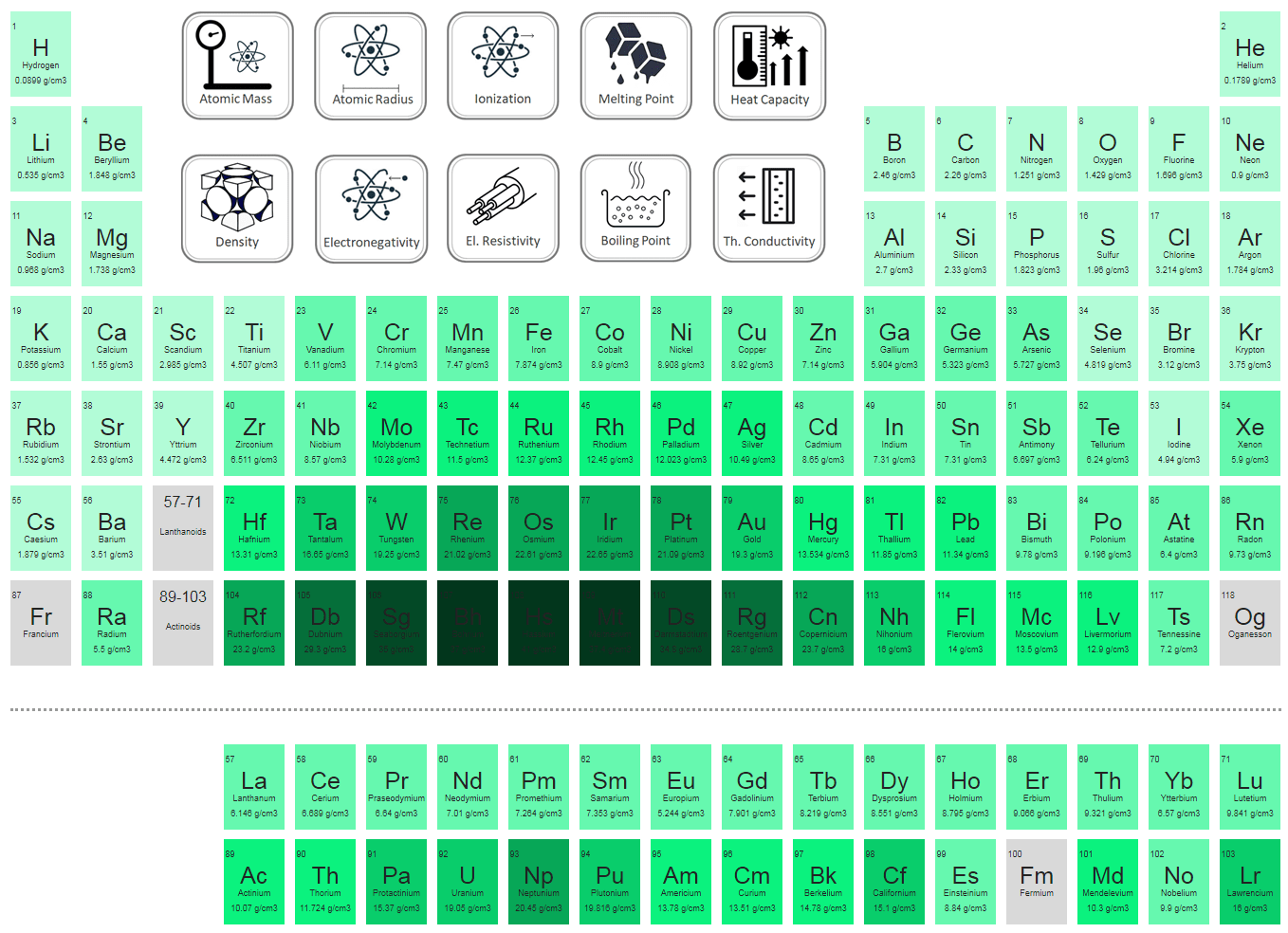
Periodic Table of Elements - density
1
H

Hydrogen

0.0899 g/cm3

2
He

Helium

0.1789 g/cm3

3
Li

Lithium

0.535 g/cm3

4
Be

Beryllium

1.848 g/cm3

5
B

Boron

2.46 g/cm3

6
C

Carbon

2.26 g/cm3

7
N

Nitrogen

1.251 g/cm3

8
O

Oxygen

1.429 g/cm3

9
F

Fluorine

1.696 g/cm3

10
Ne

Neon

0.9 g/cm3

11
Na

Sodium

0.968 g/cm3

12
Mg

Magnesium

1.738 g/cm3

13
Al

Aluminium

2.7 g/cm3

14
Si

Silicon

2.33 g/cm3

15
P

Phosphorus

1.823 g/cm3

16
S

Sulfur

1.96 g/cm3

17
Cl

Chlorine

3.214 g/cm3

18
Ar

Argon

1.784 g/cm3

19
K

Potassium

0.856 g/cm3

20
Ca

Calcium

1.55 g/cm3

21
Sc

Scandium

2.985 g/cm3

22
Ti

Titanium

4.507 g/cm3

23
V

Vanadium

6.11 g/cm3

24
Cr

Chromium

7.14 g/cm3

25
Mn

Manganese

7.47 g/cm3

26
Fe

Iron

7.874 g/cm3

27
Co

Cobalt

8.9 g/cm3

28
Ni

Nickel

8.908 g/cm3

29
Cu

Copper

8.92 g/cm3

30
Zn

Zinc

7.14 g/cm3

31
Ga

Gallium

5.904 g/cm3

32
Ge

Germanium

5.323 g/cm3

33
As

Arsenic

5.727 g/cm3

34
Se

Selenium

4.819 g/cm3

35
Br

Bromine

3.12 g/cm3

36
Kr

Krypton

3.75 g/cm3

37
Rb

Rubidium

1.532 g/cm3

38
Sr

Strontium

2.63 g/cm3

39
Y

Yttrium

4.472 g/cm3

40
Zr

Zirconium

6.511 g/cm3

41
Nb

Niobium

8.57 g/cm3

42
Mo

Molybdenum

10.28 g/cm3

43
Tc

Technetium

11.5 g/cm3

44
Ru

Ruthenium

12.37 g/cm3

45
Rh

Rhodium

12.45 g/cm3

46
Pd

Palladium

12.023 g/cm3

47
Ag

Silver

10.49 g/cm3

48
Cd

Cadmium

8.65 g/cm3

49
In

Indium

7.31 g/cm3

50
Sn

Tin

7.31 g/cm3

51
Sb

Antimony

6.697 g/cm3

52
Te

Tellurium

6.24 g/cm3

53
I

Iodine

4.94 g/cm3

54
Xe

Xenon

5.9 g/cm3

55
Cs

Caesium

1.879 g/cm3

56
Ba

Barium

3.51 g/cm3

57-71


Lanthanoids


72
Hf

Hafnium

13.31 g/cm3

73
Ta

Tantalum

16.65 g/cm3

74
W

Tungsten

19.25 g/cm3

75
Re

Rhenium

21.02 g/cm3

76
Os

Osmium

22.61 g/cm3

77
Ir

Iridium

22.65 g/cm3

78
Pt

Platinum

21.09 g/cm3

79
Au

Gold

19.3 g/cm3

80
Hg

Mercury

13.534 g/cm3

81
Tl

Thallium

11.85 g/cm3

82
Pb

Lead

11.34 g/cm3

83
Bi

Bismuth

9.78 g/cm3

84
Po

Polonium

9.196 g/cm3

85
At

Astatine

6.4 g/cm3

86
Rn

Radon

9.73 g/cm3

87
Fr

Francium


88
Ra

Radium

5.5 g/cm3

89-103


Actinoids


104
Rf

Rutherfordium

23.2 g/cm3

105
Db

Dubnium

29.3 g/cm3

106
Sg

Seaborgium

35 g/cm3

107
Bh

Bohrium

37 g/cm3

108
Hs

Hassium

41 g/cm3

109
Mt

Meitnerium

37.4 g/cm3

110
Ds

Darmstadtium

34.8 g/cm3

111
Rg

Roentgenium

28.7 g/cm3

112
Cn

Copernicium

23.7 g/cm3

113
Nh

Nihonium

16 g/cm3

114
Fl

Flerovium

14 g/cm3

115
Mc

Moscovium

13.5 g/cm3

116
Lv

Livermorium

12.9 g/cm3

117
Ts

Tennessine

7.2 g/cm3

118
Og

Oganesson


57
La

Lanthanum

6.146 g/cm3

58
Ce

Cerium

6.689 g/cm3

59
Pr

Praseodymium

6.64 g/cm3

60
Nd

Neodymium

7.01 g/cm3

61
Pm

Promethium

7.264 g/cm3

62
Sm

Samarium

7.353 g/cm3

63
Eu

Europium

5.244 g/cm3

64
Gd

Gadolinium

7.901 g/cm3

65
Tb

Terbium

8.219 g/cm3

66
Dy

Dysprosium

8.551 g/cm3

67
Ho

Holmium

8.795 g/cm3

68
Er

Erbium

9.066 g/cm3

69
Th

Thulium

9.321 g/cm3

70
Yb

Ytterbium

6.57 g/cm3

71
Lu

Lutetium

9.841 g/cm3

89
Ac

Actinium

10.07 g/cm3

90
Th

Thorium

11.724 g/cm3

91
Pa

Protactinium

15.37 g/cm3

92
U

Uranium

19.05 g/cm3

93
Np

Neptunium

20.45 g/cm3

94
Pu

Plutonium

19.816 g/cm3

95
Am

Americium

13.78 g/cm3

96
Cm

Curium

13.51 g/cm3

97
Bk

Berkelium

14.78 g/cm3

98
Cf

Californium

15.1 g/cm3

99
Es

Einsteinium

8.84 g/cm3

100
Fm

Fermium


101
Md

Mendelevium

10.3 g/cm3

102
No

Nobelium

9.9 g/cm3

103
Lr

Lawrencium

16 g/cm3

Density of Beryllium
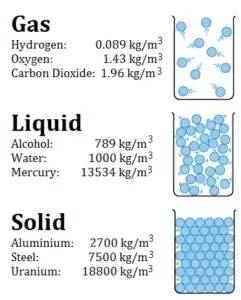
Density - Gas - Liquid - Solid

Density of Beryllium is 1.848g/cm3.

Typical densities of various substances are at atmospheric pressure.

Density is defined as the mass per unit volume. It is an intensive property, which is mathematically defined as mass divided by volume:

ρ = m/V

In words, the density (ρ) of a substance is the total mass (m) of that substance divided by the total volume (V) occupied by that substance. The standard SI unit is kilograms per cubic meter (kg/m3). The Standard English unit is pounds mass per cubic foot (lbm/ft3).

Density – Atomic Mass and Atomic Number Density

Since the density (ρ) of a substance is the total mass (m) of that substance divided by the total volume (V) occupied by that substance, it is obvious, the density of a substance strongly depends on its atomic mass and also on the atomic number density (N; atoms/cm3),

  • Atomic Weight. The atomic mass is carried by the atomic nucleus, which occupies only about 10-12 of the total volume of the atom or less, but it contains all the positive charge and at least 99.95% of the total mass of the atom. Therefore it is determined by the mass number (number of protons and neutrons).
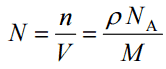
  • Atomic Number Density. The atomic number density (N; atoms/cm3), which is associated with atomic radii, is the number of atoms of a given type per unit volume (V; cm3) of the material. The atomic number density (N; atoms/cm3) of a pure material having atomic or molecular weight (M; grams/mol) and the material density (⍴; gram/cm3) is easily computed from the following equation using Avogadro’s number (NA = 6.022×10²³ atoms or molecules per mole):Atomic-Number-Density

Since nucleons (protons and neutrons) make up most of the mass of ordinary atoms, the density of normal matter tends to be limited by how closely we can pack these nucleons and depends on the internal atomic structure of a substance. The densest material found on earth is the metal osmium, but its density pales by comparison to the densities of exotic astronomical objects such as white dwarf stars and neutron stars.

If we include man made elements, the densest so far is Hassium. Hassium is a chemical element with symbol Hs and atomic number 108.  It is a synthetic element (first synthesised at Hasse in Germany) and radioactive. The most stable known isotope, 269Hs, has a half-life of approximately 9.7 seconds. It has an estimated density of 40.7 x 10³ kg/m3.  The density of Hassium results from its high atomic weight and from the significant decrease in ionic radii of the elements in the lanthanide series, known as lanthanide and actinide contraction.

Density – Pressure and Temperature

The density of a material varies with temperature and pressure. This variation is typically small for solids and liquids but much greater for gases. Most materials expand when their temperatures increase. Rising temperatures make the liquid expand in a liquid-in-tube thermometer and bend bimetallic strips. As a result of this expansion, the density of most materials decreases. This effect is caused by a decrease in the atomic number density. This dependence is usually expressed by the coefficient of linear or volume expansion.

Increasing the pressure on an material (especially for liquids or gases) decreases the volume of the object and thus increases its density via the atomic number density. Compressibility (also known as the coefficient of compressibility is a measure of the relative volume change of a fluid or solid as a response to a pressure (or mean stress) change.

See also: What is Density

See also: Densest Materials of the Earth
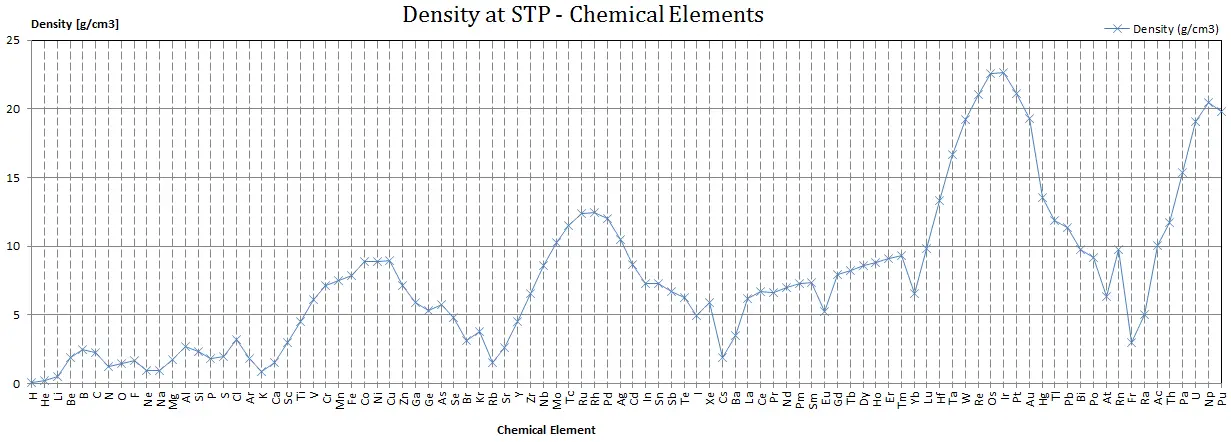
Density of chemical elements

Atomic Mass of Beryllium

Atomic mass of Beryllium is 9.0122 u. 

The atomic mass is the mass of an atom. The atomic mass or relative isotopic mass refers to the mass of a single particle, and therefore is tied to a certain specific isotope of an element. The atomic mass is carried by the atomic nucleus, which occupies only about 10-12 of the total volume of the atom or less, but it contains all the positive charge and at least 99.95% of the total mass of the atom. Note that, each element may contain more isotopes, therefore this resulting atomic mass is calculated from naturally-occuring isotopes and their abundance.

The size and mass of atoms are so small that the use of normal measuring units, while possible, is often inconvenient. Units of measure have been defined for mass and energy on the atomic scale to make measurements more convenient to express. The unit of measure for mass is the atomic mass unit (amu). One atomic mass unit is equal to 1.66 x 10⁻²⁴ grams. One unified atomic mass unit is approximately the mass of one nucleon (either a single proton or neutron) and is numerically equivalent to 1 g/mol.

For 12C the atomic mass is exactly 12u, since the atomic mass unit is defined from it. For other isotopes, the isotopic mass usually differs and is usually within 0.1 u of the mass number. For example, 63Cu (29 protons and 34 neutrons) has a mass number of 63 and an isotopic mass in its nuclear ground state is 62.91367 u.

There are two reasons for the difference between mass number and isotopic mass, known as the mass defect:

  1. The neutron is slightly heavier than the proton. This increases the mass of nuclei with more neutrons than protons relative to the atomic mass unit scale based on 12C with equal numbers of protons and neutrons.
  2. The nuclear binding energy varies between nuclei. A nucleus with greater binding energy has a lower total energy, and therefore a lower mass according to Einstein’s mass-energy equivalence relation E = mc2. For 63Cu the atomic mass is less than 63 so this must be the dominant factor.

Note that, it was found the rest mass of an atomic nucleus is measurably smaller than the sum of the rest masses of its constituent protons, neutrons and electrons. Mass was no longer considered unchangeable in the closed system. The difference is a measure of the nuclear binding energy which holds the nucleus together. According to the Einstein relationship (E=mc2), this binding energy is proportional to this mass difference and it is known as the mass defect.

See also: Atomic Mass Number – Does it conserve in a nuclear reaction?

Atomic Radius of Beryllium

The atomic radius of Beryllium atom is 96pm (covalent radius).

Atomic Radius of Chemical Elements

It must be noted, atoms lack a well-defined outer boundary. The atomic radius of a chemical element is a measure of the distance out to which the electron cloud extends from the nucleus. However, this assumes the atom to exhibit a spherical shape, which is only obeyed for atoms in vacuum or free space. Therefore, there are various non-equivalent definitions of atomic radius.

  • Van der Waals radius. In principle, Vana der Waals radius is half the minimum distance between the nuclei of two atoms of the element that are not bound to the same molecule.
  • Ionic radius. An ionic radius is one-half the distance between the nuclei of two ions in an ionic bond.
  • Covalent radius. Covalent radius is the nominal radius of the atoms of an element when covalently bound to other atoms.
  • Metallic radius. A metallic radius is one-half the distance between the nuclei of two adjacent atoms in a crystalline structure, when joined to other atoms by metallic bonds.

On the periodic table of the elements, atomic radius tends to increase when moving down columns, but decrease when moving across rows (left to right). Consequently, the smallest atom is helium with a radius of 32 pm, while one of the largest is caesium at 225 pm. The atomic radii decrease across the periodic table because as the atomic number increases, the number of protons increases across the period, but the extra electrons are only added to the same quantum shell. Therefore, the effective nuclear charge towards the outermost electrons increases, drawing the outermost electrons closer. As a result, the electron cloud contracts and the atomic radius decreases.
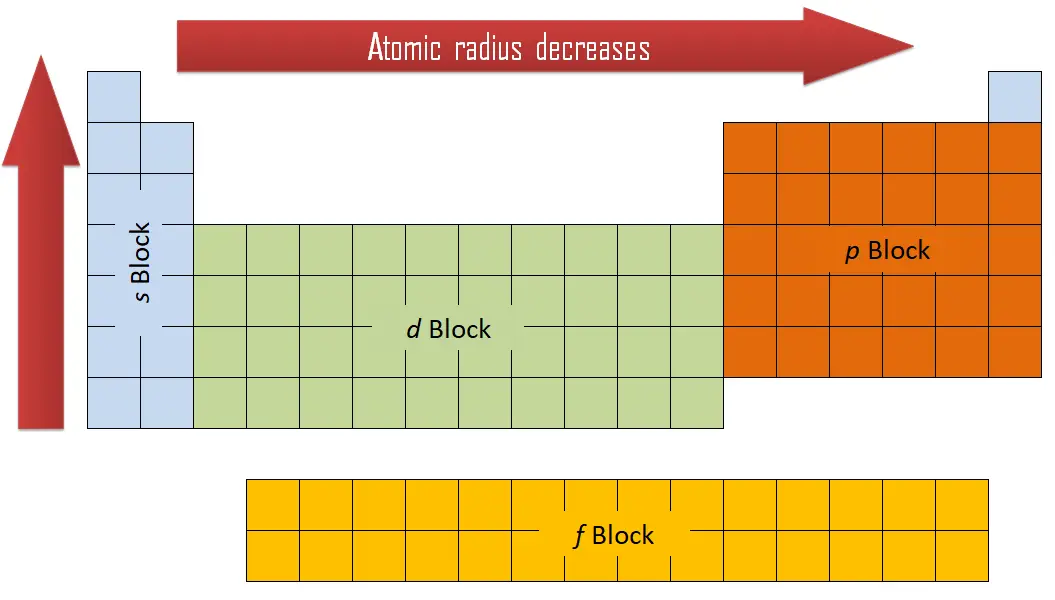
atomic radius - periodic tableThe volume of an atom is about 15 orders of magnitude larger than the volume of a nucleus. For uranium atom, the Van der Waals radius is about 186 pm = 1.86 ×10⁻¹⁰m. The Van der Waals radius, rw, of an atom is the radius of an imaginary hard sphere representing the distance of closest approach for another atom.  Assuming spherical shape, the uranium atom have volume of about  26.9 ×10⁻³⁰ m3. But this “huge” space is occupied primarily by electrons, because the nucleus occupies only about 1721×10−45 m3 of space. These electrons together weigh only a fraction (let say 0.05%) of entire atom.

It may seem, that the space and in fact the matter is empty, but it is not. Due to the quantum nature of electrons, the electrons are not point particles, they are smeared out over the whole atom. The classical description cannot be used to describe things on the atomic scale. On the atomic scale, physicists have found that quantum mechanics describes things very well on that scale. Particle locations in quantum mechanics are not at an exact position, they are described by a probability density function. Therefore the space in an atom (between electrons and an atomic nucleus) is not empty, but it is filled by a probability density function of electrons (usually known as  “electron cloud“).

Beryllium – Crystal Structure

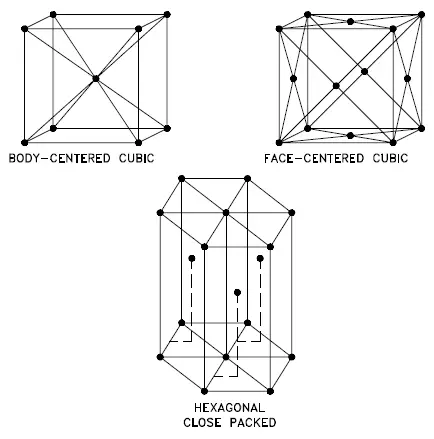
A possible crystal structure of Beryllium is hexagonal close-packed structure.
crystal structures - FCC, BCC, HCP

In metals, and in many other solids, the atoms are arranged in regular arrays called crystals. A crystal lattice is a repeating pattern of mathematical points that extends throughout space. The forces of chemical bonding causes this repetition. It is this repeated pattern which control properties like strength, ductility, density, conductivity (property of conducting or transmitting heat, electricity, etc.), and shape. There are 14 general types of such patterns known as Bravais lattices.

The three most common basic crystal patterns are:

  • Body-centered Cubic. In a body-centered cubic (BCC) arrangement of atoms, the unit cell consists of eight atoms at the corners of a cube and one atom at the body center of the cube. In a body-centered cubic arrangement, a unit cell contains (8 corner atoms × ⅛) + (1 center atom × 1) = 2 atoms. The packing is more efficient (68%) than simple cubic and the structure is a common one for alkali metals and early transition metals. Metals containing BCC structures include ferrite, chromium, vanadium, molybdenum, and tungsten. These metals possess high strength and low ductility.
  • Face-centered Cubic.In a face-centered cubic (FCC) arrangement of atoms, the unit cell consists of eight atoms at the corners of a cube and one atom at the center of each of the faces of the cube. In a face-centered cubic arrangement, a unit cell contains (8 corner atoms × ⅛) + (6 face atoms × ½) = 4 atoms. This structure, along with its hexagonal relative (hcp), has the most efficient packing (74%). Metals containing FCC structures include austenite, aluminum, copper, lead, silver, gold, nickel, platinum, and thorium. These metals possess low strength and high ductility.
  • Hexagonal Close-packed. In a hexagonal close-packed (HCP) arrangement of atoms, the unit cell consists of three layers of atoms. The top and bottom layers contain six atoms at the corners of a hexagon and one atom at the center of each hexagon. The middle layer contains three atoms nestled between the atoms of the top and bottom layers, hence, the name close-packed. Hexagonal close packed (hcp) is one of the two simple types of atomic packing with the highest density, the other being the face centered cubic (fcc). However, unlike the fcc, it is not a Bravais lattice as there are two nonequivalent sets of lattice points. Metals containing HCP structures include beryllium, magnesium, zinc, cadmium, cobalt, thallium, and zirconium. HCP metals are not as ductile as FCC metals.

–

Lithium – Density – Li

Periodic Table of Elements - density
1
H

Hydrogen

0.0899 g/cm3

2
He

Helium

0.1789 g/cm3

3
Li

Lithium

0.535 g/cm3

4
Be

Beryllium

1.848 g/cm3

5
B

Boron

2.46 g/cm3

6
C

Carbon

2.26 g/cm3

7
N

Nitrogen

1.251 g/cm3

8
O

Oxygen

1.429 g/cm3

9
F

Fluorine

1.696 g/cm3

10
Ne

Neon

0.9 g/cm3

11
Na

Sodium

0.968 g/cm3

12
Mg

Magnesium

1.738 g/cm3

13
Al

Aluminium

2.7 g/cm3

14
Si

Silicon

2.33 g/cm3

15
P

Phosphorus

1.823 g/cm3

16
S

Sulfur

1.96 g/cm3

17
Cl

Chlorine

3.214 g/cm3

18
Ar

Argon

1.784 g/cm3

19
K

Potassium

0.856 g/cm3

20
Ca

Calcium

1.55 g/cm3

21
Sc

Scandium

2.985 g/cm3

22
Ti

Titanium

4.507 g/cm3

23
V

Vanadium

6.11 g/cm3

24
Cr

Chromium

7.14 g/cm3

25
Mn

Manganese

7.47 g/cm3

26
Fe

Iron

7.874 g/cm3

27
Co

Cobalt

8.9 g/cm3

28
Ni

Nickel

8.908 g/cm3

29
Cu

Copper

8.92 g/cm3

30
Zn

Zinc

7.14 g/cm3

31
Ga

Gallium

5.904 g/cm3

32
Ge

Germanium

5.323 g/cm3

33
As

Arsenic

5.727 g/cm3

34
Se

Selenium

4.819 g/cm3

35
Br

Bromine

3.12 g/cm3

36
Kr

Krypton

3.75 g/cm3

37
Rb

Rubidium

1.532 g/cm3

38
Sr

Strontium

2.63 g/cm3

39
Y

Yttrium

4.472 g/cm3

40
Zr

Zirconium

6.511 g/cm3

41
Nb

Niobium

8.57 g/cm3

42
Mo

Molybdenum

10.28 g/cm3

43
Tc

Technetium

11.5 g/cm3

44
Ru

Ruthenium

12.37 g/cm3

45
Rh

Rhodium

12.45 g/cm3

46
Pd

Palladium

12.023 g/cm3

47
Ag

Silver

10.49 g/cm3

48
Cd

Cadmium

8.65 g/cm3

49
In

Indium

7.31 g/cm3

50
Sn

Tin

7.31 g/cm3

51
Sb

Antimony

6.697 g/cm3

52
Te

Tellurium

6.24 g/cm3

53
I

Iodine

4.94 g/cm3

54
Xe

Xenon

5.9 g/cm3

55
Cs

Caesium

1.879 g/cm3

56
Ba

Barium

3.51 g/cm3

57-71


Lanthanoids


72
Hf

Hafnium

13.31 g/cm3

73
Ta

Tantalum

16.65 g/cm3

74
W

Tungsten

19.25 g/cm3

75
Re

Rhenium

21.02 g/cm3

76
Os

Osmium

22.61 g/cm3

77
Ir

Iridium

22.65 g/cm3

78
Pt

Platinum

21.09 g/cm3

79
Au

Gold

19.3 g/cm3

80
Hg

Mercury

13.534 g/cm3

81
Tl

Thallium

11.85 g/cm3

82
Pb

Lead

11.34 g/cm3

83
Bi

Bismuth

9.78 g/cm3

84
Po

Polonium

9.196 g/cm3

85
At

Astatine

6.4 g/cm3

86
Rn

Radon

9.73 g/cm3

87
Fr

Francium


88
Ra

Radium

5.5 g/cm3

89-103


Actinoids


104
Rf

Rutherfordium

23.2 g/cm3

105
Db

Dubnium

29.3 g/cm3

106
Sg

Seaborgium

35 g/cm3

107
Bh

Bohrium

37 g/cm3

108
Hs

Hassium

41 g/cm3

109
Mt

Meitnerium

37.4 g/cm3

110
Ds

Darmstadtium

34.8 g/cm3

111
Rg

Roentgenium

28.7 g/cm3

112
Cn

Copernicium

23.7 g/cm3

113
Nh

Nihonium

16 g/cm3

114
Fl

Flerovium

14 g/cm3

115
Mc

Moscovium

13.5 g/cm3

116
Lv

Livermorium

12.9 g/cm3

117
Ts

Tennessine

7.2 g/cm3

118
Og

Oganesson


57
La

Lanthanum

6.146 g/cm3

58
Ce

Cerium

6.689 g/cm3

59
Pr

Praseodymium

6.64 g/cm3

60
Nd

Neodymium

7.01 g/cm3

61
Pm

Promethium

7.264 g/cm3

62
Sm

Samarium

7.353 g/cm3

63
Eu

Europium

5.244 g/cm3

64
Gd

Gadolinium

7.901 g/cm3

65
Tb

Terbium

8.219 g/cm3

66
Dy

Dysprosium

8.551 g/cm3

67
Ho

Holmium

8.795 g/cm3

68
Er

Erbium

9.066 g/cm3

69
Th

Thulium

9.321 g/cm3

70
Yb

Ytterbium

6.57 g/cm3

71
Lu

Lutetium

9.841 g/cm3

89
Ac

Actinium

10.07 g/cm3

90
Th

Thorium

11.724 g/cm3

91
Pa

Protactinium

15.37 g/cm3

92
U

Uranium

19.05 g/cm3

93
Np

Neptunium

20.45 g/cm3

94
Pu

Plutonium

19.816 g/cm3

95
Am

Americium

13.78 g/cm3

96
Cm

Curium

13.51 g/cm3

97
Bk

Berkelium

14.78 g/cm3

98
Cf

Californium

15.1 g/cm3

99
Es

Einsteinium

8.84 g/cm3

100
Fm

Fermium


101
Md

Mendelevium

10.3 g/cm3

102
No

Nobelium

9.9 g/cm3

103
Lr

Lawrencium

16 g/cm3

Density of Lithium

Density - Gas - Liquid - Solid

Density of Lithium is 0.535g/cm3.

Typical densities of various substances are at atmospheric pressure.

Density is defined as the mass per unit volume. It is an intensive property, which is mathematically defined as mass divided by volume:

ρ = m/V

In words, the density (ρ) of a substance is the total mass (m) of that substance divided by the total volume (V) occupied by that substance. The standard SI unit is kilograms per cubic meter (kg/m3). The Standard English unit is pounds mass per cubic foot (lbm/ft3).

Density – Atomic Mass and Atomic Number Density

Since the density (ρ) of a substance is the total mass (m) of that substance divided by the total volume (V) occupied by that substance, it is obvious, the density of a substance strongly depends on its atomic mass and also on the atomic number density (N; atoms/cm3),

  • Atomic Weight. The atomic mass is carried by the atomic nucleus, which occupies only about 10-12 of the total volume of the atom or less, but it contains all the positive charge and at least 99.95% of the total mass of the atom. Therefore it is determined by the mass number (number of protons and neutrons).
  • Atomic Number Density. The atomic number density (N; atoms/cm3), which is associated with atomic radii, is the number of atoms of a given type per unit volume (V; cm3) of the material. The atomic number density (N; atoms/cm3) of a pure material having atomic or molecular weight (M; grams/mol) and the material density (⍴; gram/cm3) is easily computed from the following equation using Avogadro’s number (NA = 6.022×10²³ atoms or molecules per mole):Atomic-Number-Density

Since nucleons (protons and neutrons) make up most of the mass of ordinary atoms, the density of normal matter tends to be limited by how closely we can pack these nucleons and depends on the internal atomic structure of a substance. The densest material found on earth is the metal osmium, but its density pales by comparison to the densities of exotic astronomical objects such as white dwarf stars and neutron stars.

If we include man made elements, the densest so far is Hassium. Hassium is a chemical element with symbol Hs and atomic number 108.  It is a synthetic element (first synthesised at Hasse in Germany) and radioactive. The most stable known isotope, 269Hs, has a half-life of approximately 9.7 seconds. It has an estimated density of 40.7 x 10³ kg/m3.  The density of Hassium results from its high atomic weight and from the significant decrease in ionic radii of the elements in the lanthanide series, known as lanthanide and actinide contraction.

Density – Pressure and Temperature

The density of a material varies with temperature and pressure. This variation is typically small for solids and liquids but much greater for gases. Most materials expand when their temperatures increase. Rising temperatures make the liquid expand in a liquid-in-tube thermometer and bend bimetallic strips. As a result of this expansion, the density of most materials decreases. This effect is caused by a decrease in the atomic number density. This dependence is usually expressed by the coefficient of linear or volume expansion.

Increasing the pressure on an material (especially for liquids or gases) decreases the volume of the object and thus increases its density via the atomic number density. Compressibility (also known as the coefficient of compressibility is a measure of the relative volume change of a fluid or solid as a response to a pressure (or mean stress) change.

See also: What is Density

See also: Densest Materials of the Earth

Density of chemical elements

Atomic Mass of Lithium

Atomic mass of Lithium is 6.941 u. 

The atomic mass is the mass of an atom. The atomic mass or relative isotopic mass refers to the mass of a single particle, and therefore is tied to a certain specific isotope of an element. The atomic mass is carried by the atomic nucleus, which occupies only about 10-12 of the total volume of the atom or less, but it contains all the positive charge and at least 99.95% of the total mass of the atom. Note that, each element may contain more isotopes, therefore this resulting atomic mass is calculated from naturally-occuring isotopes and their abundance.

The size and mass of atoms are so small that the use of normal measuring units, while possible, is often inconvenient. Units of measure have been defined for mass and energy on the atomic scale to make measurements more convenient to express. The unit of measure for mass is the atomic mass unit (amu). One atomic mass unit is equal to 1.66 x 10⁻²⁴ grams. One unified atomic mass unit is approximately the mass of one nucleon (either a single proton or neutron) and is numerically equivalent to 1 g/mol.

For 12C the atomic mass is exactly 12u, since the atomic mass unit is defined from it. For other isotopes, the isotopic mass usually differs and is usually within 0.1 u of the mass number. For example, 63Cu (29 protons and 34 neutrons) has a mass number of 63 and an isotopic mass in its nuclear ground state is 62.91367 u.

There are two reasons for the difference between mass number and isotopic mass, known as the mass defect:

  1. The neutron is slightly heavier than the proton. This increases the mass of nuclei with more neutrons than protons relative to the atomic mass unit scale based on 12C with equal numbers of protons and neutrons.
  2. The nuclear binding energy varies between nuclei. A nucleus with greater binding energy has a lower total energy, and therefore a lower mass according to Einstein’s mass-energy equivalence relation E = mc2. For 63Cu the atomic mass is less than 63 so this must be the dominant factor.

Note that, it was found the rest mass of an atomic nucleus is measurably smaller than the sum of the rest masses of its constituent protons, neutrons and electrons. Mass was no longer considered unchangeable in the closed system. The difference is a measure of the nuclear binding energy which holds the nucleus together. According to the Einstein relationship (E=mc2), this binding energy is proportional to this mass difference and it is known as the mass defect.

See also: Atomic Mass Number – Does it conserve in a nuclear reaction?

Atomic Radius of Lithium

The atomic radius of Lithium atom is 128pm (covalent radius).

Atomic Radius of Chemical Elements

It must be noted, atoms lack a well-defined outer boundary. The atomic radius of a chemical element is a measure of the distance out to which the electron cloud extends from the nucleus. However, this assumes the atom to exhibit a spherical shape, which is only obeyed for atoms in vacuum or free space. Therefore, there are various non-equivalent definitions of atomic radius.

  • Van der Waals radius. In principle, Vana der Waals radius is half the minimum distance between the nuclei of two atoms of the element that are not bound to the same molecule.
  • Ionic radius. An ionic radius is one-half the distance between the nuclei of two ions in an ionic bond.
  • Covalent radius. Covalent radius is the nominal radius of the atoms of an element when covalently bound to other atoms.
  • Metallic radius. A metallic radius is one-half the distance between the nuclei of two adjacent atoms in a crystalline structure, when joined to other atoms by metallic bonds.

On the periodic table of the elements, atomic radius tends to increase when moving down columns, but decrease when moving across rows (left to right). Consequently, the smallest atom is helium with a radius of 32 pm, while one of the largest is caesium at 225 pm. The atomic radii decrease across the periodic table because as the atomic number increases, the number of protons increases across the period, but the extra electrons are only added to the same quantum shell. Therefore, the effective nuclear charge towards the outermost electrons increases, drawing the outermost electrons closer. As a result, the electron cloud contracts and the atomic radius decreases.

atomic radius - periodic tableThe volume of an atom is about 15 orders of magnitude larger than the volume of a nucleus. For uranium atom, the Van der Waals radius is about 186 pm = 1.86 ×10⁻¹⁰m. The Van der Waals radius, rw, of an atom is the radius of an imaginary hard sphere representing the distance of closest approach for another atom.  Assuming spherical shape, the uranium atom have volume of about  26.9 ×10⁻³⁰ m3. But this “huge” space is occupied primarily by electrons, because the nucleus occupies only about 1721×10−45 m3 of space. These electrons together weigh only a fraction (let say 0.05%) of entire atom.

It may seem, that the space and in fact the matter is empty, but it is not. Due to the quantum nature of electrons, the electrons are not point particles, they are smeared out over the whole atom. The classical description cannot be used to describe things on the atomic scale. On the atomic scale, physicists have found that quantum mechanics describes things very well on that scale. Particle locations in quantum mechanics are not at an exact position, they are described by a probability density function. Therefore the space in an atom (between electrons and an atomic nucleus) is not empty, but it is filled by a probability density function of electrons (usually known as  “electron cloud“).

Lithium – Crystal Structure

A possible crystal structure of Lithium is body-centered cubic structure.

crystal structures - FCC, BCC, HCP

In metals, and in many other solids, the atoms are arranged in regular arrays called crystals. A crystal lattice is a repeating pattern of mathematical points that extends throughout space. The forces of chemical bonding causes this repetition. It is this repeated pattern which control properties like strength, ductility, density, conductivity (property of conducting or transmitting heat, electricity, etc.), and shape. There are 14 general types of such patterns known as Bravais lattices.

The three most common basic crystal patterns are:

  • Body-centered Cubic. In a body-centered cubic (BCC) arrangement of atoms, the unit cell consists of eight atoms at the corners of a cube and one atom at the body center of the cube. In a body-centered cubic arrangement, a unit cell contains (8 corner atoms × ⅛) + (1 center atom × 1) = 2 atoms. The packing is more efficient (68%) than simple cubic and the structure is a common one for alkali metals and early transition metals. Metals containing BCC structures include ferrite, chromium, vanadium, molybdenum, and tungsten. These metals possess high strength and low ductility.
  • Face-centered Cubic.In a face-centered cubic (FCC) arrangement of atoms, the unit cell consists of eight atoms at the corners of a cube and one atom at the center of each of the faces of the cube. In a face-centered cubic arrangement, a unit cell contains (8 corner atoms × ⅛) + (6 face atoms × ½) = 4 atoms. This structure, along with its hexagonal relative (hcp), has the most efficient packing (74%). Metals containing FCC structures include austenite, aluminum, copper, lead, silver, gold, nickel, platinum, and thorium. These metals possess low strength and high ductility.
  • Hexagonal Close-packed. In a hexagonal close-packed (HCP) arrangement of atoms, the unit cell consists of three layers of atoms. The top and bottom layers contain six atoms at the corners of a hexagon and one atom at the center of each hexagon. The middle layer contains three atoms nestled between the atoms of the top and bottom layers, hence, the name close-packed. Hexagonal close packed (hcp) is one of the two simple types of atomic packing with the highest density, the other being the face centered cubic (fcc). However, unlike the fcc, it is not a Bravais lattice as there are two nonequivalent sets of lattice points. Metals containing HCP structures include beryllium, magnesium, zinc, cadmium, cobalt, thallium, and zirconium. HCP metals are not as ductile as FCC metals.

–
Helium – Density – He

Periodic Table of Elements - density
1
H

Hydrogen

0.0899 g/cm3

2
He

Helium

0.1789 g/cm3

3
Li

Lithium

0.535 g/cm3

4
Be

Beryllium

1.848 g/cm3

5
B

Boron

2.46 g/cm3

6
C

Carbon

2.26 g/cm3

7
N

Nitrogen

1.251 g/cm3

8
O

Oxygen

1.429 g/cm3

9
F

Fluorine

1.696 g/cm3

10
Ne

Neon

0.9 g/cm3

11
Na

Sodium

0.968 g/cm3

12
Mg

Magnesium

1.738 g/cm3

13
Al

Aluminium

2.7 g/cm3

14
Si

Silicon

2.33 g/cm3

15
P

Phosphorus

1.823 g/cm3

16
S

Sulfur

1.96 g/cm3

17
Cl

Chlorine

3.214 g/cm3

18
Ar

Argon

1.784 g/cm3

19
K

Potassium

0.856 g/cm3

20
Ca

Calcium

1.55 g/cm3

21
Sc

Scandium

2.985 g/cm3

22
Ti

Titanium

4.507 g/cm3

23
V

Vanadium

6.11 g/cm3

24
Cr

Chromium

7.14 g/cm3

25
Mn

Manganese

7.47 g/cm3

26
Fe

Iron

7.874 g/cm3

27
Co

Cobalt

8.9 g/cm3

28
Ni

Nickel

8.908 g/cm3

29
Cu

Copper

8.92 g/cm3

30
Zn

Zinc

7.14 g/cm3

31
Ga

Gallium

5.904 g/cm3

32
Ge

Germanium

5.323 g/cm3

33
As

Arsenic

5.727 g/cm3

34
Se

Selenium

4.819 g/cm3

35
Br

Bromine

3.12 g/cm3

36
Kr

Krypton

3.75 g/cm3

37
Rb

Rubidium

1.532 g/cm3

38
Sr

Strontium

2.63 g/cm3

39
Y

Yttrium

4.472 g/cm3

40
Zr

Zirconium

6.511 g/cm3

41
Nb

Niobium

8.57 g/cm3

42
Mo

Molybdenum

10.28 g/cm3

43
Tc

Technetium

11.5 g/cm3

44
Ru

Ruthenium

12.37 g/cm3

45
Rh

Rhodium

12.45 g/cm3

46
Pd

Palladium

12.023 g/cm3

47
Ag

Silver

10.49 g/cm3

48
Cd

Cadmium

8.65 g/cm3

49
In

Indium

7.31 g/cm3

50
Sn

Tin

7.31 g/cm3

51
Sb

Antimony

6.697 g/cm3

52
Te

Tellurium

6.24 g/cm3

53
I

Iodine

4.94 g/cm3

54
Xe

Xenon

5.9 g/cm3

55
Cs

Caesium

1.879 g/cm3

56
Ba

Barium

3.51 g/cm3

57-71


Lanthanoids


72
Hf

Hafnium

13.31 g/cm3

73
Ta

Tantalum

16.65 g/cm3

74
W

Tungsten

19.25 g/cm3

75
Re

Rhenium

21.02 g/cm3

76
Os

Osmium

22.61 g/cm3

77
Ir

Iridium

22.65 g/cm3

78
Pt

Platinum

21.09 g/cm3

79
Au

Gold

19.3 g/cm3

80
Hg

Mercury

13.534 g/cm3

81
Tl

Thallium

11.85 g/cm3

82
Pb

Lead

11.34 g/cm3

83
Bi

Bismuth

9.78 g/cm3

84
Po

Polonium

9.196 g/cm3

85
At

Astatine

6.4 g/cm3

86
Rn

Radon

9.73 g/cm3

87
Fr

Francium


88
Ra

Radium

5.5 g/cm3

89-103


Actinoids


104
Rf

Rutherfordium

23.2 g/cm3

105
Db

Dubnium

29.3 g/cm3

106
Sg

Seaborgium

35 g/cm3

107
Bh

Bohrium

37 g/cm3

108
Hs

Hassium

41 g/cm3

109
Mt

Meitnerium

37.4 g/cm3

110
Ds

Darmstadtium

34.8 g/cm3

111
Rg

Roentgenium

28.7 g/cm3

112
Cn

Copernicium

23.7 g/cm3

113
Nh

Nihonium

16 g/cm3

114
Fl

Flerovium

14 g/cm3

115
Mc

Moscovium

13.5 g/cm3

116
Lv

Livermorium

12.9 g/cm3

117
Ts

Tennessine

7.2 g/cm3

118
Og

Oganesson


57
La

Lanthanum

6.146 g/cm3

58
Ce

Cerium

6.689 g/cm3

59
Pr

Praseodymium

6.64 g/cm3

60
Nd

Neodymium

7.01 g/cm3

61
Pm

Promethium

7.264 g/cm3

62
Sm

Samarium

7.353 g/cm3

63
Eu

Europium

5.244 g/cm3

64
Gd

Gadolinium

7.901 g/cm3

65
Tb

Terbium

8.219 g/cm3

66
Dy

Dysprosium

8.551 g/cm3

67
Ho

Holmium

8.795 g/cm3

68
Er

Erbium

9.066 g/cm3

69
Th

Thulium

9.321 g/cm3

70
Yb

Ytterbium

6.57 g/cm3

71
Lu

Lutetium

9.841 g/cm3

89
Ac

Actinium

10.07 g/cm3

90
Th

Thorium

11.724 g/cm3

91
Pa

Protactinium

15.37 g/cm3

92
U

Uranium

19.05 g/cm3

93
Np

Neptunium

20.45 g/cm3

94
Pu

Plutonium

19.816 g/cm3

95
Am

Americium

13.78 g/cm3

96
Cm

Curium

13.51 g/cm3

97
Bk

Berkelium

14.78 g/cm3

98
Cf

Californium

15.1 g/cm3

99
Es

Einsteinium

8.84 g/cm3

100
Fm

Fermium


101
Md

Mendelevium

10.3 g/cm3

102
No

Nobelium

9.9 g/cm3

103
Lr

Lawrencium

16 g/cm3

Density of Helium

Density - Gas - Liquid - Solid

Density of Helium is 0.1785g/cm3.

Typical densities of various substances are at atmospheric pressure.

Density is defined as the mass per unit volume. It is an intensive property, which is mathematically defined as mass divided by volume:

ρ = m/V

In words, the density (ρ) of a substance is the total mass (m) of that substance divided by the total volume (V) occupied by that substance. The standard SI unit is kilograms per cubic meter (kg/m3). The Standard English unit is pounds mass per cubic foot (lbm/ft3).

Density – Atomic Mass and Atomic Number Density

Since the density (ρ) of a substance is the total mass (m) of that substance divided by the total volume (V) occupied by that substance, it is obvious, the density of a substance strongly depends on its atomic mass and also on the atomic number density (N; atoms/cm3),

  • Atomic Weight. The atomic mass is carried by the atomic nucleus, which occupies only about 10-12 of the total volume of the atom or less, but it contains all the positive charge and at least 99.95% of the total mass of the atom. Therefore it is determined by the mass number (number of protons and neutrons).
  • Atomic Number Density. The atomic number density (N; atoms/cm3), which is associated with atomic radii, is the number of atoms of a given type per unit volume (V; cm3) of the material. The atomic number density (N; atoms/cm3) of a pure material having atomic or molecular weight (M; grams/mol) and the material density (⍴; gram/cm3) is easily computed from the following equation using Avogadro’s number (NA = 6.022×10²³ atoms or molecules per mole):Atomic-Number-Density

Since nucleons (protons and neutrons) make up most of the mass of ordinary atoms, the density of normal matter tends to be limited by how closely we can pack these nucleons and depends on the internal atomic structure of a substance. The densest material found on earth is the metal osmium, but its density pales by comparison to the densities of exotic astronomical objects such as white dwarf stars and neutron stars.

If we include man made elements, the densest so far is Hassium. Hassium is a chemical element with symbol Hs and atomic number 108.  It is a synthetic element (first synthesised at Hasse in Germany) and radioactive. The most stable known isotope, 269Hs, has a half-life of approximately 9.7 seconds. It has an estimated density of 40.7 x 10³ kg/m3.  The density of Hassium results from its high atomic weight and from the significant decrease in ionic radii of the elements in the lanthanide series, known as lanthanide and actinide contraction.

Density – Pressure and Temperature

The density of a material varies with temperature and pressure. This variation is typically small for solids and liquids but much greater for gases. Most materials expand when their temperatures increase. Rising temperatures make the liquid expand in a liquid-in-tube thermometer and bend bimetallic strips. As a result of this expansion, the density of most materials decreases. This effect is caused by a decrease in the atomic number density. This dependence is usually expressed by the coefficient of linear or volume expansion.

Increasing the pressure on an material (especially for liquids or gases) decreases the volume of the object and thus increases its density via the atomic number density. Compressibility (also known as the coefficient of compressibility is a measure of the relative volume change of a fluid or solid as a response to a pressure (or mean stress) change.

See also: What is Density

See also: Densest Materials of the Earth

Density of chemical elements

Atomic Mass of Helium

Atomic mass of Helium is 4.0026 u. 

The atomic mass is the mass of an atom. The atomic mass or relative isotopic mass refers to the mass of a single particle, and therefore is tied to a certain specific isotope of an element. The atomic mass is carried by the atomic nucleus, which occupies only about 10-12 of the total volume of the atom or less, but it contains all the positive charge and at least 99.95% of the total mass of the atom. Note that, each element may contain more isotopes, therefore this resulting atomic mass is calculated from naturally-occuring isotopes and their abundance.

The size and mass of atoms are so small that the use of normal measuring units, while possible, is often inconvenient. Units of measure have been defined for mass and energy on the atomic scale to make measurements more convenient to express. The unit of measure for mass is the atomic mass unit (amu). One atomic mass unit is equal to 1.66 x 10⁻²⁴ grams. One unified atomic mass unit is approximately the mass of one nucleon (either a single proton or neutron) and is numerically equivalent to 1 g/mol.

For 12C the atomic mass is exactly 12u, since the atomic mass unit is defined from it. For other isotopes, the isotopic mass usually differs and is usually within 0.1 u of the mass number. For example, 63Cu (29 protons and 34 neutrons) has a mass number of 63 and an isotopic mass in its nuclear ground state is 62.91367 u.

There are two reasons for the difference between mass number and isotopic mass, known as the mass defect:

  1. The neutron is slightly heavier than the proton. This increases the mass of nuclei with more neutrons than protons relative to the atomic mass unit scale based on 12C with equal numbers of protons and neutrons.
  2. The nuclear binding energy varies between nuclei. A nucleus with greater binding energy has a lower total energy, and therefore a lower mass according to Einstein’s mass-energy equivalence relation E = mc2. For 63Cu the atomic mass is less than 63 so this must be the dominant factor.

Note that, it was found the rest mass of an atomic nucleus is measurably smaller than the sum of the rest masses of its constituent protons, neutrons and electrons. Mass was no longer considered unchangeable in the closed system. The difference is a measure of the nuclear binding energy which holds the nucleus together. According to the Einstein relationship (E=mc2), this binding energy is proportional to this mass difference and it is known as the mass defect.

See also: Atomic Mass Number – Does it conserve in a nuclear reaction?

Atomic Radius of Helium

The atomic radius of Helium atom is 28pm (covalent radius).

Atomic Radius of Chemical Elements

It must be noted, atoms lack a well-defined outer boundary. The atomic radius of a chemical element is a measure of the distance out to which the electron cloud extends from the nucleus. However, this assumes the atom to exhibit a spherical shape, which is only obeyed for atoms in vacuum or free space. Therefore, there are various non-equivalent definitions of atomic radius.

  • Van der Waals radius. In principle, Vana der Waals radius is half the minimum distance between the nuclei of two atoms of the element that are not bound to the same molecule.
  • Ionic radius. An ionic radius is one-half the distance between the nuclei of two ions in an ionic bond.
  • Covalent radius. Covalent radius is the nominal radius of the atoms of an element when covalently bound to other atoms.
  • Metallic radius. A metallic radius is one-half the distance between the nuclei of two adjacent atoms in a crystalline structure, when joined to other atoms by metallic bonds.

On the periodic table of the elements, atomic radius tends to increase when moving down columns, but decrease when moving across rows (left to right). Consequently, the smallest atom is helium with a radius of 32 pm, while one of the largest is caesium at 225 pm. The atomic radii decrease across the periodic table because as the atomic number increases, the number of protons increases across the period, but the extra electrons are only added to the same quantum shell. Therefore, the effective nuclear charge towards the outermost electrons increases, drawing the outermost electrons closer. As a result, the electron cloud contracts and the atomic radius decreases.

atomic radius - periodic tableThe volume of an atom is about 15 orders of magnitude larger than the volume of a nucleus. For uranium atom, the Van der Waals radius is about 186 pm = 1.86 ×10⁻¹⁰m. The Van der Waals radius, rw, of an atom is the radius of an imaginary hard sphere representing the distance of closest approach for another atom.  Assuming spherical shape, the uranium atom have volume of about  26.9 ×10⁻³⁰ m3. But this “huge” space is occupied primarily by electrons, because the nucleus occupies only about 1721×10−45 m3 of space. These electrons together weigh only a fraction (let say 0.05%) of entire atom.

It may seem, that the space and in fact the matter is empty, but it is not. Due to the quantum nature of electrons, the electrons are not point particles, they are smeared out over the whole atom. The classical description cannot be used to describe things on the atomic scale. On the atomic scale, physicists have found that quantum mechanics describes things very well on that scale. Particle locations in quantum mechanics are not at an exact position, they are described by a probability density function. Therefore the space in an atom (between electrons and an atomic nucleus) is not empty, but it is filled by a probability density function of electrons (usually known as  “electron cloud“).

Helium – Crystal Structure

A possible crystal structure of Helium is hexagonal close-packed structure.

crystal structures - FCC, BCC, HCP

In metals, and in many other solids, the atoms are arranged in regular arrays called crystals. A crystal lattice is a repeating pattern of mathematical points that extends throughout space. The forces of chemical bonding causes this repetition. It is this repeated pattern which control properties like strength, ductility, density, conductivity (property of conducting or transmitting heat, electricity, etc.), and shape. There are 14 general types of such patterns known as Bravais lattices.

The three most common basic crystal patterns are:

  • Body-centered Cubic. In a body-centered cubic (BCC) arrangement of atoms, the unit cell consists of eight atoms at the corners of a cube and one atom at the body center of the cube. In a body-centered cubic arrangement, a unit cell contains (8 corner atoms × ⅛) + (1 center atom × 1) = 2 atoms. The packing is more efficient (68%) than simple cubic and the structure is a common one for alkali metals and early transition metals. Metals containing BCC structures include ferrite, chromium, vanadium, molybdenum, and tungsten. These metals possess high strength and low ductility.
  • Face-centered Cubic.In a face-centered cubic (FCC) arrangement of atoms, the unit cell consists of eight atoms at the corners of a cube and one atom at the center of each of the faces of the cube. In a face-centered cubic arrangement, a unit cell contains (8 corner atoms × ⅛) + (6 face atoms × ½) = 4 atoms. This structure, along with its hexagonal relative (hcp), has the most efficient packing (74%). Metals containing FCC structures include austenite, aluminum, copper, lead, silver, gold, nickel, platinum, and thorium. These metals possess low strength and high ductility.
  • Hexagonal Close-packed. In a hexagonal close-packed (HCP) arrangement of atoms, the unit cell consists of three layers of atoms. The top and bottom layers contain six atoms at the corners of a hexagon and one atom at the center of each hexagon. The middle layer contains three atoms nestled between the atoms of the top and bottom layers, hence, the name close-packed. Hexagonal close packed (hcp) is one of the two simple types of atomic packing with the highest density, the other being the face centered cubic (fcc). However, unlike the fcc, it is not a Bravais lattice as there are two nonequivalent sets of lattice points. Metals containing HCP structures include beryllium, magnesium, zinc, cadmium, cobalt, thallium, and zirconium. HCP metals are not as ductile as FCC metals.

–

Hydrogen – Density – H

Periodic Table of Elements - density
1
H

Hydrogen

0.0899 g/cm3

2
He

Helium

0.1789 g/cm3

3
Li

Lithium

0.535 g/cm3

4
Be

Beryllium

1.848 g/cm3

5
B

Boron

2.46 g/cm3

6
C

Carbon

2.26 g/cm3

7
N

Nitrogen

1.251 g/cm3

8
O

Oxygen

1.429 g/cm3

9
F

Fluorine

1.696 g/cm3

10
Ne

Neon

0.9 g/cm3

11
Na

Sodium

0.968 g/cm3

12
Mg

Magnesium

1.738 g/cm3

13
Al

Aluminium

2.7 g/cm3

14
Si

Silicon

2.33 g/cm3

15
P

Phosphorus

1.823 g/cm3

16
S

Sulfur

1.96 g/cm3

17
Cl

Chlorine

3.214 g/cm3

18
Ar

Argon

1.784 g/cm3

19
K

Potassium

0.856 g/cm3

20
Ca

Calcium

1.55 g/cm3

21
Sc

Scandium

2.985 g/cm3

22
Ti

Titanium

4.507 g/cm3

23
V

Vanadium

6.11 g/cm3

24
Cr

Chromium

7.14 g/cm3

25
Mn

Manganese

7.47 g/cm3

26
Fe

Iron

7.874 g/cm3

27
Co

Cobalt

8.9 g/cm3

28
Ni

Nickel

8.908 g/cm3

29
Cu

Copper

8.92 g/cm3

30
Zn

Zinc

7.14 g/cm3

31
Ga

Gallium

5.904 g/cm3

32
Ge

Germanium

5.323 g/cm3

33
As

Arsenic

5.727 g/cm3

34
Se

Selenium

4.819 g/cm3

35
Br

Bromine

3.12 g/cm3

36
Kr

Krypton

3.75 g/cm3

37
Rb

Rubidium

1.532 g/cm3

38
Sr

Strontium

2.63 g/cm3

39
Y

Yttrium

4.472 g/cm3

40
Zr

Zirconium

6.511 g/cm3

41
Nb

Niobium

8.57 g/cm3

42
Mo

Molybdenum

10.28 g/cm3

43
Tc

Technetium

11.5 g/cm3

44
Ru

Ruthenium

12.37 g/cm3

45
Rh

Rhodium

12.45 g/cm3

46
Pd

Palladium

12.023 g/cm3

47
Ag

Silver

10.49 g/cm3

48
Cd

Cadmium

8.65 g/cm3

49
In

Indium

7.31 g/cm3

50
Sn

Tin

7.31 g/cm3

51
Sb

Antimony

6.697 g/cm3

52
Te

Tellurium

6.24 g/cm3

53
I

Iodine

4.94 g/cm3

54
Xe

Xenon

5.9 g/cm3

55
Cs

Caesium

1.879 g/cm3

56
Ba

Barium

3.51 g/cm3

57-71


Lanthanoids


72
Hf

Hafnium

13.31 g/cm3

73
Ta

Tantalum

16.65 g/cm3

74
W

Tungsten

19.25 g/cm3

75
Re

Rhenium

21.02 g/cm3

76
Os

Osmium

22.61 g/cm3

77
Ir

Iridium

22.65 g/cm3

78
Pt

Platinum

21.09 g/cm3

79
Au

Gold

19.3 g/cm3

80
Hg

Mercury

13.534 g/cm3

81
Tl

Thallium

11.85 g/cm3

82
Pb

Lead

11.34 g/cm3

83
Bi

Bismuth

9.78 g/cm3

84
Po

Polonium

9.196 g/cm3

85
At

Astatine

6.4 g/cm3

86
Rn

Radon

9.73 g/cm3

87
Fr

Francium


88
Ra

Radium

5.5 g/cm3

89-103


Actinoids


104
Rf

Rutherfordium

23.2 g/cm3

105
Db

Dubnium

29.3 g/cm3

106
Sg

Seaborgium

35 g/cm3

107
Bh

Bohrium

37 g/cm3

108
Hs

Hassium

41 g/cm3

109
Mt

Meitnerium

37.4 g/cm3

110
Ds

Darmstadtium

34.8 g/cm3

111
Rg

Roentgenium

28.7 g/cm3

112
Cn

Copernicium

23.7 g/cm3

113
Nh

Nihonium

16 g/cm3

114
Fl

Flerovium

14 g/cm3

115
Mc

Moscovium

13.5 g/cm3

116
Lv

Livermorium

12.9 g/cm3

117
Ts

Tennessine

7.2 g/cm3

118
Og

Oganesson


57
La

Lanthanum

6.146 g/cm3

58
Ce

Cerium

6.689 g/cm3

59
Pr

Praseodymium

6.64 g/cm3

60
Nd

Neodymium

7.01 g/cm3

61
Pm

Promethium

7.264 g/cm3

62
Sm

Samarium

7.353 g/cm3

63
Eu

Europium

5.244 g/cm3

64
Gd

Gadolinium

7.901 g/cm3

65
Tb

Terbium

8.219 g/cm3

66
Dy

Dysprosium

8.551 g/cm3

67
Ho

Holmium

8.795 g/cm3

68
Er

Erbium

9.066 g/cm3

69
Th

Thulium

9.321 g/cm3

70
Yb

Ytterbium

6.57 g/cm3

71
Lu

Lutetium

9.841 g/cm3

89
Ac

Actinium

10.07 g/cm3

90
Th

Thorium

11.724 g/cm3

91
Pa

Protactinium

15.37 g/cm3

92
U

Uranium

19.05 g/cm3

93
Np

Neptunium

20.45 g/cm3

94
Pu

Plutonium

19.816 g/cm3

95
Am

Americium

13.78 g/cm3

96
Cm

Curium

13.51 g/cm3

97
Bk

Berkelium

14.78 g/cm3

98
Cf

Californium

15.1 g/cm3

99
Es

Einsteinium

8.84 g/cm3

100
Fm

Fermium


101
Md

Mendelevium

10.3 g/cm3

102
No

Nobelium

9.9 g/cm3

103
Lr

Lawrencium

16 g/cm3

Density of Hydrogen

Density - Gas - Liquid - Solid

Density of Hydrogen is 0.0899g/cm3.

Typical densities of various substances are at atmospheric pressure.

Density is defined as the mass per unit volume. It is an intensive property, which is mathematically defined as mass divided by volume:

ρ = m/V

In words, the density (ρ) of a substance is the total mass (m) of that substance divided by the total volume (V) occupied by that substance. The standard SI unit is kilograms per cubic meter (kg/m3). The Standard English unit is pounds mass per cubic foot (lbm/ft3).

Density – Atomic Mass and Atomic Number Density

Since the density (ρ) of a substance is the total mass (m) of that substance divided by the total volume (V) occupied by that substance, it is obvious, the density of a substance strongly depends on its atomic mass and also on the atomic number density (N; atoms/cm3),

  • Atomic Weight. The atomic mass is carried by the atomic nucleus, which occupies only about 10-12 of the total volume of the atom or less, but it contains all the positive charge and at least 99.95% of the total mass of the atom. Therefore it is determined by the mass number (number of protons and neutrons).
  • Atomic Number Density. The atomic number density (N; atoms/cm3), which is associated with atomic radii, is the number of atoms of a given type per unit volume (V; cm3) of the material. The atomic number density (N; atoms/cm3) of a pure material having atomic or molecular weight (M; grams/mol) and the material density (⍴; gram/cm3) is easily computed from the following equation using Avogadro’s number (NA = 6.022×10²³ atoms or molecules per mole):Atomic-Number-Density

Since nucleons (protons and neutrons) make up most of the mass of ordinary atoms, the density of normal matter tends to be limited by how closely we can pack these nucleons and depends on the internal atomic structure of a substance. The densest material found on earth is the metal osmium, but its density pales by comparison to the densities of exotic astronomical objects such as white dwarf stars and neutron stars.

If we include man made elements, the densest so far is Hassium. Hassium is a chemical element with symbol Hs and atomic number 108.  It is a synthetic element (first synthesised at Hasse in Germany) and radioactive. The most stable known isotope, 269Hs, has a half-life of approximately 9.7 seconds. It has an estimated density of 40.7 x 10³ kg/m3.  The density of Hassium results from its high atomic weight and from the significant decrease in ionic radii of the elements in the lanthanide series, known as lanthanide and actinide contraction.

Density – Pressure and Temperature

The density of a material varies with temperature and pressure. This variation is typically small for solids and liquids but much greater for gases. Most materials expand when their temperatures increase. Rising temperatures make the liquid expand in a liquid-in-tube thermometer and bend bimetallic strips. As a result of this expansion, the density of most materials decreases. This effect is caused by a decrease in the atomic number density. This dependence is usually expressed by the coefficient of linear or volume expansion.

Increasing the pressure on an material (especially for liquids or gases) decreases the volume of the object and thus increases its density via the atomic number density. Compressibility (also known as the coefficient of compressibility is a measure of the relative volume change of a fluid or solid as a response to a pressure (or mean stress) change.

See also: What is Density

See also: Densest Materials of the Earth

Density of chemical elements

Atomic Mass of Hydrogen

Atomic mass of Hydrogen is 1.0079 u. 

The atomic mass is the mass of an atom. The atomic mass or relative isotopic mass refers to the mass of a single particle, and therefore is tied to a certain specific isotope of an element. The atomic mass is carried by the atomic nucleus, which occupies only about 10-12 of the total volume of the atom or less, but it contains all the positive charge and at least 99.95% of the total mass of the atom. Note that, each element may contain more isotopes, therefore this resulting atomic mass is calculated from naturally-occuring isotopes and their abundance.

The size and mass of atoms are so small that the use of normal measuring units, while possible, is often inconvenient. Units of measure have been defined for mass and energy on the atomic scale to make measurements more convenient to express. The unit of measure for mass is the atomic mass unit (amu). One atomic mass unit is equal to 1.66 x 10⁻²⁴ grams. One unified atomic mass unit is approximately the mass of one nucleon (either a single proton or neutron) and is numerically equivalent to 1 g/mol.

For 12C the atomic mass is exactly 12u, since the atomic mass unit is defined from it. For other isotopes, the isotopic mass usually differs and is usually within 0.1 u of the mass number. For example, 63Cu (29 protons and 34 neutrons) has a mass number of 63 and an isotopic mass in its nuclear ground state is 62.91367 u.

There are two reasons for the difference between mass number and isotopic mass, known as the mass defect:

  1. The neutron is slightly heavier than the proton. This increases the mass of nuclei with more neutrons than protons relative to the atomic mass unit scale based on 12C with equal numbers of protons and neutrons.
  2. The nuclear binding energy varies between nuclei. A nucleus with greater binding energy has a lower total energy, and therefore a lower mass according to Einstein’s mass-energy equivalence relation E = mc2. For 63Cu the atomic mass is less than 63 so this must be the dominant factor.

Note that, it was found the rest mass of an atomic nucleus is measurably smaller than the sum of the rest masses of its constituent protons, neutrons and electrons. Mass was no longer considered unchangeable in the closed system. The difference is a measure of the nuclear binding energy which holds the nucleus together. According to the Einstein relationship (E=mc2), this binding energy is proportional to this mass difference and it is known as the mass defect.

See also: Atomic Mass Number – Does it conserve in a nuclear reaction?

Atomic Radius of Hydrogen

The atomic radius of Hydrogen atom is 31pm (covalent radius).

Atomic Radius of Chemical Elements

It must be noted, atoms lack a well-defined outer boundary. The atomic radius of a chemical element is a measure of the distance out to which the electron cloud extends from the nucleus. However, this assumes the atom to exhibit a spherical shape, which is only obeyed for atoms in vacuum or free space. Therefore, there are various non-equivalent definitions of atomic radius.

  • Van der Waals radius. In principle, Vana der Waals radius is half the minimum distance between the nuclei of two atoms of the element that are not bound to the same molecule.
  • Ionic radius. An ionic radius is one-half the distance between the nuclei of two ions in an ionic bond.
  • Covalent radius. Covalent radius is the nominal radius of the atoms of an element when covalently bound to other atoms.
  • Metallic radius. A metallic radius is one-half the distance between the nuclei of two adjacent atoms in a crystalline structure, when joined to other atoms by metallic bonds.

On the periodic table of the elements, atomic radius tends to increase when moving down columns, but decrease when moving across rows (left to right). Consequently, the smallest atom is helium with a radius of 32 pm, while one of the largest is caesium at 225 pm. The atomic radii decrease across the periodic table because as the atomic number increases, the number of protons increases across the period, but the extra electrons are only added to the same quantum shell. Therefore, the effective nuclear charge towards the outermost electrons increases, drawing the outermost electrons closer. As a result, the electron cloud contracts and the atomic radius decreases.

atomic radius - periodic tableThe volume of an atom is about 15 orders of magnitude larger than the volume of a nucleus. For uranium atom, the Van der Waals radius is about 186 pm = 1.86 ×10⁻¹⁰m. The Van der Waals radius, rw, of an atom is the radius of an imaginary hard sphere representing the distance of closest approach for another atom.  Assuming spherical shape, the uranium atom have volume of about  26.9 ×10⁻³⁰ m3. But this “huge” space is occupied primarily by electrons, because the nucleus occupies only about 1721×10−45 m3 of space. These electrons together weigh only a fraction (let say 0.05%) of entire atom.

It may seem, that the space and in fact the matter is empty, but it is not. Due to the quantum nature of electrons, the electrons are not point particles, they are smeared out over the whole atom. The classical description cannot be used to describe things on the atomic scale. On the atomic scale, physicists have found that quantum mechanics describes things very well on that scale. Particle locations in quantum mechanics are not at an exact position, they are described by a probability density function. Therefore the space in an atom (between electrons and an atomic nucleus) is not empty, but it is filled by a probability density function of electrons (usually known as  “electron cloud“).

Hydrogen – Crystal Structure

A possible crystal structure of Hydrogen is hexagonal structure.

crystal structures - FCC, BCC, HCP

In metals, and in many other solids, the atoms are arranged in regular arrays called crystals. A crystal lattice is a repeating pattern of mathematical points that extends throughout space. The forces of chemical bonding causes this repetition. It is this repeated pattern which control properties like strength, ductility, density, conductivity (property of conducting or transmitting heat, electricity, etc.), and shape. There are 14 general types of such patterns known as Bravais lattices.

The three most common basic crystal patterns are:

  • Body-centered Cubic. In a body-centered cubic (BCC) arrangement of atoms, the unit cell consists of eight atoms at the corners of a cube and one atom at the body center of the cube. In a body-centered cubic arrangement, a unit cell contains (8 corner atoms × ⅛) + (1 center atom × 1) = 2 atoms. The packing is more efficient (68%) than simple cubic and the structure is a common one for alkali metals and early transition metals. Metals containing BCC structures include ferrite, chromium, vanadium, molybdenum, and tungsten. These metals possess high strength and low ductility.
  • Face-centered Cubic.In a face-centered cubic (FCC) arrangement of atoms, the unit cell consists of eight atoms at the corners of a cube and one atom at the center of each of the faces of the cube. In a face-centered cubic arrangement, a unit cell contains (8 corner atoms × ⅛) + (6 face atoms × ½) = 4 atoms. This structure, along with its hexagonal relative (hcp), has the most efficient packing (74%). Metals containing FCC structures include austenite, aluminum, copper, lead, silver, gold, nickel, platinum, and thorium. These metals possess low strength and high ductility.
  • Hexagonal Close-packed. In a hexagonal close-packed (HCP) arrangement of atoms, the unit cell consists of three layers of atoms. The top and bottom layers contain six atoms at the corners of a hexagon and one atom at the center of each hexagon. The middle layer contains three atoms nestled between the atoms of the top and bottom layers, hence, the name close-packed. Hexagonal close packed (hcp) is one of the two simple types of atomic packing with the highest density, the other being the face centered cubic (fcc). However, unlike the fcc, it is not a Bravais lattice as there are two nonequivalent sets of lattice points. Metals containing HCP structures include beryllium, magnesium, zinc, cadmium, cobalt, thallium, and zirconium. HCP metals are not as ductile as FCC metals.

–

Oganesson – Electron Affinity

Periodic Table of Elements - electron affinity
1
H

Hydrogen

72.8 kJ/mol

2
He

Helium

0 kJ/mol

3
Li

Lithium

59.6 kJ/mol

4
Be

Beryllium

0 kJ/mol

5
B

Boron

26.7 kJ/mol

6
C

Carbon

153.9 kJ/mol

7
N

Nitrogen

7 kJ/mol

8
O

Oxygen

141 kJ/mol

9
F

Fluorine

328 kJ/mol

10
Ne

Neon

0 kJ/mol

11
Na

Sodium

52.8 kJ/mol

12
Mg

Magnesium

0 kJ/mol

13
Al

Aluminium

42.5 kJ/mol

14
Si

Silicon

133.6 kJ/mol

15
P

Phosphorus

72 kJ/mol

16
S

Sulfur

200 kJ/mol

17
Cl

Chlorine

349 kJ/mol

18
Ar

Argon

0 kJ/mol

19
K

Potassium

48.4 kJ/mol

20
Ca

Calcium

2.4 kJ/mol

21
Sc

Scandium

18.1 kJ/mol

22
Ti

Titanium

7.6 kJ/mol

23
V

Vanadium

50.6 kJ/mol

24
Cr

Chromium

64.3 kJ/mol

25
Mn

Manganese

0 kJ/mol

26
Fe

Iron

15.7 kJ/mol

27
Co

Cobalt

63.7 kJ/mol

28
Ni

Nickel

112 kJ/mol

29
Cu

Copper

118.4 kJ/mol

30
Zn

Zinc

0 kJ/mol

31
Ga

Gallium

28.9 kJ/mol

32
Ge

Germanium

119 kJ/mol

33
As

Arsenic

78 kJ/mol

34
Se

Selenium

195 kJ/mol

35
Br

Bromine

324.6 kJ/mol

36
Kr

Krypton

0 kJ/mol

37
Rb

Rubidium

46.9 kJ/mol

38
Sr

Strontium

5 kJ/mol

39
Y

Yttrium

29.6 kJ/mol

40
Zr

Zirconium

41.1 kJ/mol

41
Nb

Niobium

86.1 kJ/mol

42
Mo

Molybdenum

71.9 kJ/mol

43
Tc

Technetium

53 kJ/mol

44
Ru

Ruthenium

101.3 kJ/mol

45
Rh

Rhodium

109.7 kJ/mol

46
Pd

Palladium

53.7 kJ/mol

47
Ag

Silver

125.6 kJ/mol

48
Cd

Cadmium

0 kJ/mol

49
In

Indium

28.9 kJ/mol

50
Sn

Tin

107.3 kJ/mol

51
Sb

Antimony

103.2 kJ/mol

52
Te

Tellurium

190.2 kJ/mol

53
I

Iodine

295.2 kJ/mol

54
Xe

Xenon

0 kJ/mol

55
Cs

Caesium

45.5 kJ/mol

56
Ba

Barium

13.9 kJ/mol

57-71


Lanthanoids


72
Hf

Hafnium

0 kJ/mol

73
Ta

Tantalum

31 kJ/mol

74
W

Tungsten

78.6 kJ/mol

75
Re

Rhenium

14.5 kJ/mol

76
Os

Osmium

106.1 kJ/mol

77
Ir

Iridium

151 kJ/mol

78
Pt

Platinum

205.3 kJ/mol

79
Au

Gold

222.8 kJ/mol

80
Hg

Mercury

0 kJ/mol

81
Tl

Thallium

19.2 kJ/mol

82
Pb

Lead

35.1 kJ/mol

83
Bi

Bismuth

91.2 kJ/mol

84
Po

Polonium

183.3 kJ/mol

85
At

Astatine

270.1 kJ/mol

86
Rn

Radon

0 kJ/mol

87
Fr

Francium


88
Ra

Radium


89-103


Actinoids


104
Rf

Rutherfordium


105
Db

Dubnium


106
Sg

Seaborgium


107
Bh

Bohrium


108
Hs

Hassium


109
Mt

Meitnerium


110
Ds

Darmstadtium


111
Rg

Roentgenium


112
Cn

Copernicium


113
Nh

Nihonium


114
Fl

Flerovium


115
Mc

Moscovium


116
Lv

Livermorium


117
Ts

Tennessine


118
Og

Oganesson


57
La

Lanthanum

48 kJ/mol

58
Ce

Cerium

50 kJ/mol

59
Pr

Praseodymium

50 kJ/mol

60
Nd

Neodymium

50 kJ/mol

61
Pm

Promethium

50 kJ/mol

62
Sm

Samarium

50 kJ/mol

63
Eu

Europium

50 kJ/mol

64
Gd

Gadolinium

50 kJ/mol

65
Tb

Terbium

50 kJ/mol

66
Dy

Dysprosium

50 kJ/mol

67
Ho

Holmium

50 kJ/mol

68
Er

Erbium

50 kJ/mol

69
Th

Thulium

50 kJ/mol

70
Yb

Ytterbium

50 kJ/mol

71
Lu

Lutetium

50 kJ/mol

89
Ac

Actinium


90
Th

Thorium


91
Pa

Protactinium


92
U

Uranium


93
Np

Neptunium


94
Pu

Plutonium


95
Am

Americium


96
Cm

Curium


97
Bk

Berkelium


98
Cf

Californium


99
Es

Einsteinium


100
Fm

Fermium


101
Md

Mendelevium


102
No

Nobelium


103
Lr

Lawrencium


Electron Affinity of Oganesson

Electron affinity of Oganesson is — kJ/mol.

In chemistry and atomic physics, the electron affinity of an atom or molecule is defined as:

the change in energy (in kJ/mole) of a neutral atom or molecule (in the gaseous phase) when an electron is added to the atom to form a negative ion.

X + e– → X– + energy        Affinity = – ∆H

In other words, it can be expressed as the neutral atom’s likelihood of gaining an electron. Note that, ionization energies measure the tendency of a neutral atom to resist the loss of electrons. Electron affinities are more difficult to measure than ionization energies.

An atom of Oganesson in the gas phase, for example, gives off energy when it gains an electron to form an ion of Oganesson.

Og + e– → Og–        – ∆H = Affinity = — kJ/mol

To use electron affinities properly, it is essential to keep track of sign. When an electron is added to a neutral atom, energy is released. This affinity is known as the first electron affinity and these energies are negative. By convention, the negative sign shows a release of energy. However, more energy is required to add an electron to a negative ion which overwhelms any the release of energy from the electron attachment process. This affinity is known as the second electron affinity and these energies are positive.

electron affinity - periodic tableElectron affinity can be either positive or negative value. The greater the negative value, the more stable the anion is. Although affinity varies greatly across the periodic table, some patterns emerge. Generally, the elements on the right side of the periodic table will have large negative electron affinity. The electron affinities will become less negative as you go from the top to the bottom of the periodic table. However, nitrogen, oxygen, and fluorine do not follow this trend. Moreover, nonmetals have more positive affinity than metals. Atoms whose anions are more stable than neutral atoms have a greater affinity. Chlorine most strongly attracts extra electrons, while neon most weakly attracts an extra electron.

Affinities of Non metals vs. Affinities of Metals

  • Metals: Metals like to lose valence electrons to form cations to have a fully stable shell. The electron affinity of metals is lower than that of nonmetals. Mercury most weakly attracts an extra electron.
  • Nonmetals: Generally, nonmetals have more positive electron affinity than metals. Nonmetals like to gain electrons to form anions to have a fully stable electron shell. Chlorine most strongly attracts extra electrons. The electron affinities of the noble gases have not been conclusively measured, so they may or may not have slightly negative values.


–

Tennessine – Electron Affinity

Periodic Table of Elements - electron affinity
1
H

Hydrogen

72.8 kJ/mol

2
He

Helium

0 kJ/mol

3
Li

Lithium

59.6 kJ/mol

4
Be

Beryllium

0 kJ/mol

5
B

Boron

26.7 kJ/mol

6
C

Carbon

153.9 kJ/mol

7
N

Nitrogen

7 kJ/mol

8
O

Oxygen

141 kJ/mol

9
F

Fluorine

328 kJ/mol

10
Ne

Neon

0 kJ/mol

11
Na

Sodium

52.8 kJ/mol

12
Mg

Magnesium

0 kJ/mol

13
Al

Aluminium

42.5 kJ/mol

14
Si

Silicon

133.6 kJ/mol

15
P

Phosphorus

72 kJ/mol

16
S

Sulfur

200 kJ/mol

17
Cl

Chlorine

349 kJ/mol

18
Ar

Argon

0 kJ/mol

19
K

Potassium

48.4 kJ/mol

20
Ca

Calcium

2.4 kJ/mol

21
Sc

Scandium

18.1 kJ/mol

22
Ti

Titanium

7.6 kJ/mol

23
V

Vanadium

50.6 kJ/mol

24
Cr

Chromium

64.3 kJ/mol

25
Mn

Manganese

0 kJ/mol

26
Fe

Iron

15.7 kJ/mol

27
Co

Cobalt

63.7 kJ/mol

28
Ni

Nickel

112 kJ/mol

29
Cu

Copper

118.4 kJ/mol

30
Zn

Zinc

0 kJ/mol

31
Ga

Gallium

28.9 kJ/mol

32
Ge

Germanium

119 kJ/mol

33
As

Arsenic

78 kJ/mol

34
Se

Selenium

195 kJ/mol

35
Br

Bromine

324.6 kJ/mol

36
Kr

Krypton

0 kJ/mol

37
Rb

Rubidium

46.9 kJ/mol

38
Sr

Strontium

5 kJ/mol

39
Y

Yttrium

29.6 kJ/mol

40
Zr

Zirconium

41.1 kJ/mol

41
Nb

Niobium

86.1 kJ/mol

42
Mo

Molybdenum

71.9 kJ/mol

43
Tc

Technetium

53 kJ/mol

44
Ru

Ruthenium

101.3 kJ/mol

45
Rh

Rhodium

109.7 kJ/mol

46
Pd

Palladium

53.7 kJ/mol

47
Ag

Silver

125.6 kJ/mol

48
Cd

Cadmium

0 kJ/mol

49
In

Indium

28.9 kJ/mol

50
Sn

Tin

107.3 kJ/mol

51
Sb

Antimony

103.2 kJ/mol

52
Te

Tellurium

190.2 kJ/mol

53
I

Iodine

295.2 kJ/mol

54
Xe

Xenon

0 kJ/mol

55
Cs

Caesium

45.5 kJ/mol

56
Ba

Barium

13.9 kJ/mol

57-71


Lanthanoids


72
Hf

Hafnium

0 kJ/mol

73
Ta

Tantalum

31 kJ/mol

74
W

Tungsten

78.6 kJ/mol

75
Re

Rhenium

14.5 kJ/mol

76
Os

Osmium

106.1 kJ/mol

77
Ir

Iridium

151 kJ/mol

78
Pt

Platinum

205.3 kJ/mol

79
Au

Gold

222.8 kJ/mol

80
Hg

Mercury

0 kJ/mol

81
Tl

Thallium

19.2 kJ/mol

82
Pb

Lead

35.1 kJ/mol

83
Bi

Bismuth

91.2 kJ/mol

84
Po

Polonium

183.3 kJ/mol

85
At

Astatine

270.1 kJ/mol

86
Rn

Radon

0 kJ/mol

87
Fr

Francium


88
Ra

Radium


89-103


Actinoids


104
Rf

Rutherfordium


105
Db

Dubnium


106
Sg

Seaborgium


107
Bh

Bohrium


108
Hs

Hassium


109
Mt

Meitnerium


110
Ds

Darmstadtium


111
Rg

Roentgenium


112
Cn

Copernicium


113
Nh

Nihonium


114
Fl

Flerovium


115
Mc

Moscovium


116
Lv

Livermorium


117
Ts

Tennessine


118
Og

Oganesson


57
La

Lanthanum

48 kJ/mol

58
Ce

Cerium

50 kJ/mol

59
Pr

Praseodymium

50 kJ/mol

60
Nd

Neodymium

50 kJ/mol

61
Pm

Promethium

50 kJ/mol

62
Sm

Samarium

50 kJ/mol

63
Eu

Europium

50 kJ/mol

64
Gd

Gadolinium

50 kJ/mol

65
Tb

Terbium

50 kJ/mol

66
Dy

Dysprosium

50 kJ/mol

67
Ho

Holmium

50 kJ/mol

68
Er

Erbium

50 kJ/mol

69
Th

Thulium

50 kJ/mol

70
Yb

Ytterbium

50 kJ/mol

71
Lu

Lutetium

50 kJ/mol

89
Ac

Actinium


90
Th

Thorium


91
Pa

Protactinium


92
U

Uranium


93
Np

Neptunium


94
Pu

Plutonium


95
Am

Americium


96
Cm

Curium


97
Bk

Berkelium


98
Cf

Californium


99
Es

Einsteinium


100
Fm

Fermium


101
Md

Mendelevium


102
No

Nobelium


103
Lr

Lawrencium


Electron Affinity of Tennessine

Electron affinity of Tennessine is — kJ/mol.

In chemistry and atomic physics, the electron affinity of an atom or molecule is defined as:

the change in energy (in kJ/mole) of a neutral atom or molecule (in the gaseous phase) when an electron is added to the atom to form a negative ion.

X + e– → X– + energy        Affinity = – ∆H

In other words, it can be expressed as the neutral atom’s likelihood of gaining an electron. Note that, ionization energies measure the tendency of a neutral atom to resist the loss of electrons. Electron affinities are more difficult to measure than ionization energies.

An atom of Tennessine in the gas phase, for example, gives off energy when it gains an electron to form an ion of Tennessine.

Ts + e– → Ts–        – ∆H = Affinity = — kJ/mol

To use electron affinities properly, it is essential to keep track of sign. When an electron is added to a neutral atom, energy is released. This affinity is known as the first electron affinity and these energies are negative. By convention, the negative sign shows a release of energy. However, more energy is required to add an electron to a negative ion which overwhelms any the release of energy from the electron attachment process. This affinity is known as the second electron affinity and these energies are positive.

electron affinity - periodic tableElectron affinity can be either positive or negative value. The greater the negative value, the more stable the anion is. Although affinity varies greatly across the periodic table, some patterns emerge. Generally, the elements on the right side of the periodic table will have large negative electron affinity. The electron affinities will become less negative as you go from the top to the bottom of the periodic table. However, nitrogen, oxygen, and fluorine do not follow this trend. Moreover, nonmetals have more positive affinity than metals. Atoms whose anions are more stable than neutral atoms have a greater affinity. Chlorine most strongly attracts extra electrons, while neon most weakly attracts an extra electron.

Affinities of Non metals vs. Affinities of Metals

  • Metals: Metals like to lose valence electrons to form cations to have a fully stable shell. The electron affinity of metals is lower than that of nonmetals. Mercury most weakly attracts an extra electron.
  • Nonmetals: Generally, nonmetals have more positive electron affinity than metals. Nonmetals like to gain electrons to form anions to have a fully stable electron shell. Chlorine most strongly attracts extra electrons. The electron affinities of the noble gases have not been conclusively measured, so they may or may not have slightly negative values.


–

Livermorium – Electron Affinity

Periodic Table of Elements - electron affinity
1
H

Hydrogen

72.8 kJ/mol

2
He

Helium

0 kJ/mol

3
Li

Lithium

59.6 kJ/mol

4
Be

Beryllium

0 kJ/mol

5
B

Boron

26.7 kJ/mol

6
C

Carbon

153.9 kJ/mol

7
N

Nitrogen

7 kJ/mol

8
O

Oxygen

141 kJ/mol

9
F

Fluorine

328 kJ/mol

10
Ne

Neon

0 kJ/mol

11
Na

Sodium

52.8 kJ/mol

12
Mg

Magnesium

0 kJ/mol

13
Al

Aluminium

42.5 kJ/mol

14
Si

Silicon

133.6 kJ/mol

15
P

Phosphorus

72 kJ/mol

16
S

Sulfur

200 kJ/mol

17
Cl

Chlorine

349 kJ/mol

18
Ar

Argon

0 kJ/mol

19
K

Potassium

48.4 kJ/mol

20
Ca

Calcium

2.4 kJ/mol

21
Sc

Scandium

18.1 kJ/mol

22
Ti

Titanium

7.6 kJ/mol

23
V

Vanadium

50.6 kJ/mol

24
Cr

Chromium

64.3 kJ/mol

25
Mn

Manganese

0 kJ/mol

26
Fe

Iron

15.7 kJ/mol

27
Co

Cobalt

63.7 kJ/mol

28
Ni

Nickel

112 kJ/mol

29
Cu

Copper

118.4 kJ/mol

30
Zn

Zinc

0 kJ/mol

31
Ga

Gallium

28.9 kJ/mol

32
Ge

Germanium

119 kJ/mol

33
As

Arsenic

78 kJ/mol

34
Se

Selenium

195 kJ/mol

35
Br

Bromine

324.6 kJ/mol

36
Kr

Krypton

0 kJ/mol

37
Rb

Rubidium

46.9 kJ/mol

38
Sr

Strontium

5 kJ/mol

39
Y

Yttrium

29.6 kJ/mol

40
Zr

Zirconium

41.1 kJ/mol

41
Nb

Niobium

86.1 kJ/mol

42
Mo

Molybdenum

71.9 kJ/mol

43
Tc

Technetium

53 kJ/mol

44
Ru

Ruthenium

101.3 kJ/mol

45
Rh

Rhodium

109.7 kJ/mol

46
Pd

Palladium

53.7 kJ/mol

47
Ag

Silver

125.6 kJ/mol

48
Cd

Cadmium

0 kJ/mol

49
In

Indium

28.9 kJ/mol

50
Sn

Tin

107.3 kJ/mol

51
Sb

Antimony

103.2 kJ/mol

52
Te

Tellurium

190.2 kJ/mol

53
I

Iodine

295.2 kJ/mol

54
Xe

Xenon

0 kJ/mol

55
Cs

Caesium

45.5 kJ/mol

56
Ba

Barium

13.9 kJ/mol

57-71


Lanthanoids


72
Hf

Hafnium

0 kJ/mol

73
Ta

Tantalum

31 kJ/mol

74
W

Tungsten

78.6 kJ/mol

75
Re

Rhenium

14.5 kJ/mol

76
Os

Osmium

106.1 kJ/mol

77
Ir

Iridium

151 kJ/mol

78
Pt

Platinum

205.3 kJ/mol

79
Au

Gold

222.8 kJ/mol

80
Hg

Mercury

0 kJ/mol

81
Tl

Thallium

19.2 kJ/mol

82
Pb

Lead

35.1 kJ/mol

83
Bi

Bismuth

91.2 kJ/mol

84
Po

Polonium

183.3 kJ/mol

85
At

Astatine

270.1 kJ/mol

86
Rn

Radon

0 kJ/mol

87
Fr

Francium


88
Ra

Radium


89-103


Actinoids


104
Rf

Rutherfordium


105
Db

Dubnium


106
Sg

Seaborgium


107
Bh

Bohrium


108
Hs

Hassium


109
Mt

Meitnerium


110
Ds

Darmstadtium


111
Rg

Roentgenium


112
Cn

Copernicium


113
Nh

Nihonium


114
Fl

Flerovium


115
Mc

Moscovium


116
Lv

Livermorium


117
Ts

Tennessine


118
Og

Oganesson


57
La

Lanthanum

48 kJ/mol

58
Ce

Cerium

50 kJ/mol

59
Pr

Praseodymium

50 kJ/mol

60
Nd

Neodymium

50 kJ/mol

61
Pm

Promethium

50 kJ/mol

62
Sm

Samarium

50 kJ/mol

63
Eu

Europium

50 kJ/mol

64
Gd

Gadolinium

50 kJ/mol

65
Tb

Terbium

50 kJ/mol

66
Dy

Dysprosium

50 kJ/mol

67
Ho

Holmium

50 kJ/mol

68
Er

Erbium

50 kJ/mol

69
Th

Thulium

50 kJ/mol

70
Yb

Ytterbium

50 kJ/mol

71
Lu

Lutetium

50 kJ/mol

89
Ac

Actinium


90
Th

Thorium


91
Pa

Protactinium


92
U

Uranium


93
Np

Neptunium


94
Pu

Plutonium


95
Am

Americium


96
Cm

Curium


97
Bk

Berkelium


98
Cf

Californium


99
Es

Einsteinium


100
Fm

Fermium


101
Md

Mendelevium


102
No

Nobelium


103
Lr

Lawrencium


Electron Affinity of Livermorium

Electron affinity of Livermorium is — kJ/mol.

In chemistry and atomic physics, the electron affinity of an atom or molecule is defined as:

the change in energy (in kJ/mole) of a neutral atom or molecule (in the gaseous phase) when an electron is added to the atom to form a negative ion.

X + e– → X– + energy        Affinity = – ∆H

In other words, it can be expressed as the neutral atom’s likelihood of gaining an electron. Note that, ionization energies measure the tendency of a neutral atom to resist the loss of electrons. Electron affinities are more difficult to measure than ionization energies.

An atom of Livermorium in the gas phase, for example, gives off energy when it gains an electron to form an ion of Livermorium.

Lv + e– → Lv–        – ∆H = Affinity = — kJ/mol

To use electron affinities properly, it is essential to keep track of sign. When an electron is added to a neutral atom, energy is released. This affinity is known as the first electron affinity and these energies are negative. By convention, the negative sign shows a release of energy. However, more energy is required to add an electron to a negative ion which overwhelms any the release of energy from the electron attachment process. This affinity is known as the second electron affinity and these energies are positive.

electron affinity - periodic tableElectron affinity can be either positive or negative value. The greater the negative value, the more stable the anion is. Although affinity varies greatly across the periodic table, some patterns emerge. Generally, the elements on the right side of the periodic table will have large negative electron affinity. The electron affinities will become less negative as you go from the top to the bottom of the periodic table. However, nitrogen, oxygen, and fluorine do not follow this trend. Moreover, nonmetals have more positive affinity than metals. Atoms whose anions are more stable than neutral atoms have a greater affinity. Chlorine most strongly attracts extra electrons, while neon most weakly attracts an extra electron.

Affinities of Non metals vs. Affinities of Metals

  • Metals: Metals like to lose valence electrons to form cations to have a fully stable shell. The electron affinity of metals is lower than that of nonmetals. Mercury most weakly attracts an extra electron.
  • Nonmetals: Generally, nonmetals have more positive electron affinity than metals. Nonmetals like to gain electrons to form anions to have a fully stable electron shell. Chlorine most strongly attracts extra electrons. The electron affinities of the noble gases have not been conclusively measured, so they may or may not have slightly negative values.


–

Moscovium – Electron Affinity

Periodic Table of Elements - electron affinity
1
H

Hydrogen

72.8 kJ/mol

2
He

Helium

0 kJ/mol

3
Li

Lithium

59.6 kJ/mol

4
Be

Beryllium

0 kJ/mol

5
B

Boron

26.7 kJ/mol

6
C

Carbon

153.9 kJ/mol

7
N

Nitrogen

7 kJ/mol

8
O

Oxygen

141 kJ/mol

9
F

Fluorine

328 kJ/mol

10
Ne

Neon

0 kJ/mol

11
Na

Sodium

52.8 kJ/mol

12
Mg

Magnesium

0 kJ/mol

13
Al

Aluminium

42.5 kJ/mol

14
Si

Silicon

133.6 kJ/mol

15
P

Phosphorus

72 kJ/mol

16
S

Sulfur

200 kJ/mol

17
Cl

Chlorine

349 kJ/mol

18
Ar

Argon

0 kJ/mol

19
K

Potassium

48.4 kJ/mol

20
Ca

Calcium

2.4 kJ/mol

21
Sc

Scandium

18.1 kJ/mol

22
Ti

Titanium

7.6 kJ/mol

23
V

Vanadium

50.6 kJ/mol

24
Cr

Chromium

64.3 kJ/mol

25
Mn

Manganese

0 kJ/mol

26
Fe

Iron

15.7 kJ/mol

27
Co

Cobalt

63.7 kJ/mol

28
Ni

Nickel

112 kJ/mol

29
Cu

Copper

118.4 kJ/mol

30
Zn

Zinc

0 kJ/mol

31
Ga

Gallium

28.9 kJ/mol

32
Ge

Germanium

119 kJ/mol

33
As

Arsenic

78 kJ/mol

34
Se

Selenium

195 kJ/mol

35
Br

Bromine

324.6 kJ/mol

36
Kr

Krypton

0 kJ/mol

37
Rb

Rubidium

46.9 kJ/mol

38
Sr

Strontium

5 kJ/mol

39
Y

Yttrium

29.6 kJ/mol

40
Zr

Zirconium

41.1 kJ/mol

41
Nb

Niobium

86.1 kJ/mol

42
Mo

Molybdenum

71.9 kJ/mol

43
Tc

Technetium

53 kJ/mol

44
Ru

Ruthenium

101.3 kJ/mol

45
Rh

Rhodium

109.7 kJ/mol

46
Pd

Palladium

53.7 kJ/mol

47
Ag

Silver

125.6 kJ/mol

48
Cd

Cadmium

0 kJ/mol

49
In

Indium

28.9 kJ/mol

50
Sn

Tin

107.3 kJ/mol

51
Sb

Antimony

103.2 kJ/mol

52
Te

Tellurium

190.2 kJ/mol

53
I

Iodine

295.2 kJ/mol

54
Xe

Xenon

0 kJ/mol

55
Cs

Caesium

45.5 kJ/mol

56
Ba

Barium

13.9 kJ/mol

57-71


Lanthanoids


72
Hf

Hafnium

0 kJ/mol

73
Ta

Tantalum

31 kJ/mol

74
W

Tungsten

78.6 kJ/mol

75
Re

Rhenium

14.5 kJ/mol

76
Os

Osmium

106.1 kJ/mol

77
Ir

Iridium

151 kJ/mol

78
Pt

Platinum

205.3 kJ/mol

79
Au

Gold

222.8 kJ/mol

80
Hg

Mercury

0 kJ/mol

81
Tl

Thallium

19.2 kJ/mol

82
Pb

Lead

35.1 kJ/mol

83
Bi

Bismuth

91.2 kJ/mol

84
Po

Polonium

183.3 kJ/mol

85
At

Astatine

270.1 kJ/mol

86
Rn

Radon

0 kJ/mol

87
Fr

Francium


88
Ra

Radium


89-103


Actinoids


104
Rf

Rutherfordium


105
Db

Dubnium


106
Sg

Seaborgium


107
Bh

Bohrium


108
Hs

Hassium


109
Mt

Meitnerium


110
Ds

Darmstadtium


111
Rg

Roentgenium


112
Cn

Copernicium


113
Nh

Nihonium


114
Fl

Flerovium


115
Mc

Moscovium


116
Lv

Livermorium


117
Ts

Tennessine


118
Og

Oganesson


57
La

Lanthanum

48 kJ/mol

58
Ce

Cerium

50 kJ/mol

59
Pr

Praseodymium

50 kJ/mol

60
Nd

Neodymium

50 kJ/mol

61
Pm

Promethium

50 kJ/mol

62
Sm

Samarium

50 kJ/mol

63
Eu

Europium

50 kJ/mol

64
Gd

Gadolinium

50 kJ/mol

65
Tb

Terbium

50 kJ/mol

66
Dy

Dysprosium

50 kJ/mol

67
Ho

Holmium

50 kJ/mol

68
Er

Erbium

50 kJ/mol

69
Th

Thulium

50 kJ/mol

70
Yb

Ytterbium

50 kJ/mol

71
Lu

Lutetium

50 kJ/mol

89
Ac

Actinium


90
Th

Thorium


91
Pa

Protactinium


92
U

Uranium


93
Np

Neptunium


94
Pu

Plutonium


95
Am

Americium


96
Cm

Curium


97
Bk

Berkelium


98
Cf

Californium


99
Es

Einsteinium


100
Fm

Fermium


101
Md

Mendelevium


102
No

Nobelium


103
Lr

Lawrencium


Electron Affinity of Moscovium

Electron affinity of Moscovium is — kJ/mol.

In chemistry and atomic physics, the electron affinity of an atom or molecule is defined as:

the change in energy (in kJ/mole) of a neutral atom or molecule (in the gaseous phase) when an electron is added to the atom to form a negative ion.

X + e– → X– + energy        Affinity = – ∆H

In other words, it can be expressed as the neutral atom’s likelihood of gaining an electron. Note that, ionization energies measure the tendency of a neutral atom to resist the loss of electrons. Electron affinities are more difficult to measure than ionization energies.

An atom of Moscovium in the gas phase, for example, gives off energy when it gains an electron to form an ion of Moscovium.

Mc + e– → Mc–        – ∆H = Affinity = — kJ/mol

To use electron affinities properly, it is essential to keep track of sign. When an electron is added to a neutral atom, energy is released. This affinity is known as the first electron affinity and these energies are negative. By convention, the negative sign shows a release of energy. However, more energy is required to add an electron to a negative ion which overwhelms any the release of energy from the electron attachment process. This affinity is known as the second electron affinity and these energies are positive.

electron affinity - periodic tableElectron affinity can be either positive or negative value. The greater the negative value, the more stable the anion is. Although affinity varies greatly across the periodic table, some patterns emerge. Generally, the elements on the right side of the periodic table will have large negative electron affinity. The electron affinities will become less negative as you go from the top to the bottom of the periodic table. However, nitrogen, oxygen, and fluorine do not follow this trend. Moreover, nonmetals have more positive affinity than metals. Atoms whose anions are more stable than neutral atoms have a greater affinity. Chlorine most strongly attracts extra electrons, while neon most weakly attracts an extra electron.

Affinities of Non metals vs. Affinities of Metals

  • Metals: Metals like to lose valence electrons to form cations to have a fully stable shell. The electron affinity of metals is lower than that of nonmetals. Mercury most weakly attracts an extra electron.
  • Nonmetals: Generally, nonmetals have more positive electron affinity than metals. Nonmetals like to gain electrons to form anions to have a fully stable electron shell. Chlorine most strongly attracts extra electrons. The electron affinities of the noble gases have not been conclusively measured, so they may or may not have slightly negative values.


–

Flerovium – Electron Affinity

Periodic Table of Elements - electron affinity
1
H

Hydrogen

72.8 kJ/mol

2
He

Helium

0 kJ/mol

3
Li

Lithium

59.6 kJ/mol

4
Be

Beryllium

0 kJ/mol

5
B

Boron

26.7 kJ/mol

6
C

Carbon

153.9 kJ/mol

7
N

Nitrogen

7 kJ/mol

8
O

Oxygen

141 kJ/mol

9
F

Fluorine

328 kJ/mol

10
Ne

Neon

0 kJ/mol

11
Na

Sodium

52.8 kJ/mol

12
Mg

Magnesium

0 kJ/mol

13
Al

Aluminium

42.5 kJ/mol

14
Si

Silicon

133.6 kJ/mol

15
P

Phosphorus

72 kJ/mol

16
S

Sulfur

200 kJ/mol

17
Cl

Chlorine

349 kJ/mol

18
Ar

Argon

0 kJ/mol

19
K

Potassium

48.4 kJ/mol

20
Ca

Calcium

2.4 kJ/mol

21
Sc

Scandium

18.1 kJ/mol

22
Ti

Titanium

7.6 kJ/mol

23
V

Vanadium

50.6 kJ/mol

24
Cr

Chromium

64.3 kJ/mol

25
Mn

Manganese

0 kJ/mol

26
Fe

Iron

15.7 kJ/mol

27
Co

Cobalt

63.7 kJ/mol

28
Ni

Nickel

112 kJ/mol

29
Cu

Copper

118.4 kJ/mol

30
Zn

Zinc

0 kJ/mol

31
Ga

Gallium

28.9 kJ/mol

32
Ge

Germanium

119 kJ/mol

33
As

Arsenic

78 kJ/mol

34
Se

Selenium

195 kJ/mol

35
Br

Bromine

324.6 kJ/mol

36
Kr

Krypton

0 kJ/mol

37
Rb

Rubidium

46.9 kJ/mol

38
Sr

Strontium

5 kJ/mol

39
Y

Yttrium

29.6 kJ/mol

40
Zr

Zirconium

41.1 kJ/mol

41
Nb

Niobium

86.1 kJ/mol

42
Mo

Molybdenum

71.9 kJ/mol

43
Tc

Technetium

53 kJ/mol

44
Ru

Ruthenium

101.3 kJ/mol

45
Rh

Rhodium

109.7 kJ/mol

46
Pd

Palladium

53.7 kJ/mol

47
Ag

Silver

125.6 kJ/mol

48
Cd

Cadmium

0 kJ/mol

49
In

Indium

28.9 kJ/mol

50
Sn

Tin

107.3 kJ/mol

51
Sb

Antimony

103.2 kJ/mol

52
Te

Tellurium

190.2 kJ/mol

53
I

Iodine

295.2 kJ/mol

54
Xe

Xenon

0 kJ/mol

55
Cs

Caesium

45.5 kJ/mol

56
Ba

Barium

13.9 kJ/mol

57-71


Lanthanoids


72
Hf

Hafnium

0 kJ/mol

73
Ta

Tantalum

31 kJ/mol

74
W

Tungsten

78.6 kJ/mol

75
Re

Rhenium

14.5 kJ/mol

76
Os

Osmium

106.1 kJ/mol

77
Ir

Iridium

151 kJ/mol

78
Pt

Platinum

205.3 kJ/mol

79
Au

Gold

222.8 kJ/mol

80
Hg

Mercury

0 kJ/mol

81
Tl

Thallium

19.2 kJ/mol

82
Pb

Lead

35.1 kJ/mol

83
Bi

Bismuth

91.2 kJ/mol

84
Po

Polonium

183.3 kJ/mol

85
At

Astatine

270.1 kJ/mol

86
Rn

Radon

0 kJ/mol

87
Fr

Francium


88
Ra

Radium


89-103


Actinoids


104
Rf

Rutherfordium


105
Db

Dubnium


106
Sg

Seaborgium


107
Bh

Bohrium


108
Hs

Hassium


109
Mt

Meitnerium


110
Ds

Darmstadtium


111
Rg

Roentgenium


112
Cn

Copernicium


113
Nh

Nihonium


114
Fl

Flerovium


115
Mc

Moscovium


116
Lv

Livermorium


117
Ts

Tennessine


118
Og

Oganesson


57
La

Lanthanum

48 kJ/mol

58
Ce

Cerium

50 kJ/mol

59
Pr

Praseodymium

50 kJ/mol

60
Nd

Neodymium

50 kJ/mol

61
Pm

Promethium

50 kJ/mol

62
Sm

Samarium

50 kJ/mol

63
Eu

Europium

50 kJ/mol

64
Gd

Gadolinium

50 kJ/mol

65
Tb

Terbium

50 kJ/mol

66
Dy

Dysprosium

50 kJ/mol

67
Ho

Holmium

50 kJ/mol

68
Er

Erbium

50 kJ/mol

69
Th

Thulium

50 kJ/mol

70
Yb

Ytterbium

50 kJ/mol

71
Lu

Lutetium

50 kJ/mol

89
Ac

Actinium


90
Th

Thorium


91
Pa

Protactinium


92
U

Uranium


93
Np

Neptunium


94
Pu

Plutonium


95
Am

Americium


96
Cm

Curium


97
Bk

Berkelium


98
Cf

Californium


99
Es

Einsteinium


100
Fm

Fermium


101
Md

Mendelevium


102
No

Nobelium


103
Lr

Lawrencium


Electron Affinity of Flerovium

Electron affinity of Flerovium is — kJ/mol.

In chemistry and atomic physics, the electron affinity of an atom or molecule is defined as:

the change in energy (in kJ/mole) of a neutral atom or molecule (in the gaseous phase) when an electron is added to the atom to form a negative ion.

X + e– → X– + energy        Affinity = – ∆H

In other words, it can be expressed as the neutral atom’s likelihood of gaining an electron. Note that, ionization energies measure the tendency of a neutral atom to resist the loss of electrons. Electron affinities are more difficult to measure than ionization energies.

An atom of Flerovium in the gas phase, for example, gives off energy when it gains an electron to form an ion of Flerovium.

Fl + e– → Fl–        – ∆H = Affinity = — kJ/mol

To use electron affinities properly, it is essential to keep track of sign. When an electron is added to a neutral atom, energy is released. This affinity is known as the first electron affinity and these energies are negative. By convention, the negative sign shows a release of energy. However, more energy is required to add an electron to a negative ion which overwhelms any the release of energy from the electron attachment process. This affinity is known as the second electron affinity and these energies are positive.

electron affinity - periodic tableElectron affinity can be either positive or negative value. The greater the negative value, the more stable the anion is. Although affinity varies greatly across the periodic table, some patterns emerge. Generally, the elements on the right side of the periodic table will have large negative electron affinity. The electron affinities will become less negative as you go from the top to the bottom of the periodic table. However, nitrogen, oxygen, and fluorine do not follow this trend. Moreover, nonmetals have more positive affinity than metals. Atoms whose anions are more stable than neutral atoms have a greater affinity. Chlorine most strongly attracts extra electrons, while neon most weakly attracts an extra electron.

Affinities of Non metals vs. Affinities of Metals

  • Metals: Metals like to lose valence electrons to form cations to have a fully stable shell. The electron affinity of metals is lower than that of nonmetals. Mercury most weakly attracts an extra electron.
  • Nonmetals: Generally, nonmetals have more positive electron affinity than metals. Nonmetals like to gain electrons to form anions to have a fully stable electron shell. Chlorine most strongly attracts extra electrons. The electron affinities of the noble gases have not been conclusively measured, so they may or may not have slightly negative values.


–

Nihonium – Electron Affinity

Periodic Table of Elements - electron affinity
1
H

Hydrogen

72.8 kJ/mol

2
He

Helium

0 kJ/mol

3
Li

Lithium

59.6 kJ/mol

4
Be

Beryllium

0 kJ/mol

5
B

Boron

26.7 kJ/mol

6
C

Carbon

153.9 kJ/mol

7
N

Nitrogen

7 kJ/mol

8
O

Oxygen

141 kJ/mol

9
F

Fluorine

328 kJ/mol

10
Ne

Neon

0 kJ/mol

11
Na

Sodium

52.8 kJ/mol

12
Mg

Magnesium

0 kJ/mol

13
Al

Aluminium

42.5 kJ/mol

14
Si

Silicon

133.6 kJ/mol

15
P

Phosphorus

72 kJ/mol

16
S

Sulfur

200 kJ/mol

17
Cl

Chlorine

349 kJ/mol

18
Ar

Argon

0 kJ/mol

19
K

Potassium

48.4 kJ/mol

20
Ca

Calcium

2.4 kJ/mol

21
Sc

Scandium

18.1 kJ/mol

22
Ti

Titanium

7.6 kJ/mol

23
V

Vanadium

50.6 kJ/mol

24
Cr

Chromium

64.3 kJ/mol

25
Mn

Manganese

0 kJ/mol

26
Fe

Iron

15.7 kJ/mol

27
Co

Cobalt

63.7 kJ/mol

28
Ni

Nickel

112 kJ/mol

29
Cu

Copper

118.4 kJ/mol

30
Zn

Zinc

0 kJ/mol

31
Ga

Gallium

28.9 kJ/mol

32
Ge

Germanium

119 kJ/mol

33
As

Arsenic

78 kJ/mol

34
Se

Selenium

195 kJ/mol

35
Br

Bromine

324.6 kJ/mol

36
Kr

Krypton

0 kJ/mol

37
Rb

Rubidium

46.9 kJ/mol

38
Sr

Strontium

5 kJ/mol

39
Y

Yttrium

29.6 kJ/mol

40
Zr

Zirconium

41.1 kJ/mol

41
Nb

Niobium

86.1 kJ/mol

42
Mo

Molybdenum

71.9 kJ/mol

43
Tc

Technetium

53 kJ/mol

44
Ru

Ruthenium

101.3 kJ/mol

45
Rh

Rhodium

109.7 kJ/mol

46
Pd

Palladium

53.7 kJ/mol

47
Ag

Silver

125.6 kJ/mol

48
Cd

Cadmium

0 kJ/mol

49
In

Indium

28.9 kJ/mol

50
Sn

Tin

107.3 kJ/mol

51
Sb

Antimony

103.2 kJ/mol

52
Te

Tellurium

190.2 kJ/mol

53
I

Iodine

295.2 kJ/mol

54
Xe

Xenon

0 kJ/mol

55
Cs

Caesium

45.5 kJ/mol

56
Ba

Barium

13.9 kJ/mol

57-71


Lanthanoids


72
Hf

Hafnium

0 kJ/mol

73
Ta

Tantalum

31 kJ/mol

74
W

Tungsten

78.6 kJ/mol

75
Re

Rhenium

14.5 kJ/mol

76
Os

Osmium

106.1 kJ/mol

77
Ir

Iridium

151 kJ/mol

78
Pt

Platinum

205.3 kJ/mol

79
Au

Gold

222.8 kJ/mol

80
Hg

Mercury

0 kJ/mol

81
Tl

Thallium

19.2 kJ/mol

82
Pb

Lead

35.1 kJ/mol

83
Bi

Bismuth

91.2 kJ/mol

84
Po

Polonium

183.3 kJ/mol

85
At

Astatine

270.1 kJ/mol

86
Rn

Radon

0 kJ/mol

87
Fr

Francium


88
Ra

Radium


89-103


Actinoids


104
Rf

Rutherfordium


105
Db

Dubnium


106
Sg

Seaborgium


107
Bh

Bohrium


108
Hs

Hassium


109
Mt

Meitnerium


110
Ds

Darmstadtium


111
Rg

Roentgenium


112
Cn

Copernicium


113
Nh

Nihonium


114
Fl

Flerovium


115
Mc

Moscovium


116
Lv

Livermorium


117
Ts

Tennessine


118
Og

Oganesson


57
La

Lanthanum

48 kJ/mol

58
Ce

Cerium

50 kJ/mol

59
Pr

Praseodymium

50 kJ/mol

60
Nd

Neodymium

50 kJ/mol

61
Pm

Promethium

50 kJ/mol

62
Sm

Samarium

50 kJ/mol

63
Eu

Europium

50 kJ/mol

64
Gd

Gadolinium

50 kJ/mol

65
Tb

Terbium

50 kJ/mol

66
Dy

Dysprosium

50 kJ/mol

67
Ho

Holmium

50 kJ/mol

68
Er

Erbium

50 kJ/mol

69
Th

Thulium

50 kJ/mol

70
Yb

Ytterbium

50 kJ/mol

71
Lu

Lutetium

50 kJ/mol

89
Ac

Actinium


90
Th

Thorium


91
Pa

Protactinium


92
U

Uranium


93
Np

Neptunium


94
Pu

Plutonium


95
Am

Americium


96
Cm

Curium


97
Bk

Berkelium


98
Cf

Californium


99
Es

Einsteinium


100
Fm

Fermium


101
Md

Mendelevium


102
No

Nobelium


103
Lr

Lawrencium


Electron Affinity of Nihonium

Electron affinity of Nihonium is — kJ/mol.

In chemistry and atomic physics, the electron affinity of an atom or molecule is defined as:

the change in energy (in kJ/mole) of a neutral atom or molecule (in the gaseous phase) when an electron is added to the atom to form a negative ion.

X + e– → X– + energy        Affinity = – ∆H

In other words, it can be expressed as the neutral atom’s likelihood of gaining an electron. Note that, ionization energies measure the tendency of a neutral atom to resist the loss of electrons. Electron affinities are more difficult to measure than ionization energies.

An atom of Nihonium in the gas phase, for example, gives off energy when it gains an electron to form an ion of Nihonium.

Nh + e– → Nh–        – ∆H = Affinity = — kJ/mol

To use electron affinities properly, it is essential to keep track of sign. When an electron is added to a neutral atom, energy is released. This affinity is known as the first electron affinity and these energies are negative. By convention, the negative sign shows a release of energy. However, more energy is required to add an electron to a negative ion which overwhelms any the release of energy from the electron attachment process. This affinity is known as the second electron affinity and these energies are positive.

electron affinity - periodic tableElectron affinity can be either positive or negative value. The greater the negative value, the more stable the anion is. Although affinity varies greatly across the periodic table, some patterns emerge. Generally, the elements on the right side of the periodic table will have large negative electron affinity. The electron affinities will become less negative as you go from the top to the bottom of the periodic table. However, nitrogen, oxygen, and fluorine do not follow this trend. Moreover, nonmetals have more positive affinity than metals. Atoms whose anions are more stable than neutral atoms have a greater affinity. Chlorine most strongly attracts extra electrons, while neon most weakly attracts an extra electron.

Affinities of Non metals vs. Affinities of Metals

  • Metals: Metals like to lose valence electrons to form cations to have a fully stable shell. The electron affinity of metals is lower than that of nonmetals. Mercury most weakly attracts an extra electron.
  • Nonmetals: Generally, nonmetals have more positive electron affinity than metals. Nonmetals like to gain electrons to form anions to have a fully stable electron shell. Chlorine most strongly attracts extra electrons. The electron affinities of the noble gases have not been conclusively measured, so they may or may not have slightly negative values.


–