What is Erbium – Chemical Properties of Erbium – Symbol Er

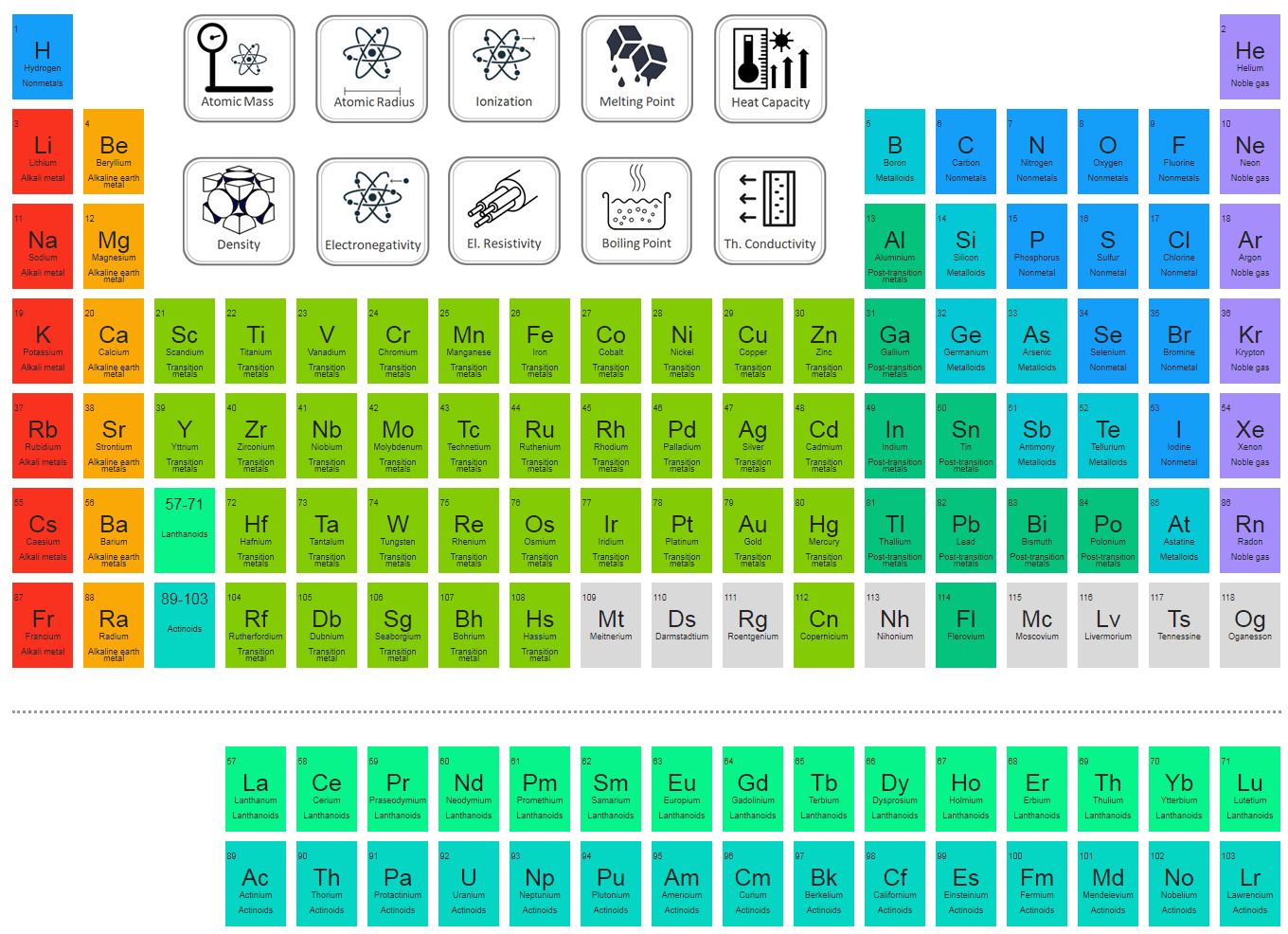
Periodic Table of Elements
1
H

Hydrogen

Nonmetals

2
He

Helium

Noble gas

3
Li

Lithium

Alkali metal

4
Be

Beryllium

Alkaline earth metal

5
B

Boron

Metalloids

6
C

Carbon

Nonmetals

7
N

Nitrogen

Nonmetals

8
O

Oxygen

Nonmetals

9
F

Fluorine

Nonmetals

10
Ne

Neon

Noble gas

11
Na

Sodium

Alkali metal

12
Mg

Magnesium

Alkaline earth metal

13
Al

Aluminium

Post-transition metals

14
Si

Silicon

Metalloids

15
P

Phosphorus

Nonmetal

16
S

Sulfur

Nonmetal

17
Cl

Chlorine

Nonmetal

18
Ar

Argon

Noble gas

19
K

Potassium

Alkali metal

20
Ca

Calcium

Alkaline earth metal

21
Sc

Scandium

Transition metals

22
Ti

Titanium

Transition metals

23
V

Vanadium

Transition metals

24
Cr

Chromium

Transition metals

25
Mn

Manganese

Transition metals

26
Fe

Iron

Transition metals

27
Co

Cobalt

Transition metals

28
Ni

Nickel

Transition metals

29
Cu

Copper

Transition metals

30
Zn

Zinc

Transition metals

31
Ga

Gallium

Post-transition metals

32
Ge

Germanium

Metalloids

33
As

Arsenic

Metalloids

34
Se

Selenium

Nonmetal

35
Br

Bromine

Nonmetal

36
Kr

Krypton

Noble gas

37
Rb

Rubidium

Alkali metals

38
Sr

Strontium

Alkaline earth metals

39
Y

Yttrium

Transition metals

40
Zr

Zirconium

Transition metals

41
Nb

Niobium

Transition metals

42
Mo

Molybdenum

Transition metals

43
Tc

Technetium

Transition metals

44
Ru

Ruthenium

Transition metals

45
Rh

Rhodium

Transition metals

46
Pd

Palladium

Transition metals

47
Ag

Silver

Transition metals

48
Cd

Cadmium

Transition metals

49
In

Indium

Post-transition metals

50
Sn

Tin

Post-transition metals

51
Sb

Antimony

Metalloids

52
Te

Tellurium

Metalloids

53
I

Iodine

Nonmetal

54
Xe

Xenon

Noble gas

55
Cs

Caesium

Alkali metals

56
Ba

Barium

Alkaline earth metals

57-71


Lanthanoids


72
Hf

Hafnium

Transition metals

73
Ta

Tantalum

Transition metals

74
W

Tungsten

Transition metals

75
Re

Rhenium

Transition metals

76
Os

Osmium

Transition metals

77
Ir

Iridium

Transition metals

78
Pt

Platinum

Transition metals

79
Au

Gold

Transition metals

80
Hg

Mercury

Transition metals

81
Tl

Thallium

Post-transition metals

82
Pb

Lead

Post-transition metals

83
Bi

Bismuth

Post-transition metals

84
Po

Polonium

Post-transition metals

85
At

Astatine

Metalloids

86
Rn

Radon

Noble gas

87
Fr

Francium

Alkali metal

88
Ra

Radium

Alkaline earth metal

89-103


Actinoids


104
Rf

Rutherfordium

Transition metal

105
Db

Dubnium

Transition metal

106
Sg

Seaborgium

Transition metal

107
Bh

Bohrium

Transition metal

108
Hs

Hassium

Transition metal

109
Mt

Meitnerium


110
Ds

Darmstadtium


111
Rg

Roentgenium


112
Cn

Copernicium


113
Nh

Nihonium


114
Fl

Flerovium


115
Mc

Moscovium


116
Lv

Livermorium


117
Ts

Tennessine


118
Og

Oganesson


57
La

Lanthanum

Lanthanoids

58
Ce

Cerium

Lanthanoids

59
Pr

Praseodymium

Lanthanoids

60
Nd

Neodymium

Lanthanoids

61
Pm

Promethium

Lanthanoids

62
Sm

Samarium

Lanthanoids

63
Eu

Europium

Lanthanoids

64
Gd

Gadolinium

Lanthanoids

65
Tb

Terbium

Lanthanoids

66
Dy

Dysprosium

Lanthanoids

67
Ho

Holmium

Lanthanoids

68
Er

Erbium

Lanthanoids

69
Th

Thulium

Lanthanoids

70
Yb

Ytterbium

Lanthanoids

71
Lu

Lutetium

Lanthanoids

89
Ac

Actinium

Actinoids

90
Th

Thorium

Actinoids

91
Pa

Protactinium

Actinoids

92
U

Uranium

Actinoids

93
Np

Neptunium

Actinoids

94
Pu

Plutonium

Actinoids

95
Am

Americium

Actinoids

96
Cm

Curium

Actinoids

97
Bk

Berkelium

Actinoids

98
Cf

Californium

Actinoids

99
Es

Einsteinium

Actinoids

100
Fm

Fermium

Actinoids

101
Md

Mendelevium

Actinoids

102
No

Nobelium

Actinoids

103
Lr

Lawrencium

Actinoids

What is Erbium

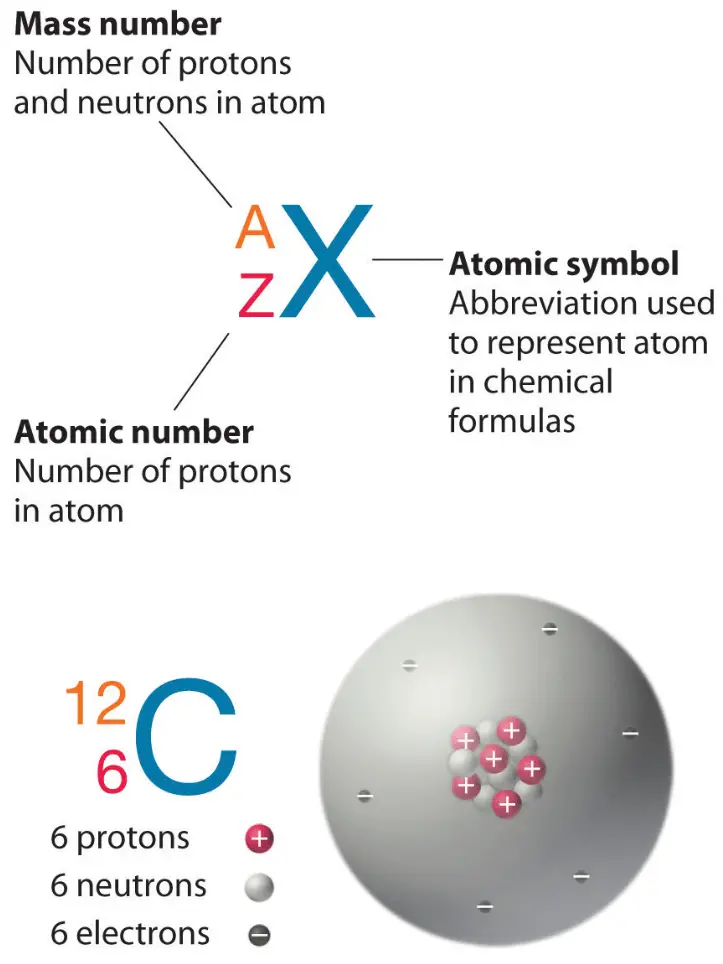
Erbium is a chemical element with atomic number 68 which means there are 68 protons and 68 electrons in the atomic structure. The chemical symbol for Erbium is Er.
Erbium is a silvery-white solid metal when artificially isolated, natural erbium is always found in chemical combination with other elements. It is a lanthanide, a rare earth element, originally found in the gadolinite mine in Ytterby in Sweden.

Erbium – Properties

Element Erbium
Atomic Number 68
Symbol Er
Element Category Rare Earth Metal
Phase at STP Solid
Atomic Mass [amu] 167.259
Density at STP [g/cm3] 9.066
Electron Configuration [Xe] 4f12 6s2
Possible Oxidation States +3
Electron Affinity [kJ/mol] 50
Electronegativity [Pauling scale] 1.24
1st Ionization Energy [eV] 6.1078
Year of Discovery 1842
Discoverer Mosander, Carl Gustav
Thermal properties
Melting Point [Celsius scale] 1529
Boiling Point [Celsius scale] 2868
Thermal Expansion µm/(m·K) 12.2
Thermal Conductivity [W/m K] 15
Specific Heat [J/g K] 0.17
Heat of Fusion [kJ/mol] 19.9
Heat of Vaporization [kJ/mol] 261

Atomic Number of Erbium

Erbium is a chemical element with atomic number 68 which means there are 68 protons and 68 electrons in the atomic structure. The chemical symbol for Erbium is Er.

Proton Number - Atomic NumberThe atom consist of a small but massive nucleus surrounded by a cloud of rapidly moving electrons. The nucleus is composed of protons and neutrons. Total number of protons in the nucleus is called the atomic number of the atom and is given the symbol Z. The total electrical charge of the nucleus is therefore +Ze, where e (elementary charge) equals to 1,602 x 10-19 coulombs. In a neutral atom there are as many electrons as protons moving about nucleus. It is the electrons that are responsible for the chemical bavavior of atoms, and which identify the various chemical elements.

See also: Atomic Number – Does it conserve in a nuclear reaction?

Atomic Number and Chemical Properties

Every solid, liquid, gas, and plasma is composed of neutral or ionized atoms. The chemical properties of the atom are determined by the number of protons, in fact, by number and arrangement of electrons. The configuration of these electrons follows from the principles of quantum mechanics. The number of electrons in each element’s electron shells, particularly the outermost valence shell, is the primary factor in determining its chemical bonding behavior. In the periodic table, the elements are listed in order of increasing atomic number Z.

It is the Pauli exclusion principle that requires the electrons in an atom to occupy different energy levels instead of them all condensing in the ground state. The ordering of the electrons in the ground state of multielectron atoms, starts with the lowest energy state (ground state) and moves progressively from there up the energy scale until each of the atom’s electrons has been assigned a unique set of quantum numbers. This fact has key implications for the building up of the periodic table of elements.
Density - Gas - Liquid - SolidDensity of Erbium

Density of Erbium is 9.066g/cm3.

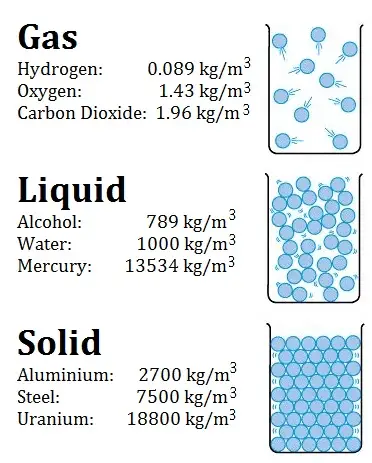
Typical densities of various substances are at atmospheric pressure.

Density is defined as the mass per unit volume. It is an intensive property, which is mathematically defined as mass divided by volume:

ρ = m/V

In words, the density (ρ) of a substance is the total mass (m) of that substance divided by the total volume (V) occupied by that substance. The standard SI unit is kilograms per cubic meter (kg/m3). The Standard English unit is pounds mass per cubic foot (lbm/ft3).

Density – Atomic Mass and Atomic Number Density

Since the density (ρ) of a substance is the total mass (m) of that substance divided by the total volume (V) occupied by that substance, it is obvious, the density of a substance strongly depends on its atomic mass and also on the atomic number density (N; atoms/cm3),

  • Atomic Weight. The atomic mass is carried by the atomic nucleus, which occupies only about 10-12 of the total volume of the atom or less, but it contains all the positive charge and at least 99.95% of the total mass of the atom. Therefore it is determined by the mass number (number of protons and neutrons).
  • Atomic Number Density. The atomic number density (N; atoms/cm3), which is associated with atomic radii, is the number of atoms of a given type per unit volume (V; cm3) of the material. The atomic number density (N; atoms/cm3) of a pure material having atomic or molecular weight (M; grams/mol) and the material density (⍴; gram/cm3) is easily computed from the following equation using Avogadro’s number (NA = 6.022×10²³ atoms or molecules per mole): Atomic-Number-Density
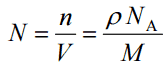
Since nucleons (protons and neutrons) make up most of the mass of ordinary atoms, the density of normal matter tends to be limited by how closely we can pack these nucleons and depends on the internal atomic structure of a substance. The densest material found on earth is the metal osmium, but its density pales by comparison to the densities of exotic astronomical objects such as white dwarf stars and neutron stars.

If we include man made elements, the densest so far is Hassium. Hassium is a chemical element with symbol Hs and atomic number 108.  It is a synthetic element (first synthesised at Hasse in Germany) and radioactive. The most stable known isotope, 269Hs, has a half-life of approximately 9.7 seconds. It has an estimated density of 40.7 x 10³ kg/m3.  The density of Hassium results from its high atomic weight and from the significant decrease in ionic radii of the elements in the lanthanide series, known as lanthanide and actinide contraction.

Density – Pressure and Temperature

The density of a material varies with temperature and pressure. This variation is typically small for solids and liquids but much greater for gases. Most materials expand when their temperatures increase. Rising temperatures make the liquid expand in a liquid-in-tube thermometer and bend bimetallic strips. As a result of this expansion, the density of most materials decreases. This effect is caused by a decrease in the atomic number density. This dependence is usually expressed by the coefficient of linear or volume expansion.

Increasing the pressure on an material (especially for liquids or gases) decreases the volume of the object and thus increases its density via the atomic number density. Compressibility (also known as the coefficient of compressibility is a measure of the relative volume change of a fluid or solid as a response to a pressure (or mean stress) change.

See also: What is Density

See also: Densest Materials of the Earth
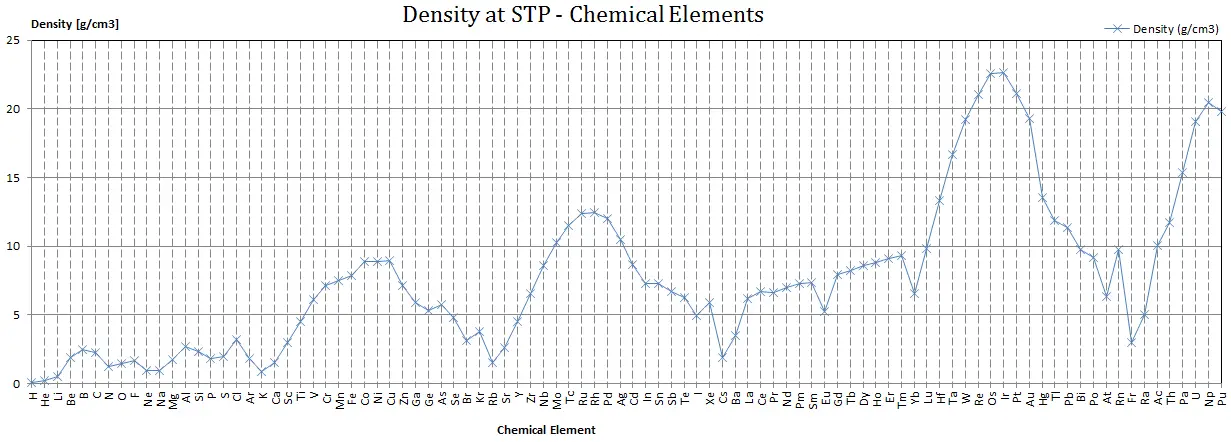
Density of chemical elements

Electron Configuration and Oxidation States of Erbium

Electron configuration of Erbium is [Xe] 4f12 6s2.

Possible oxidation states are +3.

Electron Configuration

The periodic table is a tabular display of the chemical elements organized on the basis of their atomic numbers, electron configurations, and chemical properties. The electron configuration is the distribution of electrons of an atom or molecule (or other physical structure) in atomic or molecular orbitals. Knowledge of the electron configuration of different atoms is useful in understanding the structure of the periodic table of elements.

Every solid, liquid, gas, and plasma is composed of neutral or ionized atoms. The chemical properties of the atom are determined by the number of protons, in fact, by number and arrangement of electrons. The configuration of these electrons follows from the principles of quantum mechanics. The number of electrons in each element’s electron shells, particularly the outermost valence shell, is the primary factor in determining its chemical bonding behavior. In the periodic table, the elements are listed in order of increasing atomic number Z.

It is the Pauli exclusion principle that requires the electrons in an atom to occupy different energy levels instead of them all condensing in the ground state. The ordering of the electrons in the ground state of multielectron atoms, starts with the lowest energy state (ground state) and moves progressively from there up the energy scale until each of the atom’s electrons has been assigned a unique set of quantum numbers. This fact has key implications for the building up of the periodic table of elements.
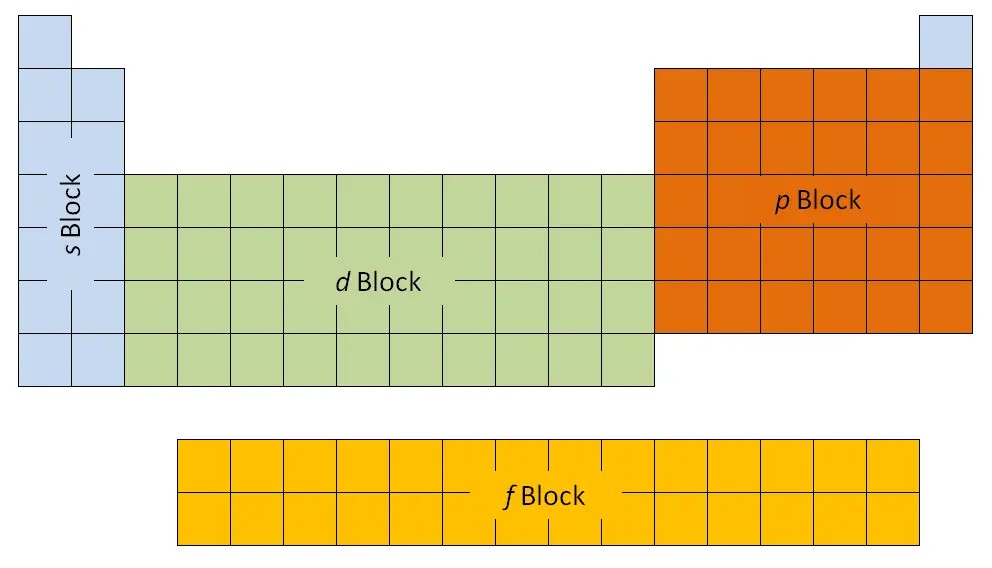
electron configuration - blocks - elementsThe first two columns on the left side of the periodic table are where the s subshells are being occupied. Because of this, the first two rows of the periodic table are labeled the s block. Similarly, the p block are the right-most six columns of the periodic table, the d block is the middle 10 columns of the periodic table, while the f block is the 14-column section that is normally depicted as detached from the main body of the periodic table. It could be part of the main body, but then the periodic table would be rather long and cumbersome.

For atoms with many electrons, this notation can become lengthy and so an abbreviated notation is used. The electron configuration can be visualized as the core electrons, equivalent to the noble gas of the preceding period, and the valence electrons (e.g. [Xe] 6s2 for barium).

Oxidation States

Oxidation states are typically represented by integers which may be positive, zero, or negative. Most elements have more than one possible oxidation state. For example, carbon has nine possible integer oxidation states from −4 to +4.

The current IUPAC Gold Book definition of oxidation state is:

“Oxidation state of an atom is the charge of this atom after ionic approximation of its heteronuclear bonds…”

and the term oxidation number is nearly synonymous. An element that is not combined with any other different elements has an oxidation state of 0. Oxidation state 0 occurs for all elements – it is simply the element in its elemental form. An atom of an element in a compound will have a positive oxidation state if it has had electrons removed. Similarly, adding electrons results in a negative oxidation state. We have also distinguish between the possible and common oxidation states of every element. For example, silicon has nine possible integer oxidation states from −4 to +4, but only -4, 0 and +4 are common oxidation states.

Electron Affinity and Electronegativity of Erbium

Electron affinity of Erbium is 50 kJ/mol.

Electronegativity of Erbium is 1.24.

Electron Affinity

In chemistry and atomic physics, the electron affinity of an atom or molecule is defined as:

the change in energy (in kJ/mole) of a neutral atom or molecule (in the gaseous phase) when an electron is added to the atom to form a negative ion.

X + e– → X– + energy        Affinity = – ∆H

In other words, it can be expressed as the neutral atom’s likelihood of gaining an electron. Note that, ionization energies measure the tendency of a neutral atom to resist the loss of electrons. Electron affinities are more difficult to measure than ionization energies.

An atom of Erbium in the gas phase, for example, gives off energy when it gains an electron to form an ion of Erbium.

Er + e– → Er–        – ∆H = Affinity = 50 kJ/mol

To use electron affinities properly, it is essential to keep track of sign. When an electron is added to a neutral atom, energy is released. This affinity is known as the first electron affinity and these energies are negative. By convention, the negative sign shows a release of energy. However, more energy is required to add an electron to a negative ion which overwhelms any the release of energy from the electron attachment process. This affinity is known as the second electron affinity and these energies are positive.
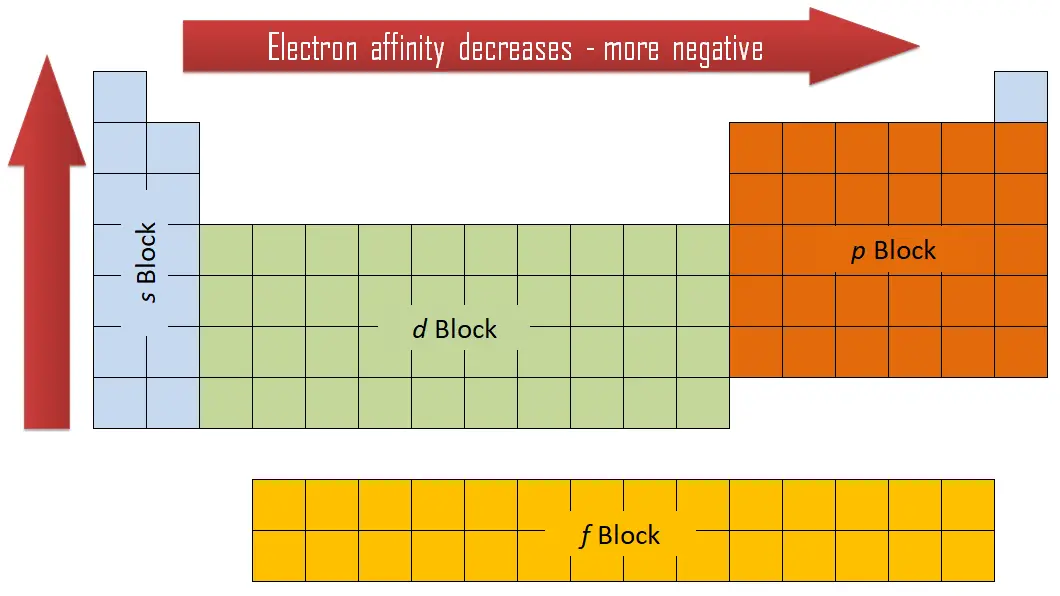
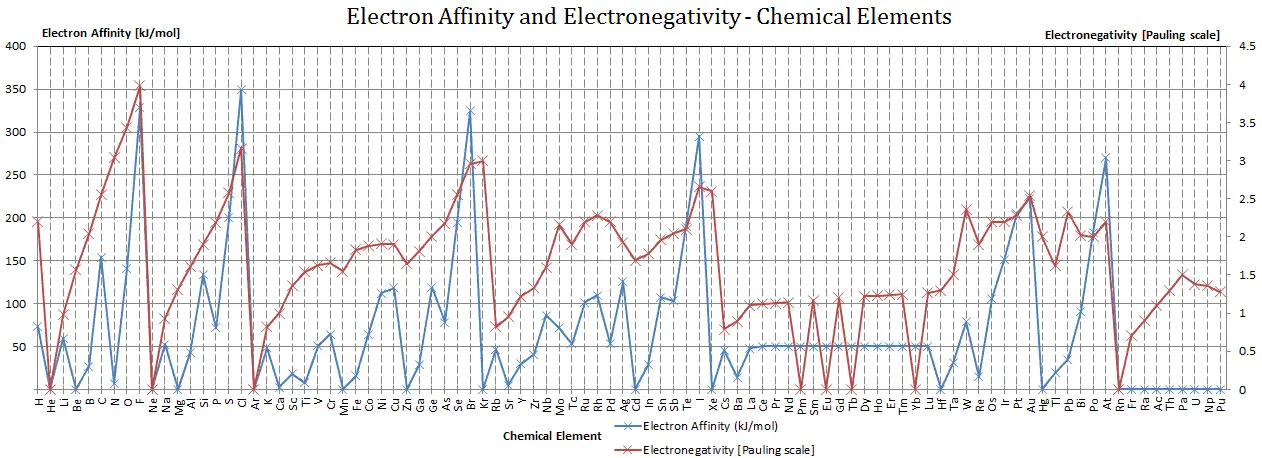
electron affinity - periodic tableElectron affinity can be either positive or negative value. The greater the negative value, the more stable the anion is. Although affinity varies greatly across the periodic table, some patterns emerge. Generally, the elements on the right side of the periodic table will have large negative electron affinity. The electron affinities will become less negative as you go from the top to the bottom of the periodic table. However, nitrogen, oxygen, and fluorine do not follow this trend. Moreover, nonmetals have more positive affinity than metals. Atoms whose anions are more stable than neutral atoms have a greater affinity. Chlorine most strongly attracts extra electrons, while neon most weakly attracts an extra electron.

Affinities of Non metals vs. Affinities of Metals

  • Metals: Metals like to lose valence electrons to form cations to have a fully stable shell. The electron affinity of metals is lower than that of nonmetals. Mercury most weakly attracts an extra electron.
  • Nonmetals: Generally, nonmetals have more positive electron affinity than metals. Nonmetals like to gain electrons to form anions to have a fully stable electron shell. Chlorine most strongly attracts extra electrons. The electron affinities of the noble gases have not been conclusively measured, so they may or may not have slightly negative values.

Electronegativity

Electronegativity, symbol χ, is a chemical property that describes the tendency of an atom to attract electrons towards this atom. For this purposes, a dimensionless quantity the Pauling scale, symbol χ, is the most commonly used.

The electronegativity of Erbium is: χ = 1.24
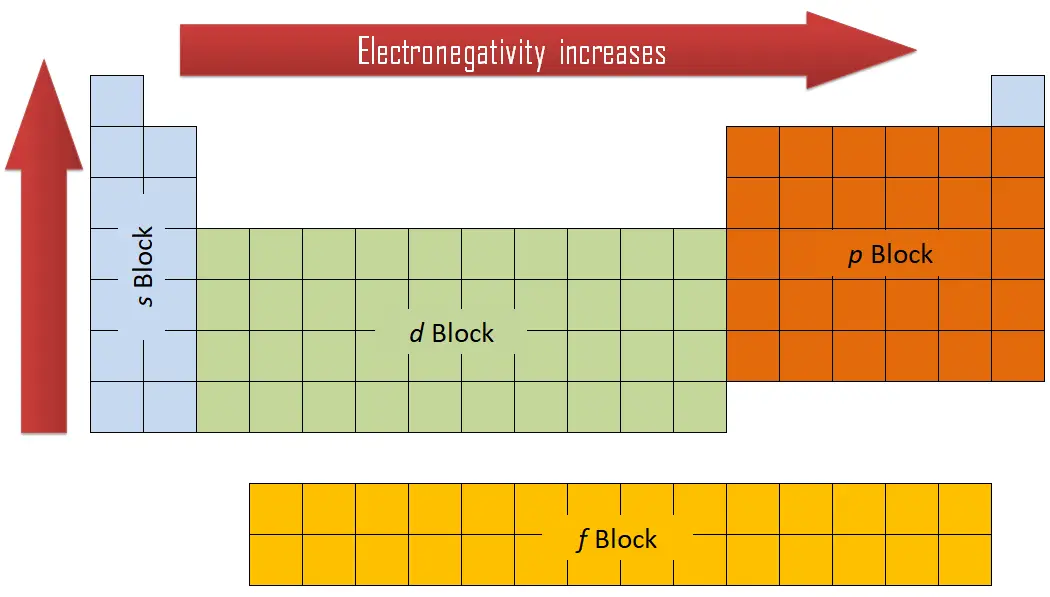
electronegativity - periodic tableIn general, an atom’s electronegativity is affected by both its atomic number and the distance at which its valence electrons reside from the charged nucleus. The higher the associated electronegativity number, the more an element or compound attracts electrons towards it. The most electronegative atom, fluorine, is assigned a value of 4.0, and values range down to cesium and francium which are the least electronegative at 0.7. Electronegativity is related with ionization energy and electron affinity. Electrons with low ionization energies have low electronegativities because their nuclei do not exert a strong attractive force on electrons. Elements with high ionization energies have high electronegativities due to the strong pull exerted by the positive nucleus on the negative electrons. Therefore the electronegativity is greatest at the top-right of the periodic table and decreases toward the bottom-left.
electron affinity and electronegativity

Erbium – Melting Point and Boiling Point

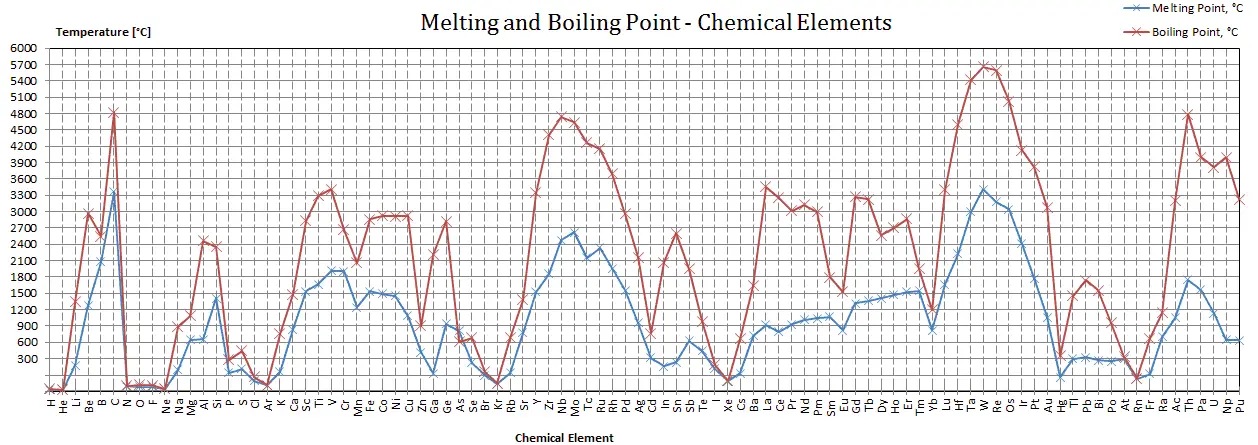
Melting point of Erbium is 1529°C.

Boiling point of Erbium is 2868°C.

Note that, these points are associated with the standard atmospheric pressure.

Boiling Point

In general, boiling is a phase change of a substance from the liquid to the gas phase. The boiling point of a substance is the temperature at which this phase change (boiling or vaporization) occurs. The temperature at which vaporization (boiling) starts to occur for a given pressure is also known as the saturation temperature and at this conditions a mixture of vapor and liquid can exist together. The liquid can be said to be saturated with thermal energy. Any addition of thermal energy results in a phase transition. At the boiling point the two phases of a substance, liquid and vapor, have identical free energies and therefore are equally likely to exist. Below the boiling point, the liquid is the more stable state of the two, whereas above the gaseous form is preferred. The pressure at which vaporization (boiling) starts to occur for a given temperature is called the saturation pressure. When considered as the temperature of the reverse change from vapor to liquid, it is referred to as the condensation point.

As can be seen, the boiling point of a liquid varies depending upon the surrounding environmental pressure. A liquid in a partial vacuum has a lower boiling point than when that liquid is at atmospheric pressure. A liquid at high pressure has a higher boiling point than when that liquid is at atmospheric pressure. For example, water boils at 100°C (212°F) at sea level, but at 93.4°C (200.1°F) at 1900 metres (6,233 ft) altitude. On the other hand, water boils at 350°C (662°F) at 16.5 MPa (typical pressure of PWRs).

In the periodic table of elements, the element with the lowest boiling point is helium. Both the boiling points of rhenium and tungsten exceed 5000 K at standard pressure. Since it is difficult to measure extreme temperatures precisely without bias, both have been cited in the literature as having the higher boiling point.

Melting Point

In general, melting is a phase change of a substance from the solid to the liquid phase. The melting point of a substance is the temperature at which this phase change occurs. The melting point also defines a condition in which the solid and liquid can exist in equilibrium. Adding a heat will convert the solid into a liquid with no temperature change. At the melting point the two phases of a substance, liquid and vapor, have identical free energies and therefore are equally likely to exist. Below the melting point, the solid is the more stable state of the two, whereas above the liquid form is preferred. The melting point of a substance depends on pressure and is usually specified at standard pressure. When considered as the temperature of the reverse change from liquid to solid, it is referred to as the freezing point or crystallization point.

See also: Melting Point Depression

The first theory explaining mechanism of melting in the bulk was proposed by Lindemann, who used vibration of atoms in the crystal to explain the melting transition. Solids are similar to liquids in that both are condensed states, with particles that are far closer together than those of a gas. The atoms in a solid are tightly bound to each other, either in a regular geometric lattice (crystalline solids, which include metals and ordinary ice) or irregularly (an amorphous solid such as common window glass), and are typically low in energy. The motion of individual atoms, ions, or molecules in a solid is restricted to vibrational motion about a fixed point. As a solid is heated, its particles vibrate more rapidly as the solid absorbs kinetic energy. At some point the amplitude of vibration becomes so large that the atoms start to invade the space of their nearest neighbors and disturb them and the melting process initiates. The melting point is the temperature at which the disruptive vibrations of the particles of the solid overcome the attractive forces operating within the solid.

As with boiling points, the melting point of a solid is dependent on the strength of those attractive forces. For example, sodium chloride  (NaCl) is an ionic compound that consists of a multitude of strong ionic bonds. Sodium chloride melts at  801°C. On the other hand, ice (solid H2O) is a molecular compound whose molecules are held together by hydrogen bonds, which is effectively a strong example of an interaction between two permanent dipoles. Though hydrogen bonds are the strongest of the intermolecular forces, the strength of hydrogen bonds is much less than that of ionic bonds. The melting point of ice is 0 °C.

Covalent bonds often result in the formation of small collections of better-connected atoms called molecules, which in solids and liquids are bound to other molecules by forces that are often much weaker than the covalent bonds that hold the molecules internally together. Such weak intermolecular bonds give organic molecular substances, such as waxes and oils, their soft bulk character, and their low melting points (in liquids, molecules must cease most structured or oriented contact with each other).
 

melting-and-boiling-point-chemical-elements-chart

Erbium – Crystal Structure

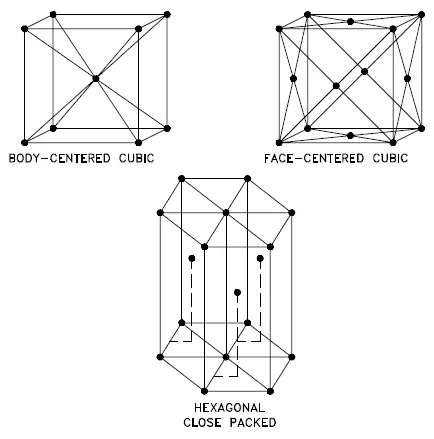
A possible crystal structure of Erbium is hexagonal close-packed structure.
crystal structures - FCC, BCC, HCP

In metals, and in many other solids, the atoms are arranged in regular arrays called crystals. A crystal lattice is a repeating pattern of mathematical points that extends throughout space. The forces of chemical bonding causes this repetition. It is this repeated pattern which control properties like strength, ductility, density, conductivity (property of conducting or transmitting heat, electricity, etc.), and shape. There are 14 general types of such patterns known as Bravais lattices.

The three most common basic crystal patterns are:

  • Body-centered Cubic. In a body-centered cubic (BCC) arrangement of atoms, the unit cell consists of eight atoms at the corners of a cube and one atom at the body center of the cube. In a body-centered cubic arrangement, a unit cell contains (8 corner atoms × ⅛) + (1 center atom × 1) = 2 atoms. The packing is more efficient (68%) than simple cubic and the structure is a common one for alkali metals and early transition metals. Metals containing BCC structures include ferrite, chromium, vanadium, molybdenum, and tungsten. These metals possess high strength and low ductility.
  • Face-centered Cubic.In a face-centered cubic (FCC) arrangement of atoms, the unit cell consists of eight atoms at the corners of a cube and one atom at the center of each of the faces of the cube. In a face-centered cubic arrangement, a unit cell contains (8 corner atoms × ⅛) + (6 face atoms × ½) = 4 atoms. This structure, along with its hexagonal relative (hcp), has the most efficient packing (74%). Metals containing FCC structures include austenite, aluminum, copper, lead, silver, gold, nickel, platinum, and thorium. These metals possess low strength and high ductility.
  • Hexagonal Close-packed. In a hexagonal close-packed (HCP) arrangement of atoms, the unit cell consists of three layers of atoms. The top and bottom layers contain six atoms at the corners of a hexagon and one atom at the center of each hexagon. The middle layer contains three atoms nestled between the atoms of the top and bottom layers, hence, the name close-packed. Hexagonal close packed (hcp) is one of the two simple types of atomic packing with the highest density, the other being the face centered cubic (fcc). However, unlike the fcc, it is not a Bravais lattice as there are two nonequivalent sets of lattice points. Metals containing HCP structures include beryllium, magnesium, zinc, cadmium, cobalt, thallium, and zirconium. HCP metals are not as ductile as FCC metals.

–

What is Holmium – Chemical Properties of Holmium – Symbol Ho

Periodic Table of Elements
1
H

Hydrogen

Nonmetals

2
He

Helium

Noble gas

3
Li

Lithium

Alkali metal

4
Be

Beryllium

Alkaline earth metal

5
B

Boron

Metalloids

6
C

Carbon

Nonmetals

7
N

Nitrogen

Nonmetals

8
O

Oxygen

Nonmetals

9
F

Fluorine

Nonmetals

10
Ne

Neon

Noble gas

11
Na

Sodium

Alkali metal

12
Mg

Magnesium

Alkaline earth metal

13
Al

Aluminium

Post-transition metals

14
Si

Silicon

Metalloids

15
P

Phosphorus

Nonmetal

16
S

Sulfur

Nonmetal

17
Cl

Chlorine

Nonmetal

18
Ar

Argon

Noble gas

19
K

Potassium

Alkali metal

20
Ca

Calcium

Alkaline earth metal

21
Sc

Scandium

Transition metals

22
Ti

Titanium

Transition metals

23
V

Vanadium

Transition metals

24
Cr

Chromium

Transition metals

25
Mn

Manganese

Transition metals

26
Fe

Iron

Transition metals

27
Co

Cobalt

Transition metals

28
Ni

Nickel

Transition metals

29
Cu

Copper

Transition metals

30
Zn

Zinc

Transition metals

31
Ga

Gallium

Post-transition metals

32
Ge

Germanium

Metalloids

33
As

Arsenic

Metalloids

34
Se

Selenium

Nonmetal

35
Br

Bromine

Nonmetal

36
Kr

Krypton

Noble gas

37
Rb

Rubidium

Alkali metals

38
Sr

Strontium

Alkaline earth metals

39
Y

Yttrium

Transition metals

40
Zr

Zirconium

Transition metals

41
Nb

Niobium

Transition metals

42
Mo

Molybdenum

Transition metals

43
Tc

Technetium

Transition metals

44
Ru

Ruthenium

Transition metals

45
Rh

Rhodium

Transition metals

46
Pd

Palladium

Transition metals

47
Ag

Silver

Transition metals

48
Cd

Cadmium

Transition metals

49
In

Indium

Post-transition metals

50
Sn

Tin

Post-transition metals

51
Sb

Antimony

Metalloids

52
Te

Tellurium

Metalloids

53
I

Iodine

Nonmetal

54
Xe

Xenon

Noble gas

55
Cs

Caesium

Alkali metals

56
Ba

Barium

Alkaline earth metals

57-71


Lanthanoids


72
Hf

Hafnium

Transition metals

73
Ta

Tantalum

Transition metals

74
W

Tungsten

Transition metals

75
Re

Rhenium

Transition metals

76
Os

Osmium

Transition metals

77
Ir

Iridium

Transition metals

78
Pt

Platinum

Transition metals

79
Au

Gold

Transition metals

80
Hg

Mercury

Transition metals

81
Tl

Thallium

Post-transition metals

82
Pb

Lead

Post-transition metals

83
Bi

Bismuth

Post-transition metals

84
Po

Polonium

Post-transition metals

85
At

Astatine

Metalloids

86
Rn

Radon

Noble gas

87
Fr

Francium

Alkali metal

88
Ra

Radium

Alkaline earth metal

89-103


Actinoids


104
Rf

Rutherfordium

Transition metal

105
Db

Dubnium

Transition metal

106
Sg

Seaborgium

Transition metal

107
Bh

Bohrium

Transition metal

108
Hs

Hassium

Transition metal

109
Mt

Meitnerium


110
Ds

Darmstadtium


111
Rg

Roentgenium


112
Cn

Copernicium


113
Nh

Nihonium


114
Fl

Flerovium


115
Mc

Moscovium


116
Lv

Livermorium


117
Ts

Tennessine


118
Og

Oganesson


57
La

Lanthanum

Lanthanoids

58
Ce

Cerium

Lanthanoids

59
Pr

Praseodymium

Lanthanoids

60
Nd

Neodymium

Lanthanoids

61
Pm

Promethium

Lanthanoids

62
Sm

Samarium

Lanthanoids

63
Eu

Europium

Lanthanoids

64
Gd

Gadolinium

Lanthanoids

65
Tb

Terbium

Lanthanoids

66
Dy

Dysprosium

Lanthanoids

67
Ho

Holmium

Lanthanoids

68
Er

Erbium

Lanthanoids

69
Th

Thulium

Lanthanoids

70
Yb

Ytterbium

Lanthanoids

71
Lu

Lutetium

Lanthanoids

89
Ac

Actinium

Actinoids

90
Th

Thorium

Actinoids

91
Pa

Protactinium

Actinoids

92
U

Uranium

Actinoids

93
Np

Neptunium

Actinoids

94
Pu

Plutonium

Actinoids

95
Am

Americium

Actinoids

96
Cm

Curium

Actinoids

97
Bk

Berkelium

Actinoids

98
Cf

Californium

Actinoids

99
Es

Einsteinium

Actinoids

100
Fm

Fermium

Actinoids

101
Md

Mendelevium

Actinoids

102
No

Nobelium

Actinoids

103
Lr

Lawrencium

Actinoids

What is Holmium

Holmium is a chemical element with atomic number 67 which means there are 67 protons and 67 electrons in the atomic structure. The chemical symbol for Holmium is Ho.

Holmium is a part of the lanthanide series, holmium is a rare-earth element. Holmium is a relatively soft and malleable silvery-white metal.

Holmium – Properties

Element Holmium
Atomic Number 67
Symbol Ho
Element Category Rare Earth Metal
Phase at STP Solid
Atomic Mass [amu] 164.9303
Density at STP [g/cm3] 8.795
Electron Configuration [Xe] 4f11 6s2
Possible Oxidation States +3
Electron Affinity [kJ/mol] 50
Electronegativity [Pauling scale] 1.23
1st Ionization Energy [eV] 6.0216
Year of Discovery 1879
Discoverer Cleve, Per Theodor
Thermal properties
Melting Point [Celsius scale] 1474
Boiling Point [Celsius scale] 2600
Thermal Expansion µm/(m·K) 11.2
Thermal Conductivity [W/m K] 16
Specific Heat [J/g K] 0.16
Heat of Fusion [kJ/mol] 12.2
Heat of Vaporization [kJ/mol] 241

Atomic Number of Holmium

Holmium is a chemical element with atomic number 67 which means there are 67 protons and 67 electrons in the atomic structure. The chemical symbol for Holmium is Ho.

Proton Number - Atomic NumberThe atom consist of a small but massive nucleus surrounded by a cloud of rapidly moving electrons. The nucleus is composed of protons and neutrons. Total number of protons in the nucleus is called the atomic number of the atom and is given the symbol Z. The total electrical charge of the nucleus is therefore +Ze, where e (elementary charge) equals to 1,602 x 10-19 coulombs. In a neutral atom there are as many electrons as protons moving about nucleus. It is the electrons that are responsible for the chemical bavavior of atoms, and which identify the various chemical elements.

See also: Atomic Number – Does it conserve in a nuclear reaction?

Atomic Number and Chemical Properties

Every solid, liquid, gas, and plasma is composed of neutral or ionized atoms. The chemical properties of the atom are determined by the number of protons, in fact, by number and arrangement of electrons. The configuration of these electrons follows from the principles of quantum mechanics. The number of electrons in each element’s electron shells, particularly the outermost valence shell, is the primary factor in determining its chemical bonding behavior. In the periodic table, the elements are listed in order of increasing atomic number Z.

It is the Pauli exclusion principle that requires the electrons in an atom to occupy different energy levels instead of them all condensing in the ground state. The ordering of the electrons in the ground state of multielectron atoms, starts with the lowest energy state (ground state) and moves progressively from there up the energy scale until each of the atom’s electrons has been assigned a unique set of quantum numbers. This fact has key implications for the building up of the periodic table of elements.

Density - Gas - Liquid - SolidDensity of Holmium

Density of Holmium is 8.795g/cm3.

Typical densities of various substances are at atmospheric pressure.

Density is defined as the mass per unit volume. It is an intensive property, which is mathematically defined as mass divided by volume:

ρ = m/V

In words, the density (ρ) of a substance is the total mass (m) of that substance divided by the total volume (V) occupied by that substance. The standard SI unit is kilograms per cubic meter (kg/m3). The Standard English unit is pounds mass per cubic foot (lbm/ft3).

Density – Atomic Mass and Atomic Number Density

Since the density (ρ) of a substance is the total mass (m) of that substance divided by the total volume (V) occupied by that substance, it is obvious, the density of a substance strongly depends on its atomic mass and also on the atomic number density (N; atoms/cm3),

  • Atomic Weight. The atomic mass is carried by the atomic nucleus, which occupies only about 10-12 of the total volume of the atom or less, but it contains all the positive charge and at least 99.95% of the total mass of the atom. Therefore it is determined by the mass number (number of protons and neutrons).
  • Atomic Number Density. The atomic number density (N; atoms/cm3), which is associated with atomic radii, is the number of atoms of a given type per unit volume (V; cm3) of the material. The atomic number density (N; atoms/cm3) of a pure material having atomic or molecular weight (M; grams/mol) and the material density (⍴; gram/cm3) is easily computed from the following equation using Avogadro’s number (NA = 6.022×10²³ atoms or molecules per mole): Atomic-Number-Density

Since nucleons (protons and neutrons) make up most of the mass of ordinary atoms, the density of normal matter tends to be limited by how closely we can pack these nucleons and depends on the internal atomic structure of a substance. The densest material found on earth is the metal osmium, but its density pales by comparison to the densities of exotic astronomical objects such as white dwarf stars and neutron stars.

If we include man made elements, the densest so far is Hassium. Hassium is a chemical element with symbol Hs and atomic number 108.  It is a synthetic element (first synthesised at Hasse in Germany) and radioactive. The most stable known isotope, 269Hs, has a half-life of approximately 9.7 seconds. It has an estimated density of 40.7 x 10³ kg/m3.  The density of Hassium results from its high atomic weight and from the significant decrease in ionic radii of the elements in the lanthanide series, known as lanthanide and actinide contraction.

Density – Pressure and Temperature

The density of a material varies with temperature and pressure. This variation is typically small for solids and liquids but much greater for gases. Most materials expand when their temperatures increase. Rising temperatures make the liquid expand in a liquid-in-tube thermometer and bend bimetallic strips. As a result of this expansion, the density of most materials decreases. This effect is caused by a decrease in the atomic number density. This dependence is usually expressed by the coefficient of linear or volume expansion.

Increasing the pressure on an material (especially for liquids or gases) decreases the volume of the object and thus increases its density via the atomic number density. Compressibility (also known as the coefficient of compressibility is a measure of the relative volume change of a fluid or solid as a response to a pressure (or mean stress) change.

See also: What is Density

See also: Densest Materials of the Earth

Density of chemical elements

Electron Configuration and Oxidation States of Holmium

Electron configuration of Holmium is [Xe] 4f11 6s2.

Possible oxidation states are +3.

Electron Configuration

The periodic table is a tabular display of the chemical elements organized on the basis of their atomic numbers, electron configurations, and chemical properties. The electron configuration is the distribution of electrons of an atom or molecule (or other physical structure) in atomic or molecular orbitals. Knowledge of the electron configuration of different atoms is useful in understanding the structure of the periodic table of elements.

Every solid, liquid, gas, and plasma is composed of neutral or ionized atoms. The chemical properties of the atom are determined by the number of protons, in fact, by number and arrangement of electrons. The configuration of these electrons follows from the principles of quantum mechanics. The number of electrons in each element’s electron shells, particularly the outermost valence shell, is the primary factor in determining its chemical bonding behavior. In the periodic table, the elements are listed in order of increasing atomic number Z.

It is the Pauli exclusion principle that requires the electrons in an atom to occupy different energy levels instead of them all condensing in the ground state. The ordering of the electrons in the ground state of multielectron atoms, starts with the lowest energy state (ground state) and moves progressively from there up the energy scale until each of the atom’s electrons has been assigned a unique set of quantum numbers. This fact has key implications for the building up of the periodic table of elements.

electron configuration - blocks - elementsThe first two columns on the left side of the periodic table are where the s subshells are being occupied. Because of this, the first two rows of the periodic table are labeled the s block. Similarly, the p block are the right-most six columns of the periodic table, the d block is the middle 10 columns of the periodic table, while the f block is the 14-column section that is normally depicted as detached from the main body of the periodic table. It could be part of the main body, but then the periodic table would be rather long and cumbersome.

For atoms with many electrons, this notation can become lengthy and so an abbreviated notation is used. The electron configuration can be visualized as the core electrons, equivalent to the noble gas of the preceding period, and the valence electrons (e.g. [Xe] 6s2 for barium).

Oxidation States

Oxidation states are typically represented by integers which may be positive, zero, or negative. Most elements have more than one possible oxidation state. For example, carbon has nine possible integer oxidation states from −4 to +4.

The current IUPAC Gold Book definition of oxidation state is:

“Oxidation state of an atom is the charge of this atom after ionic approximation of its heteronuclear bonds…”

and the term oxidation number is nearly synonymous. An element that is not combined with any other different elements has an oxidation state of 0. Oxidation state 0 occurs for all elements – it is simply the element in its elemental form. An atom of an element in a compound will have a positive oxidation state if it has had electrons removed. Similarly, adding electrons results in a negative oxidation state. We have also distinguish between the possible and common oxidation states of every element. For example, silicon has nine possible integer oxidation states from −4 to +4, but only -4, 0 and +4 are common oxidation states.

Electron Affinity and Electronegativity of Holmium

Electron affinity of Holmium is 50 kJ/mol.

Electronegativity of Holmium is 1.23.

Electron Affinity

In chemistry and atomic physics, the electron affinity of an atom or molecule is defined as:

the change in energy (in kJ/mole) of a neutral atom or molecule (in the gaseous phase) when an electron is added to the atom to form a negative ion.

X + e– → X– + energy        Affinity = – ∆H

In other words, it can be expressed as the neutral atom’s likelihood of gaining an electron. Note that, ionization energies measure the tendency of a neutral atom to resist the loss of electrons. Electron affinities are more difficult to measure than ionization energies.

An atom of Holmium in the gas phase, for example, gives off energy when it gains an electron to form an ion of Holmium.

Ho + e– → Ho–        – ∆H = Affinity = 50 kJ/mol

To use electron affinities properly, it is essential to keep track of sign. When an electron is added to a neutral atom, energy is released. This affinity is known as the first electron affinity and these energies are negative. By convention, the negative sign shows a release of energy. However, more energy is required to add an electron to a negative ion which overwhelms any the release of energy from the electron attachment process. This affinity is known as the second electron affinity and these energies are positive.

electron affinity - periodic tableElectron affinity can be either positive or negative value. The greater the negative value, the more stable the anion is. Although affinity varies greatly across the periodic table, some patterns emerge. Generally, the elements on the right side of the periodic table will have large negative electron affinity. The electron affinities will become less negative as you go from the top to the bottom of the periodic table. However, nitrogen, oxygen, and fluorine do not follow this trend. Moreover, nonmetals have more positive affinity than metals. Atoms whose anions are more stable than neutral atoms have a greater affinity. Chlorine most strongly attracts extra electrons, while neon most weakly attracts an extra electron.

Affinities of Non metals vs. Affinities of Metals

  • Metals: Metals like to lose valence electrons to form cations to have a fully stable shell. The electron affinity of metals is lower than that of nonmetals. Mercury most weakly attracts an extra electron.
  • Nonmetals: Generally, nonmetals have more positive electron affinity than metals. Nonmetals like to gain electrons to form anions to have a fully stable electron shell. Chlorine most strongly attracts extra electrons. The electron affinities of the noble gases have not been conclusively measured, so they may or may not have slightly negative values.

Electronegativity

Electronegativity, symbol χ, is a chemical property that describes the tendency of an atom to attract electrons towards this atom. For this purposes, a dimensionless quantity the Pauling scale, symbol χ, is the most commonly used.

The electronegativity of Holmium is: χ = 1.23

electronegativity - periodic tableIn general, an atom’s electronegativity is affected by both its atomic number and the distance at which its valence electrons reside from the charged nucleus. The higher the associated electronegativity number, the more an element or compound attracts electrons towards it. The most electronegative atom, fluorine, is assigned a value of 4.0, and values range down to cesium and francium which are the least electronegative at 0.7. Electronegativity is related with ionization energy and electron affinity. Electrons with low ionization energies have low electronegativities because their nuclei do not exert a strong attractive force on electrons. Elements with high ionization energies have high electronegativities due to the strong pull exerted by the positive nucleus on the negative electrons. Therefore the electronegativity is greatest at the top-right of the periodic table and decreases toward the bottom-left.

electron affinity and electronegativity

Holmium – Melting Point and Boiling Point

Melting point of Holmium is 1474°C.

Boiling point of Holmium is 2600°C.

Note that, these points are associated with the standard atmospheric pressure.

Boiling Point

In general, boiling is a phase change of a substance from the liquid to the gas phase. The boiling point of a substance is the temperature at which this phase change (boiling or vaporization) occurs. The temperature at which vaporization (boiling) starts to occur for a given pressure is also known as the saturation temperature and at this conditions a mixture of vapor and liquid can exist together. The liquid can be said to be saturated with thermal energy. Any addition of thermal energy results in a phase transition. At the boiling point the two phases of a substance, liquid and vapor, have identical free energies and therefore are equally likely to exist. Below the boiling point, the liquid is the more stable state of the two, whereas above the gaseous form is preferred. The pressure at which vaporization (boiling) starts to occur for a given temperature is called the saturation pressure. When considered as the temperature of the reverse change from vapor to liquid, it is referred to as the condensation point.

As can be seen, the boiling point of a liquid varies depending upon the surrounding environmental pressure. A liquid in a partial vacuum has a lower boiling point than when that liquid is at atmospheric pressure. A liquid at high pressure has a higher boiling point than when that liquid is at atmospheric pressure. For example, water boils at 100°C (212°F) at sea level, but at 93.4°C (200.1°F) at 1900 metres (6,233 ft) altitude. On the other hand, water boils at 350°C (662°F) at 16.5 MPa (typical pressure of PWRs).

In the periodic table of elements, the element with the lowest boiling point is helium. Both the boiling points of rhenium and tungsten exceed 5000 K at standard pressure. Since it is difficult to measure extreme temperatures precisely without bias, both have been cited in the literature as having the higher boiling point.

Melting Point

In general, melting is a phase change of a substance from the solid to the liquid phase. The melting point of a substance is the temperature at which this phase change occurs. The melting point also defines a condition in which the solid and liquid can exist in equilibrium. Adding a heat will convert the solid into a liquid with no temperature change. At the melting point the two phases of a substance, liquid and vapor, have identical free energies and therefore are equally likely to exist. Below the melting point, the solid is the more stable state of the two, whereas above the liquid form is preferred. The melting point of a substance depends on pressure and is usually specified at standard pressure. When considered as the temperature of the reverse change from liquid to solid, it is referred to as the freezing point or crystallization point.

See also: Melting Point Depression

The first theory explaining mechanism of melting in the bulk was proposed by Lindemann, who used vibration of atoms in the crystal to explain the melting transition. Solids are similar to liquids in that both are condensed states, with particles that are far closer together than those of a gas. The atoms in a solid are tightly bound to each other, either in a regular geometric lattice (crystalline solids, which include metals and ordinary ice) or irregularly (an amorphous solid such as common window glass), and are typically low in energy. The motion of individual atoms, ions, or molecules in a solid is restricted to vibrational motion about a fixed point. As a solid is heated, its particles vibrate more rapidly as the solid absorbs kinetic energy. At some point the amplitude of vibration becomes so large that the atoms start to invade the space of their nearest neighbors and disturb them and the melting process initiates. The melting point is the temperature at which the disruptive vibrations of the particles of the solid overcome the attractive forces operating within the solid.

As with boiling points, the melting point of a solid is dependent on the strength of those attractive forces. For example, sodium chloride  (NaCl) is an ionic compound that consists of a multitude of strong ionic bonds. Sodium chloride melts at  801°C. On the other hand, ice (solid H2O) is a molecular compound whose molecules are held together by hydrogen bonds, which is effectively a strong example of an interaction between two permanent dipoles. Though hydrogen bonds are the strongest of the intermolecular forces, the strength of hydrogen bonds is much less than that of ionic bonds. The melting point of ice is 0 °C.

Covalent bonds often result in the formation of small collections of better-connected atoms called molecules, which in solids and liquids are bound to other molecules by forces that are often much weaker than the covalent bonds that hold the molecules internally together. Such weak intermolecular bonds give organic molecular substances, such as waxes and oils, their soft bulk character, and their low melting points (in liquids, molecules must cease most structured or oriented contact with each other).


melting-and-boiling-point-chemical-elements-chart

Holmium – Crystal Structure

A possible crystal structure of Holmium is hexagonal close-packed structure.

crystal structures - FCC, BCC, HCP

In metals, and in many other solids, the atoms are arranged in regular arrays called crystals. A crystal lattice is a repeating pattern of mathematical points that extends throughout space. The forces of chemical bonding causes this repetition. It is this repeated pattern which control properties like strength, ductility, density, conductivity (property of conducting or transmitting heat, electricity, etc.), and shape. There are 14 general types of such patterns known as Bravais lattices.

The three most common basic crystal patterns are:

  • Body-centered Cubic. In a body-centered cubic (BCC) arrangement of atoms, the unit cell consists of eight atoms at the corners of a cube and one atom at the body center of the cube. In a body-centered cubic arrangement, a unit cell contains (8 corner atoms × ⅛) + (1 center atom × 1) = 2 atoms. The packing is more efficient (68%) than simple cubic and the structure is a common one for alkali metals and early transition metals. Metals containing BCC structures include ferrite, chromium, vanadium, molybdenum, and tungsten. These metals possess high strength and low ductility.
  • Face-centered Cubic.In a face-centered cubic (FCC) arrangement of atoms, the unit cell consists of eight atoms at the corners of a cube and one atom at the center of each of the faces of the cube. In a face-centered cubic arrangement, a unit cell contains (8 corner atoms × ⅛) + (6 face atoms × ½) = 4 atoms. This structure, along with its hexagonal relative (hcp), has the most efficient packing (74%). Metals containing FCC structures include austenite, aluminum, copper, lead, silver, gold, nickel, platinum, and thorium. These metals possess low strength and high ductility.
  • Hexagonal Close-packed. In a hexagonal close-packed (HCP) arrangement of atoms, the unit cell consists of three layers of atoms. The top and bottom layers contain six atoms at the corners of a hexagon and one atom at the center of each hexagon. The middle layer contains three atoms nestled between the atoms of the top and bottom layers, hence, the name close-packed. Hexagonal close packed (hcp) is one of the two simple types of atomic packing with the highest density, the other being the face centered cubic (fcc). However, unlike the fcc, it is not a Bravais lattice as there are two nonequivalent sets of lattice points. Metals containing HCP structures include beryllium, magnesium, zinc, cadmium, cobalt, thallium, and zirconium. HCP metals are not as ductile as FCC metals.

–

What is Dysprosium – Chemical Properties of Dysprosium – Symbol Dy

Periodic Table of Elements
1
H

Hydrogen

Nonmetals

2
He

Helium

Noble gas

3
Li

Lithium

Alkali metal

4
Be

Beryllium

Alkaline earth metal

5
B

Boron

Metalloids

6
C

Carbon

Nonmetals

7
N

Nitrogen

Nonmetals

8
O

Oxygen

Nonmetals

9
F

Fluorine

Nonmetals

10
Ne

Neon

Noble gas

11
Na

Sodium

Alkali metal

12
Mg

Magnesium

Alkaline earth metal

13
Al

Aluminium

Post-transition metals

14
Si

Silicon

Metalloids

15
P

Phosphorus

Nonmetal

16
S

Sulfur

Nonmetal

17
Cl

Chlorine

Nonmetal

18
Ar

Argon

Noble gas

19
K

Potassium

Alkali metal

20
Ca

Calcium

Alkaline earth metal

21
Sc

Scandium

Transition metals

22
Ti

Titanium

Transition metals

23
V

Vanadium

Transition metals

24
Cr

Chromium

Transition metals

25
Mn

Manganese

Transition metals

26
Fe

Iron

Transition metals

27
Co

Cobalt

Transition metals

28
Ni

Nickel

Transition metals

29
Cu

Copper

Transition metals

30
Zn

Zinc

Transition metals

31
Ga

Gallium

Post-transition metals

32
Ge

Germanium

Metalloids

33
As

Arsenic

Metalloids

34
Se

Selenium

Nonmetal

35
Br

Bromine

Nonmetal

36
Kr

Krypton

Noble gas

37
Rb

Rubidium

Alkali metals

38
Sr

Strontium

Alkaline earth metals

39
Y

Yttrium

Transition metals

40
Zr

Zirconium

Transition metals

41
Nb

Niobium

Transition metals

42
Mo

Molybdenum

Transition metals

43
Tc

Technetium

Transition metals

44
Ru

Ruthenium

Transition metals

45
Rh

Rhodium

Transition metals

46
Pd

Palladium

Transition metals

47
Ag

Silver

Transition metals

48
Cd

Cadmium

Transition metals

49
In

Indium

Post-transition metals

50
Sn

Tin

Post-transition metals

51
Sb

Antimony

Metalloids

52
Te

Tellurium

Metalloids

53
I

Iodine

Nonmetal

54
Xe

Xenon

Noble gas

55
Cs

Caesium

Alkali metals

56
Ba

Barium

Alkaline earth metals

57-71


Lanthanoids


72
Hf

Hafnium

Transition metals

73
Ta

Tantalum

Transition metals

74
W

Tungsten

Transition metals

75
Re

Rhenium

Transition metals

76
Os

Osmium

Transition metals

77
Ir

Iridium

Transition metals

78
Pt

Platinum

Transition metals

79
Au

Gold

Transition metals

80
Hg

Mercury

Transition metals

81
Tl

Thallium

Post-transition metals

82
Pb

Lead

Post-transition metals

83
Bi

Bismuth

Post-transition metals

84
Po

Polonium

Post-transition metals

85
At

Astatine

Metalloids

86
Rn

Radon

Noble gas

87
Fr

Francium

Alkali metal

88
Ra

Radium

Alkaline earth metal

89-103


Actinoids


104
Rf

Rutherfordium

Transition metal

105
Db

Dubnium

Transition metal

106
Sg

Seaborgium

Transition metal

107
Bh

Bohrium

Transition metal

108
Hs

Hassium

Transition metal

109
Mt

Meitnerium


110
Ds

Darmstadtium


111
Rg

Roentgenium


112
Cn

Copernicium


113
Nh

Nihonium


114
Fl

Flerovium


115
Mc

Moscovium


116
Lv

Livermorium


117
Ts

Tennessine


118
Og

Oganesson


57
La

Lanthanum

Lanthanoids

58
Ce

Cerium

Lanthanoids

59
Pr

Praseodymium

Lanthanoids

60
Nd

Neodymium

Lanthanoids

61
Pm

Promethium

Lanthanoids

62
Sm

Samarium

Lanthanoids

63
Eu

Europium

Lanthanoids

64
Gd

Gadolinium

Lanthanoids

65
Tb

Terbium

Lanthanoids

66
Dy

Dysprosium

Lanthanoids

67
Ho

Holmium

Lanthanoids

68
Er

Erbium

Lanthanoids

69
Th

Thulium

Lanthanoids

70
Yb

Ytterbium

Lanthanoids

71
Lu

Lutetium

Lanthanoids

89
Ac

Actinium

Actinoids

90
Th

Thorium

Actinoids

91
Pa

Protactinium

Actinoids

92
U

Uranium

Actinoids

93
Np

Neptunium

Actinoids

94
Pu

Plutonium

Actinoids

95
Am

Americium

Actinoids

96
Cm

Curium

Actinoids

97
Bk

Berkelium

Actinoids

98
Cf

Californium

Actinoids

99
Es

Einsteinium

Actinoids

100
Fm

Fermium

Actinoids

101
Md

Mendelevium

Actinoids

102
No

Nobelium

Actinoids

103
Lr

Lawrencium

Actinoids

What is Dysprosium

Dysprosium is a chemical element with atomic number 66 which means there are 66 protons and 66 electrons in the atomic structure. The chemical symbol for Dysprosium is Dy.

is a rare earth element with a metallic silver luster. Dysprosium is used for its high thermal neutron absorption cross-section in making control rods in nuclear reactors, for its high magnetic susceptibility in data storage applications.

Dysprosium – Properties

Element Dysprosium
Atomic Number 66
Symbol Dy
Element Category Rare Earth Metal
Phase at STP Solid
Atomic Mass [amu] 162.5
Density at STP [g/cm3] 8.551
Electron Configuration [Xe] 4f10 6s2
Possible Oxidation States +3
Electron Affinity [kJ/mol] 50
Electronegativity [Pauling scale] 1.22
1st Ionization Energy [eV] 5.9389
Year of Discovery 1886
Discoverer Lecoq de Boisbaudran, Paul-Émile
Thermal properties
Melting Point [Celsius scale] 1412
Boiling Point [Celsius scale] 2567
Thermal Expansion µm/(m·K) 9.9
Thermal Conductivity [W/m K] 11
Specific Heat [J/g K] 0.17
Heat of Fusion [kJ/mol] 11.06
Heat of Vaporization [kJ/mol] 230.1

Atomic Number of Dysprosium

Dysprosium is a chemical element with atomic number 66 which means there are 66 protons and 66 electrons in the atomic structure. The chemical symbol for Dysprosium is Dy.

Proton Number - Atomic NumberThe atom consist of a small but massive nucleus surrounded by a cloud of rapidly moving electrons. The nucleus is composed of protons and neutrons. Total number of protons in the nucleus is called the atomic number of the atom and is given the symbol Z. The total electrical charge of the nucleus is therefore +Ze, where e (elementary charge) equals to 1,602 x 10-19 coulombs. In a neutral atom there are as many electrons as protons moving about nucleus. It is the electrons that are responsible for the chemical bavavior of atoms, and which identify the various chemical elements.

See also: Atomic Number – Does it conserve in a nuclear reaction?

Atomic Number and Chemical Properties

Every solid, liquid, gas, and plasma is composed of neutral or ionized atoms. The chemical properties of the atom are determined by the number of protons, in fact, by number and arrangement of electrons. The configuration of these electrons follows from the principles of quantum mechanics. The number of electrons in each element’s electron shells, particularly the outermost valence shell, is the primary factor in determining its chemical bonding behavior. In the periodic table, the elements are listed in order of increasing atomic number Z.

It is the Pauli exclusion principle that requires the electrons in an atom to occupy different energy levels instead of them all condensing in the ground state. The ordering of the electrons in the ground state of multielectron atoms, starts with the lowest energy state (ground state) and moves progressively from there up the energy scale until each of the atom’s electrons has been assigned a unique set of quantum numbers. This fact has key implications for the building up of the periodic table of elements.

Density - Gas - Liquid - SolidDensity of Dysprosium

Density of Dysprosium is 8.551g/cm3.

Typical densities of various substances are at atmospheric pressure.

Density is defined as the mass per unit volume. It is an intensive property, which is mathematically defined as mass divided by volume:

ρ = m/V

In words, the density (ρ) of a substance is the total mass (m) of that substance divided by the total volume (V) occupied by that substance. The standard SI unit is kilograms per cubic meter (kg/m3). The Standard English unit is pounds mass per cubic foot (lbm/ft3).

Density – Atomic Mass and Atomic Number Density

Since the density (ρ) of a substance is the total mass (m) of that substance divided by the total volume (V) occupied by that substance, it is obvious, the density of a substance strongly depends on its atomic mass and also on the atomic number density (N; atoms/cm3),

  • Atomic Weight. The atomic mass is carried by the atomic nucleus, which occupies only about 10-12 of the total volume of the atom or less, but it contains all the positive charge and at least 99.95% of the total mass of the atom. Therefore it is determined by the mass number (number of protons and neutrons).
  • Atomic Number Density. The atomic number density (N; atoms/cm3), which is associated with atomic radii, is the number of atoms of a given type per unit volume (V; cm3) of the material. The atomic number density (N; atoms/cm3) of a pure material having atomic or molecular weight (M; grams/mol) and the material density (⍴; gram/cm3) is easily computed from the following equation using Avogadro’s number (NA = 6.022×10²³ atoms or molecules per mole): Atomic-Number-Density

Since nucleons (protons and neutrons) make up most of the mass of ordinary atoms, the density of normal matter tends to be limited by how closely we can pack these nucleons and depends on the internal atomic structure of a substance. The densest material found on earth is the metal osmium, but its density pales by comparison to the densities of exotic astronomical objects such as white dwarf stars and neutron stars.

If we include man made elements, the densest so far is Hassium. Hassium is a chemical element with symbol Hs and atomic number 108.  It is a synthetic element (first synthesised at Hasse in Germany) and radioactive. The most stable known isotope, 269Hs, has a half-life of approximately 9.7 seconds. It has an estimated density of 40.7 x 10³ kg/m3.  The density of Hassium results from its high atomic weight and from the significant decrease in ionic radii of the elements in the lanthanide series, known as lanthanide and actinide contraction.

Density – Pressure and Temperature

The density of a material varies with temperature and pressure. This variation is typically small for solids and liquids but much greater for gases. Most materials expand when their temperatures increase. Rising temperatures make the liquid expand in a liquid-in-tube thermometer and bend bimetallic strips. As a result of this expansion, the density of most materials decreases. This effect is caused by a decrease in the atomic number density. This dependence is usually expressed by the coefficient of linear or volume expansion.

Increasing the pressure on an material (especially for liquids or gases) decreases the volume of the object and thus increases its density via the atomic number density. Compressibility (also known as the coefficient of compressibility is a measure of the relative volume change of a fluid or solid as a response to a pressure (or mean stress) change.

See also: What is Density

See also: Densest Materials of the Earth

Density of chemical elements

Electron Configuration and Oxidation States of Dysprosium

Electron configuration of Dysprosium is [Xe] 4f10 6s2.

Possible oxidation states are +3.

Electron Configuration

The periodic table is a tabular display of the chemical elements organized on the basis of their atomic numbers, electron configurations, and chemical properties. The electron configuration is the distribution of electrons of an atom or molecule (or other physical structure) in atomic or molecular orbitals. Knowledge of the electron configuration of different atoms is useful in understanding the structure of the periodic table of elements.

Every solid, liquid, gas, and plasma is composed of neutral or ionized atoms. The chemical properties of the atom are determined by the number of protons, in fact, by number and arrangement of electrons. The configuration of these electrons follows from the principles of quantum mechanics. The number of electrons in each element’s electron shells, particularly the outermost valence shell, is the primary factor in determining its chemical bonding behavior. In the periodic table, the elements are listed in order of increasing atomic number Z.

It is the Pauli exclusion principle that requires the electrons in an atom to occupy different energy levels instead of them all condensing in the ground state. The ordering of the electrons in the ground state of multielectron atoms, starts with the lowest energy state (ground state) and moves progressively from there up the energy scale until each of the atom’s electrons has been assigned a unique set of quantum numbers. This fact has key implications for the building up of the periodic table of elements.

electron configuration - blocks - elementsThe first two columns on the left side of the periodic table are where the s subshells are being occupied. Because of this, the first two rows of the periodic table are labeled the s block. Similarly, the p block are the right-most six columns of the periodic table, the d block is the middle 10 columns of the periodic table, while the f block is the 14-column section that is normally depicted as detached from the main body of the periodic table. It could be part of the main body, but then the periodic table would be rather long and cumbersome.

For atoms with many electrons, this notation can become lengthy and so an abbreviated notation is used. The electron configuration can be visualized as the core electrons, equivalent to the noble gas of the preceding period, and the valence electrons (e.g. [Xe] 6s2 for barium).

Oxidation States

Oxidation states are typically represented by integers which may be positive, zero, or negative. Most elements have more than one possible oxidation state. For example, carbon has nine possible integer oxidation states from −4 to +4.

The current IUPAC Gold Book definition of oxidation state is:

“Oxidation state of an atom is the charge of this atom after ionic approximation of its heteronuclear bonds…”

and the term oxidation number is nearly synonymous. An element that is not combined with any other different elements has an oxidation state of 0. Oxidation state 0 occurs for all elements – it is simply the element in its elemental form. An atom of an element in a compound will have a positive oxidation state if it has had electrons removed. Similarly, adding electrons results in a negative oxidation state. We have also distinguish between the possible and common oxidation states of every element. For example, silicon has nine possible integer oxidation states from −4 to +4, but only -4, 0 and +4 are common oxidation states.

Electron Affinity and Electronegativity of Dysprosium

Electron affinity of Dysprosium is 50 kJ/mol.

Electronegativity of Dysprosium is 1.22.

Electron Affinity

In chemistry and atomic physics, the electron affinity of an atom or molecule is defined as:

the change in energy (in kJ/mole) of a neutral atom or molecule (in the gaseous phase) when an electron is added to the atom to form a negative ion.

X + e– → X– + energy        Affinity = – ∆H

In other words, it can be expressed as the neutral atom’s likelihood of gaining an electron. Note that, ionization energies measure the tendency of a neutral atom to resist the loss of electrons. Electron affinities are more difficult to measure than ionization energies.

An atom of Dysprosium in the gas phase, for example, gives off energy when it gains an electron to form an ion of Dysprosium.

Dy + e– → Dy–        – ∆H = Affinity = 50 kJ/mol

To use electron affinities properly, it is essential to keep track of sign. When an electron is added to a neutral atom, energy is released. This affinity is known as the first electron affinity and these energies are negative. By convention, the negative sign shows a release of energy. However, more energy is required to add an electron to a negative ion which overwhelms any the release of energy from the electron attachment process. This affinity is known as the second electron affinity and these energies are positive.

electron affinity - periodic tableElectron affinity can be either positive or negative value. The greater the negative value, the more stable the anion is. Although affinity varies greatly across the periodic table, some patterns emerge. Generally, the elements on the right side of the periodic table will have large negative electron affinity. The electron affinities will become less negative as you go from the top to the bottom of the periodic table. However, nitrogen, oxygen, and fluorine do not follow this trend. Moreover, nonmetals have more positive affinity than metals. Atoms whose anions are more stable than neutral atoms have a greater affinity. Chlorine most strongly attracts extra electrons, while neon most weakly attracts an extra electron.

Affinities of Non metals vs. Affinities of Metals

  • Metals: Metals like to lose valence electrons to form cations to have a fully stable shell. The electron affinity of metals is lower than that of nonmetals. Mercury most weakly attracts an extra electron.
  • Nonmetals: Generally, nonmetals have more positive electron affinity than metals. Nonmetals like to gain electrons to form anions to have a fully stable electron shell. Chlorine most strongly attracts extra electrons. The electron affinities of the noble gases have not been conclusively measured, so they may or may not have slightly negative values.

Electronegativity

Electronegativity, symbol χ, is a chemical property that describes the tendency of an atom to attract electrons towards this atom. For this purposes, a dimensionless quantity the Pauling scale, symbol χ, is the most commonly used.

The electronegativity of Dysprosium is: χ = 1.22

electronegativity - periodic tableIn general, an atom’s electronegativity is affected by both its atomic number and the distance at which its valence electrons reside from the charged nucleus. The higher the associated electronegativity number, the more an element or compound attracts electrons towards it. The most electronegative atom, fluorine, is assigned a value of 4.0, and values range down to cesium and francium which are the least electronegative at 0.7. Electronegativity is related with ionization energy and electron affinity. Electrons with low ionization energies have low electronegativities because their nuclei do not exert a strong attractive force on electrons. Elements with high ionization energies have high electronegativities due to the strong pull exerted by the positive nucleus on the negative electrons. Therefore the electronegativity is greatest at the top-right of the periodic table and decreases toward the bottom-left.

electron affinity and electronegativity

Dysprosium – Melting Point and Boiling Point

Melting point of Dysprosium is 1412°C.

Boiling point of Dysprosium is 2567°C.

Note that, these points are associated with the standard atmospheric pressure.

Boiling Point

In general, boiling is a phase change of a substance from the liquid to the gas phase. The boiling point of a substance is the temperature at which this phase change (boiling or vaporization) occurs. The temperature at which vaporization (boiling) starts to occur for a given pressure is also known as the saturation temperature and at this conditions a mixture of vapor and liquid can exist together. The liquid can be said to be saturated with thermal energy. Any addition of thermal energy results in a phase transition. At the boiling point the two phases of a substance, liquid and vapor, have identical free energies and therefore are equally likely to exist. Below the boiling point, the liquid is the more stable state of the two, whereas above the gaseous form is preferred. The pressure at which vaporization (boiling) starts to occur for a given temperature is called the saturation pressure. When considered as the temperature of the reverse change from vapor to liquid, it is referred to as the condensation point.

As can be seen, the boiling point of a liquid varies depending upon the surrounding environmental pressure. A liquid in a partial vacuum has a lower boiling point than when that liquid is at atmospheric pressure. A liquid at high pressure has a higher boiling point than when that liquid is at atmospheric pressure. For example, water boils at 100°C (212°F) at sea level, but at 93.4°C (200.1°F) at 1900 metres (6,233 ft) altitude. On the other hand, water boils at 350°C (662°F) at 16.5 MPa (typical pressure of PWRs).

In the periodic table of elements, the element with the lowest boiling point is helium. Both the boiling points of rhenium and tungsten exceed 5000 K at standard pressure. Since it is difficult to measure extreme temperatures precisely without bias, both have been cited in the literature as having the higher boiling point.

Melting Point

In general, melting is a phase change of a substance from the solid to the liquid phase. The melting point of a substance is the temperature at which this phase change occurs. The melting point also defines a condition in which the solid and liquid can exist in equilibrium. Adding a heat will convert the solid into a liquid with no temperature change. At the melting point the two phases of a substance, liquid and vapor, have identical free energies and therefore are equally likely to exist. Below the melting point, the solid is the more stable state of the two, whereas above the liquid form is preferred. The melting point of a substance depends on pressure and is usually specified at standard pressure. When considered as the temperature of the reverse change from liquid to solid, it is referred to as the freezing point or crystallization point.

See also: Melting Point Depression

The first theory explaining mechanism of melting in the bulk was proposed by Lindemann, who used vibration of atoms in the crystal to explain the melting transition. Solids are similar to liquids in that both are condensed states, with particles that are far closer together than those of a gas. The atoms in a solid are tightly bound to each other, either in a regular geometric lattice (crystalline solids, which include metals and ordinary ice) or irregularly (an amorphous solid such as common window glass), and are typically low in energy. The motion of individual atoms, ions, or molecules in a solid is restricted to vibrational motion about a fixed point. As a solid is heated, its particles vibrate more rapidly as the solid absorbs kinetic energy. At some point the amplitude of vibration becomes so large that the atoms start to invade the space of their nearest neighbors and disturb them and the melting process initiates. The melting point is the temperature at which the disruptive vibrations of the particles of the solid overcome the attractive forces operating within the solid.

As with boiling points, the melting point of a solid is dependent on the strength of those attractive forces. For example, sodium chloride  (NaCl) is an ionic compound that consists of a multitude of strong ionic bonds. Sodium chloride melts at  801°C. On the other hand, ice (solid H2O) is a molecular compound whose molecules are held together by hydrogen bonds, which is effectively a strong example of an interaction between two permanent dipoles. Though hydrogen bonds are the strongest of the intermolecular forces, the strength of hydrogen bonds is much less than that of ionic bonds. The melting point of ice is 0 °C.

Covalent bonds often result in the formation of small collections of better-connected atoms called molecules, which in solids and liquids are bound to other molecules by forces that are often much weaker than the covalent bonds that hold the molecules internally together. Such weak intermolecular bonds give organic molecular substances, such as waxes and oils, their soft bulk character, and their low melting points (in liquids, molecules must cease most structured or oriented contact with each other).


melting-and-boiling-point-chemical-elements-chart

Dysprosium – Crystal Structure

A possible crystal structure of Dysprosium is hexagonal close-packed structure.

crystal structures - FCC, BCC, HCP

In metals, and in many other solids, the atoms are arranged in regular arrays called crystals. A crystal lattice is a repeating pattern of mathematical points that extends throughout space. The forces of chemical bonding causes this repetition. It is this repeated pattern which control properties like strength, ductility, density, conductivity (property of conducting or transmitting heat, electricity, etc.), and shape. There are 14 general types of such patterns known as Bravais lattices.

The three most common basic crystal patterns are:

  • Body-centered Cubic. In a body-centered cubic (BCC) arrangement of atoms, the unit cell consists of eight atoms at the corners of a cube and one atom at the body center of the cube. In a body-centered cubic arrangement, a unit cell contains (8 corner atoms × ⅛) + (1 center atom × 1) = 2 atoms. The packing is more efficient (68%) than simple cubic and the structure is a common one for alkali metals and early transition metals. Metals containing BCC structures include ferrite, chromium, vanadium, molybdenum, and tungsten. These metals possess high strength and low ductility.
  • Face-centered Cubic.In a face-centered cubic (FCC) arrangement of atoms, the unit cell consists of eight atoms at the corners of a cube and one atom at the center of each of the faces of the cube. In a face-centered cubic arrangement, a unit cell contains (8 corner atoms × ⅛) + (6 face atoms × ½) = 4 atoms. This structure, along with its hexagonal relative (hcp), has the most efficient packing (74%). Metals containing FCC structures include austenite, aluminum, copper, lead, silver, gold, nickel, platinum, and thorium. These metals possess low strength and high ductility.
  • Hexagonal Close-packed. In a hexagonal close-packed (HCP) arrangement of atoms, the unit cell consists of three layers of atoms. The top and bottom layers contain six atoms at the corners of a hexagon and one atom at the center of each hexagon. The middle layer contains three atoms nestled between the atoms of the top and bottom layers, hence, the name close-packed. Hexagonal close packed (hcp) is one of the two simple types of atomic packing with the highest density, the other being the face centered cubic (fcc). However, unlike the fcc, it is not a Bravais lattice as there are two nonequivalent sets of lattice points. Metals containing HCP structures include beryllium, magnesium, zinc, cadmium, cobalt, thallium, and zirconium. HCP metals are not as ductile as FCC metals.

–

What is Terbium – Chemical Properties of Terbium – Symbol Tb

Periodic Table of Elements
1
H

Hydrogen

Nonmetals

2
He

Helium

Noble gas

3
Li

Lithium

Alkali metal

4
Be

Beryllium

Alkaline earth metal

5
B

Boron

Metalloids

6
C

Carbon

Nonmetals

7
N

Nitrogen

Nonmetals

8
O

Oxygen

Nonmetals

9
F

Fluorine

Nonmetals

10
Ne

Neon

Noble gas

11
Na

Sodium

Alkali metal

12
Mg

Magnesium

Alkaline earth metal

13
Al

Aluminium

Post-transition metals

14
Si

Silicon

Metalloids

15
P

Phosphorus

Nonmetal

16
S

Sulfur

Nonmetal

17
Cl

Chlorine

Nonmetal

18
Ar

Argon

Noble gas

19
K

Potassium

Alkali metal

20
Ca

Calcium

Alkaline earth metal

21
Sc

Scandium

Transition metals

22
Ti

Titanium

Transition metals

23
V

Vanadium

Transition metals

24
Cr

Chromium

Transition metals

25
Mn

Manganese

Transition metals

26
Fe

Iron

Transition metals

27
Co

Cobalt

Transition metals

28
Ni

Nickel

Transition metals

29
Cu

Copper

Transition metals

30
Zn

Zinc

Transition metals

31
Ga

Gallium

Post-transition metals

32
Ge

Germanium

Metalloids

33
As

Arsenic

Metalloids

34
Se

Selenium

Nonmetal

35
Br

Bromine

Nonmetal

36
Kr

Krypton

Noble gas

37
Rb

Rubidium

Alkali metals

38
Sr

Strontium

Alkaline earth metals

39
Y

Yttrium

Transition metals

40
Zr

Zirconium

Transition metals

41
Nb

Niobium

Transition metals

42
Mo

Molybdenum

Transition metals

43
Tc

Technetium

Transition metals

44
Ru

Ruthenium

Transition metals

45
Rh

Rhodium

Transition metals

46
Pd

Palladium

Transition metals

47
Ag

Silver

Transition metals

48
Cd

Cadmium

Transition metals

49
In

Indium

Post-transition metals

50
Sn

Tin

Post-transition metals

51
Sb

Antimony

Metalloids

52
Te

Tellurium

Metalloids

53
I

Iodine

Nonmetal

54
Xe

Xenon

Noble gas

55
Cs

Caesium

Alkali metals

56
Ba

Barium

Alkaline earth metals

57-71


Lanthanoids


72
Hf

Hafnium

Transition metals

73
Ta

Tantalum

Transition metals

74
W

Tungsten

Transition metals

75
Re

Rhenium

Transition metals

76
Os

Osmium

Transition metals

77
Ir

Iridium

Transition metals

78
Pt

Platinum

Transition metals

79
Au

Gold

Transition metals

80
Hg

Mercury

Transition metals

81
Tl

Thallium

Post-transition metals

82
Pb

Lead

Post-transition metals

83
Bi

Bismuth

Post-transition metals

84
Po

Polonium

Post-transition metals

85
At

Astatine

Metalloids

86
Rn

Radon

Noble gas

87
Fr

Francium

Alkali metal

88
Ra

Radium

Alkaline earth metal

89-103


Actinoids


104
Rf

Rutherfordium

Transition metal

105
Db

Dubnium

Transition metal

106
Sg

Seaborgium

Transition metal

107
Bh

Bohrium

Transition metal

108
Hs

Hassium

Transition metal

109
Mt

Meitnerium


110
Ds

Darmstadtium


111
Rg

Roentgenium


112
Cn

Copernicium


113
Nh

Nihonium


114
Fl

Flerovium


115
Mc

Moscovium


116
Lv

Livermorium


117
Ts

Tennessine


118
Og

Oganesson


57
La

Lanthanum

Lanthanoids

58
Ce

Cerium

Lanthanoids

59
Pr

Praseodymium

Lanthanoids

60
Nd

Neodymium

Lanthanoids

61
Pm

Promethium

Lanthanoids

62
Sm

Samarium

Lanthanoids

63
Eu

Europium

Lanthanoids

64
Gd

Gadolinium

Lanthanoids

65
Tb

Terbium

Lanthanoids

66
Dy

Dysprosium

Lanthanoids

67
Ho

Holmium

Lanthanoids

68
Er

Erbium

Lanthanoids

69
Th

Thulium

Lanthanoids

70
Yb

Ytterbium

Lanthanoids

71
Lu

Lutetium

Lanthanoids

89
Ac

Actinium

Actinoids

90
Th

Thorium

Actinoids

91
Pa

Protactinium

Actinoids

92
U

Uranium

Actinoids

93
Np

Neptunium

Actinoids

94
Pu

Plutonium

Actinoids

95
Am

Americium

Actinoids

96
Cm

Curium

Actinoids

97
Bk

Berkelium

Actinoids

98
Cf

Californium

Actinoids

99
Es

Einsteinium

Actinoids

100
Fm

Fermium

Actinoids

101
Md

Mendelevium

Actinoids

102
No

Nobelium

Actinoids

103
Lr

Lawrencium

Actinoids

What is Terbium

Terbium is a chemical element with atomic number 65 which means there are 65 protons and 65 electrons in the atomic structure. The chemical symbol for Terbium is Tb.

Terbium is a silvery-white, rare earth metal that is malleable, ductile, and soft enough to be cut with a knife. The ninth member of the lanthanide series, terbium is a fairly electropositive metal that reacts with water, evolving hydrogen gas.

Terbium – Properties

Element Terbium
Atomic Number 65
Symbol Tb
Element Category Rare Earth Metal
Phase at STP Solid
Atomic Mass [amu] 158.9253
Density at STP [g/cm3] 8.219
Electron Configuration [Xe] 4f9 6s2
Possible Oxidation States +3
Electron Affinity [kJ/mol] 50
Electronegativity [Pauling scale] —
1st Ionization Energy [eV] 5.8939
Year of Discovery 1843
Discoverer Mosander, Carl Gustav
Thermal properties
Melting Point [Celsius scale] 1365
Boiling Point [Celsius scale] 3123
Thermal Expansion µm/(m·K) 10.3
Thermal Conductivity [W/m K] 11
Specific Heat [J/g K] 0.18
Heat of Fusion [kJ/mol] 10.8
Heat of Vaporization [kJ/mol] 330.9

Atomic Number of Terbium

Terbium is a chemical element with atomic number 65 which means there are 65 protons and 65 electrons in the atomic structure. The chemical symbol for Terbium is Tb.

Proton Number - Atomic NumberThe atom consist of a small but massive nucleus surrounded by a cloud of rapidly moving electrons. The nucleus is composed of protons and neutrons. Total number of protons in the nucleus is called the atomic number of the atom and is given the symbol Z. The total electrical charge of the nucleus is therefore +Ze, where e (elementary charge) equals to 1,602 x 10-19 coulombs. In a neutral atom there are as many electrons as protons moving about nucleus. It is the electrons that are responsible for the chemical bavavior of atoms, and which identify the various chemical elements.

See also: Atomic Number – Does it conserve in a nuclear reaction?

Atomic Number and Chemical Properties

Every solid, liquid, gas, and plasma is composed of neutral or ionized atoms. The chemical properties of the atom are determined by the number of protons, in fact, by number and arrangement of electrons. The configuration of these electrons follows from the principles of quantum mechanics. The number of electrons in each element’s electron shells, particularly the outermost valence shell, is the primary factor in determining its chemical bonding behavior. In the periodic table, the elements are listed in order of increasing atomic number Z.

It is the Pauli exclusion principle that requires the electrons in an atom to occupy different energy levels instead of them all condensing in the ground state. The ordering of the electrons in the ground state of multielectron atoms, starts with the lowest energy state (ground state) and moves progressively from there up the energy scale until each of the atom’s electrons has been assigned a unique set of quantum numbers. This fact has key implications for the building up of the periodic table of elements.

Density - Gas - Liquid - SolidDensity of Terbium

Density of Terbium is 8.219g/cm3.

Typical densities of various substances are at atmospheric pressure.

Density is defined as the mass per unit volume. It is an intensive property, which is mathematically defined as mass divided by volume:

ρ = m/V

In words, the density (ρ) of a substance is the total mass (m) of that substance divided by the total volume (V) occupied by that substance. The standard SI unit is kilograms per cubic meter (kg/m3). The Standard English unit is pounds mass per cubic foot (lbm/ft3).

Density – Atomic Mass and Atomic Number Density

Since the density (ρ) of a substance is the total mass (m) of that substance divided by the total volume (V) occupied by that substance, it is obvious, the density of a substance strongly depends on its atomic mass and also on the atomic number density (N; atoms/cm3),

  • Atomic Weight. The atomic mass is carried by the atomic nucleus, which occupies only about 10-12 of the total volume of the atom or less, but it contains all the positive charge and at least 99.95% of the total mass of the atom. Therefore it is determined by the mass number (number of protons and neutrons).
  • Atomic Number Density. The atomic number density (N; atoms/cm3), which is associated with atomic radii, is the number of atoms of a given type per unit volume (V; cm3) of the material. The atomic number density (N; atoms/cm3) of a pure material having atomic or molecular weight (M; grams/mol) and the material density (⍴; gram/cm3) is easily computed from the following equation using Avogadro’s number (NA = 6.022×10²³ atoms or molecules per mole): Atomic-Number-Density

Since nucleons (protons and neutrons) make up most of the mass of ordinary atoms, the density of normal matter tends to be limited by how closely we can pack these nucleons and depends on the internal atomic structure of a substance. The densest material found on earth is the metal osmium, but its density pales by comparison to the densities of exotic astronomical objects such as white dwarf stars and neutron stars.

If we include man made elements, the densest so far is Hassium. Hassium is a chemical element with symbol Hs and atomic number 108.  It is a synthetic element (first synthesised at Hasse in Germany) and radioactive. The most stable known isotope, 269Hs, has a half-life of approximately 9.7 seconds. It has an estimated density of 40.7 x 10³ kg/m3.  The density of Hassium results from its high atomic weight and from the significant decrease in ionic radii of the elements in the lanthanide series, known as lanthanide and actinide contraction.

Density – Pressure and Temperature

The density of a material varies with temperature and pressure. This variation is typically small for solids and liquids but much greater for gases. Most materials expand when their temperatures increase. Rising temperatures make the liquid expand in a liquid-in-tube thermometer and bend bimetallic strips. As a result of this expansion, the density of most materials decreases. This effect is caused by a decrease in the atomic number density. This dependence is usually expressed by the coefficient of linear or volume expansion.

Increasing the pressure on an material (especially for liquids or gases) decreases the volume of the object and thus increases its density via the atomic number density. Compressibility (also known as the coefficient of compressibility is a measure of the relative volume change of a fluid or solid as a response to a pressure (or mean stress) change.

See also: What is Density

See also: Densest Materials of the Earth

Density of chemical elements

Electron Configuration and Oxidation States of Terbium

Electron configuration of Terbium is [Xe] 4f9 6s2.

Possible oxidation states are +3.

Electron Configuration

The periodic table is a tabular display of the chemical elements organized on the basis of their atomic numbers, electron configurations, and chemical properties. The electron configuration is the distribution of electrons of an atom or molecule (or other physical structure) in atomic or molecular orbitals. Knowledge of the electron configuration of different atoms is useful in understanding the structure of the periodic table of elements.

Every solid, liquid, gas, and plasma is composed of neutral or ionized atoms. The chemical properties of the atom are determined by the number of protons, in fact, by number and arrangement of electrons. The configuration of these electrons follows from the principles of quantum mechanics. The number of electrons in each element’s electron shells, particularly the outermost valence shell, is the primary factor in determining its chemical bonding behavior. In the periodic table, the elements are listed in order of increasing atomic number Z.

It is the Pauli exclusion principle that requires the electrons in an atom to occupy different energy levels instead of them all condensing in the ground state. The ordering of the electrons in the ground state of multielectron atoms, starts with the lowest energy state (ground state) and moves progressively from there up the energy scale until each of the atom’s electrons has been assigned a unique set of quantum numbers. This fact has key implications for the building up of the periodic table of elements.

electron configuration - blocks - elementsThe first two columns on the left side of the periodic table are where the s subshells are being occupied. Because of this, the first two rows of the periodic table are labeled the s block. Similarly, the p block are the right-most six columns of the periodic table, the d block is the middle 10 columns of the periodic table, while the f block is the 14-column section that is normally depicted as detached from the main body of the periodic table. It could be part of the main body, but then the periodic table would be rather long and cumbersome.

For atoms with many electrons, this notation can become lengthy and so an abbreviated notation is used. The electron configuration can be visualized as the core electrons, equivalent to the noble gas of the preceding period, and the valence electrons (e.g. [Xe] 6s2 for barium).

Oxidation States

Oxidation states are typically represented by integers which may be positive, zero, or negative. Most elements have more than one possible oxidation state. For example, carbon has nine possible integer oxidation states from −4 to +4.

The current IUPAC Gold Book definition of oxidation state is:

“Oxidation state of an atom is the charge of this atom after ionic approximation of its heteronuclear bonds…”

and the term oxidation number is nearly synonymous. An element that is not combined with any other different elements has an oxidation state of 0. Oxidation state 0 occurs for all elements – it is simply the element in its elemental form. An atom of an element in a compound will have a positive oxidation state if it has had electrons removed. Similarly, adding electrons results in a negative oxidation state. We have also distinguish between the possible and common oxidation states of every element. For example, silicon has nine possible integer oxidation states from −4 to +4, but only -4, 0 and +4 are common oxidation states.

Electron Affinity and Electronegativity of Terbium

Electron affinity of Terbium is 50 kJ/mol.

Electronegativity of Terbium is —.

Electron Affinity

In chemistry and atomic physics, the electron affinity of an atom or molecule is defined as:

the change in energy (in kJ/mole) of a neutral atom or molecule (in the gaseous phase) when an electron is added to the atom to form a negative ion.

X + e– → X– + energy        Affinity = – ∆H

In other words, it can be expressed as the neutral atom’s likelihood of gaining an electron. Note that, ionization energies measure the tendency of a neutral atom to resist the loss of electrons. Electron affinities are more difficult to measure than ionization energies.

An atom of Terbium in the gas phase, for example, gives off energy when it gains an electron to form an ion of Terbium.

Tb + e– → Tb–        – ∆H = Affinity = 50 kJ/mol

To use electron affinities properly, it is essential to keep track of sign. When an electron is added to a neutral atom, energy is released. This affinity is known as the first electron affinity and these energies are negative. By convention, the negative sign shows a release of energy. However, more energy is required to add an electron to a negative ion which overwhelms any the release of energy from the electron attachment process. This affinity is known as the second electron affinity and these energies are positive.

electron affinity - periodic tableElectron affinity can be either positive or negative value. The greater the negative value, the more stable the anion is. Although affinity varies greatly across the periodic table, some patterns emerge. Generally, the elements on the right side of the periodic table will have large negative electron affinity. The electron affinities will become less negative as you go from the top to the bottom of the periodic table. However, nitrogen, oxygen, and fluorine do not follow this trend. Moreover, nonmetals have more positive affinity than metals. Atoms whose anions are more stable than neutral atoms have a greater affinity. Chlorine most strongly attracts extra electrons, while neon most weakly attracts an extra electron.

Affinities of Non metals vs. Affinities of Metals

  • Metals: Metals like to lose valence electrons to form cations to have a fully stable shell. The electron affinity of metals is lower than that of nonmetals. Mercury most weakly attracts an extra electron.
  • Nonmetals: Generally, nonmetals have more positive electron affinity than metals. Nonmetals like to gain electrons to form anions to have a fully stable electron shell. Chlorine most strongly attracts extra electrons. The electron affinities of the noble gases have not been conclusively measured, so they may or may not have slightly negative values.

Electronegativity

Electronegativity, symbol χ, is a chemical property that describes the tendency of an atom to attract electrons towards this atom. For this purposes, a dimensionless quantity the Pauling scale, symbol χ, is the most commonly used.

The electronegativity of Terbium is: χ = —

electronegativity - periodic tableIn general, an atom’s electronegativity is affected by both its atomic number and the distance at which its valence electrons reside from the charged nucleus. The higher the associated electronegativity number, the more an element or compound attracts electrons towards it. The most electronegative atom, fluorine, is assigned a value of 4.0, and values range down to cesium and francium which are the least electronegative at 0.7. Electronegativity is related with ionization energy and electron affinity. Electrons with low ionization energies have low electronegativities because their nuclei do not exert a strong attractive force on electrons. Elements with high ionization energies have high electronegativities due to the strong pull exerted by the positive nucleus on the negative electrons. Therefore the electronegativity is greatest at the top-right of the periodic table and decreases toward the bottom-left.

electron affinity and electronegativity

Terbium – Melting Point and Boiling Point

Melting point of Terbium is 1365°C.

Boiling point of Terbium is 3123°C.

Note that, these points are associated with the standard atmospheric pressure.

Boiling Point

In general, boiling is a phase change of a substance from the liquid to the gas phase. The boiling point of a substance is the temperature at which this phase change (boiling or vaporization) occurs. The temperature at which vaporization (boiling) starts to occur for a given pressure is also known as the saturation temperature and at this conditions a mixture of vapor and liquid can exist together. The liquid can be said to be saturated with thermal energy. Any addition of thermal energy results in a phase transition. At the boiling point the two phases of a substance, liquid and vapor, have identical free energies and therefore are equally likely to exist. Below the boiling point, the liquid is the more stable state of the two, whereas above the gaseous form is preferred. The pressure at which vaporization (boiling) starts to occur for a given temperature is called the saturation pressure. When considered as the temperature of the reverse change from vapor to liquid, it is referred to as the condensation point.

As can be seen, the boiling point of a liquid varies depending upon the surrounding environmental pressure. A liquid in a partial vacuum has a lower boiling point than when that liquid is at atmospheric pressure. A liquid at high pressure has a higher boiling point than when that liquid is at atmospheric pressure. For example, water boils at 100°C (212°F) at sea level, but at 93.4°C (200.1°F) at 1900 metres (6,233 ft) altitude. On the other hand, water boils at 350°C (662°F) at 16.5 MPa (typical pressure of PWRs).

In the periodic table of elements, the element with the lowest boiling point is helium. Both the boiling points of rhenium and tungsten exceed 5000 K at standard pressure. Since it is difficult to measure extreme temperatures precisely without bias, both have been cited in the literature as having the higher boiling point.

Melting Point

In general, melting is a phase change of a substance from the solid to the liquid phase. The melting point of a substance is the temperature at which this phase change occurs. The melting point also defines a condition in which the solid and liquid can exist in equilibrium. Adding a heat will convert the solid into a liquid with no temperature change. At the melting point the two phases of a substance, liquid and vapor, have identical free energies and therefore are equally likely to exist. Below the melting point, the solid is the more stable state of the two, whereas above the liquid form is preferred. The melting point of a substance depends on pressure and is usually specified at standard pressure. When considered as the temperature of the reverse change from liquid to solid, it is referred to as the freezing point or crystallization point.

See also: Melting Point Depression

The first theory explaining mechanism of melting in the bulk was proposed by Lindemann, who used vibration of atoms in the crystal to explain the melting transition. Solids are similar to liquids in that both are condensed states, with particles that are far closer together than those of a gas. The atoms in a solid are tightly bound to each other, either in a regular geometric lattice (crystalline solids, which include metals and ordinary ice) or irregularly (an amorphous solid such as common window glass), and are typically low in energy. The motion of individual atoms, ions, or molecules in a solid is restricted to vibrational motion about a fixed point. As a solid is heated, its particles vibrate more rapidly as the solid absorbs kinetic energy. At some point the amplitude of vibration becomes so large that the atoms start to invade the space of their nearest neighbors and disturb them and the melting process initiates. The melting point is the temperature at which the disruptive vibrations of the particles of the solid overcome the attractive forces operating within the solid.

As with boiling points, the melting point of a solid is dependent on the strength of those attractive forces. For example, sodium chloride  (NaCl) is an ionic compound that consists of a multitude of strong ionic bonds. Sodium chloride melts at  801°C. On the other hand, ice (solid H2O) is a molecular compound whose molecules are held together by hydrogen bonds, which is effectively a strong example of an interaction between two permanent dipoles. Though hydrogen bonds are the strongest of the intermolecular forces, the strength of hydrogen bonds is much less than that of ionic bonds. The melting point of ice is 0 °C.

Covalent bonds often result in the formation of small collections of better-connected atoms called molecules, which in solids and liquids are bound to other molecules by forces that are often much weaker than the covalent bonds that hold the molecules internally together. Such weak intermolecular bonds give organic molecular substances, such as waxes and oils, their soft bulk character, and their low melting points (in liquids, molecules must cease most structured or oriented contact with each other).


melting-and-boiling-point-chemical-elements-chart

Terbium – Crystal Structure

A possible crystal structure of Terbium is hexagonal close-packed structure.

crystal structures - FCC, BCC, HCP

In metals, and in many other solids, the atoms are arranged in regular arrays called crystals. A crystal lattice is a repeating pattern of mathematical points that extends throughout space. The forces of chemical bonding causes this repetition. It is this repeated pattern which control properties like strength, ductility, density, conductivity (property of conducting or transmitting heat, electricity, etc.), and shape. There are 14 general types of such patterns known as Bravais lattices.

The three most common basic crystal patterns are:

  • Body-centered Cubic. In a body-centered cubic (BCC) arrangement of atoms, the unit cell consists of eight atoms at the corners of a cube and one atom at the body center of the cube. In a body-centered cubic arrangement, a unit cell contains (8 corner atoms × ⅛) + (1 center atom × 1) = 2 atoms. The packing is more efficient (68%) than simple cubic and the structure is a common one for alkali metals and early transition metals. Metals containing BCC structures include ferrite, chromium, vanadium, molybdenum, and tungsten. These metals possess high strength and low ductility.
  • Face-centered Cubic.In a face-centered cubic (FCC) arrangement of atoms, the unit cell consists of eight atoms at the corners of a cube and one atom at the center of each of the faces of the cube. In a face-centered cubic arrangement, a unit cell contains (8 corner atoms × ⅛) + (6 face atoms × ½) = 4 atoms. This structure, along with its hexagonal relative (hcp), has the most efficient packing (74%). Metals containing FCC structures include austenite, aluminum, copper, lead, silver, gold, nickel, platinum, and thorium. These metals possess low strength and high ductility.
  • Hexagonal Close-packed. In a hexagonal close-packed (HCP) arrangement of atoms, the unit cell consists of three layers of atoms. The top and bottom layers contain six atoms at the corners of a hexagon and one atom at the center of each hexagon. The middle layer contains three atoms nestled between the atoms of the top and bottom layers, hence, the name close-packed. Hexagonal close packed (hcp) is one of the two simple types of atomic packing with the highest density, the other being the face centered cubic (fcc). However, unlike the fcc, it is not a Bravais lattice as there are two nonequivalent sets of lattice points. Metals containing HCP structures include beryllium, magnesium, zinc, cadmium, cobalt, thallium, and zirconium. HCP metals are not as ductile as FCC metals.

–

What is Gadolinium – Chemical Properties of Gadolinium – Symbol Gd

Periodic Table of Elements
1
H

Hydrogen

Nonmetals

2
He

Helium

Noble gas

3
Li

Lithium

Alkali metal

4
Be

Beryllium

Alkaline earth metal

5
B

Boron

Metalloids

6
C

Carbon

Nonmetals

7
N

Nitrogen

Nonmetals

8
O

Oxygen

Nonmetals

9
F

Fluorine

Nonmetals

10
Ne

Neon

Noble gas

11
Na

Sodium

Alkali metal

12
Mg

Magnesium

Alkaline earth metal

13
Al

Aluminium

Post-transition metals

14
Si

Silicon

Metalloids

15
P

Phosphorus

Nonmetal

16
S

Sulfur

Nonmetal

17
Cl

Chlorine

Nonmetal

18
Ar

Argon

Noble gas

19
K

Potassium

Alkali metal

20
Ca

Calcium

Alkaline earth metal

21
Sc

Scandium

Transition metals

22
Ti

Titanium

Transition metals

23
V

Vanadium

Transition metals

24
Cr

Chromium

Transition metals

25
Mn

Manganese

Transition metals

26
Fe

Iron

Transition metals

27
Co

Cobalt

Transition metals

28
Ni

Nickel

Transition metals

29
Cu

Copper

Transition metals

30
Zn

Zinc

Transition metals

31
Ga

Gallium

Post-transition metals

32
Ge

Germanium

Metalloids

33
As

Arsenic

Metalloids

34
Se

Selenium

Nonmetal

35
Br

Bromine

Nonmetal

36
Kr

Krypton

Noble gas

37
Rb

Rubidium

Alkali metals

38
Sr

Strontium

Alkaline earth metals

39
Y

Yttrium

Transition metals

40
Zr

Zirconium

Transition metals

41
Nb

Niobium

Transition metals

42
Mo

Molybdenum

Transition metals

43
Tc

Technetium

Transition metals

44
Ru

Ruthenium

Transition metals

45
Rh

Rhodium

Transition metals

46
Pd

Palladium

Transition metals

47
Ag

Silver

Transition metals

48
Cd

Cadmium

Transition metals

49
In

Indium

Post-transition metals

50
Sn

Tin

Post-transition metals

51
Sb

Antimony

Metalloids

52
Te

Tellurium

Metalloids

53
I

Iodine

Nonmetal

54
Xe

Xenon

Noble gas

55
Cs

Caesium

Alkali metals

56
Ba

Barium

Alkaline earth metals

57-71


Lanthanoids


72
Hf

Hafnium

Transition metals

73
Ta

Tantalum

Transition metals

74
W

Tungsten

Transition metals

75
Re

Rhenium

Transition metals

76
Os

Osmium

Transition metals

77
Ir

Iridium

Transition metals

78
Pt

Platinum

Transition metals

79
Au

Gold

Transition metals

80
Hg

Mercury

Transition metals

81
Tl

Thallium

Post-transition metals

82
Pb

Lead

Post-transition metals

83
Bi

Bismuth

Post-transition metals

84
Po

Polonium

Post-transition metals

85
At

Astatine

Metalloids

86
Rn

Radon

Noble gas

87
Fr

Francium

Alkali metal

88
Ra

Radium

Alkaline earth metal

89-103


Actinoids


104
Rf

Rutherfordium

Transition metal

105
Db

Dubnium

Transition metal

106
Sg

Seaborgium

Transition metal

107
Bh

Bohrium

Transition metal

108
Hs

Hassium

Transition metal

109
Mt

Meitnerium


110
Ds

Darmstadtium


111
Rg

Roentgenium


112
Cn

Copernicium


113
Nh

Nihonium


114
Fl

Flerovium


115
Mc

Moscovium


116
Lv

Livermorium


117
Ts

Tennessine


118
Og

Oganesson


57
La

Lanthanum

Lanthanoids

58
Ce

Cerium

Lanthanoids

59
Pr

Praseodymium

Lanthanoids

60
Nd

Neodymium

Lanthanoids

61
Pm

Promethium

Lanthanoids

62
Sm

Samarium

Lanthanoids

63
Eu

Europium

Lanthanoids

64
Gd

Gadolinium

Lanthanoids

65
Tb

Terbium

Lanthanoids

66
Dy

Dysprosium

Lanthanoids

67
Ho

Holmium

Lanthanoids

68
Er

Erbium

Lanthanoids

69
Th

Thulium

Lanthanoids

70
Yb

Ytterbium

Lanthanoids

71
Lu

Lutetium

Lanthanoids

89
Ac

Actinium

Actinoids

90
Th

Thorium

Actinoids

91
Pa

Protactinium

Actinoids

92
U

Uranium

Actinoids

93
Np

Neptunium

Actinoids

94
Pu

Plutonium

Actinoids

95
Am

Americium

Actinoids

96
Cm

Curium

Actinoids

97
Bk

Berkelium

Actinoids

98
Cf

Californium

Actinoids

99
Es

Einsteinium

Actinoids

100
Fm

Fermium

Actinoids

101
Md

Mendelevium

Actinoids

102
No

Nobelium

Actinoids

103
Lr

Lawrencium

Actinoids

What is Gadolinium

Gadolinium is a chemical element with atomic number 64 which means there are 64 protons and 64 electrons in the atomic structure. The chemical symbol for Gadolinium is Gd.

Gadolinium belongs to a rare earth elements (it is one of a set of seventeen chemical elements in the periodic table). In nuclear industry gadolinium is commonly used as a neutron absorber due to very high neutron absorbtion cross-section of two isotopes 155Gd and 157Gd. In fact their absorption cross-sections are the highest among all stable isotopes.

Gadolinium – Properties

Element Gadolinium
Atomic Number 64
Symbol Gd
Element Category Rare Earth Metal
Phase at STP Solid
Atomic Mass [amu] 157.25
Density at STP [g/cm3] 7.901
Electron Configuration [Xe] 4f7 5d1 6s2
Possible Oxidation States +3
Electron Affinity [kJ/mol] 50
Electronegativity [Pauling scale] 1.2
1st Ionization Energy [eV] 6.15
Year of Discovery 1880
Discoverer De Marignac, Charles Galissard
Thermal properties
Melting Point [Celsius scale] 1313
Boiling Point [Celsius scale] 3000
Thermal Expansion µm/(m·K) 9.4
Thermal Conductivity [W/m K] 11
Specific Heat [J/g K] 0.23
Heat of Fusion [kJ/mol] 10.05
Heat of Vaporization [kJ/mol] 359.4

Atomic Number of Gadolinium

Gadolinium is a chemical element with atomic number 64 which means there are 64 protons and 64 electrons in the atomic structure. The chemical symbol for Gadolinium is Gd.

Proton Number - Atomic NumberThe atom consist of a small but massive nucleus surrounded by a cloud of rapidly moving electrons. The nucleus is composed of protons and neutrons. Total number of protons in the nucleus is called the atomic number of the atom and is given the symbol Z. The total electrical charge of the nucleus is therefore +Ze, where e (elementary charge) equals to 1,602 x 10-19 coulombs. In a neutral atom there are as many electrons as protons moving about nucleus. It is the electrons that are responsible for the chemical bavavior of atoms, and which identify the various chemical elements.

See also: Atomic Number – Does it conserve in a nuclear reaction?

Atomic Number and Chemical Properties

Every solid, liquid, gas, and plasma is composed of neutral or ionized atoms. The chemical properties of the atom are determined by the number of protons, in fact, by number and arrangement of electrons. The configuration of these electrons follows from the principles of quantum mechanics. The number of electrons in each element’s electron shells, particularly the outermost valence shell, is the primary factor in determining its chemical bonding behavior. In the periodic table, the elements are listed in order of increasing atomic number Z.

It is the Pauli exclusion principle that requires the electrons in an atom to occupy different energy levels instead of them all condensing in the ground state. The ordering of the electrons in the ground state of multielectron atoms, starts with the lowest energy state (ground state) and moves progressively from there up the energy scale until each of the atom’s electrons has been assigned a unique set of quantum numbers. This fact has key implications for the building up of the periodic table of elements.

Density - Gas - Liquid - SolidDensity of Gadolinium

Density of Gadolinium is 7.901g/cm3.

Typical densities of various substances are at atmospheric pressure.

Density is defined as the mass per unit volume. It is an intensive property, which is mathematically defined as mass divided by volume:

ρ = m/V

In words, the density (ρ) of a substance is the total mass (m) of that substance divided by the total volume (V) occupied by that substance. The standard SI unit is kilograms per cubic meter (kg/m3). The Standard English unit is pounds mass per cubic foot (lbm/ft3).

Density – Atomic Mass and Atomic Number Density

Since the density (ρ) of a substance is the total mass (m) of that substance divided by the total volume (V) occupied by that substance, it is obvious, the density of a substance strongly depends on its atomic mass and also on the atomic number density (N; atoms/cm3),

  • Atomic Weight. The atomic mass is carried by the atomic nucleus, which occupies only about 10-12 of the total volume of the atom or less, but it contains all the positive charge and at least 99.95% of the total mass of the atom. Therefore it is determined by the mass number (number of protons and neutrons).
  • Atomic Number Density. The atomic number density (N; atoms/cm3), which is associated with atomic radii, is the number of atoms of a given type per unit volume (V; cm3) of the material. The atomic number density (N; atoms/cm3) of a pure material having atomic or molecular weight (M; grams/mol) and the material density (⍴; gram/cm3) is easily computed from the following equation using Avogadro’s number (NA = 6.022×10²³ atoms or molecules per mole): Atomic-Number-Density

Since nucleons (protons and neutrons) make up most of the mass of ordinary atoms, the density of normal matter tends to be limited by how closely we can pack these nucleons and depends on the internal atomic structure of a substance. The densest material found on earth is the metal osmium, but its density pales by comparison to the densities of exotic astronomical objects such as white dwarf stars and neutron stars.

If we include man made elements, the densest so far is Hassium. Hassium is a chemical element with symbol Hs and atomic number 108.  It is a synthetic element (first synthesised at Hasse in Germany) and radioactive. The most stable known isotope, 269Hs, has a half-life of approximately 9.7 seconds. It has an estimated density of 40.7 x 10³ kg/m3.  The density of Hassium results from its high atomic weight and from the significant decrease in ionic radii of the elements in the lanthanide series, known as lanthanide and actinide contraction.

Density – Pressure and Temperature

The density of a material varies with temperature and pressure. This variation is typically small for solids and liquids but much greater for gases. Most materials expand when their temperatures increase. Rising temperatures make the liquid expand in a liquid-in-tube thermometer and bend bimetallic strips. As a result of this expansion, the density of most materials decreases. This effect is caused by a decrease in the atomic number density. This dependence is usually expressed by the coefficient of linear or volume expansion.

Increasing the pressure on an material (especially for liquids or gases) decreases the volume of the object and thus increases its density via the atomic number density. Compressibility (also known as the coefficient of compressibility is a measure of the relative volume change of a fluid or solid as a response to a pressure (or mean stress) change.

See also: What is Density

See also: Densest Materials of the Earth

Density of chemical elements

Electron Configuration and Oxidation States of Gadolinium

Electron configuration of Gadolinium is [Xe] 4f7 5d1 6s2.

Possible oxidation states are +3.

Electron Configuration

The periodic table is a tabular display of the chemical elements organized on the basis of their atomic numbers, electron configurations, and chemical properties. The electron configuration is the distribution of electrons of an atom or molecule (or other physical structure) in atomic or molecular orbitals. Knowledge of the electron configuration of different atoms is useful in understanding the structure of the periodic table of elements.

Every solid, liquid, gas, and plasma is composed of neutral or ionized atoms. The chemical properties of the atom are determined by the number of protons, in fact, by number and arrangement of electrons. The configuration of these electrons follows from the principles of quantum mechanics. The number of electrons in each element’s electron shells, particularly the outermost valence shell, is the primary factor in determining its chemical bonding behavior. In the periodic table, the elements are listed in order of increasing atomic number Z.

It is the Pauli exclusion principle that requires the electrons in an atom to occupy different energy levels instead of them all condensing in the ground state. The ordering of the electrons in the ground state of multielectron atoms, starts with the lowest energy state (ground state) and moves progressively from there up the energy scale until each of the atom’s electrons has been assigned a unique set of quantum numbers. This fact has key implications for the building up of the periodic table of elements.

electron configuration - blocks - elementsThe first two columns on the left side of the periodic table are where the s subshells are being occupied. Because of this, the first two rows of the periodic table are labeled the s block. Similarly, the p block are the right-most six columns of the periodic table, the d block is the middle 10 columns of the periodic table, while the f block is the 14-column section that is normally depicted as detached from the main body of the periodic table. It could be part of the main body, but then the periodic table would be rather long and cumbersome.

For atoms with many electrons, this notation can become lengthy and so an abbreviated notation is used. The electron configuration can be visualized as the core electrons, equivalent to the noble gas of the preceding period, and the valence electrons (e.g. [Xe] 6s2 for barium).

Oxidation States

Oxidation states are typically represented by integers which may be positive, zero, or negative. Most elements have more than one possible oxidation state. For example, carbon has nine possible integer oxidation states from −4 to +4.

The current IUPAC Gold Book definition of oxidation state is:

“Oxidation state of an atom is the charge of this atom after ionic approximation of its heteronuclear bonds…”

and the term oxidation number is nearly synonymous. An element that is not combined with any other different elements has an oxidation state of 0. Oxidation state 0 occurs for all elements – it is simply the element in its elemental form. An atom of an element in a compound will have a positive oxidation state if it has had electrons removed. Similarly, adding electrons results in a negative oxidation state. We have also distinguish between the possible and common oxidation states of every element. For example, silicon has nine possible integer oxidation states from −4 to +4, but only -4, 0 and +4 are common oxidation states.

Electron Affinity and Electronegativity of Gadolinium

Electron affinity of Gadolinium is 50 kJ/mol.

Electronegativity of Gadolinium is 1.2.

Electron Affinity

In chemistry and atomic physics, the electron affinity of an atom or molecule is defined as:

the change in energy (in kJ/mole) of a neutral atom or molecule (in the gaseous phase) when an electron is added to the atom to form a negative ion.

X + e– → X– + energy        Affinity = – ∆H

In other words, it can be expressed as the neutral atom’s likelihood of gaining an electron. Note that, ionization energies measure the tendency of a neutral atom to resist the loss of electrons. Electron affinities are more difficult to measure than ionization energies.

An atom of Gadolinium in the gas phase, for example, gives off energy when it gains an electron to form an ion of Gadolinium.

Gd + e– → Gd–        – ∆H = Affinity = 50 kJ/mol

To use electron affinities properly, it is essential to keep track of sign. When an electron is added to a neutral atom, energy is released. This affinity is known as the first electron affinity and these energies are negative. By convention, the negative sign shows a release of energy. However, more energy is required to add an electron to a negative ion which overwhelms any the release of energy from the electron attachment process. This affinity is known as the second electron affinity and these energies are positive.

electron affinity - periodic tableElectron affinity can be either positive or negative value. The greater the negative value, the more stable the anion is. Although affinity varies greatly across the periodic table, some patterns emerge. Generally, the elements on the right side of the periodic table will have large negative electron affinity. The electron affinities will become less negative as you go from the top to the bottom of the periodic table. However, nitrogen, oxygen, and fluorine do not follow this trend. Moreover, nonmetals have more positive affinity than metals. Atoms whose anions are more stable than neutral atoms have a greater affinity. Chlorine most strongly attracts extra electrons, while neon most weakly attracts an extra electron.

Affinities of Non metals vs. Affinities of Metals

  • Metals: Metals like to lose valence electrons to form cations to have a fully stable shell. The electron affinity of metals is lower than that of nonmetals. Mercury most weakly attracts an extra electron.
  • Nonmetals: Generally, nonmetals have more positive electron affinity than metals. Nonmetals like to gain electrons to form anions to have a fully stable electron shell. Chlorine most strongly attracts extra electrons. The electron affinities of the noble gases have not been conclusively measured, so they may or may not have slightly negative values.

Electronegativity

Electronegativity, symbol χ, is a chemical property that describes the tendency of an atom to attract electrons towards this atom. For this purposes, a dimensionless quantity the Pauling scale, symbol χ, is the most commonly used.

The electronegativity of Gadolinium is: χ = 1.2

electronegativity - periodic tableIn general, an atom’s electronegativity is affected by both its atomic number and the distance at which its valence electrons reside from the charged nucleus. The higher the associated electronegativity number, the more an element or compound attracts electrons towards it. The most electronegative atom, fluorine, is assigned a value of 4.0, and values range down to cesium and francium which are the least electronegative at 0.7. Electronegativity is related with ionization energy and electron affinity. Electrons with low ionization energies have low electronegativities because their nuclei do not exert a strong attractive force on electrons. Elements with high ionization energies have high electronegativities due to the strong pull exerted by the positive nucleus on the negative electrons. Therefore the electronegativity is greatest at the top-right of the periodic table and decreases toward the bottom-left.

electron affinity and electronegativity

Gadolinium – Melting Point and Boiling Point

Melting point of Gadolinium is 1313°C.

Boiling point of Gadolinium is 3000°C.

Note that, these points are associated with the standard atmospheric pressure.

Boiling Point

In general, boiling is a phase change of a substance from the liquid to the gas phase. The boiling point of a substance is the temperature at which this phase change (boiling or vaporization) occurs. The temperature at which vaporization (boiling) starts to occur for a given pressure is also known as the saturation temperature and at this conditions a mixture of vapor and liquid can exist together. The liquid can be said to be saturated with thermal energy. Any addition of thermal energy results in a phase transition. At the boiling point the two phases of a substance, liquid and vapor, have identical free energies and therefore are equally likely to exist. Below the boiling point, the liquid is the more stable state of the two, whereas above the gaseous form is preferred. The pressure at which vaporization (boiling) starts to occur for a given temperature is called the saturation pressure. When considered as the temperature of the reverse change from vapor to liquid, it is referred to as the condensation point.

As can be seen, the boiling point of a liquid varies depending upon the surrounding environmental pressure. A liquid in a partial vacuum has a lower boiling point than when that liquid is at atmospheric pressure. A liquid at high pressure has a higher boiling point than when that liquid is at atmospheric pressure. For example, water boils at 100°C (212°F) at sea level, but at 93.4°C (200.1°F) at 1900 metres (6,233 ft) altitude. On the other hand, water boils at 350°C (662°F) at 16.5 MPa (typical pressure of PWRs).

In the periodic table of elements, the element with the lowest boiling point is helium. Both the boiling points of rhenium and tungsten exceed 5000 K at standard pressure. Since it is difficult to measure extreme temperatures precisely without bias, both have been cited in the literature as having the higher boiling point.

Melting Point

In general, melting is a phase change of a substance from the solid to the liquid phase. The melting point of a substance is the temperature at which this phase change occurs. The melting point also defines a condition in which the solid and liquid can exist in equilibrium. Adding a heat will convert the solid into a liquid with no temperature change. At the melting point the two phases of a substance, liquid and vapor, have identical free energies and therefore are equally likely to exist. Below the melting point, the solid is the more stable state of the two, whereas above the liquid form is preferred. The melting point of a substance depends on pressure and is usually specified at standard pressure. When considered as the temperature of the reverse change from liquid to solid, it is referred to as the freezing point or crystallization point.

See also: Melting Point Depression

The first theory explaining mechanism of melting in the bulk was proposed by Lindemann, who used vibration of atoms in the crystal to explain the melting transition. Solids are similar to liquids in that both are condensed states, with particles that are far closer together than those of a gas. The atoms in a solid are tightly bound to each other, either in a regular geometric lattice (crystalline solids, which include metals and ordinary ice) or irregularly (an amorphous solid such as common window glass), and are typically low in energy. The motion of individual atoms, ions, or molecules in a solid is restricted to vibrational motion about a fixed point. As a solid is heated, its particles vibrate more rapidly as the solid absorbs kinetic energy. At some point the amplitude of vibration becomes so large that the atoms start to invade the space of their nearest neighbors and disturb them and the melting process initiates. The melting point is the temperature at which the disruptive vibrations of the particles of the solid overcome the attractive forces operating within the solid.

As with boiling points, the melting point of a solid is dependent on the strength of those attractive forces. For example, sodium chloride  (NaCl) is an ionic compound that consists of a multitude of strong ionic bonds. Sodium chloride melts at  801°C. On the other hand, ice (solid H2O) is a molecular compound whose molecules are held together by hydrogen bonds, which is effectively a strong example of an interaction between two permanent dipoles. Though hydrogen bonds are the strongest of the intermolecular forces, the strength of hydrogen bonds is much less than that of ionic bonds. The melting point of ice is 0 °C.

Covalent bonds often result in the formation of small collections of better-connected atoms called molecules, which in solids and liquids are bound to other molecules by forces that are often much weaker than the covalent bonds that hold the molecules internally together. Such weak intermolecular bonds give organic molecular substances, such as waxes and oils, their soft bulk character, and their low melting points (in liquids, molecules must cease most structured or oriented contact with each other).


melting-and-boiling-point-chemical-elements-chart

Gadolinium – Crystal Structure

A possible crystal structure of Gadolinium is hexagonal close-packed structure.

crystal structures - FCC, BCC, HCP

In metals, and in many other solids, the atoms are arranged in regular arrays called crystals. A crystal lattice is a repeating pattern of mathematical points that extends throughout space. The forces of chemical bonding causes this repetition. It is this repeated pattern which control properties like strength, ductility, density, conductivity (property of conducting or transmitting heat, electricity, etc.), and shape. There are 14 general types of such patterns known as Bravais lattices.

The three most common basic crystal patterns are:

  • Body-centered Cubic. In a body-centered cubic (BCC) arrangement of atoms, the unit cell consists of eight atoms at the corners of a cube and one atom at the body center of the cube. In a body-centered cubic arrangement, a unit cell contains (8 corner atoms × ⅛) + (1 center atom × 1) = 2 atoms. The packing is more efficient (68%) than simple cubic and the structure is a common one for alkali metals and early transition metals. Metals containing BCC structures include ferrite, chromium, vanadium, molybdenum, and tungsten. These metals possess high strength and low ductility.
  • Face-centered Cubic.In a face-centered cubic (FCC) arrangement of atoms, the unit cell consists of eight atoms at the corners of a cube and one atom at the center of each of the faces of the cube. In a face-centered cubic arrangement, a unit cell contains (8 corner atoms × ⅛) + (6 face atoms × ½) = 4 atoms. This structure, along with its hexagonal relative (hcp), has the most efficient packing (74%). Metals containing FCC structures include austenite, aluminum, copper, lead, silver, gold, nickel, platinum, and thorium. These metals possess low strength and high ductility.
  • Hexagonal Close-packed. In a hexagonal close-packed (HCP) arrangement of atoms, the unit cell consists of three layers of atoms. The top and bottom layers contain six atoms at the corners of a hexagon and one atom at the center of each hexagon. The middle layer contains three atoms nestled between the atoms of the top and bottom layers, hence, the name close-packed. Hexagonal close packed (hcp) is one of the two simple types of atomic packing with the highest density, the other being the face centered cubic (fcc). However, unlike the fcc, it is not a Bravais lattice as there are two nonequivalent sets of lattice points. Metals containing HCP structures include beryllium, magnesium, zinc, cadmium, cobalt, thallium, and zirconium. HCP metals are not as ductile as FCC metals.

–

What is Europium – Chemical Properties of Europium – Symbol Eu

Periodic Table of Elements
1
H

Hydrogen

Nonmetals

2
He

Helium

Noble gas

3
Li

Lithium

Alkali metal

4
Be

Beryllium

Alkaline earth metal

5
B

Boron

Metalloids

6
C

Carbon

Nonmetals

7
N

Nitrogen

Nonmetals

8
O

Oxygen

Nonmetals

9
F

Fluorine

Nonmetals

10
Ne

Neon

Noble gas

11
Na

Sodium

Alkali metal

12
Mg

Magnesium

Alkaline earth metal

13
Al

Aluminium

Post-transition metals

14
Si

Silicon

Metalloids

15
P

Phosphorus

Nonmetal

16
S

Sulfur

Nonmetal

17
Cl

Chlorine

Nonmetal

18
Ar

Argon

Noble gas

19
K

Potassium

Alkali metal

20
Ca

Calcium

Alkaline earth metal

21
Sc

Scandium

Transition metals

22
Ti

Titanium

Transition metals

23
V

Vanadium

Transition metals

24
Cr

Chromium

Transition metals

25
Mn

Manganese

Transition metals

26
Fe

Iron

Transition metals

27
Co

Cobalt

Transition metals

28
Ni

Nickel

Transition metals

29
Cu

Copper

Transition metals

30
Zn

Zinc

Transition metals

31
Ga

Gallium

Post-transition metals

32
Ge

Germanium

Metalloids

33
As

Arsenic

Metalloids

34
Se

Selenium

Nonmetal

35
Br

Bromine

Nonmetal

36
Kr

Krypton

Noble gas

37
Rb

Rubidium

Alkali metals

38
Sr

Strontium

Alkaline earth metals

39
Y

Yttrium

Transition metals

40
Zr

Zirconium

Transition metals

41
Nb

Niobium

Transition metals

42
Mo

Molybdenum

Transition metals

43
Tc

Technetium

Transition metals

44
Ru

Ruthenium

Transition metals

45
Rh

Rhodium

Transition metals

46
Pd

Palladium

Transition metals

47
Ag

Silver

Transition metals

48
Cd

Cadmium

Transition metals

49
In

Indium

Post-transition metals

50
Sn

Tin

Post-transition metals

51
Sb

Antimony

Metalloids

52
Te

Tellurium

Metalloids

53
I

Iodine

Nonmetal

54
Xe

Xenon

Noble gas

55
Cs

Caesium

Alkali metals

56
Ba

Barium

Alkaline earth metals

57-71


Lanthanoids


72
Hf

Hafnium

Transition metals

73
Ta

Tantalum

Transition metals

74
W

Tungsten

Transition metals

75
Re

Rhenium

Transition metals

76
Os

Osmium

Transition metals

77
Ir

Iridium

Transition metals

78
Pt

Platinum

Transition metals

79
Au

Gold

Transition metals

80
Hg

Mercury

Transition metals

81
Tl

Thallium

Post-transition metals

82
Pb

Lead

Post-transition metals

83
Bi

Bismuth

Post-transition metals

84
Po

Polonium

Post-transition metals

85
At

Astatine

Metalloids

86
Rn

Radon

Noble gas

87
Fr

Francium

Alkali metal

88
Ra

Radium

Alkaline earth metal

89-103


Actinoids


104
Rf

Rutherfordium

Transition metal

105
Db

Dubnium

Transition metal

106
Sg

Seaborgium

Transition metal

107
Bh

Bohrium

Transition metal

108
Hs

Hassium

Transition metal

109
Mt

Meitnerium


110
Ds

Darmstadtium


111
Rg

Roentgenium


112
Cn

Copernicium


113
Nh

Nihonium


114
Fl

Flerovium


115
Mc

Moscovium


116
Lv

Livermorium


117
Ts

Tennessine


118
Og

Oganesson


57
La

Lanthanum

Lanthanoids

58
Ce

Cerium

Lanthanoids

59
Pr

Praseodymium

Lanthanoids

60
Nd

Neodymium

Lanthanoids

61
Pm

Promethium

Lanthanoids

62
Sm

Samarium

Lanthanoids

63
Eu

Europium

Lanthanoids

64
Gd

Gadolinium

Lanthanoids

65
Tb

Terbium

Lanthanoids

66
Dy

Dysprosium

Lanthanoids

67
Ho

Holmium

Lanthanoids

68
Er

Erbium

Lanthanoids

69
Th

Thulium

Lanthanoids

70
Yb

Ytterbium

Lanthanoids

71
Lu

Lutetium

Lanthanoids

89
Ac

Actinium

Actinoids

90
Th

Thorium

Actinoids

91
Pa

Protactinium

Actinoids

92
U

Uranium

Actinoids

93
Np

Neptunium

Actinoids

94
Pu

Plutonium

Actinoids

95
Am

Americium

Actinoids

96
Cm

Curium

Actinoids

97
Bk

Berkelium

Actinoids

98
Cf

Californium

Actinoids

99
Es

Einsteinium

Actinoids

100
Fm

Fermium

Actinoids

101
Md

Mendelevium

Actinoids

102
No

Nobelium

Actinoids

103
Lr

Lawrencium

Actinoids

What is Europium

Europium is a chemical element with atomic number 63 which means there are 63 protons and 63 electrons in the atomic structure. The chemical symbol for Europium is Eu.

Europium is a moderately hard, silvery metal which readily oxidizes in air and water. Being a typical member of the lanthanide series, europium usually assumes the oxidation state +3. Europium is one of the least abundant elements in the universe. Only about 5×10⁻⁸% of all matter in the universe is europium.

Europium – Properties

Element Europium
Atomic Number 63
Symbol Eu
Element Category Rare Earth Metal
Phase at STP Solid
Atomic Mass [amu] 151.964
Density at STP [g/cm3] 5.244
Electron Configuration [Xe] 4f7 6s2
Possible Oxidation States +2,3
Electron Affinity [kJ/mol] 50
Electronegativity [Pauling scale] —
1st Ionization Energy [eV] 5.6704
Year of Discovery 1901
Discoverer Demarçay, Eugène-Antole
Thermal properties
Melting Point [Celsius scale] 822
Boiling Point [Celsius scale] 1529
Thermal Expansion µm/(m·K) 35
Thermal Conductivity [W/m K] 14
Specific Heat [J/g K] 0.18
Heat of Fusion [kJ/mol] 9.21
Heat of Vaporization [kJ/mol] 143.5

Atomic Number of Europium

Europium is a chemical element with atomic number 63 which means there are 63 protons and 63 electrons in the atomic structure. The chemical symbol for Europium is Eu.

Proton Number - Atomic NumberThe atom consist of a small but massive nucleus surrounded by a cloud of rapidly moving electrons. The nucleus is composed of protons and neutrons. Total number of protons in the nucleus is called the atomic number of the atom and is given the symbol Z. The total electrical charge of the nucleus is therefore +Ze, where e (elementary charge) equals to 1,602 x 10-19 coulombs. In a neutral atom there are as many electrons as protons moving about nucleus. It is the electrons that are responsible for the chemical bavavior of atoms, and which identify the various chemical elements.

See also: Atomic Number – Does it conserve in a nuclear reaction?

Atomic Number and Chemical Properties

Every solid, liquid, gas, and plasma is composed of neutral or ionized atoms. The chemical properties of the atom are determined by the number of protons, in fact, by number and arrangement of electrons. The configuration of these electrons follows from the principles of quantum mechanics. The number of electrons in each element’s electron shells, particularly the outermost valence shell, is the primary factor in determining its chemical bonding behavior. In the periodic table, the elements are listed in order of increasing atomic number Z.

It is the Pauli exclusion principle that requires the electrons in an atom to occupy different energy levels instead of them all condensing in the ground state. The ordering of the electrons in the ground state of multielectron atoms, starts with the lowest energy state (ground state) and moves progressively from there up the energy scale until each of the atom’s electrons has been assigned a unique set of quantum numbers. This fact has key implications for the building up of the periodic table of elements.

Density - Gas - Liquid - SolidDensity of Europium

Density of Europium is 5.244g/cm3.

Typical densities of various substances are at atmospheric pressure.

Density is defined as the mass per unit volume. It is an intensive property, which is mathematically defined as mass divided by volume:

ρ = m/V

In words, the density (ρ) of a substance is the total mass (m) of that substance divided by the total volume (V) occupied by that substance. The standard SI unit is kilograms per cubic meter (kg/m3). The Standard English unit is pounds mass per cubic foot (lbm/ft3).

Density – Atomic Mass and Atomic Number Density

Since the density (ρ) of a substance is the total mass (m) of that substance divided by the total volume (V) occupied by that substance, it is obvious, the density of a substance strongly depends on its atomic mass and also on the atomic number density (N; atoms/cm3),

  • Atomic Weight. The atomic mass is carried by the atomic nucleus, which occupies only about 10-12 of the total volume of the atom or less, but it contains all the positive charge and at least 99.95% of the total mass of the atom. Therefore it is determined by the mass number (number of protons and neutrons).
  • Atomic Number Density. The atomic number density (N; atoms/cm3), which is associated with atomic radii, is the number of atoms of a given type per unit volume (V; cm3) of the material. The atomic number density (N; atoms/cm3) of a pure material having atomic or molecular weight (M; grams/mol) and the material density (⍴; gram/cm3) is easily computed from the following equation using Avogadro’s number (NA = 6.022×10²³ atoms or molecules per mole): Atomic-Number-Density

Since nucleons (protons and neutrons) make up most of the mass of ordinary atoms, the density of normal matter tends to be limited by how closely we can pack these nucleons and depends on the internal atomic structure of a substance. The densest material found on earth is the metal osmium, but its density pales by comparison to the densities of exotic astronomical objects such as white dwarf stars and neutron stars.

If we include man made elements, the densest so far is Hassium. Hassium is a chemical element with symbol Hs and atomic number 108.  It is a synthetic element (first synthesised at Hasse in Germany) and radioactive. The most stable known isotope, 269Hs, has a half-life of approximately 9.7 seconds. It has an estimated density of 40.7 x 10³ kg/m3.  The density of Hassium results from its high atomic weight and from the significant decrease in ionic radii of the elements in the lanthanide series, known as lanthanide and actinide contraction.

Density – Pressure and Temperature

The density of a material varies with temperature and pressure. This variation is typically small for solids and liquids but much greater for gases. Most materials expand when their temperatures increase. Rising temperatures make the liquid expand in a liquid-in-tube thermometer and bend bimetallic strips. As a result of this expansion, the density of most materials decreases. This effect is caused by a decrease in the atomic number density. This dependence is usually expressed by the coefficient of linear or volume expansion.

Increasing the pressure on an material (especially for liquids or gases) decreases the volume of the object and thus increases its density via the atomic number density. Compressibility (also known as the coefficient of compressibility is a measure of the relative volume change of a fluid or solid as a response to a pressure (or mean stress) change.

See also: What is Density

See also: Densest Materials of the Earth

Density of chemical elements

Electron Configuration and Oxidation States of Europium

Electron configuration of Europium is [Xe] 4f7 6s2.

Possible oxidation states are +2,3.

Electron Configuration

The periodic table is a tabular display of the chemical elements organized on the basis of their atomic numbers, electron configurations, and chemical properties. The electron configuration is the distribution of electrons of an atom or molecule (or other physical structure) in atomic or molecular orbitals. Knowledge of the electron configuration of different atoms is useful in understanding the structure of the periodic table of elements.

Every solid, liquid, gas, and plasma is composed of neutral or ionized atoms. The chemical properties of the atom are determined by the number of protons, in fact, by number and arrangement of electrons. The configuration of these electrons follows from the principles of quantum mechanics. The number of electrons in each element’s electron shells, particularly the outermost valence shell, is the primary factor in determining its chemical bonding behavior. In the periodic table, the elements are listed in order of increasing atomic number Z.

It is the Pauli exclusion principle that requires the electrons in an atom to occupy different energy levels instead of them all condensing in the ground state. The ordering of the electrons in the ground state of multielectron atoms, starts with the lowest energy state (ground state) and moves progressively from there up the energy scale until each of the atom’s electrons has been assigned a unique set of quantum numbers. This fact has key implications for the building up of the periodic table of elements.

electron configuration - blocks - elementsThe first two columns on the left side of the periodic table are where the s subshells are being occupied. Because of this, the first two rows of the periodic table are labeled the s block. Similarly, the p block are the right-most six columns of the periodic table, the d block is the middle 10 columns of the periodic table, while the f block is the 14-column section that is normally depicted as detached from the main body of the periodic table. It could be part of the main body, but then the periodic table would be rather long and cumbersome.

For atoms with many electrons, this notation can become lengthy and so an abbreviated notation is used. The electron configuration can be visualized as the core electrons, equivalent to the noble gas of the preceding period, and the valence electrons (e.g. [Xe] 6s2 for barium).

Oxidation States

Oxidation states are typically represented by integers which may be positive, zero, or negative. Most elements have more than one possible oxidation state. For example, carbon has nine possible integer oxidation states from −4 to +4.

The current IUPAC Gold Book definition of oxidation state is:

“Oxidation state of an atom is the charge of this atom after ionic approximation of its heteronuclear bonds…”

and the term oxidation number is nearly synonymous. An element that is not combined with any other different elements has an oxidation state of 0. Oxidation state 0 occurs for all elements – it is simply the element in its elemental form. An atom of an element in a compound will have a positive oxidation state if it has had electrons removed. Similarly, adding electrons results in a negative oxidation state. We have also distinguish between the possible and common oxidation states of every element. For example, silicon has nine possible integer oxidation states from −4 to +4, but only -4, 0 and +4 are common oxidation states.

Electron Affinity and Electronegativity of Europium

Electron affinity of Europium is 50 kJ/mol.

Electronegativity of Europium is —.

Electron Affinity

In chemistry and atomic physics, the electron affinity of an atom or molecule is defined as:

the change in energy (in kJ/mole) of a neutral atom or molecule (in the gaseous phase) when an electron is added to the atom to form a negative ion.

X + e– → X– + energy        Affinity = – ∆H

In other words, it can be expressed as the neutral atom’s likelihood of gaining an electron. Note that, ionization energies measure the tendency of a neutral atom to resist the loss of electrons. Electron affinities are more difficult to measure than ionization energies.

An atom of Europium in the gas phase, for example, gives off energy when it gains an electron to form an ion of Europium.

Eu + e– → Eu–        – ∆H = Affinity = 50 kJ/mol

To use electron affinities properly, it is essential to keep track of sign. When an electron is added to a neutral atom, energy is released. This affinity is known as the first electron affinity and these energies are negative. By convention, the negative sign shows a release of energy. However, more energy is required to add an electron to a negative ion which overwhelms any the release of energy from the electron attachment process. This affinity is known as the second electron affinity and these energies are positive.

electron affinity - periodic tableElectron affinity can be either positive or negative value. The greater the negative value, the more stable the anion is. Although affinity varies greatly across the periodic table, some patterns emerge. Generally, the elements on the right side of the periodic table will have large negative electron affinity. The electron affinities will become less negative as you go from the top to the bottom of the periodic table. However, nitrogen, oxygen, and fluorine do not follow this trend. Moreover, nonmetals have more positive affinity than metals. Atoms whose anions are more stable than neutral atoms have a greater affinity. Chlorine most strongly attracts extra electrons, while neon most weakly attracts an extra electron.

Affinities of Non metals vs. Affinities of Metals

  • Metals: Metals like to lose valence electrons to form cations to have a fully stable shell. The electron affinity of metals is lower than that of nonmetals. Mercury most weakly attracts an extra electron.
  • Nonmetals: Generally, nonmetals have more positive electron affinity than metals. Nonmetals like to gain electrons to form anions to have a fully stable electron shell. Chlorine most strongly attracts extra electrons. The electron affinities of the noble gases have not been conclusively measured, so they may or may not have slightly negative values.

Electronegativity

Electronegativity, symbol χ, is a chemical property that describes the tendency of an atom to attract electrons towards this atom. For this purposes, a dimensionless quantity the Pauling scale, symbol χ, is the most commonly used.

The electronegativity of Europium is: χ = —

electronegativity - periodic tableIn general, an atom’s electronegativity is affected by both its atomic number and the distance at which its valence electrons reside from the charged nucleus. The higher the associated electronegativity number, the more an element or compound attracts electrons towards it. The most electronegative atom, fluorine, is assigned a value of 4.0, and values range down to cesium and francium which are the least electronegative at 0.7. Electronegativity is related with ionization energy and electron affinity. Electrons with low ionization energies have low electronegativities because their nuclei do not exert a strong attractive force on electrons. Elements with high ionization energies have high electronegativities due to the strong pull exerted by the positive nucleus on the negative electrons. Therefore the electronegativity is greatest at the top-right of the periodic table and decreases toward the bottom-left.

electron affinity and electronegativity

Europium – Melting Point and Boiling Point

Melting point of Europium is 822°C.

Boiling point of Europium is 1529°C.

Note that, these points are associated with the standard atmospheric pressure.

Boiling Point

In general, boiling is a phase change of a substance from the liquid to the gas phase. The boiling point of a substance is the temperature at which this phase change (boiling or vaporization) occurs. The temperature at which vaporization (boiling) starts to occur for a given pressure is also known as the saturation temperature and at this conditions a mixture of vapor and liquid can exist together. The liquid can be said to be saturated with thermal energy. Any addition of thermal energy results in a phase transition. At the boiling point the two phases of a substance, liquid and vapor, have identical free energies and therefore are equally likely to exist. Below the boiling point, the liquid is the more stable state of the two, whereas above the gaseous form is preferred. The pressure at which vaporization (boiling) starts to occur for a given temperature is called the saturation pressure. When considered as the temperature of the reverse change from vapor to liquid, it is referred to as the condensation point.

As can be seen, the boiling point of a liquid varies depending upon the surrounding environmental pressure. A liquid in a partial vacuum has a lower boiling point than when that liquid is at atmospheric pressure. A liquid at high pressure has a higher boiling point than when that liquid is at atmospheric pressure. For example, water boils at 100°C (212°F) at sea level, but at 93.4°C (200.1°F) at 1900 metres (6,233 ft) altitude. On the other hand, water boils at 350°C (662°F) at 16.5 MPa (typical pressure of PWRs).

In the periodic table of elements, the element with the lowest boiling point is helium. Both the boiling points of rhenium and tungsten exceed 5000 K at standard pressure. Since it is difficult to measure extreme temperatures precisely without bias, both have been cited in the literature as having the higher boiling point.

Melting Point

In general, melting is a phase change of a substance from the solid to the liquid phase. The melting point of a substance is the temperature at which this phase change occurs. The melting point also defines a condition in which the solid and liquid can exist in equilibrium. Adding a heat will convert the solid into a liquid with no temperature change. At the melting point the two phases of a substance, liquid and vapor, have identical free energies and therefore are equally likely to exist. Below the melting point, the solid is the more stable state of the two, whereas above the liquid form is preferred. The melting point of a substance depends on pressure and is usually specified at standard pressure. When considered as the temperature of the reverse change from liquid to solid, it is referred to as the freezing point or crystallization point.

See also: Melting Point Depression

The first theory explaining mechanism of melting in the bulk was proposed by Lindemann, who used vibration of atoms in the crystal to explain the melting transition. Solids are similar to liquids in that both are condensed states, with particles that are far closer together than those of a gas. The atoms in a solid are tightly bound to each other, either in a regular geometric lattice (crystalline solids, which include metals and ordinary ice) or irregularly (an amorphous solid such as common window glass), and are typically low in energy. The motion of individual atoms, ions, or molecules in a solid is restricted to vibrational motion about a fixed point. As a solid is heated, its particles vibrate more rapidly as the solid absorbs kinetic energy. At some point the amplitude of vibration becomes so large that the atoms start to invade the space of their nearest neighbors and disturb them and the melting process initiates. The melting point is the temperature at which the disruptive vibrations of the particles of the solid overcome the attractive forces operating within the solid.

As with boiling points, the melting point of a solid is dependent on the strength of those attractive forces. For example, sodium chloride  (NaCl) is an ionic compound that consists of a multitude of strong ionic bonds. Sodium chloride melts at  801°C. On the other hand, ice (solid H2O) is a molecular compound whose molecules are held together by hydrogen bonds, which is effectively a strong example of an interaction between two permanent dipoles. Though hydrogen bonds are the strongest of the intermolecular forces, the strength of hydrogen bonds is much less than that of ionic bonds. The melting point of ice is 0 °C.

Covalent bonds often result in the formation of small collections of better-connected atoms called molecules, which in solids and liquids are bound to other molecules by forces that are often much weaker than the covalent bonds that hold the molecules internally together. Such weak intermolecular bonds give organic molecular substances, such as waxes and oils, their soft bulk character, and their low melting points (in liquids, molecules must cease most structured or oriented contact with each other).


melting-and-boiling-point-chemical-elements-chart

Europium – Crystal Structure

A possible crystal structure of Europium is body-centered cubic structure.

crystal structures - FCC, BCC, HCP

In metals, and in many other solids, the atoms are arranged in regular arrays called crystals. A crystal lattice is a repeating pattern of mathematical points that extends throughout space. The forces of chemical bonding causes this repetition. It is this repeated pattern which control properties like strength, ductility, density, conductivity (property of conducting or transmitting heat, electricity, etc.), and shape. There are 14 general types of such patterns known as Bravais lattices.

The three most common basic crystal patterns are:

  • Body-centered Cubic. In a body-centered cubic (BCC) arrangement of atoms, the unit cell consists of eight atoms at the corners of a cube and one atom at the body center of the cube. In a body-centered cubic arrangement, a unit cell contains (8 corner atoms × ⅛) + (1 center atom × 1) = 2 atoms. The packing is more efficient (68%) than simple cubic and the structure is a common one for alkali metals and early transition metals. Metals containing BCC structures include ferrite, chromium, vanadium, molybdenum, and tungsten. These metals possess high strength and low ductility.
  • Face-centered Cubic.In a face-centered cubic (FCC) arrangement of atoms, the unit cell consists of eight atoms at the corners of a cube and one atom at the center of each of the faces of the cube. In a face-centered cubic arrangement, a unit cell contains (8 corner atoms × ⅛) + (6 face atoms × ½) = 4 atoms. This structure, along with its hexagonal relative (hcp), has the most efficient packing (74%). Metals containing FCC structures include austenite, aluminum, copper, lead, silver, gold, nickel, platinum, and thorium. These metals possess low strength and high ductility.
  • Hexagonal Close-packed. In a hexagonal close-packed (HCP) arrangement of atoms, the unit cell consists of three layers of atoms. The top and bottom layers contain six atoms at the corners of a hexagon and one atom at the center of each hexagon. The middle layer contains three atoms nestled between the atoms of the top and bottom layers, hence, the name close-packed. Hexagonal close packed (hcp) is one of the two simple types of atomic packing with the highest density, the other being the face centered cubic (fcc). However, unlike the fcc, it is not a Bravais lattice as there are two nonequivalent sets of lattice points. Metals containing HCP structures include beryllium, magnesium, zinc, cadmium, cobalt, thallium, and zirconium. HCP metals are not as ductile as FCC metals.

–

What is Samarium – Chemical Properties of Samarium – Symbol Sm

Periodic Table of Elements
1
H

Hydrogen

Nonmetals

2
He

Helium

Noble gas

3
Li

Lithium

Alkali metal

4
Be

Beryllium

Alkaline earth metal

5
B

Boron

Metalloids

6
C

Carbon

Nonmetals

7
N

Nitrogen

Nonmetals

8
O

Oxygen

Nonmetals

9
F

Fluorine

Nonmetals

10
Ne

Neon

Noble gas

11
Na

Sodium

Alkali metal

12
Mg

Magnesium

Alkaline earth metal

13
Al

Aluminium

Post-transition metals

14
Si

Silicon

Metalloids

15
P

Phosphorus

Nonmetal

16
S

Sulfur

Nonmetal

17
Cl

Chlorine

Nonmetal

18
Ar

Argon

Noble gas

19
K

Potassium

Alkali metal

20
Ca

Calcium

Alkaline earth metal

21
Sc

Scandium

Transition metals

22
Ti

Titanium

Transition metals

23
V

Vanadium

Transition metals

24
Cr

Chromium

Transition metals

25
Mn

Manganese

Transition metals

26
Fe

Iron

Transition metals

27
Co

Cobalt

Transition metals

28
Ni

Nickel

Transition metals

29
Cu

Copper

Transition metals

30
Zn

Zinc

Transition metals

31
Ga

Gallium

Post-transition metals

32
Ge

Germanium

Metalloids

33
As

Arsenic

Metalloids

34
Se

Selenium

Nonmetal

35
Br

Bromine

Nonmetal

36
Kr

Krypton

Noble gas

37
Rb

Rubidium

Alkali metals

38
Sr

Strontium

Alkaline earth metals

39
Y

Yttrium

Transition metals

40
Zr

Zirconium

Transition metals

41
Nb

Niobium

Transition metals

42
Mo

Molybdenum

Transition metals

43
Tc

Technetium

Transition metals

44
Ru

Ruthenium

Transition metals

45
Rh

Rhodium

Transition metals

46
Pd

Palladium

Transition metals

47
Ag

Silver

Transition metals

48
Cd

Cadmium

Transition metals

49
In

Indium

Post-transition metals

50
Sn

Tin

Post-transition metals

51
Sb

Antimony

Metalloids

52
Te

Tellurium

Metalloids

53
I

Iodine

Nonmetal

54
Xe

Xenon

Noble gas

55
Cs

Caesium

Alkali metals

56
Ba

Barium

Alkaline earth metals

57-71


Lanthanoids


72
Hf

Hafnium

Transition metals

73
Ta

Tantalum

Transition metals

74
W

Tungsten

Transition metals

75
Re

Rhenium

Transition metals

76
Os

Osmium

Transition metals

77
Ir

Iridium

Transition metals

78
Pt

Platinum

Transition metals

79
Au

Gold

Transition metals

80
Hg

Mercury

Transition metals

81
Tl

Thallium

Post-transition metals

82
Pb

Lead

Post-transition metals

83
Bi

Bismuth

Post-transition metals

84
Po

Polonium

Post-transition metals

85
At

Astatine

Metalloids

86
Rn

Radon

Noble gas

87
Fr

Francium

Alkali metal

88
Ra

Radium

Alkaline earth metal

89-103


Actinoids


104
Rf

Rutherfordium

Transition metal

105
Db

Dubnium

Transition metal

106
Sg

Seaborgium

Transition metal

107
Bh

Bohrium

Transition metal

108
Hs

Hassium

Transition metal

109
Mt

Meitnerium


110
Ds

Darmstadtium


111
Rg

Roentgenium


112
Cn

Copernicium


113
Nh

Nihonium


114
Fl

Flerovium


115
Mc

Moscovium


116
Lv

Livermorium


117
Ts

Tennessine


118
Og

Oganesson


57
La

Lanthanum

Lanthanoids

58
Ce

Cerium

Lanthanoids

59
Pr

Praseodymium

Lanthanoids

60
Nd

Neodymium

Lanthanoids

61
Pm

Promethium

Lanthanoids

62
Sm

Samarium

Lanthanoids

63
Eu

Europium

Lanthanoids

64
Gd

Gadolinium

Lanthanoids

65
Tb

Terbium

Lanthanoids

66
Dy

Dysprosium

Lanthanoids

67
Ho

Holmium

Lanthanoids

68
Er

Erbium

Lanthanoids

69
Th

Thulium

Lanthanoids

70
Yb

Ytterbium

Lanthanoids

71
Lu

Lutetium

Lanthanoids

89
Ac

Actinium

Actinoids

90
Th

Thorium

Actinoids

91
Pa

Protactinium

Actinoids

92
U

Uranium

Actinoids

93
Np

Neptunium

Actinoids

94
Pu

Plutonium

Actinoids

95
Am

Americium

Actinoids

96
Cm

Curium

Actinoids

97
Bk

Berkelium

Actinoids

98
Cf

Californium

Actinoids

99
Es

Einsteinium

Actinoids

100
Fm

Fermium

Actinoids

101
Md

Mendelevium

Actinoids

102
No

Nobelium

Actinoids

103
Lr

Lawrencium

Actinoids

What is Samarium

Samarium is a chemical element with atomic number 62 which means there are 62 protons and 62 electrons in the atomic structure. The chemical symbol for Samarium is Sm.

Samarium is a typical member of the lanthanide series, it is a moderately hard silvery metal that readily oxidizes in air. The name samarium is after the mineral samarskite from which it was isolated. Although classified as a rare earth element, samarium is the 40th most abundant element in the Earth’s crust and is more common than such metals as tin. In nuclear industry, especially natural and artificial samarium 149 has an important impact on the operation of a nuclear reactor. Samarium 149 has a very large neutron capture cross-section (about 42,000 barns). Since natural samarium contains about 14% of 149Sm, it can be used as an absorbing material in control rods.

Samarium – Properties

Element Samarium
Atomic Number 62
Symbol Sm
Element Category Rare Earth Metal
Phase at STP Solid
Atomic Mass [amu] 150.36
Density at STP [g/cm3] 7.353
Electron Configuration [Xe] 4f6 6s2
Possible Oxidation States +2,3
Electron Affinity [kJ/mol] 50
Electronegativity [Pauling scale] 1.17
1st Ionization Energy [eV] 5.6437
Year of Discovery 1879
Discoverer Lecoq de Boisbaudran, Paul-Émile
Thermal properties
Melting Point [Celsius scale] 1074
Boiling Point [Celsius scale] 1900
Thermal Expansion µm/(m·K) 12.7
Thermal Conductivity [W/m K] 13
Specific Heat [J/g K] 0.2
Heat of Fusion [kJ/mol] 8.63
Heat of Vaporization [kJ/mol] 192

Atomic Number of Samarium

Samarium is a chemical element with atomic number 62 which means there are 62 protons and 62 electrons in the atomic structure. The chemical symbol for Samarium is Sm.

Proton Number - Atomic NumberThe atom consist of a small but massive nucleus surrounded by a cloud of rapidly moving electrons. The nucleus is composed of protons and neutrons. Total number of protons in the nucleus is called the atomic number of the atom and is given the symbol Z. The total electrical charge of the nucleus is therefore +Ze, where e (elementary charge) equals to 1,602 x 10-19 coulombs. In a neutral atom there are as many electrons as protons moving about nucleus. It is the electrons that are responsible for the chemical bavavior of atoms, and which identify the various chemical elements.

See also: Atomic Number – Does it conserve in a nuclear reaction?

Atomic Number and Chemical Properties

Every solid, liquid, gas, and plasma is composed of neutral or ionized atoms. The chemical properties of the atom are determined by the number of protons, in fact, by number and arrangement of electrons. The configuration of these electrons follows from the principles of quantum mechanics. The number of electrons in each element’s electron shells, particularly the outermost valence shell, is the primary factor in determining its chemical bonding behavior. In the periodic table, the elements are listed in order of increasing atomic number Z.

It is the Pauli exclusion principle that requires the electrons in an atom to occupy different energy levels instead of them all condensing in the ground state. The ordering of the electrons in the ground state of multielectron atoms, starts with the lowest energy state (ground state) and moves progressively from there up the energy scale until each of the atom’s electrons has been assigned a unique set of quantum numbers. This fact has key implications for the building up of the periodic table of elements.

Density - Gas - Liquid - SolidDensity of Samarium

Density of Samarium is 7.353g/cm3.

Typical densities of various substances are at atmospheric pressure.

Density is defined as the mass per unit volume. It is an intensive property, which is mathematically defined as mass divided by volume:

ρ = m/V

In words, the density (ρ) of a substance is the total mass (m) of that substance divided by the total volume (V) occupied by that substance. The standard SI unit is kilograms per cubic meter (kg/m3). The Standard English unit is pounds mass per cubic foot (lbm/ft3).

Density – Atomic Mass and Atomic Number Density

Since the density (ρ) of a substance is the total mass (m) of that substance divided by the total volume (V) occupied by that substance, it is obvious, the density of a substance strongly depends on its atomic mass and also on the atomic number density (N; atoms/cm3),

  • Atomic Weight. The atomic mass is carried by the atomic nucleus, which occupies only about 10-12 of the total volume of the atom or less, but it contains all the positive charge and at least 99.95% of the total mass of the atom. Therefore it is determined by the mass number (number of protons and neutrons).
  • Atomic Number Density. The atomic number density (N; atoms/cm3), which is associated with atomic radii, is the number of atoms of a given type per unit volume (V; cm3) of the material. The atomic number density (N; atoms/cm3) of a pure material having atomic or molecular weight (M; grams/mol) and the material density (⍴; gram/cm3) is easily computed from the following equation using Avogadro’s number (NA = 6.022×10²³ atoms or molecules per mole): Atomic-Number-Density

Since nucleons (protons and neutrons) make up most of the mass of ordinary atoms, the density of normal matter tends to be limited by how closely we can pack these nucleons and depends on the internal atomic structure of a substance. The densest material found on earth is the metal osmium, but its density pales by comparison to the densities of exotic astronomical objects such as white dwarf stars and neutron stars.

If we include man made elements, the densest so far is Hassium. Hassium is a chemical element with symbol Hs and atomic number 108.  It is a synthetic element (first synthesised at Hasse in Germany) and radioactive. The most stable known isotope, 269Hs, has a half-life of approximately 9.7 seconds. It has an estimated density of 40.7 x 10³ kg/m3.  The density of Hassium results from its high atomic weight and from the significant decrease in ionic radii of the elements in the lanthanide series, known as lanthanide and actinide contraction.

Density – Pressure and Temperature

The density of a material varies with temperature and pressure. This variation is typically small for solids and liquids but much greater for gases. Most materials expand when their temperatures increase. Rising temperatures make the liquid expand in a liquid-in-tube thermometer and bend bimetallic strips. As a result of this expansion, the density of most materials decreases. This effect is caused by a decrease in the atomic number density. This dependence is usually expressed by the coefficient of linear or volume expansion.

Increasing the pressure on an material (especially for liquids or gases) decreases the volume of the object and thus increases its density via the atomic number density. Compressibility (also known as the coefficient of compressibility is a measure of the relative volume change of a fluid or solid as a response to a pressure (or mean stress) change.

See also: What is Density

See also: Densest Materials of the Earth

Density of chemical elements

Electron Configuration and Oxidation States of Samarium

Electron configuration of Samarium is [Xe] 4f6 6s2.

Possible oxidation states are +2,3.

Electron Configuration

The periodic table is a tabular display of the chemical elements organized on the basis of their atomic numbers, electron configurations, and chemical properties. The electron configuration is the distribution of electrons of an atom or molecule (or other physical structure) in atomic or molecular orbitals. Knowledge of the electron configuration of different atoms is useful in understanding the structure of the periodic table of elements.

Every solid, liquid, gas, and plasma is composed of neutral or ionized atoms. The chemical properties of the atom are determined by the number of protons, in fact, by number and arrangement of electrons. The configuration of these electrons follows from the principles of quantum mechanics. The number of electrons in each element’s electron shells, particularly the outermost valence shell, is the primary factor in determining its chemical bonding behavior. In the periodic table, the elements are listed in order of increasing atomic number Z.

It is the Pauli exclusion principle that requires the electrons in an atom to occupy different energy levels instead of them all condensing in the ground state. The ordering of the electrons in the ground state of multielectron atoms, starts with the lowest energy state (ground state) and moves progressively from there up the energy scale until each of the atom’s electrons has been assigned a unique set of quantum numbers. This fact has key implications for the building up of the periodic table of elements.

electron configuration - blocks - elementsThe first two columns on the left side of the periodic table are where the s subshells are being occupied. Because of this, the first two rows of the periodic table are labeled the s block. Similarly, the p block are the right-most six columns of the periodic table, the d block is the middle 10 columns of the periodic table, while the f block is the 14-column section that is normally depicted as detached from the main body of the periodic table. It could be part of the main body, but then the periodic table would be rather long and cumbersome.

For atoms with many electrons, this notation can become lengthy and so an abbreviated notation is used. The electron configuration can be visualized as the core electrons, equivalent to the noble gas of the preceding period, and the valence electrons (e.g. [Xe] 6s2 for barium).

Oxidation States

Oxidation states are typically represented by integers which may be positive, zero, or negative. Most elements have more than one possible oxidation state. For example, carbon has nine possible integer oxidation states from −4 to +4.

The current IUPAC Gold Book definition of oxidation state is:

“Oxidation state of an atom is the charge of this atom after ionic approximation of its heteronuclear bonds…”

and the term oxidation number is nearly synonymous. An element that is not combined with any other different elements has an oxidation state of 0. Oxidation state 0 occurs for all elements – it is simply the element in its elemental form. An atom of an element in a compound will have a positive oxidation state if it has had electrons removed. Similarly, adding electrons results in a negative oxidation state. We have also distinguish between the possible and common oxidation states of every element. For example, silicon has nine possible integer oxidation states from −4 to +4, but only -4, 0 and +4 are common oxidation states.

Electron Affinity and Electronegativity of Samarium

Electron affinity of Samarium is 50 kJ/mol.

Electronegativity of Samarium is 1.17.

Electron Affinity

In chemistry and atomic physics, the electron affinity of an atom or molecule is defined as:

the change in energy (in kJ/mole) of a neutral atom or molecule (in the gaseous phase) when an electron is added to the atom to form a negative ion.

X + e– → X– + energy        Affinity = – ∆H

In other words, it can be expressed as the neutral atom’s likelihood of gaining an electron. Note that, ionization energies measure the tendency of a neutral atom to resist the loss of electrons. Electron affinities are more difficult to measure than ionization energies.

An atom of Samarium in the gas phase, for example, gives off energy when it gains an electron to form an ion of Samarium.

Sm + e– → Sm–        – ∆H = Affinity = 50 kJ/mol

To use electron affinities properly, it is essential to keep track of sign. When an electron is added to a neutral atom, energy is released. This affinity is known as the first electron affinity and these energies are negative. By convention, the negative sign shows a release of energy. However, more energy is required to add an electron to a negative ion which overwhelms any the release of energy from the electron attachment process. This affinity is known as the second electron affinity and these energies are positive.

electron affinity - periodic tableElectron affinity can be either positive or negative value. The greater the negative value, the more stable the anion is. Although affinity varies greatly across the periodic table, some patterns emerge. Generally, the elements on the right side of the periodic table will have large negative electron affinity. The electron affinities will become less negative as you go from the top to the bottom of the periodic table. However, nitrogen, oxygen, and fluorine do not follow this trend. Moreover, nonmetals have more positive affinity than metals. Atoms whose anions are more stable than neutral atoms have a greater affinity. Chlorine most strongly attracts extra electrons, while neon most weakly attracts an extra electron.

Affinities of Non metals vs. Affinities of Metals

  • Metals: Metals like to lose valence electrons to form cations to have a fully stable shell. The electron affinity of metals is lower than that of nonmetals. Mercury most weakly attracts an extra electron.
  • Nonmetals: Generally, nonmetals have more positive electron affinity than metals. Nonmetals like to gain electrons to form anions to have a fully stable electron shell. Chlorine most strongly attracts extra electrons. The electron affinities of the noble gases have not been conclusively measured, so they may or may not have slightly negative values.

Electronegativity

Electronegativity, symbol χ, is a chemical property that describes the tendency of an atom to attract electrons towards this atom. For this purposes, a dimensionless quantity the Pauling scale, symbol χ, is the most commonly used.

The electronegativity of Samarium is: χ = 1.17

electronegativity - periodic tableIn general, an atom’s electronegativity is affected by both its atomic number and the distance at which its valence electrons reside from the charged nucleus. The higher the associated electronegativity number, the more an element or compound attracts electrons towards it. The most electronegative atom, fluorine, is assigned a value of 4.0, and values range down to cesium and francium which are the least electronegative at 0.7. Electronegativity is related with ionization energy and electron affinity. Electrons with low ionization energies have low electronegativities because their nuclei do not exert a strong attractive force on electrons. Elements with high ionization energies have high electronegativities due to the strong pull exerted by the positive nucleus on the negative electrons. Therefore the electronegativity is greatest at the top-right of the periodic table and decreases toward the bottom-left.

electron affinity and electronegativity

Samarium – Melting Point and Boiling Point

Melting point of Samarium is 1074°C.

Boiling point of Samarium is 1900°C.

Note that, these points are associated with the standard atmospheric pressure.

Boiling Point

In general, boiling is a phase change of a substance from the liquid to the gas phase. The boiling point of a substance is the temperature at which this phase change (boiling or vaporization) occurs. The temperature at which vaporization (boiling) starts to occur for a given pressure is also known as the saturation temperature and at this conditions a mixture of vapor and liquid can exist together. The liquid can be said to be saturated with thermal energy. Any addition of thermal energy results in a phase transition. At the boiling point the two phases of a substance, liquid and vapor, have identical free energies and therefore are equally likely to exist. Below the boiling point, the liquid is the more stable state of the two, whereas above the gaseous form is preferred. The pressure at which vaporization (boiling) starts to occur for a given temperature is called the saturation pressure. When considered as the temperature of the reverse change from vapor to liquid, it is referred to as the condensation point.

As can be seen, the boiling point of a liquid varies depending upon the surrounding environmental pressure. A liquid in a partial vacuum has a lower boiling point than when that liquid is at atmospheric pressure. A liquid at high pressure has a higher boiling point than when that liquid is at atmospheric pressure. For example, water boils at 100°C (212°F) at sea level, but at 93.4°C (200.1°F) at 1900 metres (6,233 ft) altitude. On the other hand, water boils at 350°C (662°F) at 16.5 MPa (typical pressure of PWRs).

In the periodic table of elements, the element with the lowest boiling point is helium. Both the boiling points of rhenium and tungsten exceed 5000 K at standard pressure. Since it is difficult to measure extreme temperatures precisely without bias, both have been cited in the literature as having the higher boiling point.

Melting Point

In general, melting is a phase change of a substance from the solid to the liquid phase. The melting point of a substance is the temperature at which this phase change occurs. The melting point also defines a condition in which the solid and liquid can exist in equilibrium. Adding a heat will convert the solid into a liquid with no temperature change. At the melting point the two phases of a substance, liquid and vapor, have identical free energies and therefore are equally likely to exist. Below the melting point, the solid is the more stable state of the two, whereas above the liquid form is preferred. The melting point of a substance depends on pressure and is usually specified at standard pressure. When considered as the temperature of the reverse change from liquid to solid, it is referred to as the freezing point or crystallization point.

See also: Melting Point Depression

The first theory explaining mechanism of melting in the bulk was proposed by Lindemann, who used vibration of atoms in the crystal to explain the melting transition. Solids are similar to liquids in that both are condensed states, with particles that are far closer together than those of a gas. The atoms in a solid are tightly bound to each other, either in a regular geometric lattice (crystalline solids, which include metals and ordinary ice) or irregularly (an amorphous solid such as common window glass), and are typically low in energy. The motion of individual atoms, ions, or molecules in a solid is restricted to vibrational motion about a fixed point. As a solid is heated, its particles vibrate more rapidly as the solid absorbs kinetic energy. At some point the amplitude of vibration becomes so large that the atoms start to invade the space of their nearest neighbors and disturb them and the melting process initiates. The melting point is the temperature at which the disruptive vibrations of the particles of the solid overcome the attractive forces operating within the solid.

As with boiling points, the melting point of a solid is dependent on the strength of those attractive forces. For example, sodium chloride  (NaCl) is an ionic compound that consists of a multitude of strong ionic bonds. Sodium chloride melts at  801°C. On the other hand, ice (solid H2O) is a molecular compound whose molecules are held together by hydrogen bonds, which is effectively a strong example of an interaction between two permanent dipoles. Though hydrogen bonds are the strongest of the intermolecular forces, the strength of hydrogen bonds is much less than that of ionic bonds. The melting point of ice is 0 °C.

Covalent bonds often result in the formation of small collections of better-connected atoms called molecules, which in solids and liquids are bound to other molecules by forces that are often much weaker than the covalent bonds that hold the molecules internally together. Such weak intermolecular bonds give organic molecular substances, such as waxes and oils, their soft bulk character, and their low melting points (in liquids, molecules must cease most structured or oriented contact with each other).


melting-and-boiling-point-chemical-elements-chart

Samarium – Crystal Structure

A possible crystal structure of Samarium is rhombohedral structure.

crystal structures - FCC, BCC, HCP

In metals, and in many other solids, the atoms are arranged in regular arrays called crystals. A crystal lattice is a repeating pattern of mathematical points that extends throughout space. The forces of chemical bonding causes this repetition. It is this repeated pattern which control properties like strength, ductility, density, conductivity (property of conducting or transmitting heat, electricity, etc.), and shape. There are 14 general types of such patterns known as Bravais lattices.

The three most common basic crystal patterns are:

  • Body-centered Cubic. In a body-centered cubic (BCC) arrangement of atoms, the unit cell consists of eight atoms at the corners of a cube and one atom at the body center of the cube. In a body-centered cubic arrangement, a unit cell contains (8 corner atoms × ⅛) + (1 center atom × 1) = 2 atoms. The packing is more efficient (68%) than simple cubic and the structure is a common one for alkali metals and early transition metals. Metals containing BCC structures include ferrite, chromium, vanadium, molybdenum, and tungsten. These metals possess high strength and low ductility.
  • Face-centered Cubic.In a face-centered cubic (FCC) arrangement of atoms, the unit cell consists of eight atoms at the corners of a cube and one atom at the center of each of the faces of the cube. In a face-centered cubic arrangement, a unit cell contains (8 corner atoms × ⅛) + (6 face atoms × ½) = 4 atoms. This structure, along with its hexagonal relative (hcp), has the most efficient packing (74%). Metals containing FCC structures include austenite, aluminum, copper, lead, silver, gold, nickel, platinum, and thorium. These metals possess low strength and high ductility.
  • Hexagonal Close-packed. In a hexagonal close-packed (HCP) arrangement of atoms, the unit cell consists of three layers of atoms. The top and bottom layers contain six atoms at the corners of a hexagon and one atom at the center of each hexagon. The middle layer contains three atoms nestled between the atoms of the top and bottom layers, hence, the name close-packed. Hexagonal close packed (hcp) is one of the two simple types of atomic packing with the highest density, the other being the face centered cubic (fcc). However, unlike the fcc, it is not a Bravais lattice as there are two nonequivalent sets of lattice points. Metals containing HCP structures include beryllium, magnesium, zinc, cadmium, cobalt, thallium, and zirconium. HCP metals are not as ductile as FCC metals.

–

What is Promethium – Chemical Properties of Promethium – Symbol Pm

Periodic Table of Elements
1
H

Hydrogen

Nonmetals

2
He

Helium

Noble gas

3
Li

Lithium

Alkali metal

4
Be

Beryllium

Alkaline earth metal

5
B

Boron

Metalloids

6
C

Carbon

Nonmetals

7
N

Nitrogen

Nonmetals

8
O

Oxygen

Nonmetals

9
F

Fluorine

Nonmetals

10
Ne

Neon

Noble gas

11
Na

Sodium

Alkali metal

12
Mg

Magnesium

Alkaline earth metal

13
Al

Aluminium

Post-transition metals

14
Si

Silicon

Metalloids

15
P

Phosphorus

Nonmetal

16
S

Sulfur

Nonmetal

17
Cl

Chlorine

Nonmetal

18
Ar

Argon

Noble gas

19
K

Potassium

Alkali metal

20
Ca

Calcium

Alkaline earth metal

21
Sc

Scandium

Transition metals

22
Ti

Titanium

Transition metals

23
V

Vanadium

Transition metals

24
Cr

Chromium

Transition metals

25
Mn

Manganese

Transition metals

26
Fe

Iron

Transition metals

27
Co

Cobalt

Transition metals

28
Ni

Nickel

Transition metals

29
Cu

Copper

Transition metals

30
Zn

Zinc

Transition metals

31
Ga

Gallium

Post-transition metals

32
Ge

Germanium

Metalloids

33
As

Arsenic

Metalloids

34
Se

Selenium

Nonmetal

35
Br

Bromine

Nonmetal

36
Kr

Krypton

Noble gas

37
Rb

Rubidium

Alkali metals

38
Sr

Strontium

Alkaline earth metals

39
Y

Yttrium

Transition metals

40
Zr

Zirconium

Transition metals

41
Nb

Niobium

Transition metals

42
Mo

Molybdenum

Transition metals

43
Tc

Technetium

Transition metals

44
Ru

Ruthenium

Transition metals

45
Rh

Rhodium

Transition metals

46
Pd

Palladium

Transition metals

47
Ag

Silver

Transition metals

48
Cd

Cadmium

Transition metals

49
In

Indium

Post-transition metals

50
Sn

Tin

Post-transition metals

51
Sb

Antimony

Metalloids

52
Te

Tellurium

Metalloids

53
I

Iodine

Nonmetal

54
Xe

Xenon

Noble gas

55
Cs

Caesium

Alkali metals

56
Ba

Barium

Alkaline earth metals

57-71


Lanthanoids


72
Hf

Hafnium

Transition metals

73
Ta

Tantalum

Transition metals

74
W

Tungsten

Transition metals

75
Re

Rhenium

Transition metals

76
Os

Osmium

Transition metals

77
Ir

Iridium

Transition metals

78
Pt

Platinum

Transition metals

79
Au

Gold

Transition metals

80
Hg

Mercury

Transition metals

81
Tl

Thallium

Post-transition metals

82
Pb

Lead

Post-transition metals

83
Bi

Bismuth

Post-transition metals

84
Po

Polonium

Post-transition metals

85
At

Astatine

Metalloids

86
Rn

Radon

Noble gas

87
Fr

Francium

Alkali metal

88
Ra

Radium

Alkaline earth metal

89-103


Actinoids


104
Rf

Rutherfordium

Transition metal

105
Db

Dubnium

Transition metal

106
Sg

Seaborgium

Transition metal

107
Bh

Bohrium

Transition metal

108
Hs

Hassium

Transition metal

109
Mt

Meitnerium


110
Ds

Darmstadtium


111
Rg

Roentgenium


112
Cn

Copernicium


113
Nh

Nihonium


114
Fl

Flerovium


115
Mc

Moscovium


116
Lv

Livermorium


117
Ts

Tennessine


118
Og

Oganesson


57
La

Lanthanum

Lanthanoids

58
Ce

Cerium

Lanthanoids

59
Pr

Praseodymium

Lanthanoids

60
Nd

Neodymium

Lanthanoids

61
Pm

Promethium

Lanthanoids

62
Sm

Samarium

Lanthanoids

63
Eu

Europium

Lanthanoids

64
Gd

Gadolinium

Lanthanoids

65
Tb

Terbium

Lanthanoids

66
Dy

Dysprosium

Lanthanoids

67
Ho

Holmium

Lanthanoids

68
Er

Erbium

Lanthanoids

69
Th

Thulium

Lanthanoids

70
Yb

Ytterbium

Lanthanoids

71
Lu

Lutetium

Lanthanoids

89
Ac

Actinium

Actinoids

90
Th

Thorium

Actinoids

91
Pa

Protactinium

Actinoids

92
U

Uranium

Actinoids

93
Np

Neptunium

Actinoids

94
Pu

Plutonium

Actinoids

95
Am

Americium

Actinoids

96
Cm

Curium

Actinoids

97
Bk

Berkelium

Actinoids

98
Cf

Californium

Actinoids

99
Es

Einsteinium

Actinoids

100
Fm

Fermium

Actinoids

101
Md

Mendelevium

Actinoids

102
No

Nobelium

Actinoids

103
Lr

Lawrencium

Actinoids

What is Promethium

Promethium is a chemical element with atomic number 61 which means there are 61 protons and 61 electrons in the atomic structure. The chemical symbol for Promethium is Pm.

Promethium is one of only two such elements that are followed in the periodic table by elements with stable forms. All of its isotopes are radioactive. In nuclear reactors, promethium equilibrium exists in power operation. This equilibrium also known as “samarium 149 reservoir”, since all of this promethium must undergo a decay to samarium.

Promethium – Properties

Element Promethium
Atomic Number 61
Symbol Pm
Element Category Rare Earth Metal
Phase at STP Synthetic
Atomic Mass [amu] 145
Density at STP [g/cm3] 7.264
Electron Configuration [Xe] 4f5 6s2
Possible Oxidation States +3
Electron Affinity [kJ/mol] 50
Electronegativity [Pauling scale] —
1st Ionization Energy [eV] 5.55
Year of Discovery 1944
Discoverer Marinsky, Jacob A. & Coryell, Charles D. & Glendenin, Lawerence. E.
Thermal properties
Melting Point [Celsius scale] 1042
Boiling Point [Celsius scale] 3000
Thermal Expansion µm/(m·K) 9
Thermal Conductivity [W/m K] 15
Specific Heat [J/g K] 0.18
Heat of Fusion [kJ/mol] —
Heat of Vaporization [kJ/mol] —

Atomic Number of Promethium

Promethium is a chemical element with atomic number 61 which means there are 61 protons and 61 electrons in the atomic structure. The chemical symbol for Promethium is Pm.

Proton Number - Atomic NumberThe atom consist of a small but massive nucleus surrounded by a cloud of rapidly moving electrons. The nucleus is composed of protons and neutrons. Total number of protons in the nucleus is called the atomic number of the atom and is given the symbol Z. The total electrical charge of the nucleus is therefore +Ze, where e (elementary charge) equals to 1,602 x 10-19 coulombs. In a neutral atom there are as many electrons as protons moving about nucleus. It is the electrons that are responsible for the chemical bavavior of atoms, and which identify the various chemical elements.

See also: Atomic Number – Does it conserve in a nuclear reaction?

Atomic Number and Chemical Properties

Every solid, liquid, gas, and plasma is composed of neutral or ionized atoms. The chemical properties of the atom are determined by the number of protons, in fact, by number and arrangement of electrons. The configuration of these electrons follows from the principles of quantum mechanics. The number of electrons in each element’s electron shells, particularly the outermost valence shell, is the primary factor in determining its chemical bonding behavior. In the periodic table, the elements are listed in order of increasing atomic number Z.

It is the Pauli exclusion principle that requires the electrons in an atom to occupy different energy levels instead of them all condensing in the ground state. The ordering of the electrons in the ground state of multielectron atoms, starts with the lowest energy state (ground state) and moves progressively from there up the energy scale until each of the atom’s electrons has been assigned a unique set of quantum numbers. This fact has key implications for the building up of the periodic table of elements.

Density - Gas - Liquid - SolidDensity of Promethium

Density of Promethium is 7.264g/cm3.

Typical densities of various substances are at atmospheric pressure.

Density is defined as the mass per unit volume. It is an intensive property, which is mathematically defined as mass divided by volume:

ρ = m/V

In words, the density (ρ) of a substance is the total mass (m) of that substance divided by the total volume (V) occupied by that substance. The standard SI unit is kilograms per cubic meter (kg/m3). The Standard English unit is pounds mass per cubic foot (lbm/ft3).

Density – Atomic Mass and Atomic Number Density

Since the density (ρ) of a substance is the total mass (m) of that substance divided by the total volume (V) occupied by that substance, it is obvious, the density of a substance strongly depends on its atomic mass and also on the atomic number density (N; atoms/cm3),

  • Atomic Weight. The atomic mass is carried by the atomic nucleus, which occupies only about 10-12 of the total volume of the atom or less, but it contains all the positive charge and at least 99.95% of the total mass of the atom. Therefore it is determined by the mass number (number of protons and neutrons).
  • Atomic Number Density. The atomic number density (N; atoms/cm3), which is associated with atomic radii, is the number of atoms of a given type per unit volume (V; cm3) of the material. The atomic number density (N; atoms/cm3) of a pure material having atomic or molecular weight (M; grams/mol) and the material density (⍴; gram/cm3) is easily computed from the following equation using Avogadro’s number (NA = 6.022×10²³ atoms or molecules per mole): Atomic-Number-Density

Since nucleons (protons and neutrons) make up most of the mass of ordinary atoms, the density of normal matter tends to be limited by how closely we can pack these nucleons and depends on the internal atomic structure of a substance. The densest material found on earth is the metal osmium, but its density pales by comparison to the densities of exotic astronomical objects such as white dwarf stars and neutron stars.

If we include man made elements, the densest so far is Hassium. Hassium is a chemical element with symbol Hs and atomic number 108.  It is a synthetic element (first synthesised at Hasse in Germany) and radioactive. The most stable known isotope, 269Hs, has a half-life of approximately 9.7 seconds. It has an estimated density of 40.7 x 10³ kg/m3.  The density of Hassium results from its high atomic weight and from the significant decrease in ionic radii of the elements in the lanthanide series, known as lanthanide and actinide contraction.

Density – Pressure and Temperature

The density of a material varies with temperature and pressure. This variation is typically small for solids and liquids but much greater for gases. Most materials expand when their temperatures increase. Rising temperatures make the liquid expand in a liquid-in-tube thermometer and bend bimetallic strips. As a result of this expansion, the density of most materials decreases. This effect is caused by a decrease in the atomic number density. This dependence is usually expressed by the coefficient of linear or volume expansion.

Increasing the pressure on an material (especially for liquids or gases) decreases the volume of the object and thus increases its density via the atomic number density. Compressibility (also known as the coefficient of compressibility is a measure of the relative volume change of a fluid or solid as a response to a pressure (or mean stress) change.

See also: What is Density

See also: Densest Materials of the Earth

Density of chemical elements

Electron Configuration and Oxidation States of Promethium

Electron configuration of Promethium is [Xe] 4f5 6s2.

Possible oxidation states are +3.

Electron Configuration

The periodic table is a tabular display of the chemical elements organized on the basis of their atomic numbers, electron configurations, and chemical properties. The electron configuration is the distribution of electrons of an atom or molecule (or other physical structure) in atomic or molecular orbitals. Knowledge of the electron configuration of different atoms is useful in understanding the structure of the periodic table of elements.

Every solid, liquid, gas, and plasma is composed of neutral or ionized atoms. The chemical properties of the atom are determined by the number of protons, in fact, by number and arrangement of electrons. The configuration of these electrons follows from the principles of quantum mechanics. The number of electrons in each element’s electron shells, particularly the outermost valence shell, is the primary factor in determining its chemical bonding behavior. In the periodic table, the elements are listed in order of increasing atomic number Z.

It is the Pauli exclusion principle that requires the electrons in an atom to occupy different energy levels instead of them all condensing in the ground state. The ordering of the electrons in the ground state of multielectron atoms, starts with the lowest energy state (ground state) and moves progressively from there up the energy scale until each of the atom’s electrons has been assigned a unique set of quantum numbers. This fact has key implications for the building up of the periodic table of elements.

electron configuration - blocks - elementsThe first two columns on the left side of the periodic table are where the s subshells are being occupied. Because of this, the first two rows of the periodic table are labeled the s block. Similarly, the p block are the right-most six columns of the periodic table, the d block is the middle 10 columns of the periodic table, while the f block is the 14-column section that is normally depicted as detached from the main body of the periodic table. It could be part of the main body, but then the periodic table would be rather long and cumbersome.

For atoms with many electrons, this notation can become lengthy and so an abbreviated notation is used. The electron configuration can be visualized as the core electrons, equivalent to the noble gas of the preceding period, and the valence electrons (e.g. [Xe] 6s2 for barium).

Oxidation States

Oxidation states are typically represented by integers which may be positive, zero, or negative. Most elements have more than one possible oxidation state. For example, carbon has nine possible integer oxidation states from −4 to +4.

The current IUPAC Gold Book definition of oxidation state is:

“Oxidation state of an atom is the charge of this atom after ionic approximation of its heteronuclear bonds…”

and the term oxidation number is nearly synonymous. An element that is not combined with any other different elements has an oxidation state of 0. Oxidation state 0 occurs for all elements – it is simply the element in its elemental form. An atom of an element in a compound will have a positive oxidation state if it has had electrons removed. Similarly, adding electrons results in a negative oxidation state. We have also distinguish between the possible and common oxidation states of every element. For example, silicon has nine possible integer oxidation states from −4 to +4, but only -4, 0 and +4 are common oxidation states.

Electron Affinity and Electronegativity of Promethium

Electron affinity of Promethium is 50 kJ/mol.

Electronegativity of Promethium is —.

Electron Affinity

In chemistry and atomic physics, the electron affinity of an atom or molecule is defined as:

the change in energy (in kJ/mole) of a neutral atom or molecule (in the gaseous phase) when an electron is added to the atom to form a negative ion.

X + e– → X– + energy        Affinity = – ∆H

In other words, it can be expressed as the neutral atom’s likelihood of gaining an electron. Note that, ionization energies measure the tendency of a neutral atom to resist the loss of electrons. Electron affinities are more difficult to measure than ionization energies.

An atom of Promethium in the gas phase, for example, gives off energy when it gains an electron to form an ion of Promethium.

Pm + e– → Pm–        – ∆H = Affinity = 50 kJ/mol

To use electron affinities properly, it is essential to keep track of sign. When an electron is added to a neutral atom, energy is released. This affinity is known as the first electron affinity and these energies are negative. By convention, the negative sign shows a release of energy. However, more energy is required to add an electron to a negative ion which overwhelms any the release of energy from the electron attachment process. This affinity is known as the second electron affinity and these energies are positive.

electron affinity - periodic tableElectron affinity can be either positive or negative value. The greater the negative value, the more stable the anion is. Although affinity varies greatly across the periodic table, some patterns emerge. Generally, the elements on the right side of the periodic table will have large negative electron affinity. The electron affinities will become less negative as you go from the top to the bottom of the periodic table. However, nitrogen, oxygen, and fluorine do not follow this trend. Moreover, nonmetals have more positive affinity than metals. Atoms whose anions are more stable than neutral atoms have a greater affinity. Chlorine most strongly attracts extra electrons, while neon most weakly attracts an extra electron.

Affinities of Non metals vs. Affinities of Metals

  • Metals: Metals like to lose valence electrons to form cations to have a fully stable shell. The electron affinity of metals is lower than that of nonmetals. Mercury most weakly attracts an extra electron.
  • Nonmetals: Generally, nonmetals have more positive electron affinity than metals. Nonmetals like to gain electrons to form anions to have a fully stable electron shell. Chlorine most strongly attracts extra electrons. The electron affinities of the noble gases have not been conclusively measured, so they may or may not have slightly negative values.

Electronegativity

Electronegativity, symbol χ, is a chemical property that describes the tendency of an atom to attract electrons towards this atom. For this purposes, a dimensionless quantity the Pauling scale, symbol χ, is the most commonly used.

The electronegativity of Promethium is: χ = —

electronegativity - periodic tableIn general, an atom’s electronegativity is affected by both its atomic number and the distance at which its valence electrons reside from the charged nucleus. The higher the associated electronegativity number, the more an element or compound attracts electrons towards it. The most electronegative atom, fluorine, is assigned a value of 4.0, and values range down to cesium and francium which are the least electronegative at 0.7. Electronegativity is related with ionization energy and electron affinity. Electrons with low ionization energies have low electronegativities because their nuclei do not exert a strong attractive force on electrons. Elements with high ionization energies have high electronegativities due to the strong pull exerted by the positive nucleus on the negative electrons. Therefore the electronegativity is greatest at the top-right of the periodic table and decreases toward the bottom-left.

electron affinity and electronegativity

Promethium – Melting Point and Boiling Point

Melting point of Promethium is 1042°C.

Boiling point of Promethium is 3000°C.

Note that, these points are associated with the standard atmospheric pressure.

Boiling Point

In general, boiling is a phase change of a substance from the liquid to the gas phase. The boiling point of a substance is the temperature at which this phase change (boiling or vaporization) occurs. The temperature at which vaporization (boiling) starts to occur for a given pressure is also known as the saturation temperature and at this conditions a mixture of vapor and liquid can exist together. The liquid can be said to be saturated with thermal energy. Any addition of thermal energy results in a phase transition. At the boiling point the two phases of a substance, liquid and vapor, have identical free energies and therefore are equally likely to exist. Below the boiling point, the liquid is the more stable state of the two, whereas above the gaseous form is preferred. The pressure at which vaporization (boiling) starts to occur for a given temperature is called the saturation pressure. When considered as the temperature of the reverse change from vapor to liquid, it is referred to as the condensation point.

As can be seen, the boiling point of a liquid varies depending upon the surrounding environmental pressure. A liquid in a partial vacuum has a lower boiling point than when that liquid is at atmospheric pressure. A liquid at high pressure has a higher boiling point than when that liquid is at atmospheric pressure. For example, water boils at 100°C (212°F) at sea level, but at 93.4°C (200.1°F) at 1900 metres (6,233 ft) altitude. On the other hand, water boils at 350°C (662°F) at 16.5 MPa (typical pressure of PWRs).

In the periodic table of elements, the element with the lowest boiling point is helium. Both the boiling points of rhenium and tungsten exceed 5000 K at standard pressure. Since it is difficult to measure extreme temperatures precisely without bias, both have been cited in the literature as having the higher boiling point.

Melting Point

In general, melting is a phase change of a substance from the solid to the liquid phase. The melting point of a substance is the temperature at which this phase change occurs. The melting point also defines a condition in which the solid and liquid can exist in equilibrium. Adding a heat will convert the solid into a liquid with no temperature change. At the melting point the two phases of a substance, liquid and vapor, have identical free energies and therefore are equally likely to exist. Below the melting point, the solid is the more stable state of the two, whereas above the liquid form is preferred. The melting point of a substance depends on pressure and is usually specified at standard pressure. When considered as the temperature of the reverse change from liquid to solid, it is referred to as the freezing point or crystallization point.

See also: Melting Point Depression

The first theory explaining mechanism of melting in the bulk was proposed by Lindemann, who used vibration of atoms in the crystal to explain the melting transition. Solids are similar to liquids in that both are condensed states, with particles that are far closer together than those of a gas. The atoms in a solid are tightly bound to each other, either in a regular geometric lattice (crystalline solids, which include metals and ordinary ice) or irregularly (an amorphous solid such as common window glass), and are typically low in energy. The motion of individual atoms, ions, or molecules in a solid is restricted to vibrational motion about a fixed point. As a solid is heated, its particles vibrate more rapidly as the solid absorbs kinetic energy. At some point the amplitude of vibration becomes so large that the atoms start to invade the space of their nearest neighbors and disturb them and the melting process initiates. The melting point is the temperature at which the disruptive vibrations of the particles of the solid overcome the attractive forces operating within the solid.

As with boiling points, the melting point of a solid is dependent on the strength of those attractive forces. For example, sodium chloride  (NaCl) is an ionic compound that consists of a multitude of strong ionic bonds. Sodium chloride melts at  801°C. On the other hand, ice (solid H2O) is a molecular compound whose molecules are held together by hydrogen bonds, which is effectively a strong example of an interaction between two permanent dipoles. Though hydrogen bonds are the strongest of the intermolecular forces, the strength of hydrogen bonds is much less than that of ionic bonds. The melting point of ice is 0 °C.

Covalent bonds often result in the formation of small collections of better-connected atoms called molecules, which in solids and liquids are bound to other molecules by forces that are often much weaker than the covalent bonds that hold the molecules internally together. Such weak intermolecular bonds give organic molecular substances, such as waxes and oils, their soft bulk character, and their low melting points (in liquids, molecules must cease most structured or oriented contact with each other).


melting-and-boiling-point-chemical-elements-chart

Promethium – Crystal Structure

A possible crystal structure of Promethium is double hexagonal close-packed structure.

crystal structures - FCC, BCC, HCP

In metals, and in many other solids, the atoms are arranged in regular arrays called crystals. A crystal lattice is a repeating pattern of mathematical points that extends throughout space. The forces of chemical bonding causes this repetition. It is this repeated pattern which control properties like strength, ductility, density, conductivity (property of conducting or transmitting heat, electricity, etc.), and shape. There are 14 general types of such patterns known as Bravais lattices.

The three most common basic crystal patterns are:

  • Body-centered Cubic. In a body-centered cubic (BCC) arrangement of atoms, the unit cell consists of eight atoms at the corners of a cube and one atom at the body center of the cube. In a body-centered cubic arrangement, a unit cell contains (8 corner atoms × ⅛) + (1 center atom × 1) = 2 atoms. The packing is more efficient (68%) than simple cubic and the structure is a common one for alkali metals and early transition metals. Metals containing BCC structures include ferrite, chromium, vanadium, molybdenum, and tungsten. These metals possess high strength and low ductility.
  • Face-centered Cubic.In a face-centered cubic (FCC) arrangement of atoms, the unit cell consists of eight atoms at the corners of a cube and one atom at the center of each of the faces of the cube. In a face-centered cubic arrangement, a unit cell contains (8 corner atoms × ⅛) + (6 face atoms × ½) = 4 atoms. This structure, along with its hexagonal relative (hcp), has the most efficient packing (74%). Metals containing FCC structures include austenite, aluminum, copper, lead, silver, gold, nickel, platinum, and thorium. These metals possess low strength and high ductility.
  • Hexagonal Close-packed. In a hexagonal close-packed (HCP) arrangement of atoms, the unit cell consists of three layers of atoms. The top and bottom layers contain six atoms at the corners of a hexagon and one atom at the center of each hexagon. The middle layer contains three atoms nestled between the atoms of the top and bottom layers, hence, the name close-packed. Hexagonal close packed (hcp) is one of the two simple types of atomic packing with the highest density, the other being the face centered cubic (fcc). However, unlike the fcc, it is not a Bravais lattice as there are two nonequivalent sets of lattice points. Metals containing HCP structures include beryllium, magnesium, zinc, cadmium, cobalt, thallium, and zirconium. HCP metals are not as ductile as FCC metals.

–

What is Neodymium – Chemical Properties of Neodymium – Symbol Nd

Periodic Table of Elements
1
H

Hydrogen

Nonmetals

2
He

Helium

Noble gas

3
Li

Lithium

Alkali metal

4
Be

Beryllium

Alkaline earth metal

5
B

Boron

Metalloids

6
C

Carbon

Nonmetals

7
N

Nitrogen

Nonmetals

8
O

Oxygen

Nonmetals

9
F

Fluorine

Nonmetals

10
Ne

Neon

Noble gas

11
Na

Sodium

Alkali metal

12
Mg

Magnesium

Alkaline earth metal

13
Al

Aluminium

Post-transition metals

14
Si

Silicon

Metalloids

15
P

Phosphorus

Nonmetal

16
S

Sulfur

Nonmetal

17
Cl

Chlorine

Nonmetal

18
Ar

Argon

Noble gas

19
K

Potassium

Alkali metal

20
Ca

Calcium

Alkaline earth metal

21
Sc

Scandium

Transition metals

22
Ti

Titanium

Transition metals

23
V

Vanadium

Transition metals

24
Cr

Chromium

Transition metals

25
Mn

Manganese

Transition metals

26
Fe

Iron

Transition metals

27
Co

Cobalt

Transition metals

28
Ni

Nickel

Transition metals

29
Cu

Copper

Transition metals

30
Zn

Zinc

Transition metals

31
Ga

Gallium

Post-transition metals

32
Ge

Germanium

Metalloids

33
As

Arsenic

Metalloids

34
Se

Selenium

Nonmetal

35
Br

Bromine

Nonmetal

36
Kr

Krypton

Noble gas

37
Rb

Rubidium

Alkali metals

38
Sr

Strontium

Alkaline earth metals

39
Y

Yttrium

Transition metals

40
Zr

Zirconium

Transition metals

41
Nb

Niobium

Transition metals

42
Mo

Molybdenum

Transition metals

43
Tc

Technetium

Transition metals

44
Ru

Ruthenium

Transition metals

45
Rh

Rhodium

Transition metals

46
Pd

Palladium

Transition metals

47
Ag

Silver

Transition metals

48
Cd

Cadmium

Transition metals

49
In

Indium

Post-transition metals

50
Sn

Tin

Post-transition metals

51
Sb

Antimony

Metalloids

52
Te

Tellurium

Metalloids

53
I

Iodine

Nonmetal

54
Xe

Xenon

Noble gas

55
Cs

Caesium

Alkali metals

56
Ba

Barium

Alkaline earth metals

57-71


Lanthanoids


72
Hf

Hafnium

Transition metals

73
Ta

Tantalum

Transition metals

74
W

Tungsten

Transition metals

75
Re

Rhenium

Transition metals

76
Os

Osmium

Transition metals

77
Ir

Iridium

Transition metals

78
Pt

Platinum

Transition metals

79
Au

Gold

Transition metals

80
Hg

Mercury

Transition metals

81
Tl

Thallium

Post-transition metals

82
Pb

Lead

Post-transition metals

83
Bi

Bismuth

Post-transition metals

84
Po

Polonium

Post-transition metals

85
At

Astatine

Metalloids

86
Rn

Radon

Noble gas

87
Fr

Francium

Alkali metal

88
Ra

Radium

Alkaline earth metal

89-103


Actinoids


104
Rf

Rutherfordium

Transition metal

105
Db

Dubnium

Transition metal

106
Sg

Seaborgium

Transition metal

107
Bh

Bohrium

Transition metal

108
Hs

Hassium

Transition metal

109
Mt

Meitnerium


110
Ds

Darmstadtium


111
Rg

Roentgenium


112
Cn

Copernicium


113
Nh

Nihonium


114
Fl

Flerovium


115
Mc

Moscovium


116
Lv

Livermorium


117
Ts

Tennessine


118
Og

Oganesson


57
La

Lanthanum

Lanthanoids

58
Ce

Cerium

Lanthanoids

59
Pr

Praseodymium

Lanthanoids

60
Nd

Neodymium

Lanthanoids

61
Pm

Promethium

Lanthanoids

62
Sm

Samarium

Lanthanoids

63
Eu

Europium

Lanthanoids

64
Gd

Gadolinium

Lanthanoids

65
Tb

Terbium

Lanthanoids

66
Dy

Dysprosium

Lanthanoids

67
Ho

Holmium

Lanthanoids

68
Er

Erbium

Lanthanoids

69
Th

Thulium

Lanthanoids

70
Yb

Ytterbium

Lanthanoids

71
Lu

Lutetium

Lanthanoids

89
Ac

Actinium

Actinoids

90
Th

Thorium

Actinoids

91
Pa

Protactinium

Actinoids

92
U

Uranium

Actinoids

93
Np

Neptunium

Actinoids

94
Pu

Plutonium

Actinoids

95
Am

Americium

Actinoids

96
Cm

Curium

Actinoids

97
Bk

Berkelium

Actinoids

98
Cf

Californium

Actinoids

99
Es

Einsteinium

Actinoids

100
Fm

Fermium

Actinoids

101
Md

Mendelevium

Actinoids

102
No

Nobelium

Actinoids

103
Lr

Lawrencium

Actinoids

What is Neodymium

Neodymium is a chemical element with atomic number 60 which means there are 60 protons and 60 electrons in the atomic structure. The chemical symbol for Neodymium is Nd.

Neodymium is a soft silvery metal that tarnishes in air. Neodymium is not found naturally in metallic form or unmixed with other lanthanides, and it is usually refined for general use. Although neodymium is classed as a rare earth, it is a fairly common element.

Neodymium – Properties

Element Neodymium
Atomic Number 60
Symbol Nd
Element Category Rare Earth Metal
Phase at STP Solid
Atomic Mass [amu] 144.24
Density at STP [g/cm3] 7.01
Electron Configuration [Xe] 4f4 6s2
Possible Oxidation States +3
Electron Affinity [kJ/mol] 50
Electronegativity [Pauling scale] 1.14
1st Ionization Energy [eV] 5.525
Year of Discovery 1885
Discoverer Von Welsbach, Baron Auer
Thermal properties
Melting Point [Celsius scale] 1016
Boiling Point [Celsius scale] 3074
Thermal Expansion µm/(m·K) 9.6
Thermal Conductivity [W/m K] 17
Specific Heat [J/g K] 0.19
Heat of Fusion [kJ/mol] 7.14
Heat of Vaporization [kJ/mol] 273

Atomic Number of Neodymium

Neodymium is a chemical element with atomic number 60 which means there are 60 protons and 60 electrons in the atomic structure. The chemical symbol for Neodymium is Nd.

Proton Number - Atomic NumberThe atom consist of a small but massive nucleus surrounded by a cloud of rapidly moving electrons. The nucleus is composed of protons and neutrons. Total number of protons in the nucleus is called the atomic number of the atom and is given the symbol Z. The total electrical charge of the nucleus is therefore +Ze, where e (elementary charge) equals to 1,602 x 10-19 coulombs. In a neutral atom there are as many electrons as protons moving about nucleus. It is the electrons that are responsible for the chemical bavavior of atoms, and which identify the various chemical elements.

See also: Atomic Number – Does it conserve in a nuclear reaction?

Atomic Number and Chemical Properties

Every solid, liquid, gas, and plasma is composed of neutral or ionized atoms. The chemical properties of the atom are determined by the number of protons, in fact, by number and arrangement of electrons. The configuration of these electrons follows from the principles of quantum mechanics. The number of electrons in each element’s electron shells, particularly the outermost valence shell, is the primary factor in determining its chemical bonding behavior. In the periodic table, the elements are listed in order of increasing atomic number Z.

It is the Pauli exclusion principle that requires the electrons in an atom to occupy different energy levels instead of them all condensing in the ground state. The ordering of the electrons in the ground state of multielectron atoms, starts with the lowest energy state (ground state) and moves progressively from there up the energy scale until each of the atom’s electrons has been assigned a unique set of quantum numbers. This fact has key implications for the building up of the periodic table of elements.

Density - Gas - Liquid - SolidDensity of Neodymium

Density of Neodymium is 7.01g/cm3.

Typical densities of various substances are at atmospheric pressure.

Density is defined as the mass per unit volume. It is an intensive property, which is mathematically defined as mass divided by volume:

ρ = m/V

In words, the density (ρ) of a substance is the total mass (m) of that substance divided by the total volume (V) occupied by that substance. The standard SI unit is kilograms per cubic meter (kg/m3). The Standard English unit is pounds mass per cubic foot (lbm/ft3).

Density – Atomic Mass and Atomic Number Density

Since the density (ρ) of a substance is the total mass (m) of that substance divided by the total volume (V) occupied by that substance, it is obvious, the density of a substance strongly depends on its atomic mass and also on the atomic number density (N; atoms/cm3),

  • Atomic Weight. The atomic mass is carried by the atomic nucleus, which occupies only about 10-12 of the total volume of the atom or less, but it contains all the positive charge and at least 99.95% of the total mass of the atom. Therefore it is determined by the mass number (number of protons and neutrons).
  • Atomic Number Density. The atomic number density (N; atoms/cm3), which is associated with atomic radii, is the number of atoms of a given type per unit volume (V; cm3) of the material. The atomic number density (N; atoms/cm3) of a pure material having atomic or molecular weight (M; grams/mol) and the material density (⍴; gram/cm3) is easily computed from the following equation using Avogadro’s number (NA = 6.022×10²³ atoms or molecules per mole): Atomic-Number-Density

Since nucleons (protons and neutrons) make up most of the mass of ordinary atoms, the density of normal matter tends to be limited by how closely we can pack these nucleons and depends on the internal atomic structure of a substance. The densest material found on earth is the metal osmium, but its density pales by comparison to the densities of exotic astronomical objects such as white dwarf stars and neutron stars.

If we include man made elements, the densest so far is Hassium. Hassium is a chemical element with symbol Hs and atomic number 108.  It is a synthetic element (first synthesised at Hasse in Germany) and radioactive. The most stable known isotope, 269Hs, has a half-life of approximately 9.7 seconds. It has an estimated density of 40.7 x 10³ kg/m3.  The density of Hassium results from its high atomic weight and from the significant decrease in ionic radii of the elements in the lanthanide series, known as lanthanide and actinide contraction.

Density – Pressure and Temperature

The density of a material varies with temperature and pressure. This variation is typically small for solids and liquids but much greater for gases. Most materials expand when their temperatures increase. Rising temperatures make the liquid expand in a liquid-in-tube thermometer and bend bimetallic strips. As a result of this expansion, the density of most materials decreases. This effect is caused by a decrease in the atomic number density. This dependence is usually expressed by the coefficient of linear or volume expansion.

Increasing the pressure on an material (especially for liquids or gases) decreases the volume of the object and thus increases its density via the atomic number density. Compressibility (also known as the coefficient of compressibility is a measure of the relative volume change of a fluid or solid as a response to a pressure (or mean stress) change.

See also: What is Density

See also: Densest Materials of the Earth

Density of chemical elements

Electron Configuration and Oxidation States of Neodymium

Electron configuration of Neodymium is [Xe] 4f4 6s2.

Possible oxidation states are +3.

Electron Configuration

The periodic table is a tabular display of the chemical elements organized on the basis of their atomic numbers, electron configurations, and chemical properties. The electron configuration is the distribution of electrons of an atom or molecule (or other physical structure) in atomic or molecular orbitals. Knowledge of the electron configuration of different atoms is useful in understanding the structure of the periodic table of elements.

Every solid, liquid, gas, and plasma is composed of neutral or ionized atoms. The chemical properties of the atom are determined by the number of protons, in fact, by number and arrangement of electrons. The configuration of these electrons follows from the principles of quantum mechanics. The number of electrons in each element’s electron shells, particularly the outermost valence shell, is the primary factor in determining its chemical bonding behavior. In the periodic table, the elements are listed in order of increasing atomic number Z.

It is the Pauli exclusion principle that requires the electrons in an atom to occupy different energy levels instead of them all condensing in the ground state. The ordering of the electrons in the ground state of multielectron atoms, starts with the lowest energy state (ground state) and moves progressively from there up the energy scale until each of the atom’s electrons has been assigned a unique set of quantum numbers. This fact has key implications for the building up of the periodic table of elements.

electron configuration - blocks - elementsThe first two columns on the left side of the periodic table are where the s subshells are being occupied. Because of this, the first two rows of the periodic table are labeled the s block. Similarly, the p block are the right-most six columns of the periodic table, the d block is the middle 10 columns of the periodic table, while the f block is the 14-column section that is normally depicted as detached from the main body of the periodic table. It could be part of the main body, but then the periodic table would be rather long and cumbersome.

For atoms with many electrons, this notation can become lengthy and so an abbreviated notation is used. The electron configuration can be visualized as the core electrons, equivalent to the noble gas of the preceding period, and the valence electrons (e.g. [Xe] 6s2 for barium).

Oxidation States

Oxidation states are typically represented by integers which may be positive, zero, or negative. Most elements have more than one possible oxidation state. For example, carbon has nine possible integer oxidation states from −4 to +4.

The current IUPAC Gold Book definition of oxidation state is:

“Oxidation state of an atom is the charge of this atom after ionic approximation of its heteronuclear bonds…”

and the term oxidation number is nearly synonymous. An element that is not combined with any other different elements has an oxidation state of 0. Oxidation state 0 occurs for all elements – it is simply the element in its elemental form. An atom of an element in a compound will have a positive oxidation state if it has had electrons removed. Similarly, adding electrons results in a negative oxidation state. We have also distinguish between the possible and common oxidation states of every element. For example, silicon has nine possible integer oxidation states from −4 to +4, but only -4, 0 and +4 are common oxidation states.

Electron Affinity and Electronegativity of Neodymium

Electron affinity of Neodymium is 50 kJ/mol.

Electronegativity of Neodymium is 1.14.

Electron Affinity

In chemistry and atomic physics, the electron affinity of an atom or molecule is defined as:

the change in energy (in kJ/mole) of a neutral atom or molecule (in the gaseous phase) when an electron is added to the atom to form a negative ion.

X + e– → X– + energy        Affinity = – ∆H

In other words, it can be expressed as the neutral atom’s likelihood of gaining an electron. Note that, ionization energies measure the tendency of a neutral atom to resist the loss of electrons. Electron affinities are more difficult to measure than ionization energies.

An atom of Neodymium in the gas phase, for example, gives off energy when it gains an electron to form an ion of Neodymium.

Nd + e– → Nd–        – ∆H = Affinity = 50 kJ/mol

To use electron affinities properly, it is essential to keep track of sign. When an electron is added to a neutral atom, energy is released. This affinity is known as the first electron affinity and these energies are negative. By convention, the negative sign shows a release of energy. However, more energy is required to add an electron to a negative ion which overwhelms any the release of energy from the electron attachment process. This affinity is known as the second electron affinity and these energies are positive.

electron affinity - periodic tableElectron affinity can be either positive or negative value. The greater the negative value, the more stable the anion is. Although affinity varies greatly across the periodic table, some patterns emerge. Generally, the elements on the right side of the periodic table will have large negative electron affinity. The electron affinities will become less negative as you go from the top to the bottom of the periodic table. However, nitrogen, oxygen, and fluorine do not follow this trend. Moreover, nonmetals have more positive affinity than metals. Atoms whose anions are more stable than neutral atoms have a greater affinity. Chlorine most strongly attracts extra electrons, while neon most weakly attracts an extra electron.

Affinities of Non metals vs. Affinities of Metals

  • Metals: Metals like to lose valence electrons to form cations to have a fully stable shell. The electron affinity of metals is lower than that of nonmetals. Mercury most weakly attracts an extra electron.
  • Nonmetals: Generally, nonmetals have more positive electron affinity than metals. Nonmetals like to gain electrons to form anions to have a fully stable electron shell. Chlorine most strongly attracts extra electrons. The electron affinities of the noble gases have not been conclusively measured, so they may or may not have slightly negative values.

Electronegativity

Electronegativity, symbol χ, is a chemical property that describes the tendency of an atom to attract electrons towards this atom. For this purposes, a dimensionless quantity the Pauling scale, symbol χ, is the most commonly used.

The electronegativity of Neodymium is: χ = 1.14

electronegativity - periodic tableIn general, an atom’s electronegativity is affected by both its atomic number and the distance at which its valence electrons reside from the charged nucleus. The higher the associated electronegativity number, the more an element or compound attracts electrons towards it. The most electronegative atom, fluorine, is assigned a value of 4.0, and values range down to cesium and francium which are the least electronegative at 0.7. Electronegativity is related with ionization energy and electron affinity. Electrons with low ionization energies have low electronegativities because their nuclei do not exert a strong attractive force on electrons. Elements with high ionization energies have high electronegativities due to the strong pull exerted by the positive nucleus on the negative electrons. Therefore the electronegativity is greatest at the top-right of the periodic table and decreases toward the bottom-left.

electron affinity and electronegativity

Neodymium – Melting Point and Boiling Point

Melting point of Neodymium is 1016°C.

Boiling point of Neodymium is 3074°C.

Note that, these points are associated with the standard atmospheric pressure.

Boiling Point

In general, boiling is a phase change of a substance from the liquid to the gas phase. The boiling point of a substance is the temperature at which this phase change (boiling or vaporization) occurs. The temperature at which vaporization (boiling) starts to occur for a given pressure is also known as the saturation temperature and at this conditions a mixture of vapor and liquid can exist together. The liquid can be said to be saturated with thermal energy. Any addition of thermal energy results in a phase transition. At the boiling point the two phases of a substance, liquid and vapor, have identical free energies and therefore are equally likely to exist. Below the boiling point, the liquid is the more stable state of the two, whereas above the gaseous form is preferred. The pressure at which vaporization (boiling) starts to occur for a given temperature is called the saturation pressure. When considered as the temperature of the reverse change from vapor to liquid, it is referred to as the condensation point.

As can be seen, the boiling point of a liquid varies depending upon the surrounding environmental pressure. A liquid in a partial vacuum has a lower boiling point than when that liquid is at atmospheric pressure. A liquid at high pressure has a higher boiling point than when that liquid is at atmospheric pressure. For example, water boils at 100°C (212°F) at sea level, but at 93.4°C (200.1°F) at 1900 metres (6,233 ft) altitude. On the other hand, water boils at 350°C (662°F) at 16.5 MPa (typical pressure of PWRs).

In the periodic table of elements, the element with the lowest boiling point is helium. Both the boiling points of rhenium and tungsten exceed 5000 K at standard pressure. Since it is difficult to measure extreme temperatures precisely without bias, both have been cited in the literature as having the higher boiling point.

Melting Point

In general, melting is a phase change of a substance from the solid to the liquid phase. The melting point of a substance is the temperature at which this phase change occurs. The melting point also defines a condition in which the solid and liquid can exist in equilibrium. Adding a heat will convert the solid into a liquid with no temperature change. At the melting point the two phases of a substance, liquid and vapor, have identical free energies and therefore are equally likely to exist. Below the melting point, the solid is the more stable state of the two, whereas above the liquid form is preferred. The melting point of a substance depends on pressure and is usually specified at standard pressure. When considered as the temperature of the reverse change from liquid to solid, it is referred to as the freezing point or crystallization point.

See also: Melting Point Depression

The first theory explaining mechanism of melting in the bulk was proposed by Lindemann, who used vibration of atoms in the crystal to explain the melting transition. Solids are similar to liquids in that both are condensed states, with particles that are far closer together than those of a gas. The atoms in a solid are tightly bound to each other, either in a regular geometric lattice (crystalline solids, which include metals and ordinary ice) or irregularly (an amorphous solid such as common window glass), and are typically low in energy. The motion of individual atoms, ions, or molecules in a solid is restricted to vibrational motion about a fixed point. As a solid is heated, its particles vibrate more rapidly as the solid absorbs kinetic energy. At some point the amplitude of vibration becomes so large that the atoms start to invade the space of their nearest neighbors and disturb them and the melting process initiates. The melting point is the temperature at which the disruptive vibrations of the particles of the solid overcome the attractive forces operating within the solid.

As with boiling points, the melting point of a solid is dependent on the strength of those attractive forces. For example, sodium chloride  (NaCl) is an ionic compound that consists of a multitude of strong ionic bonds. Sodium chloride melts at  801°C. On the other hand, ice (solid H2O) is a molecular compound whose molecules are held together by hydrogen bonds, which is effectively a strong example of an interaction between two permanent dipoles. Though hydrogen bonds are the strongest of the intermolecular forces, the strength of hydrogen bonds is much less than that of ionic bonds. The melting point of ice is 0 °C.

Covalent bonds often result in the formation of small collections of better-connected atoms called molecules, which in solids and liquids are bound to other molecules by forces that are often much weaker than the covalent bonds that hold the molecules internally together. Such weak intermolecular bonds give organic molecular substances, such as waxes and oils, their soft bulk character, and their low melting points (in liquids, molecules must cease most structured or oriented contact with each other).


melting-and-boiling-point-chemical-elements-chart

Neodymium – Crystal Structure

A possible crystal structure of Neodymium is double hexagonal close-packed structure.

crystal structures - FCC, BCC, HCP

In metals, and in many other solids, the atoms are arranged in regular arrays called crystals. A crystal lattice is a repeating pattern of mathematical points that extends throughout space. The forces of chemical bonding causes this repetition. It is this repeated pattern which control properties like strength, ductility, density, conductivity (property of conducting or transmitting heat, electricity, etc.), and shape. There are 14 general types of such patterns known as Bravais lattices.

The three most common basic crystal patterns are:

  • Body-centered Cubic. In a body-centered cubic (BCC) arrangement of atoms, the unit cell consists of eight atoms at the corners of a cube and one atom at the body center of the cube. In a body-centered cubic arrangement, a unit cell contains (8 corner atoms × ⅛) + (1 center atom × 1) = 2 atoms. The packing is more efficient (68%) than simple cubic and the structure is a common one for alkali metals and early transition metals. Metals containing BCC structures include ferrite, chromium, vanadium, molybdenum, and tungsten. These metals possess high strength and low ductility.
  • Face-centered Cubic.In a face-centered cubic (FCC) arrangement of atoms, the unit cell consists of eight atoms at the corners of a cube and one atom at the center of each of the faces of the cube. In a face-centered cubic arrangement, a unit cell contains (8 corner atoms × ⅛) + (6 face atoms × ½) = 4 atoms. This structure, along with its hexagonal relative (hcp), has the most efficient packing (74%). Metals containing FCC structures include austenite, aluminum, copper, lead, silver, gold, nickel, platinum, and thorium. These metals possess low strength and high ductility.
  • Hexagonal Close-packed. In a hexagonal close-packed (HCP) arrangement of atoms, the unit cell consists of three layers of atoms. The top and bottom layers contain six atoms at the corners of a hexagon and one atom at the center of each hexagon. The middle layer contains three atoms nestled between the atoms of the top and bottom layers, hence, the name close-packed. Hexagonal close packed (hcp) is one of the two simple types of atomic packing with the highest density, the other being the face centered cubic (fcc). However, unlike the fcc, it is not a Bravais lattice as there are two nonequivalent sets of lattice points. Metals containing HCP structures include beryllium, magnesium, zinc, cadmium, cobalt, thallium, and zirconium. HCP metals are not as ductile as FCC metals.

–

What is Praseodymium – Chemical Properties of Praseodymium – Symbol Pr

Periodic Table of Elements
1
H

Hydrogen

Nonmetals

2
He

Helium

Noble gas

3
Li

Lithium

Alkali metal

4
Be

Beryllium

Alkaline earth metal

5
B

Boron

Metalloids

6
C

Carbon

Nonmetals

7
N

Nitrogen

Nonmetals

8
O

Oxygen

Nonmetals

9
F

Fluorine

Nonmetals

10
Ne

Neon

Noble gas

11
Na

Sodium

Alkali metal

12
Mg

Magnesium

Alkaline earth metal

13
Al

Aluminium

Post-transition metals

14
Si

Silicon

Metalloids

15
P

Phosphorus

Nonmetal

16
S

Sulfur

Nonmetal

17
Cl

Chlorine

Nonmetal

18
Ar

Argon

Noble gas

19
K

Potassium

Alkali metal

20
Ca

Calcium

Alkaline earth metal

21
Sc

Scandium

Transition metals

22
Ti

Titanium

Transition metals

23
V

Vanadium

Transition metals

24
Cr

Chromium

Transition metals

25
Mn

Manganese

Transition metals

26
Fe

Iron

Transition metals

27
Co

Cobalt

Transition metals

28
Ni

Nickel

Transition metals

29
Cu

Copper

Transition metals

30
Zn

Zinc

Transition metals

31
Ga

Gallium

Post-transition metals

32
Ge

Germanium

Metalloids

33
As

Arsenic

Metalloids

34
Se

Selenium

Nonmetal

35
Br

Bromine

Nonmetal

36
Kr

Krypton

Noble gas

37
Rb

Rubidium

Alkali metals

38
Sr

Strontium

Alkaline earth metals

39
Y

Yttrium

Transition metals

40
Zr

Zirconium

Transition metals

41
Nb

Niobium

Transition metals

42
Mo

Molybdenum

Transition metals

43
Tc

Technetium

Transition metals

44
Ru

Ruthenium

Transition metals

45
Rh

Rhodium

Transition metals

46
Pd

Palladium

Transition metals

47
Ag

Silver

Transition metals

48
Cd

Cadmium

Transition metals

49
In

Indium

Post-transition metals

50
Sn

Tin

Post-transition metals

51
Sb

Antimony

Metalloids

52
Te

Tellurium

Metalloids

53
I

Iodine

Nonmetal

54
Xe

Xenon

Noble gas

55
Cs

Caesium

Alkali metals

56
Ba

Barium

Alkaline earth metals

57-71


Lanthanoids


72
Hf

Hafnium

Transition metals

73
Ta

Tantalum

Transition metals

74
W

Tungsten

Transition metals

75
Re

Rhenium

Transition metals

76
Os

Osmium

Transition metals

77
Ir

Iridium

Transition metals

78
Pt

Platinum

Transition metals

79
Au

Gold

Transition metals

80
Hg

Mercury

Transition metals

81
Tl

Thallium

Post-transition metals

82
Pb

Lead

Post-transition metals

83
Bi

Bismuth

Post-transition metals

84
Po

Polonium

Post-transition metals

85
At

Astatine

Metalloids

86
Rn

Radon

Noble gas

87
Fr

Francium

Alkali metal

88
Ra

Radium

Alkaline earth metal

89-103


Actinoids


104
Rf

Rutherfordium

Transition metal

105
Db

Dubnium

Transition metal

106
Sg

Seaborgium

Transition metal

107
Bh

Bohrium

Transition metal

108
Hs

Hassium

Transition metal

109
Mt

Meitnerium


110
Ds

Darmstadtium


111
Rg

Roentgenium


112
Cn

Copernicium


113
Nh

Nihonium


114
Fl

Flerovium


115
Mc

Moscovium


116
Lv

Livermorium


117
Ts

Tennessine


118
Og

Oganesson


57
La

Lanthanum

Lanthanoids

58
Ce

Cerium

Lanthanoids

59
Pr

Praseodymium

Lanthanoids

60
Nd

Neodymium

Lanthanoids

61
Pm

Promethium

Lanthanoids

62
Sm

Samarium

Lanthanoids

63
Eu

Europium

Lanthanoids

64
Gd

Gadolinium

Lanthanoids

65
Tb

Terbium

Lanthanoids

66
Dy

Dysprosium

Lanthanoids

67
Ho

Holmium

Lanthanoids

68
Er

Erbium

Lanthanoids

69
Th

Thulium

Lanthanoids

70
Yb

Ytterbium

Lanthanoids

71
Lu

Lutetium

Lanthanoids

89
Ac

Actinium

Actinoids

90
Th

Thorium

Actinoids

91
Pa

Protactinium

Actinoids

92
U

Uranium

Actinoids

93
Np

Neptunium

Actinoids

94
Pu

Plutonium

Actinoids

95
Am

Americium

Actinoids

96
Cm

Curium

Actinoids

97
Bk

Berkelium

Actinoids

98
Cf

Californium

Actinoids

99
Es

Einsteinium

Actinoids

100
Fm

Fermium

Actinoids

101
Md

Mendelevium

Actinoids

102
No

Nobelium

Actinoids

103
Lr

Lawrencium

Actinoids

What is Praseodymium

Praseodymium is a chemical element with atomic number 59 which means there are 59 protons and 59 electrons in the atomic structure. The chemical symbol for Praseodymium is Pr.

Praseodymium is a soft, silvery, malleable and ductile metal, valued for its magnetic, electrical, chemical, and optical properties. Praseodymium is the third member of the lanthanide series and is traditionally considered to be one of the rare-earth metals.

Praseodymium – Properties

Element Praseodymium
Atomic Number 59
Symbol Pr
Element Category Rare Earth Metal
Phase at STP Solid
Atomic Mass [amu] 140.9077
Density at STP [g/cm3] 6.64
Electron Configuration [Xe] 4f3 6s2
Possible Oxidation States +3
Electron Affinity [kJ/mol] 50
Electronegativity [Pauling scale] 1.13
1st Ionization Energy [eV] 5.464
Year of Discovery 1885
Discoverer Von Welsbach, Baron Auer
Thermal properties
Melting Point [Celsius scale] 931
Boiling Point [Celsius scale] 3130
Thermal Expansion µm/(m·K) 6.7
Thermal Conductivity [W/m K] 13
Specific Heat [J/g K] 0.19
Heat of Fusion [kJ/mol] 6.89
Heat of Vaporization [kJ/mol] 296.8

Atomic Number of Praseodymium

Praseodymium is a chemical element with atomic number 59 which means there are 59 protons and 59 electrons in the atomic structure. The chemical symbol for Praseodymium is Pr.

Proton Number - Atomic NumberThe atom consist of a small but massive nucleus surrounded by a cloud of rapidly moving electrons. The nucleus is composed of protons and neutrons. Total number of protons in the nucleus is called the atomic number of the atom and is given the symbol Z. The total electrical charge of the nucleus is therefore +Ze, where e (elementary charge) equals to 1,602 x 10-19 coulombs. In a neutral atom there are as many electrons as protons moving about nucleus. It is the electrons that are responsible for the chemical bavavior of atoms, and which identify the various chemical elements.

See also: Atomic Number – Does it conserve in a nuclear reaction?

Atomic Number and Chemical Properties

Every solid, liquid, gas, and plasma is composed of neutral or ionized atoms. The chemical properties of the atom are determined by the number of protons, in fact, by number and arrangement of electrons. The configuration of these electrons follows from the principles of quantum mechanics. The number of electrons in each element’s electron shells, particularly the outermost valence shell, is the primary factor in determining its chemical bonding behavior. In the periodic table, the elements are listed in order of increasing atomic number Z.

It is the Pauli exclusion principle that requires the electrons in an atom to occupy different energy levels instead of them all condensing in the ground state. The ordering of the electrons in the ground state of multielectron atoms, starts with the lowest energy state (ground state) and moves progressively from there up the energy scale until each of the atom’s electrons has been assigned a unique set of quantum numbers. This fact has key implications for the building up of the periodic table of elements.

Density - Gas - Liquid - SolidDensity of Praseodymium

Density of Praseodymium is 6.64g/cm3.

Typical densities of various substances are at atmospheric pressure.

Density is defined as the mass per unit volume. It is an intensive property, which is mathematically defined as mass divided by volume:

ρ = m/V

In words, the density (ρ) of a substance is the total mass (m) of that substance divided by the total volume (V) occupied by that substance. The standard SI unit is kilograms per cubic meter (kg/m3). The Standard English unit is pounds mass per cubic foot (lbm/ft3).

Density – Atomic Mass and Atomic Number Density

Since the density (ρ) of a substance is the total mass (m) of that substance divided by the total volume (V) occupied by that substance, it is obvious, the density of a substance strongly depends on its atomic mass and also on the atomic number density (N; atoms/cm3),

  • Atomic Weight. The atomic mass is carried by the atomic nucleus, which occupies only about 10-12 of the total volume of the atom or less, but it contains all the positive charge and at least 99.95% of the total mass of the atom. Therefore it is determined by the mass number (number of protons and neutrons).
  • Atomic Number Density. The atomic number density (N; atoms/cm3), which is associated with atomic radii, is the number of atoms of a given type per unit volume (V; cm3) of the material. The atomic number density (N; atoms/cm3) of a pure material having atomic or molecular weight (M; grams/mol) and the material density (⍴; gram/cm3) is easily computed from the following equation using Avogadro’s number (NA = 6.022×10²³ atoms or molecules per mole): Atomic-Number-Density

Since nucleons (protons and neutrons) make up most of the mass of ordinary atoms, the density of normal matter tends to be limited by how closely we can pack these nucleons and depends on the internal atomic structure of a substance. The densest material found on earth is the metal osmium, but its density pales by comparison to the densities of exotic astronomical objects such as white dwarf stars and neutron stars.

If we include man made elements, the densest so far is Hassium. Hassium is a chemical element with symbol Hs and atomic number 108.  It is a synthetic element (first synthesised at Hasse in Germany) and radioactive. The most stable known isotope, 269Hs, has a half-life of approximately 9.7 seconds. It has an estimated density of 40.7 x 10³ kg/m3.  The density of Hassium results from its high atomic weight and from the significant decrease in ionic radii of the elements in the lanthanide series, known as lanthanide and actinide contraction.

Density – Pressure and Temperature

The density of a material varies with temperature and pressure. This variation is typically small for solids and liquids but much greater for gases. Most materials expand when their temperatures increase. Rising temperatures make the liquid expand in a liquid-in-tube thermometer and bend bimetallic strips. As a result of this expansion, the density of most materials decreases. This effect is caused by a decrease in the atomic number density. This dependence is usually expressed by the coefficient of linear or volume expansion.

Increasing the pressure on an material (especially for liquids or gases) decreases the volume of the object and thus increases its density via the atomic number density. Compressibility (also known as the coefficient of compressibility is a measure of the relative volume change of a fluid or solid as a response to a pressure (or mean stress) change.

See also: What is Density

See also: Densest Materials of the Earth

Density of chemical elements

Electron Configuration and Oxidation States of Praseodymium

Electron configuration of Praseodymium is [Xe] 4f3 6s2.

Possible oxidation states are +3.

Electron Configuration

The periodic table is a tabular display of the chemical elements organized on the basis of their atomic numbers, electron configurations, and chemical properties. The electron configuration is the distribution of electrons of an atom or molecule (or other physical structure) in atomic or molecular orbitals. Knowledge of the electron configuration of different atoms is useful in understanding the structure of the periodic table of elements.

Every solid, liquid, gas, and plasma is composed of neutral or ionized atoms. The chemical properties of the atom are determined by the number of protons, in fact, by number and arrangement of electrons. The configuration of these electrons follows from the principles of quantum mechanics. The number of electrons in each element’s electron shells, particularly the outermost valence shell, is the primary factor in determining its chemical bonding behavior. In the periodic table, the elements are listed in order of increasing atomic number Z.

It is the Pauli exclusion principle that requires the electrons in an atom to occupy different energy levels instead of them all condensing in the ground state. The ordering of the electrons in the ground state of multielectron atoms, starts with the lowest energy state (ground state) and moves progressively from there up the energy scale until each of the atom’s electrons has been assigned a unique set of quantum numbers. This fact has key implications for the building up of the periodic table of elements.

electron configuration - blocks - elementsThe first two columns on the left side of the periodic table are where the s subshells are being occupied. Because of this, the first two rows of the periodic table are labeled the s block. Similarly, the p block are the right-most six columns of the periodic table, the d block is the middle 10 columns of the periodic table, while the f block is the 14-column section that is normally depicted as detached from the main body of the periodic table. It could be part of the main body, but then the periodic table would be rather long and cumbersome.

For atoms with many electrons, this notation can become lengthy and so an abbreviated notation is used. The electron configuration can be visualized as the core electrons, equivalent to the noble gas of the preceding period, and the valence electrons (e.g. [Xe] 6s2 for barium).

Oxidation States

Oxidation states are typically represented by integers which may be positive, zero, or negative. Most elements have more than one possible oxidation state. For example, carbon has nine possible integer oxidation states from −4 to +4.

The current IUPAC Gold Book definition of oxidation state is:

“Oxidation state of an atom is the charge of this atom after ionic approximation of its heteronuclear bonds…”

and the term oxidation number is nearly synonymous. An element that is not combined with any other different elements has an oxidation state of 0. Oxidation state 0 occurs for all elements – it is simply the element in its elemental form. An atom of an element in a compound will have a positive oxidation state if it has had electrons removed. Similarly, adding electrons results in a negative oxidation state. We have also distinguish between the possible and common oxidation states of every element. For example, silicon has nine possible integer oxidation states from −4 to +4, but only -4, 0 and +4 are common oxidation states.

Electron Affinity and Electronegativity of Praseodymium

Electron affinity of Praseodymium is 50 kJ/mol.

Electronegativity of Praseodymium is 1.13.

Electron Affinity

In chemistry and atomic physics, the electron affinity of an atom or molecule is defined as:

the change in energy (in kJ/mole) of a neutral atom or molecule (in the gaseous phase) when an electron is added to the atom to form a negative ion.

X + e– → X– + energy        Affinity = – ∆H

In other words, it can be expressed as the neutral atom’s likelihood of gaining an electron. Note that, ionization energies measure the tendency of a neutral atom to resist the loss of electrons. Electron affinities are more difficult to measure than ionization energies.

An atom of Praseodymium in the gas phase, for example, gives off energy when it gains an electron to form an ion of Praseodymium.

Pr + e– → Pr–        – ∆H = Affinity = 50 kJ/mol

To use electron affinities properly, it is essential to keep track of sign. When an electron is added to a neutral atom, energy is released. This affinity is known as the first electron affinity and these energies are negative. By convention, the negative sign shows a release of energy. However, more energy is required to add an electron to a negative ion which overwhelms any the release of energy from the electron attachment process. This affinity is known as the second electron affinity and these energies are positive.

electron affinity - periodic tableElectron affinity can be either positive or negative value. The greater the negative value, the more stable the anion is. Although affinity varies greatly across the periodic table, some patterns emerge. Generally, the elements on the right side of the periodic table will have large negative electron affinity. The electron affinities will become less negative as you go from the top to the bottom of the periodic table. However, nitrogen, oxygen, and fluorine do not follow this trend. Moreover, nonmetals have more positive affinity than metals. Atoms whose anions are more stable than neutral atoms have a greater affinity. Chlorine most strongly attracts extra electrons, while neon most weakly attracts an extra electron.

Affinities of Non metals vs. Affinities of Metals

  • Metals: Metals like to lose valence electrons to form cations to have a fully stable shell. The electron affinity of metals is lower than that of nonmetals. Mercury most weakly attracts an extra electron.
  • Nonmetals: Generally, nonmetals have more positive electron affinity than metals. Nonmetals like to gain electrons to form anions to have a fully stable electron shell. Chlorine most strongly attracts extra electrons. The electron affinities of the noble gases have not been conclusively measured, so they may or may not have slightly negative values.

Electronegativity

Electronegativity, symbol χ, is a chemical property that describes the tendency of an atom to attract electrons towards this atom. For this purposes, a dimensionless quantity the Pauling scale, symbol χ, is the most commonly used.

The electronegativity of Praseodymium is: χ = 1.13

electronegativity - periodic tableIn general, an atom’s electronegativity is affected by both its atomic number and the distance at which its valence electrons reside from the charged nucleus. The higher the associated electronegativity number, the more an element or compound attracts electrons towards it. The most electronegative atom, fluorine, is assigned a value of 4.0, and values range down to cesium and francium which are the least electronegative at 0.7. Electronegativity is related with ionization energy and electron affinity. Electrons with low ionization energies have low electronegativities because their nuclei do not exert a strong attractive force on electrons. Elements with high ionization energies have high electronegativities due to the strong pull exerted by the positive nucleus on the negative electrons. Therefore the electronegativity is greatest at the top-right of the periodic table and decreases toward the bottom-left.

electron affinity and electronegativity

Praseodymium – Melting Point and Boiling Point

Melting point of Praseodymium is 931°C.

Boiling point of Praseodymium is 3130°C.

Note that, these points are associated with the standard atmospheric pressure.

Boiling Point

In general, boiling is a phase change of a substance from the liquid to the gas phase. The boiling point of a substance is the temperature at which this phase change (boiling or vaporization) occurs. The temperature at which vaporization (boiling) starts to occur for a given pressure is also known as the saturation temperature and at this conditions a mixture of vapor and liquid can exist together. The liquid can be said to be saturated with thermal energy. Any addition of thermal energy results in a phase transition. At the boiling point the two phases of a substance, liquid and vapor, have identical free energies and therefore are equally likely to exist. Below the boiling point, the liquid is the more stable state of the two, whereas above the gaseous form is preferred. The pressure at which vaporization (boiling) starts to occur for a given temperature is called the saturation pressure. When considered as the temperature of the reverse change from vapor to liquid, it is referred to as the condensation point.

As can be seen, the boiling point of a liquid varies depending upon the surrounding environmental pressure. A liquid in a partial vacuum has a lower boiling point than when that liquid is at atmospheric pressure. A liquid at high pressure has a higher boiling point than when that liquid is at atmospheric pressure. For example, water boils at 100°C (212°F) at sea level, but at 93.4°C (200.1°F) at 1900 metres (6,233 ft) altitude. On the other hand, water boils at 350°C (662°F) at 16.5 MPa (typical pressure of PWRs).

In the periodic table of elements, the element with the lowest boiling point is helium. Both the boiling points of rhenium and tungsten exceed 5000 K at standard pressure. Since it is difficult to measure extreme temperatures precisely without bias, both have been cited in the literature as having the higher boiling point.

Melting Point

In general, melting is a phase change of a substance from the solid to the liquid phase. The melting point of a substance is the temperature at which this phase change occurs. The melting point also defines a condition in which the solid and liquid can exist in equilibrium. Adding a heat will convert the solid into a liquid with no temperature change. At the melting point the two phases of a substance, liquid and vapor, have identical free energies and therefore are equally likely to exist. Below the melting point, the solid is the more stable state of the two, whereas above the liquid form is preferred. The melting point of a substance depends on pressure and is usually specified at standard pressure. When considered as the temperature of the reverse change from liquid to solid, it is referred to as the freezing point or crystallization point.

See also: Melting Point Depression

The first theory explaining mechanism of melting in the bulk was proposed by Lindemann, who used vibration of atoms in the crystal to explain the melting transition. Solids are similar to liquids in that both are condensed states, with particles that are far closer together than those of a gas. The atoms in a solid are tightly bound to each other, either in a regular geometric lattice (crystalline solids, which include metals and ordinary ice) or irregularly (an amorphous solid such as common window glass), and are typically low in energy. The motion of individual atoms, ions, or molecules in a solid is restricted to vibrational motion about a fixed point. As a solid is heated, its particles vibrate more rapidly as the solid absorbs kinetic energy. At some point the amplitude of vibration becomes so large that the atoms start to invade the space of their nearest neighbors and disturb them and the melting process initiates. The melting point is the temperature at which the disruptive vibrations of the particles of the solid overcome the attractive forces operating within the solid.

As with boiling points, the melting point of a solid is dependent on the strength of those attractive forces. For example, sodium chloride  (NaCl) is an ionic compound that consists of a multitude of strong ionic bonds. Sodium chloride melts at  801°C. On the other hand, ice (solid H2O) is a molecular compound whose molecules are held together by hydrogen bonds, which is effectively a strong example of an interaction between two permanent dipoles. Though hydrogen bonds are the strongest of the intermolecular forces, the strength of hydrogen bonds is much less than that of ionic bonds. The melting point of ice is 0 °C.

Covalent bonds often result in the formation of small collections of better-connected atoms called molecules, which in solids and liquids are bound to other molecules by forces that are often much weaker than the covalent bonds that hold the molecules internally together. Such weak intermolecular bonds give organic molecular substances, such as waxes and oils, their soft bulk character, and their low melting points (in liquids, molecules must cease most structured or oriented contact with each other).


melting-and-boiling-point-chemical-elements-chart

Praseodymium – Crystal Structure

A possible crystal structure of Praseodymium is double hexagonal close-packed structure.

crystal structures - FCC, BCC, HCP

In metals, and in many other solids, the atoms are arranged in regular arrays called crystals. A crystal lattice is a repeating pattern of mathematical points that extends throughout space. The forces of chemical bonding causes this repetition. It is this repeated pattern which control properties like strength, ductility, density, conductivity (property of conducting or transmitting heat, electricity, etc.), and shape. There are 14 general types of such patterns known as Bravais lattices.

The three most common basic crystal patterns are:

  • Body-centered Cubic. In a body-centered cubic (BCC) arrangement of atoms, the unit cell consists of eight atoms at the corners of a cube and one atom at the body center of the cube. In a body-centered cubic arrangement, a unit cell contains (8 corner atoms × ⅛) + (1 center atom × 1) = 2 atoms. The packing is more efficient (68%) than simple cubic and the structure is a common one for alkali metals and early transition metals. Metals containing BCC structures include ferrite, chromium, vanadium, molybdenum, and tungsten. These metals possess high strength and low ductility.
  • Face-centered Cubic.In a face-centered cubic (FCC) arrangement of atoms, the unit cell consists of eight atoms at the corners of a cube and one atom at the center of each of the faces of the cube. In a face-centered cubic arrangement, a unit cell contains (8 corner atoms × ⅛) + (6 face atoms × ½) = 4 atoms. This structure, along with its hexagonal relative (hcp), has the most efficient packing (74%). Metals containing FCC structures include austenite, aluminum, copper, lead, silver, gold, nickel, platinum, and thorium. These metals possess low strength and high ductility.
  • Hexagonal Close-packed. In a hexagonal close-packed (HCP) arrangement of atoms, the unit cell consists of three layers of atoms. The top and bottom layers contain six atoms at the corners of a hexagon and one atom at the center of each hexagon. The middle layer contains three atoms nestled between the atoms of the top and bottom layers, hence, the name close-packed. Hexagonal close packed (hcp) is one of the two simple types of atomic packing with the highest density, the other being the face centered cubic (fcc). However, unlike the fcc, it is not a Bravais lattice as there are two nonequivalent sets of lattice points. Metals containing HCP structures include beryllium, magnesium, zinc, cadmium, cobalt, thallium, and zirconium. HCP metals are not as ductile as FCC metals.

–